
True mastery rarely comes from passive observation. Engineers do not become confident by watching lectures, reading slides, or reviewing methodology diagrams alone. They build skill by applying concepts, making decisions, debugging mistakes, reviewing results and understanding why a method works in a real engineering context.
This is especially true in semiconductor verification.
Modern verification engineers work in complex environments shaped by SystemVerilog, UVM, assertions, Formal Verification, RISC-V architectures, FPGA platforms, mixed-signal integration, coverage closure, regression analysis and increasingly “AI in DV”. These are not subjects that can be mastered through theory alone. They require practice.
Key Learning Points
| Key learning point | Link to detailed explanation | External reference link |
| Engineers build real verification capability through active practice, not passive observation. | Why passive training is not enough for Modern Verification Teams | [1] |
| SystemVerilog and UVM skills become valuable when engineers build, run and debug real verification components. | Learning by doing in SystemVerilog and UVM training | [2], [3] |
| Formal Verification requires practical property writing, counterexample review and engineering judgement to avoid false confidence. | Learning by doing in Formal Verification training | [3] |
| RISC-V and FPGA verification require project-like exercises because architectural, integration, and debugging risks are practical engineering problems. | Learning by doing in RISC-V verification training | [4] |
| “AI in DV” should be learned through bounded, reviewable pilots with governance, measurement and human sign-off. | Learning by doing in “AI in DV” | [5] |
A verification engineer needs to know how to build a testbench, run simulations, interpret failures, refine stimulus, review coverage, write meaningful assertions, understand design intent and make evidence-based sign-off decisions. That practical judgement only develops when engineers actively work through realistic problems.
That is why “learning by doing” matters.
For semiconductor teams, practical training is not a soft educational preference. It is a delivery requirement. Teams need engineers who can contribute to real projects, not simply repeat course terminology. They need people who can apply methods under schedule pressure, understand debug information, ask the right questions and connect verification activity to engineering risk.
Alpinum’s semiconductor verification training is built around this principle: helping engineers move from theoretical awareness to usable engineering capability.
Why Passive Training Is Not Enough for Modern Verification Teams
Traditional training often focuses on knowledge transfer. A course explains the language, describes the methodology, shows the tool, reviews the process and then moves on. This can be useful for awareness, but it rarely builds deep engineering capability on its own. A junior engineer may understand what UVM is after a lecture. That does not mean they can build a reusable UVM component, connect a monitor, debug a sequence issue or understand why a scoreboard is producing mismatches.
A design engineer may understand assertion-based verification. That does not mean they can write an effective proof, avoid vacuous proofs, interpret a counterexample or decide whether a formal result is meaningful. A team may attend a presentation on “AI in DV”. That does not mean they are ready to integrate AI safely into regression triage, coverage review, documentation search or verification planning without weakening review discipline.
In semiconductor verification, knowing the concept is only the first step. The real value comes when engineers can apply the concept in a project-like workflow. This is why practical, exercise-led training is important. Engineers need to work through examples, make decisions, see failures, review results and understand the engineering consequences of those results.
What “Learning by Doing” Means in Semiconductor Verification
In design verification, learning by doing means engineers practise the actions they will need on real projects. It means moving beyond “what is UVM?” into building, running and debugging UVM-based environments. It means moving beyond “what is functional coverage?” into identifying coverage points, running tests, reviewing gaps and deciding what to improve. It means moving beyond “what is Formal Verification?” into writing assertions, analysing proof results and understanding the limits of the evidence.
Practical semiconductor verification training may include:
| Training Area | What Engineers Should Practise |
| SystemVerilog | Writing interfaces, classes, constraints, assertions and reusable verification code |
| UVM | Building agents, sequences, monitors, scoreboards and reusable testbench structures |
| Debug | Investigating failing tests, interpreting logs, tracing mismatches and finding root causes |
| Coverage | Defining functional coverage, reviewing holes and connecting closure to verification intent |
| Formal Verification | Writing properties, reviewing counterexamples, avoiding false confidence and proving meaningful behaviour |
| RISC-V Verification | Running instruction streams, using CPU/SoC verification strategies and validating integration behaviour |
| FPGA Verification | Connecting verification strategy to prototyping, hardware/software interaction and system validation |
| “AI in DV” | Reviewing AI-assisted outputs, applying governance and using AI in bounded, traceable workflows |
This type of training builds practical confidence. Engineers do not just remember a method. They learn how to use it.
From Knowledge to Engineering Capability
There is an important difference between knowledge and capability. Knowledge means an engineer can explain a term. Capability means they can apply that knowledge to a useful engineering outcome.
| Knowledge | Capability |
| Knowing what UVM stands for | Building and debugging a UVM testbench component |
| Knowing what constrained-random verification means | Creating useful constraints and reviewing stimulus quality |
| Knowing what functional coverage is | Identifying meaningful coverage points and closing coverage gaps |
| Knowing what an assertion is | Writing properties that capture real design intent |
| Knowing what RISC-V is | Understanding how CPU and SoC verification strategies apply to a RISC-V design |
| Knowing that AI can support verification | Selecting safe, reviewable AI use cases within existing engineering workflows |
This distinction matters because semiconductor projects are not judged by awareness. They are judged by outcomes: fewer missed bugs, stronger coverage, better debug, improved review quality, more confident sign-off and reduced project risk. Training should therefore be designed around the capabilities a team needs to build.
Why Practical Training Reduces Project Risk
Verification risk often appears when teams have gaps between theory and execution.
A team may know that coverage matters, but still collect coverage that does not reflect real design intent. Engineers may understand UVM in principle, but create fragile testbenches that are difficult to reuse or debug. A team may adopt formal tools, but struggle to select the right properties or interpret proof results. Organisations may experiment with AI, but without clear review boundaries, governance or measurement.
These gaps can increase project risk.
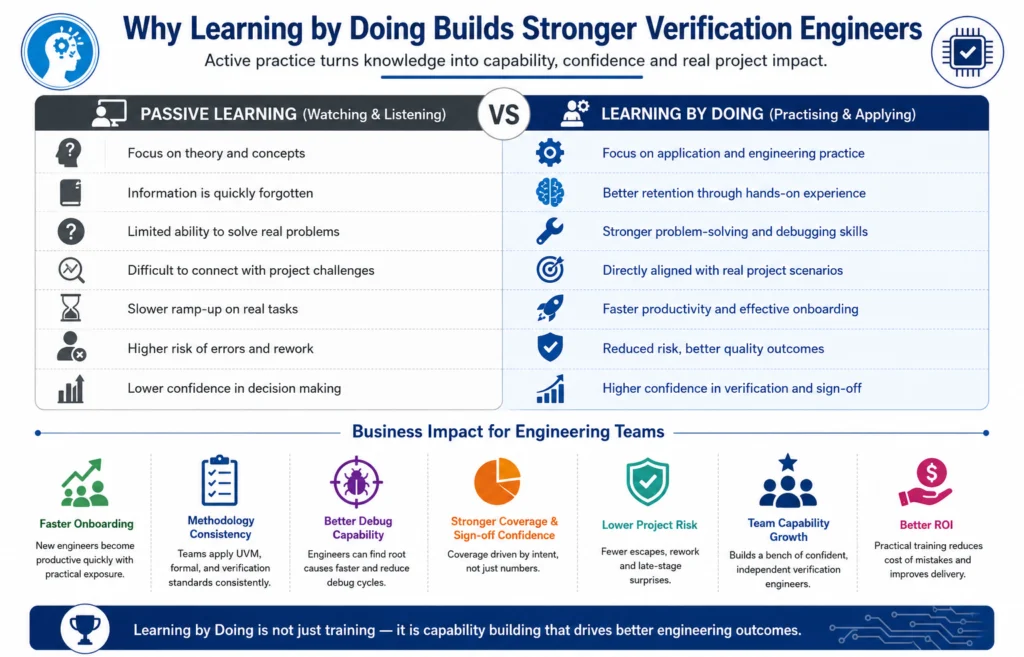
Practical training helps reduce this risk by giving engineers guided exposure to the same issues before they face them on a live project. Engineers can practise in a safe environment, make mistakes, receive feedback and build mental models that transfer into real work.
For semiconductor teams, this can support faster onboarding of graduate and early-career engineers, better alignment around verification methodology, improved debug discipline, stronger coverage and sign-off discussions, more confident adoption of Formal Verification, safer use of AI-assisted workflows and reduced dependence on a small number of senior experts.
The aim is not to turn every engineer into an expert overnight. The aim is to create a stronger baseline of practical competence across the team.
Why This Matters More as Verification Becomes More Complex
Semiconductor verification is becoming harder because designs are becoming more integrated, more configurable and more software-driven.
Modern teams may need to verify complex SoCs, custom processors, AI accelerators, RISC-V subsystems, FPGA-based platforms, mixed-signal interfaces, embedded software interactions and safety-related behaviours. At the same time, delivery schedules remain tight and engineering teams are expected to make faster decisions with stronger evidence.
This creates a skills challenge.
It is not enough for engineers to know individual languages or tools. They need to understand how verification methods fit together across a project workflow. They need to connect requirements, testbench design, stimulus, checking, assertions, coverage, debug, regression results and sign-off.
This is why practical training is becoming more important. It helps engineers develop judgement, not just knowledge.
Alpinum’s broader design verification services and training experience support this need by connecting methodology, engineering delivery, and practical verification capabilities.
Learning by Doing in SystemVerilog and UVM Training
SystemVerilog and UVM are good examples of why practical training is essential.
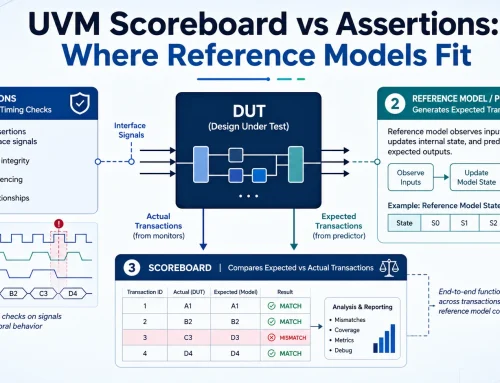
The concepts can be explained in slides, but real understanding comes when engineers work through examples. They need to understand how transactions move through a verification environment, how sequences are controlled, how monitors observe behaviour, how scoreboards compare expected and actual results, and how debug information is used when something fails.
A strong SV/UVM training approach should include testbench examples, practical exercises, debugging tasks, and the progressive development of verification components. This helps engineers understand not just the structure of a UVM environment, but how to use it effectively in a real project.
For teams that need this capability, Alpinum’s SystemVerilog and UVM training provides engineers with a practical path to modern verification methodology.
This is important because UVM is not simply a library or a set of class names. It is a disciplined way of structuring verification environments, encouraging reuse, improving debug and supporting scalable verification across larger designs.
Engineers need to learn this by doing.
Learning by Doing in Formal Verification Training
Formal Verification is another area where passive learning is not enough.
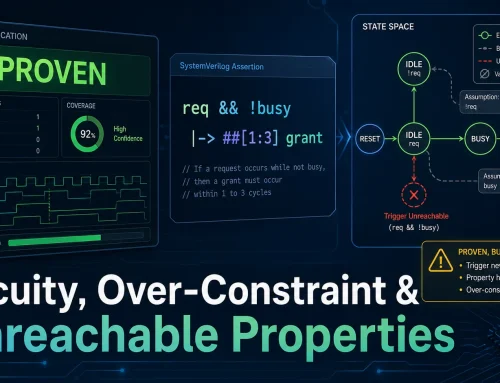
An engineer can understand the definition of a property, but that does not mean they can write a useful assertion. They can understand what a proof is, but that does not mean they can recognise over-constraint, vacuity, unreachable states or a weak verification target.
Formal methods require careful thinking. Engineers need to practise expressing intent, reviewing counterexamples, deciding whether the tool’s result is meaningful, and combining formal methods with simulation-based verification.
This is why Formal Verification should be taught through practical examples, guided exercises and engineering review rather than theory alone.
The aim is to help engineers understand what formal tools prove, what they do not prove, and how to use formal evidence within a broader verification strategy.
This is especially important in safety-related, security-sensitive or high-complexity designs, where weak assumptions or misunderstood results can create false confidence.
Learning by Doing in RISC-V Verification Training
RISC-V verification is also highly practical. Engineers need to understand not only the instruction set architecture but also CPU verification strategies, instruction generation, simulation, SoC integration, coverage, debugging, and the relationship between processor behaviour and system-level verification.
A RISC-V training course should therefore go beyond explaining the architecture. It should help engineers practise planning and executing verification in a processor or SoC context. Alpinum’s RISC-V verification training is a strong fit for this learning-by-doing message, as RISC-V verification requires engineers to apply their knowledge to practical CPU and SoC verification problems.
This is also valuable from an industry perspective. RISC-V adoption continues to create demand for engineers who understand both architecture and verification methodology. Teams need people who can work with open instruction-set designs, verification environments, simulation flows, coverage goals, and integration-level challenges. For readers who need more background, Alpinum’s article on RISC-V and its growing role in semiconductor design can also support the learning path.
Learning by Doing in FPGA Verification and Prototyping
FPGA work also benefits from practical training because FPGA engineering often sits close to hardware/software interaction, prototyping, acceleration, system integration and real-world debug.
In FPGA projects, engineers may need to understand timing, interfaces, interaction with embedded software, board-level behaviour, hardware validation, and the differences between simulation results and system behaviour. These are practical engineering problems that cannot be fully mastered through passive learning.
Alpinum’s FPGA services connect well with this topic because FPGA teams often need engineering support that combines implementation knowledge with verification discipline.
Learning by doing helps engineers understand how verification decisions affect downstream prototyping, integration and validation. This can reduce late-stage surprises and improve communication between design, verification, firmware and system teams.
Learning by Doing in “AI in DV”
AI is now becoming part of the verification conversation, but it creates a different kind of training challenge. Many engineers can experiment with public AI tools. That does not mean a team is ready to adopt AI in a production verification workflow. In semiconductor environments, AI must be used with care because teams work with sensitive design data, proprietary RTL, internal logs, specifications, tool outputs and established sign-off processes. Alpinum’s “AI in DV” adoption work already recognises this difference between experimentation and controlled engineering adoption.
Learning by doing in “AI in DV” should not mean uncontrolled experimentation. It should mean safe, bounded and reviewable practice. For example, engineers may practise using AI to summarise regression logs, review AI-generated verification-planning suggestions, check AI-assisted assertions before use, compare AI outputs against approved project knowledge, and identify where human review remains essential.
This helps teams move from AI curiosity to AI capability. Alpinum’s article on safe AI pilots in design verification is a useful supporting resource for organisations that want to explore AI without weakening engineering control.
What Practical Semiconductor Training Should Include
A practical training programme should be built around the way engineers actually work.
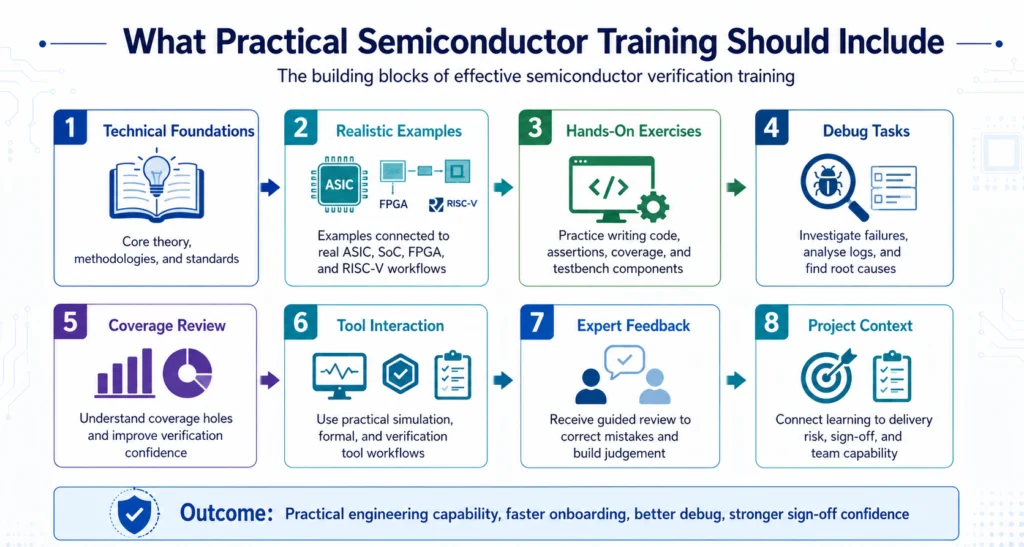
The strongest programmes usually include a combination of explanation, demonstration, exercises, feedback and review. The goal is not to overload engineers with information, but to help them build usable patterns.
| Component | Why It Matters |
| Clear technical foundations | Engineers need enough theory to understand why a method exists |
| Realistic examples | Examples connect abstract concepts to engineering use |
| Hands-on exercises | Exercises turn knowledge into skill |
| Debug tasks | Debug teaches engineers how to reason through failure |
| Coverage review | Coverage connects activity to confidence |
| Tool interaction | Engineers need to understand practical workflows, not just diagrams |
| Feedback | Feedback helps correct mistakes before they become habits |
| Project context | Training should connect to real ASIC, SoC, FPGA or embedded challenges |
| Follow-on learning | Capability improves when engineers can continue practising |
This is where online and self-paced verification training can be especially useful for organisations that need flexible access while still supporting structured technical development. Practical learning does not always have to happen in a classroom. It can also happen through guided exercises, recorded sessions, tool-based practice, review tasks and structured learning paths that engineers can follow around project commitments.
Why Engineering Managers Should Care
For engineering managers, learning by doing is not only about the quality of education. It is about delivery capability. Managers need teams that can apply methods consistently. They need engineers who can understand verification intent, follow methodology, debug efficiently, communicate problems clearly and make better technical decisions.
Practical training can help managers answer important questions:
Can our engineers apply UVM consistently across projects? Are junior engineers becoming productive quickly enough? Do we have enough internal Formal Verification capability? Can our team effectively verify RISC-V or CPU-based SoC designs? Are we prepared to use AI in verification without weakening review discipline? Are our engineers confident enough to discuss coverage, debug and sign-off decisions? Are we too dependent on a few senior experts?
When training is practical, it becomes part of engineering risk management. This also makes training more commercially valuable. It is not just a learning activity. It supports project execution, team resilience and delivery confidence.
Why Engineers Should Care
For individual engineers, learning by doing is also the fastest path to confidence. A lecture can introduce a topic, but hands-on practice helps engineers build the instincts they need in real work. They learn how to approach a problem, where mistakes commonly happen, how to read tool outputs, how to debug step by step and how to explain their reasoning to others.
This matters for career development. Engineers who can apply verification methods are more valuable than engineers who only know the vocabulary. Practical capability makes it easier to contribute to projects, move into more advanced roles and participate in technical discussions with confidence.
For early-career engineers, practical training can shorten the gap between academic knowledge and industry contribution. For experienced engineers, it can support transitions into new areas such as Formal Verification, RISC-V verification, AI-assisted workflows or advanced UVM methods.
How Alpinum Supports Learning by Doing
Alpinum’s training is well-positioned for this need because it is grounded in real semiconductor engineering practice. The training portfolio covers SystemVerilog, UVM, Formal Verification, RISC-V verification, AMS, FPGA and “AI in DV” workflows. The focus is not only on explaining methods but also on helping engineers develop practical capabilities applicable in real verification environments.
This practical positioning is important. Semiconductor teams do not need generic training. They need training that understands engineering pressure, project delivery, IP sensitivity, sign-off expectations, EDA tool environments and the difference between theoretical awareness and usable capability. Alpinum can support graduate engineer onboarding, verification team upskilling, UVM and SystemVerilog training, Formal Verification training, RISC-V verification training, AMS and mixed-signal verification training, “AI in DV” awareness and private workshops aligned with project needs.
The key message is simple:
Engineers learn verification best by practising it.
Conclusion: Practical Capability Is Built Through Participation
Learning by doing is not a new idea, but it is highly relevant to modern semiconductor verification. Verification engineers need to do more than understand concepts. They need to apply methods, debug failures, review evidence, close coverage gaps, understand tool outputs, question assumptions, and contribute to real project decisions.
For semiconductor organisations, this makes practical training a strategic investment. It helps teams build capability, reduce methodology gaps, onboard engineers faster and prepare for emerging workflows such as “AI in DV”. The strongest training is not passive. It is active, guided and connected to real engineering work.
That is how engineers move from knowledge to capability. That is how teams build confidence. And that is why learning by doing remains one of the most effective ways to develop stronger semiconductor verification engineers.
Build Practical Verification Capability with Alpinum Training
Alpinum helps engineers and semiconductor teams develop practical skills in SystemVerilog, UVM, Formal Verification, RISC-V verification, AMS, FPGA and “AI in DV” workflows. Whether you are onboarding new engineers, strengthening an existing verification team, or preparing for new project demands, Alpinum can help you build training that reflects real engineering capability.
Explore Alpinum Semiconductor Verification Training
References
[1] S. Freeman, S. L. Eddy, M. McDonough, M. K. Smith, N. Okoroafor, H. Jordt, and M. P. Wenderoth, “Active learning increases student performance in science, engineering, and mathematics,” Proc. Nat. Acad. Sci. U.S.A., vol. 111, no. 23, pp. 8410–8415, Jun. 2014, doi: 10.1073/pnas.1319030111.
[2] Accellera Systems Initiative, Universal Verification Methodology (UVM) 1.2 User’s Guide, Accellera Systems Initiative, 2015. [Online]. Available: https://www.accellera.org/downloads/standards/uvm. [Accessed: 15-Jun-2026].
[3] 2024 Functional Verification Study, Siemens Digital Industries Software and Wilson Research Group, 2024. [Online]. Available: https://resources.sw.siemens.com. [Accessed: 15-Jun-2026].
[4] RISC-V International, RISC-V Specifications and Ratified Standards. [Online]. Available: https://riscv.org/specifications/. [Accessed: 15-Jun-2026].
[5] National Institute of Standards and Technology (NIST), Artificial Intelligence Risk Management Framework (AI RMF 1.0), NIST AI 100-1, Gaithersburg, MD, USA, Jan. 2023. [Online]. Available: https://www.nist.gov/itl/ai-risk-management-framework. [Accessed: 15-Jun-2026].
FAQs
Hands-on training is important because verification engineers need to apply methods in realistic workflows. Concepts such as UVM, Formal Verification, coverage closure, debug and RISC-V verification only become useful when engineers practise them through examples, exercises and project-like tasks.
Learning by doing in design verification means engineers actively build, test, debug, and review verification work rather than just watching lectures. This may include writing SystemVerilog, creating UVM components, running simulations, reviewing coverage, writing assertions and analysing formal results.
Yes. UVM is best understood through practical work. Engineers need to see how sequences, drivers, monitors, agents, scoreboards and environments interact inside a working testbench. Practical exercises help engineers build usable UVM skills.
Formal Verification requires practical training because engineers need to learn how to write meaningful properties, review counterexamples, avoid weak checks and understand proof results. Passive theory alone is not enough to build confidence in formal methods.
Training can reduce project risk by improving methodological consistency, debugging capability, coverage understanding, review quality, and sign-off confidence. It can also help teams onboard engineers more quickly and reduce dependence on a small group of senior specialists.
Practical “AI in DV” training helps engineers understand where AI can safely support verification workflows, such as regression triage, log summarisation, documentation search, coverage review and verification planning. It also helps teams maintain governance, review and traceability.

Written by : Mike Bartley
Mike started in software testing in 1988 after completing a PhD in Math, moving to semiconductor Design Verification (DV) in 1994, verifying designs (on Silicon and FPGA) going into commercial and safety-related sectors such as mobile phones, automotive, comms, cloud/data servers, and Artificial Intelligence. Mike built and managed state-of-the-art DV teams inside several companies, specialising in CPU verification.
Mike founded and grew a DV services company to 450+ engineers globally, successfully delivering services and solutions to over 50+ clients.
Mike started Alpinum in April 2016 to deliver a range of start-of-the art industry solutions:
Alpinum AI provides tools and automations using Artificial Intelligence to help companies reduce development costs (by up to 90%!) Alpinum Services provides RTL to GDS VLSI services from nearshore and offshore centres in Vietnam, India, Egypt, Eastern Europe, Mexico and Costa Rica. Alpinum Consulting also provides strategic board level consultancy services, helping companies to grow. Alpinum training department provides self-paced, fully online training in System Verilog, UVM Introduction and Advanced, Formal Verification, DV methodologies for SV, UVM, VHDL and OSVVM and CPU/RISC-V. Alpinum Events organises a number of free-to-attend industry events
You can contact Mike (mike@alpinumconsulting.com or +44 7796 307958) or book a meeting with Mike using Calendly (https://calendly.com/mike-alpinum-consulting).
Stay Informed and Stay Ahead
Latest Articles, Guides and News
Explore related insights from Alpinum that dive deeper into design verification challenges, practical solutions, and expert perspectives from across the global engineering landscape.