
Executive Summary
Artificial intelligence is becoming increasingly visible inside semiconductor workflows, but the practical question for engineers is no longer whether AI matters. The more important question is which AI capabilities are genuinely useful inside engineering environments and how teams should develop them responsibly.
Semiconductor engineering presents very different requirements from generic software development. Verification teams work with constrained-random environments, coverage targets, assertions, regressions and sign-off evidence. Manufacturing teams manage process variation, yield behaviour, anomaly detection and operational analytics. RTL and SoC engineers operate inside tightly constrained design flows where traceability, reviewability and reproducibility matter.
As a result, semiconductor engineers require a workflow-oriented AI learning path rather than generic online AI tutorials. This article builds on the broader discussion of AI-assisted semiconductor workflows but focuses specifically on the practical skills engineers need to develop next.
The strongest AI capability development strategies in 2026 are not centred around becoming machine-learning researchers. They focus on understanding how AI fits into real engineering workflows, where automation helps, where human review remains essential and how engineering organisations can integrate AI-assisted processes safely.
This article explores the most valuable AI skills for semiconductor engineers, practical workflow applications, capability development priorities and the engineering disciplines required for responsible AI adoption.
| Key learning point | Link to detailed explanation | External reference link |
| Semiconductor engineers need a workflow-based AI learning path because generic AI tutorials do not reflect verification, RTL, EDA, manufacturing or sign-off environments. | Why Semiconductor Engineers Need a Different AI Learning Path | [1], [3], [6] |
| AI is most useful when it is applied inside real semiconductor workflows such as regression analysis, coverage review, debug support, manufacturing analytics, EDA automation and documentation retrieval. | Where AI Fits Inside Real Semiconductor Workflows | [1], [2], [3], [7] |
| The most valuable AI skills for semiconductor engineers in 2026 include Python-based automation, data analysis, statistics, ML fundamentals, log analysis, traceability and AI output validation. | The Most Valuable AI Skills for Semiconductor Engineers in 2026 | [1], [3], [4] |
| Verification engineers should prioritise AI skills that improve regression triage, log analysis, coverage analytics, workflow automation, prompt review discipline and evidence validation. | AI Skills Roadmap for Verification Engineers | [3], [6] |
| Semiconductor organisations should build AI capability through structured training, measurable pilots, secure deployment, governance, workflow integration and clear engineering accountability. | How Semiconductor Organisations Should Build AI Capability | [4], [5], [7] |
Why Semiconductor Engineers Need a Different AI Learning Path
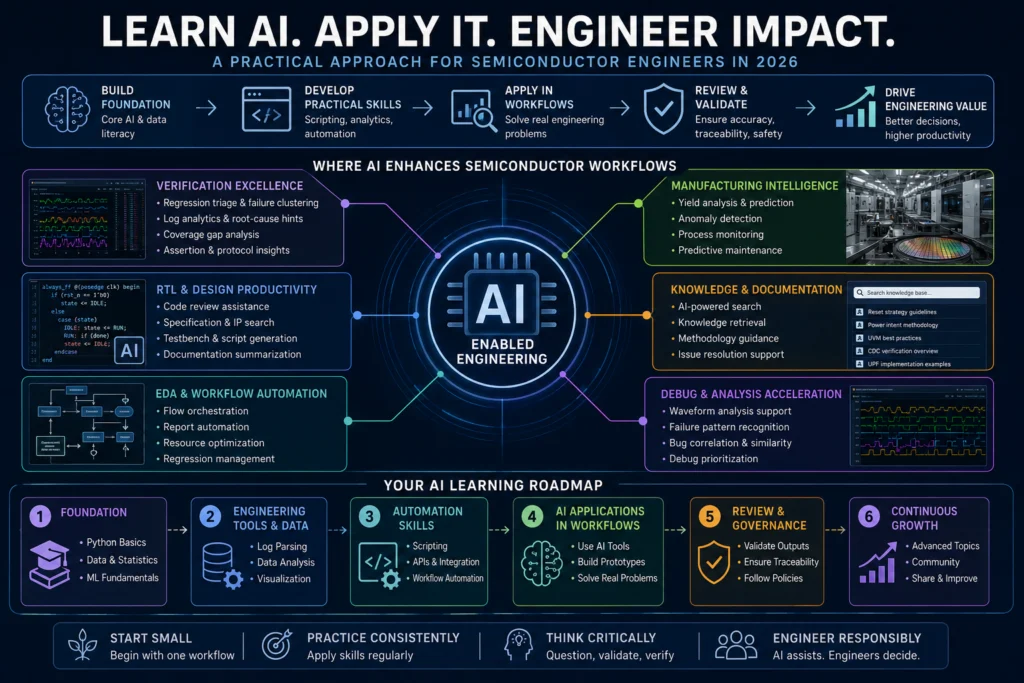
Most public AI learning material is designed for software developers, data scientists or consumer application builders. Semiconductor engineering operates under very different constraints.
A verification engineer reviewing regression failures is not solving the same problem as a web developer building a chatbot. A manufacturing engineer monitoring yield excursions is not operating in the same environment as a generic machine-learning practitioner analysing social media data.
Semiconductor workflows depend heavily on deterministic behaviour, evidence traceability, constrained environments, specification alignment, review accountability, reproducibility and sign-off confidence. This changes how AI skills should be learned.
Generic tutorials often emphasise image classifiers, public training datasets, consumer AI applications, and broad deep learning experiments. These activities may explain general AI concepts, but they do not directly prepare engineers for regression triage, coverage analytics, debug clustering, waveform analysis, documentation retrieval, manufacturing anomaly detection or EDA workflow orchestration.
The most effective semiconductor AI learning paths are workflow-based rather than model-based. Engineers gain more practical value when they understand where AI can accelerate engineering analysis, how AI outputs should be validated, where AI recommendations become risky, how automation integrates with verification flows and how evidence quality affects engineering decisions.
System-level thinking remains central. An engineer who understands architecture intent, verification closure, debug evidence and operational constraints will usually gain more value from AI tooling than someone who only understands machine-learning theory in isolation.
This is why an effective AI in DV adoption strategy must start with engineering workflows, review discipline and measurable capability rather than tool experimentation alone.
Where AI Fits Inside Real Semiconductor Workflows
AI adoption in semiconductor engineering is becoming increasingly workflow-specific rather than tool-centric. The strongest applications are usually connected to existing engineering evidence, repeatable processes and reviewable outputs.
For teams working on complex verification programmes, Alpinum’s design verification services provide a useful reference point for understanding how methodology, evidence and workflow maturity shape AI-assisted engineering adoption.
Verification Workflows
Verification environments generate large volumes of structured and semi-structured data, including regression logs, assertion failures, coverage reports, waveform traces, simulation outputs and bug databases.
These activities are closely connected to verification planning to coverage closure, where requirements, scenarios, coverage evidence and sign-off confidence must remain aligned.
AI-assisted workflows can help cluster similar failures, summarise logs, identify recurring error signatures, reduce manual regression sorting, highlight likely root-cause regions and prioritise debug activity. These applications are valuable because verification teams often spend considerable time preparing evidence before deep engineering analysis even begins.
The engineer still performs the final technical interpretation. AI can accelerate analysis preparation, but sign-off accountability remains an engineering responsibility.
RTL Development
AI-assisted RTL support increasingly appears in code review assistance, documentation retrieval, specification search, syntax guidance, script generation and testbench support. For RTL engineers, the most valuable capability is often retrieval acceleration rather than autonomous design generation.
Experienced RTL engineers still need to validate architecture intent, protocol correctness, timing assumptions, reset behaviour and interface consistency. AI can support productivity, but it cannot remove the need for engineering judgement around design intent and implementation correctness.
For engineers working on processor, SoC or open architecture projects, RISC-V verification training can provide a structured foundation for understanding how verification methodology and AI-assisted workflow skills intersect. Teams working with open instruction set architectures may also benefit from Alpinum’s wider technical analysis on RISC-V architecture and verification challenges.
Regression Analysis
Large regressions frequently produce thousands of failures. AI-assisted analysis systems can identify duplicate failures, correlate seeds and tests, classify recurring patterns, reduce initial debug noise and highlight likely common causes.
This improves engineering efficiency without weakening engineering responsibility. The value lies in reducing the time required to organise evidence, not in handing over debug ownership to an automated system.
A controlled AI in design verification safe pilot can help teams measure whether failure clustering, log summarisation and triage automation provide real engineering value before wider deployment.
Coverage Review
Coverage closure often involves repetitive report analysis across functional coverage, assertion coverage, code coverage and scenario analysis. AI-assisted workflows may help identify persistent coverage gaps, weak scenario diversity, repeated untested conditions and missing requirement alignment.
Human review remains essential because coverage metrics alone do not guarantee verification completeness. Engineers still need to determine whether coverage results reflect meaningful verification intent.
Manufacturing Analytics
Semiconductor manufacturing environments increasingly use AI-assisted analytics for yield analysis, defect classification, anomaly detection, predictive maintenance, process variation analysis and operational monitoring.
These workflows depend heavily on statistical interpretation and process understanding rather than generic AI experimentation. A model may identify an anomaly, but an experienced manufacturing engineer is still needed to decide whether that anomaly reflects process drift, equipment behaviour, data noise or a genuine production risk.
EDA Workflow Automation
EDA environments increasingly integrate automation for job orchestration, report analysis, flow management, parameter optimisation, resource scheduling and regression prioritisation.
Engineers who understand scripting, workflow automation and data interpretation gain significant operational advantages. These skills allow teams to reduce repetitive manual activity and improve the consistency of engineering processes.
Similar automation principles also apply to FPGA services, where design, prototyping, verification and workflow orchestration often need to operate under tight project constraints.
Documentation Retrieval
One of the most immediately valuable applications involves engineering knowledge retrieval. AI-assisted retrieval systems can help engineers search specifications, architecture documents, verification plans, issue trackers, design notes and methodology guidance.
This reduces time lost navigating fragmented engineering documentation. It also supports better knowledge reuse across teams, provided access control, source traceability and review discipline are handled correctly.
The Most Valuable AI Skills for Semiconductor Engineers in 2026
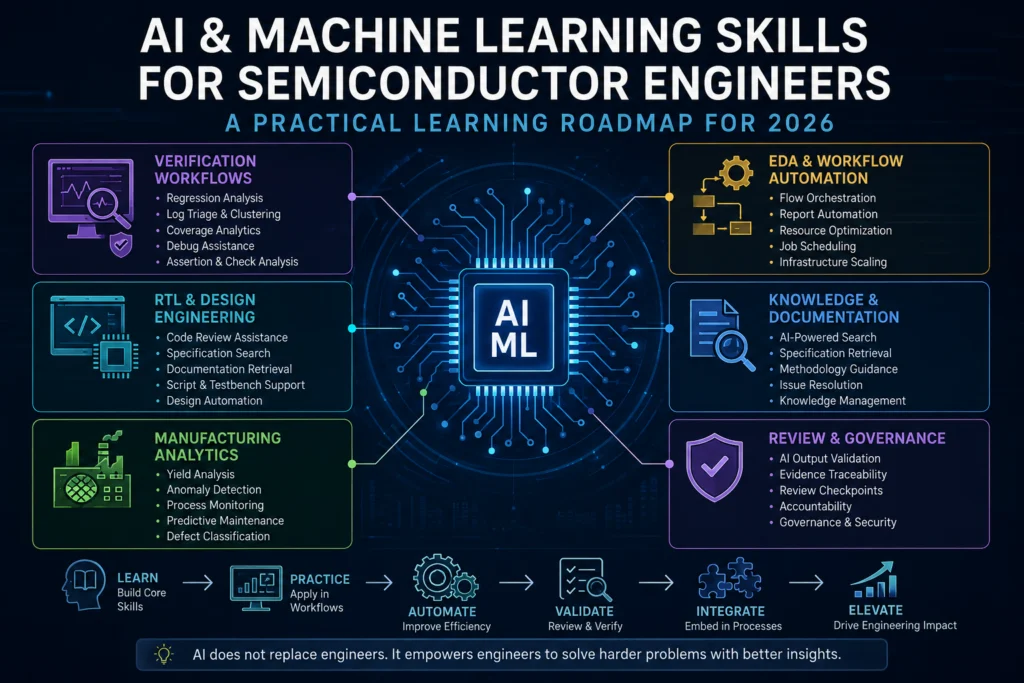
The most valuable AI skills for semiconductor engineers are not limited to machine-learning theory. They sit at the intersection of engineering workflow knowledge, automation, data analysis, review discipline and traceability.
| Skill | Why It Matters | Engineering Relevance | Workflow Application |
| Python scripting | Enables automation and data analysis | Common across verification and analytics flows | Regression parsing, automation scripts |
| Data analysis | Helps interpret engineering datasets | Useful for logs, yield and coverage | Trend analysis and debug support |
| Statistics fundamentals | Supports evidence interpretation | Critical for manufacturing and verification metrics | Yield analysis and anomaly detection |
| Workflow automation | Reduces repetitive engineering effort | Improves scalability | Regression management |
| Prompt review discipline | Prevents unsafe AI usage | Supports engineering accountability | AI-assisted review workflows |
| Log analysis | Accelerates debug preparation | Useful in DV environments | Failure clustering |
| Coverage analytics | Supports verification closure | Helps identify gaps | Coverage trend analysis |
| AI output validation | Reduces engineering risk | Critical for sign-off environments | Evidence verification |
| Traceability awareness | Maintains auditability | Important for regulated workflows | Review accountability |
| Documentation retrieval | Reduces search friction | Improves engineering efficiency | Knowledge management |
| Model limitation awareness | Prevents overtrust | Essential for safe adoption | Risk reduction |
| Workflow orchestration | Improves infrastructure efficiency | Supports large engineering teams | Automation coordination |
These skills are valuable because they connect AI capability to practical engineering outcomes. A semiconductor engineer does not need to treat AI as a separate discipline. The more useful approach is to understand how AI can support existing workflows while maintaining engineering review, reproducibility and accountability.
AI Skills Roadmap for Verification Engineers
Verification engineers are among the strongest candidates for workflow-oriented AI capability development because verification environments already generate large amounts of structured data.
Engineers building practical DV capability should also understand structured SV/UVM training, because AI-assisted workflows are most effective when they sit on top of sound methodology.
Regression Triage
A practical starting point involves regression analytics. Verification engineers should learn how to parse logs, categorise failures, recognise repeated error patterns, cluster related failures, automate routine summaries and compare regression behaviour across tests, seeds and configurations.
These skills integrate naturally into existing workflows. They help teams reduce the time spent sorting failures before meaningful debug work begins.
Coverage Analytics
Coverage review increasingly benefits from automated analysis. Useful capabilities include coverage trend extraction, report correlation, dashboard automation, scenario classification and requirement mapping.
The goal is not automated sign-off. The goal is to reduce manual review overhead while improving visibility into coverage gaps, repeated omissions and weak scenario diversity.
Workflow Automation
Automation skills often provide more immediate value than advanced machine-learning theory. Verification engineers benefit from scripting regression flows, automating repetitive reporting, integrating analysis tools, supporting orchestration and connecting AI-assisted analysis into CI environments.
This type of workflow automation helps teams move from isolated experiments to repeatable engineering processes.
Prompt Review Discipline
Verification engineers should treat AI outputs similarly to engineering evidence. They need to review assumptions, verify references, inspect missing context, validate recommendations and confirm reproducibility.
AI-generated outputs should never bypass engineering review processes. In verification, confidence depends on evidence, not on fluent explanations.
Evidence Validation
Strong verification engineers increasingly need AI-assisted workflow literacy, evidence-review capability, traceability awareness and reproducibility discipline. These skills align closely with existing verification thinking.
This evidence-led mindset is also central to formal verification, where assumptions, properties, proofs and review discipline directly affect confidence in the result.
The most valuable DV engineers will not be those who use the most AI tools. They will be those who can apply AI-assisted analysis without weakening verification intent, sign-off evidence or engineering accountability.
AI Skills Roadmap for Semiconductor Manufacturing Engineers
Manufacturing environments generate large operational datasets that increasingly benefit from AI-assisted analysis. The learning path for manufacturing engineers should therefore focus on process data, statistical interpretation, anomaly review and operational decision support.
Process Data Analysis
Manufacturing engineers should understand statistical interpretation, trend analysis, process correlation, operational dashboards and anomaly identification. These skills help engineers evaluate whether AI-assisted outputs reflect meaningful process behaviour or simply patterns in noisy data.
The emphasis should remain engineering-led. AI can support analysis, but manufacturing context determines whether the analysis is actionable.
Yield Analytics
Yield environments increasingly use classification systems, pattern analysis, operational clustering, excursion detection and predictive analytics. Understanding how these systems operate helps engineers interpret results more effectively.
Yield analytics also requires careful attention to data quality, process history and equipment context. A model output is useful only when it can be connected to credible manufacturing evidence.
Anomaly Detection
AI-assisted anomaly detection may support equipment monitoring, process stability review, defect pattern analysis and operational alerts. These systems can help identify unusual behaviour earlier, particularly when datasets are too large for manual inspection alone.
However, engineering teams still need domain expertise to determine whether detected anomalies represent real manufacturing risks. False positives, missing context and process variation can all affect interpretation.
Digital Twins
Digital-twin environments continue to expand in advanced manufacturing contexts. Useful knowledge areas include model correlation, process simulation, operational state tracking and predictive maintenance logic.
The strongest engineers understand both operational context and analytical interpretation. They can assess whether a modelled behaviour reflects the physical manufacturing environment accurately enough to support engineering decisions.
The Practical Learning Stack Semiconductor Engineers Should Prioritise
Semiconductor engineers do not need to become full-time machine-learning researchers to gain value from AI-assisted workflows. The most effective learning stack is practical and engineering-focused.
Python
Python remains useful because many semiconductor workflows already integrate automation scripts, parsing tools, analytics pipelines and workflow orchestration.
The priority should be workflow enablement rather than generic software development. Engineers should focus on using Python to process logs, extract metrics, automate reports, manage data and connect engineering tools.
Data Analysis
Engineers should become comfortable with structured data interpretation, trend analysis, report summarisation, metrics correlation and basic visualisation.
These skills are relevant across verification, RTL support, EDA flow analysis and manufacturing operations. They help engineers move from raw data to useful engineering evidence.
Statistics Fundamentals
Statistical reasoning remains extremely valuable for yield interpretation, coverage analysis, anomaly detection, operational metrics and confidence evaluation.
In semiconductor environments, statistical understanding helps engineers avoid overreacting to noise, underestimating process variation or drawing conclusions from insufficient evidence.
Machine-Learning Fundamentals
Engineers should understand supervised learning, classification, clustering, inference limitations, overfitting risks and data-quality dependency.
Deep theoretical specialisation is usually unnecessary for most workflow applications. The practical objective is to understand what models can support, where they fail and how their outputs should be reviewed.
Prompt Engineering
Prompt engineering matters less as a standalone skill and more as part of engineering review discipline. Engineers should learn how to specify context, reduce ambiguity, validate outputs, check evidence and preserve reproducibility.
In semiconductor workflows, a good prompt is not simply a well-written instruction. It is a controlled engineering request that includes relevant context, constraints and review expectations.
Workflow Review
AI-assisted workflows require review checkpoints, escalation logic, traceability tracking and approval ownership.
These are engineering governance issues rather than purely technical AI topics. Organisations that treat AI only as a productivity tool can miss the process discipline needed to use it safely in engineering environments.
AI Tools Semiconductor Engineers Should Understand
The semiconductor industry is increasingly adopting workflow-oriented AI tooling. Engineers do not need to evaluate every vendor product, but they should understand the main categories of tools appearing inside engineering flows.
Verification Workflow Tools
Verification workflow tools increasingly support regression summarisation, coverage analytics, log clustering, waveform assistance and debug prioritisation. These systems are most useful when connected to existing verification data and reviewed by engineers who understand the underlying design and test intent.
AI-Assisted Debug Systems
Emerging debug systems support failure classification, root-cause suggestions, recurring issue identification and bug correlation. These systems assist engineers rather than replacing debug expertise.
Their value depends on the quality of the input data, the relevance of the engineering context and the review discipline applied to the output.
Manufacturing Analytics Platforms
Manufacturing analytics environments increasingly support operational dashboards, predictive maintenance, process correlation, defect analytics and anomaly review.
These platforms are valuable when they help engineers see process behaviour more clearly. They are less effective when deployed without clear ownership, data-quality controls or review processes.
EDA Automation
EDA automation continues expanding across flow orchestration, optimisation support, infrastructure scaling, report management and scheduling efficiency.
Engineers who understand EDA automation can help teams improve throughput, reduce manual reporting work and make regression and analysis flows more consistent.
Internal AI Copilots
Many organisations are deploying internal engineering copilots connected to specifications, design documentation, methodology repositories, verification plans and engineering knowledge bases.
These systems can improve knowledge retrieval, but security and access governance remain critical. Semiconductor organisations must protect confidential IP, customer data and sensitive architecture information.
Documentation Search Systems
Retrieval-augmented systems increasingly help engineers navigate fragmented documentation environments. They can reduce operational friction significantly when implemented carefully.
The key requirement is source traceability. Engineers need to know where an answer came from, whether the underlying document is current and whether the result is suitable for engineering use.
What Engineering Teams Often Get Wrong About AI Learning
Many AI adoption efforts fail because organisations focus on tools before workflows. In semiconductor environments, the workflow matters more than the model.
Tool-First Thinking
Purchasing AI tools without workflow integration rarely produces lasting engineering value. A tool that is not connected to regression flows, coverage review, documentation systems, manufacturing data or engineering sign-off processes will often remain peripheral.
This is why choosing an AI in DV partner should involve workflow fit, governance maturity and review accountability, not only tool features.
Weak Review Discipline
Engineering environments require evidence validation. Teams that treat AI outputs as authoritative rather than reviewable create operational risk.
AI-generated summaries, classifications and recommendations should be treated as inputs to engineering review, not as final decisions.
Lack of Governance
AI adoption without traceability, auditability, review checkpoints and ownership clarity can create serious engineering problems.
This is particularly important in verification, manufacturing and customer-facing engineering environments where decisions must be reproducible and accountable.
Shallow Upskilling
Watching generic AI tutorials does not create semiconductor workflow capability. Practical engineering integration is essential.
Upskilling should be connected to real tasks such as regression analysis, coverage review, log summarisation, manufacturing analytics, documentation retrieval and workflow automation.
Ignoring Verification Intent
Verification environments depend heavily on intent alignment. AI-generated activity without verification context can produce misleading confidence.
A system may summarise failures or suggest coverage gaps, but engineers still need to decide whether those outputs reflect the verification intent defined by the architecture, specification and verification plan.
How Semiconductor Organisations Should Build AI Capability
Effective AI capability development is organisational as well as technical. It requires training, governance, measurable pilots, workflow integration, secure deployment and clear engineering accountability.
For many organisations, structured engineering training services are the most practical starting point because they connect AI awareness to real team roles, workflows and review responsibilities.
Structured Training
Training should align with engineering roles, workflow maturity, operational requirements and infrastructure realities.
Verification engineers, RTL engineers, manufacturing specialists and technical managers do not need identical AI training. Each group needs capability development that reflects its engineering responsibilities.
Larger teams may also benefit from token-based training for engineering teams, particularly when capability development needs to support different roles, projects and learning speeds.
Measurable Pilots
Pilot programmes should target specific workflow pain points, define measurable metrics, maintain review discipline and track reproducibility.
A strong pilot might focus on reducing regression triage time, improving failure clustering, accelerating coverage review or improving manufacturing anomaly review. The objective should be measurable engineering value, not generic AI experimentation.
Workflow Integration
AI should integrate into existing engineering flows, CI infrastructure, regression systems and reporting environments rather than operating as an isolated experiment.
This is where many AI initiatives succeed or fail. If engineers have to leave their normal workflow to use AI, adoption often remains limited.
Secure Deployment
Semiconductor environments frequently involve confidential IP, sensitive architecture data and restricted customer information. Secure deployment models therefore matter significantly.
Organisations need to consider data access, prompt logging, output retention, permission boundaries and review responsibilities before scaling AI-assisted workflows.
Engineering Accountability
Final engineering decisions must remain attributable to accountable engineers. AI systems can assist analysis, but responsibility cannot become ambiguous.
For organisations exploring broader AI-assisted engineering adoption, contextual capability planning and governance frameworks are increasingly important alongside tooling evaluation.
AI Learning Strategy for Junior vs Senior Engineers
AI learning should differ by role and experience level. Junior engineers, verification leads, manufacturing specialists and technical managers each need a different emphasis.
Junior Engineers
Junior engineers benefit most from scripting, workflow automation, data interpretation, documentation retrieval and debug support.
The focus should remain practical. Junior engineers should learn how AI-assisted tools support existing engineering tasks, while still developing strong fundamentals in verification, RTL, manufacturing or system design.
Verification Leads
Verification leads increasingly need workflow integration awareness, AI review discipline, automation planning and operational scalability thinking.
Their role is not only to use AI tools, but to decide where those tools fit into verification processes and how outputs should be reviewed.
Manufacturing Specialists
Manufacturing specialists should focus on analytics interpretation, anomaly review, operational modelling and statistical analysis.
Their AI learning path should remain closely connected to process behaviour, yield evidence, equipment context and production risk.
Technical Managers
Managers increasingly require governance understanding, pilot evaluation capability, infrastructure planning and organisational adoption strategy.
Leadership capability matters as much as technical familiarity. Managers need to understand where AI can improve engineering throughput and where uncontrolled adoption may increase operational risk.
What Will Matter Most in Semiconductor Engineering Careers After 2026
The most valuable semiconductor engineers will likely combine system-level thinking, cross-domain judgement, verification discipline, workflow leadership, review capability and operational understanding.
AI may automate portions of repetitive engineering activity, but engineering value increasingly comes from interpreting evidence, managing complexity, validating assumptions, integrating workflows and maintaining accountability.
The ability to supervise AI-assisted engineering environments responsibly may become more important than deep standalone AI specialisation. Engineers who can combine domain expertise with AI-assisted workflow literacy will be better placed to support complex semiconductor programmes.
Conclusion
Semiconductor engineers do not need to become machine-learning researchers to remain effective in AI-assisted environments.
The more important objective is understanding where AI fits into real engineering workflows, how outputs should be reviewed and which capabilities improve engineering efficiency without weakening accountability.
The strongest semiconductor AI learning strategies in 2026 are practical, workflow-oriented and engineering-led.
Verification teams benefit from automation, regression analytics and evidence-review discipline. Manufacturing teams benefit from operational analytics, anomaly interpretation and process intelligence. Engineering leaders benefit from governance awareness, workflow integration capability and measurable adoption planning.
AI capability development in semiconductor engineering is therefore less about substituting engineering expertise and more about strengthening engineering effectiveness inside increasingly data-intensive workflows.
Ready to build practical AI capability inside your semiconductor workflows?
Alpinum Consulting helps engineering teams move from AI interest to measurable engineering value through structured training, verification workflow support and safe “AI in DV” adoption planning.
Explore AI in DV Adoption
Discuss Your Verification Workflow
References
[1] Synopsys, “AI-Driven EDA and Semiconductor Design Workflows.”
[2] Cadence Design Systems, “Machine Learning Applications in Semiconductor Design.”
[3] Siemens EDA, “AI-Assisted Verification and Analytics.”
[4] Semiconductor Engineering, “AI Adoption in Semiconductor Workflows.”
[5] IEEE, “Artificial Intelligence Applications in Semiconductor Manufacturing.”
[6] Accellera Systems Initiative, “Verification Methodology and Automation Standards.”
[7] SEMI, “Smart Manufacturing and Semiconductor Analytics.”
FAQ
The most valuable AI-related skills for DV engineers include regression analytics, log analysis, workflow automation, scripting, coverage analytics and AI output validation. Practical workflow integration is usually more valuable than advanced model development.
RTL engineers do not necessarily need deep machine-learning expertise, but understanding AI-assisted workflow tools, documentation retrieval systems and automation techniques can improve engineering efficiency significantly.
Most semiconductor engineers benefit more from workflow-oriented AI literacy than from advanced research-level machine-learning expertise. Understanding automation, analytics, review discipline and model limitations is often sufficient.
Useful categories include regression analysis tools, AI-assisted debug systems, manufacturing analytics platforms, workflow orchestration tools and engineering documentation retrieval systems.
Manufacturing environments increasingly use AI-assisted analytics for yield analysis, anomaly detection, predictive maintenance, defect classification and operational monitoring.
No. AI can accelerate portions of regression analysis, log review and workflow preparation, but verification sign-off still requires accountable engineering review and evidence validation.
Engineering environments require reproducibility, accountability and evidence tracking. Traceability helps ensure AI-assisted decisions remain reviewable and auditable.

Written by : Mike Bartley
Mike started in software testing in 1988 after completing a PhD in Math, moving to semiconductor Design Verification (DV) in 1994, verifying designs (on Silicon and FPGA) going into commercial and safety-related sectors such as mobile phones, automotive, comms, cloud/data servers, and Artificial Intelligence. Mike built and managed state-of-the-art DV teams inside several companies, specialising in CPU verification.
Mike founded and grew a DV services company to 450+ engineers globally, successfully delivering services and solutions to over 50+ clients.
Mike started Alpinum in April 2016 to deliver a range of start-of-the art industry solutions:
Alpinum AI provides tools and automations using Artificial Intelligence to help companies reduce development costs (by up to 90%!) Alpinum Services provides RTL to GDS VLSI services from nearshore and offshore centres in Vietnam, India, Egypt, Eastern Europe, Mexico and Costa Rica. Alpinum Consulting also provides strategic board level consultancy services, helping companies to grow. Alpinum training department provides self-paced, fully online training in System Verilog, UVM Introduction and Advanced, Formal Verification, DV methodologies for SV, UVM, VHDL and OSVVM and CPU/RISC-V. Alpinum Events organises a number of free-to-attend industry events
You can contact Mike (mike@alpinumconsulting.com or +44 7796 307958) or book a meeting with Mike using Calendly (https://calendly.com/mike-alpinum-consulting).
Stay Informed and Stay Ahead
Latest Articles, Guides and News
Explore related insights from Alpinum that dive deeper into design verification challenges, practical solutions, and expert perspectives from across the global engineering landscape.