
Quick Answer: Will AI Replace Semiconductor Engineers?
No. AI is unlikely to replace semiconductor engineers as a complete profession.
AI will automate or compress selected tasks across documentation search, script generation, RTL assistance, regression triage, debugging, design optimisation and manufacturing analytics. The larger change will be a redesign of engineering roles rather than the disappearance of engineers.
Semiconductor development still requires people who can:
- Translate product requirements into engineering intent
- Define architectures, constraints and verification objectives
- Judge whether AI-generated outputs are technically correct
- Balance power, performance, area, cost, schedule and risk
- Interpret evidence from simulation, formal verification and manufacturing data
- Take responsibility for sign-off and production decisions
AI can accelerate parts of an engineering workflow. It cannot independently own the full technical and commercial consequences of a semiconductor programme.
The strongest engineers in the AI era will therefore be those who combine deep semiconductor knowledge with automation, data analysis and disciplined review.
2026 Update: Why the AI Replacement Question Has Returned
The question “will AI replace semiconductor engineers?” has become more urgent because AI has moved beyond general-purpose chatbots and coding assistants.
EDA companies are now developing agentic systems that can interact with design and verification tools, interpret specifications, generate RTL, create testbenches, manage regressions and support debugging.
Synopsys announced an agentic workflow that coordinates multiple EDA agents across RTL generation, lint and verification. The company reported productivity improvements in selected customer use cases, while also positioning the technology as a way to augment engineering teams rather than remove them. Cadence has similarly announced AI agents spanning specification interpretation, RTL development, verification planning, formal analysis, simulation and debug. These are vendor-reported capabilities and performance figures, but they demonstrate the speed at which AI is entering production semiconductor workflows.
The important distinction is between executing engineering tasks and owning engineering outcomes.
An AI agent may:
- Generate candidate RTL
- Draft a testbench
- Run simulations
- Analyse failures
- Suggest fixes
- Repeat a workflow until a defined target is reached
An engineer must still decide:
- Whether the specification is complete
- Whether the generated implementation reflects the intended architecture
- Whether the verification plan covers the relevant risks
- Whether constraints and assumptions are valid
- Whether a reported result is sufficient for sign-off
- Whether the design is safe to manufacture and deploy
The practical question for 2026 is therefore not simply whether AI can perform semiconductor engineering tasks. The better question is:
Which tasks can AI perform reliably, under what controls, and who remains accountable for the final engineering decision?
AI Will Replace Tasks Before It Replaces Roles
Semiconductor engineering jobs consist of many different activities. Some are repetitive, structured and data-rich. Others depend on incomplete information, cross-domain reasoning and accountability.
AI is advancing fastest in the first category.
| Engineering activity | Where AI can help | What engineers still own |
| Technical documentation | Search, summarisation and information retrieval | Interpretation, relevance and application to the design |
| RTL development | Code suggestions, templates and repetitive logic | Architecture, requirements, constraints and review |
| Testbench development | Scaffolding, sequence ideas and test generation | Verification strategy, intent and completeness |
| Regression analysis | Log summarisation, failure clustering and prioritisation | Root-cause judgement and corrective action |
| Coverage closure | Coverage-gap identification and stimulus suggestions | Coverage meaning, exclusions, waivers and closure decisions |
| Formal verification | Property suggestions, counterexample analysis and workflow assistance | Assumptions, proof strategy and interpretation of evidence |
| Physical implementation | Optimisation recommendations and design-space exploration | System trade-offs and sign-off constraints |
| Manufacturing analysis | Anomaly detection, yield modelling and predictive analytics | Process interpretation, quality and production risk |
| Engineering management | Reporting, workflow coordination and knowledge retrieval | Capability planning, priorities, governance and accountability |
The tasks most exposed to automation are those with:
- Clear inputs
- Repeatable procedures
- Large historical datasets
- Machine-readable outputs
- Objective success criteria
- Low ambiguity
The roles least exposed are those requiring:
- Problem definition
- Architecture
- Cross-domain trade-offs
- Risk ownership
- Requirements interpretation
- Technical leadership
- Sign-off accountability
AI will change how engineers spend their time. It does not automatically eliminate the need for engineering expertise.
Will AI Replace VLSI Engineers?
AI is unlikely to replace VLSI engineers as a profession, but it will change both front-end and back-end VLSI work.
Front-end engineers can increasingly use AI for:
- Specification search
- RTL generation assistance
- Code review
- Lint-fix suggestions
- Testbench scaffolding
- Assertion suggestions
- Debug support
Back-end engineers can use AI for:
- Floorplanning assistance
- Placement and routing optimisation
- Timing analysis
- Power optimisation
- Design-rule correction
- Design-space exploration
However, a VLSI programme does not succeed because one tool produces an apparently improved result.
Engineers must still understand:
- Architectural intent
- Clocking and reset behaviour
- Performance targets
- Power constraints
- Interface requirements
- Safety and security implications
- Testability
- Manufacturability
- System integration
AI may reduce the time spent performing individual optimisation loops. It does not remove the need to understand how a local change affects the wider design.
A timing improvement may increase power. A power-saving decision may reduce performance. A design change may introduce new verification or software risks. Experienced VLSI engineers remain responsible for evaluating those consequences.
Will AI Replace Chip Design Engineers?
Chip design engineers are unlikely to disappear, but their working methods will become increasingly AI-assisted.
AI can already help engineers generate candidate implementations, search technical material, automate scripts and explore design alternatives. Agentic systems are also beginning to coordinate multiple stages of front-end semiconductor development.
Yet chip design starts before RTL generation.
Engineers must determine:
- What the product needs to achieve
- Which functions should be implemented in hardware or software
- Which architecture can meet performance and power targets
- How third-party IP should be integrated
- Which faults, threats and corner cases must be considered
- How the device will be verified, manufactured and supported
A model may generate syntactically correct RTL without understanding the commercial purpose, hidden assumptions or wider programme constraints.
AI-generated design output must therefore be treated as a candidate engineering artefact—not as unquestionable design authority.
Teams exploring agentic workflows can read more about the opportunities and controls in AI Agents in Production Chip Teams.
Will AI Replace Design Verification Engineers?
Design verification is one of the areas where AI can create substantial productivity gains. It is also one of the areas where complete replacement is least credible.
AI can support:
- Verification-plan drafting
- UVM testbench scaffolding
- Sequence generation
- Assertion suggestions
- Regression prioritisation
- Log summarisation
- Failure clustering
- Debug recommendations
- Coverage-hole investigation
- Formal counterexample analysis
These activities can reduce time spent on repetitive investigation and allow engineers to focus on higher-value decisions.
However, verification is not simply the production of more tests.
Verification engineers must decide:
- What behaviour needs to be verified
- Which requirements are safety- or security-critical
- Which assumptions are valid
- What a coverage metric actually proves
- Whether a failure is caused by the DUT, testbench or specification
- Whether an exclusion or waiver is justified
- Whether the available evidence is sufficient for sign-off
AI cannot independently determine whether a verification team is proving the right behaviour.
A system may generate hundreds of tests and increase coverage without addressing the programme’s most important risks. It may also produce plausible assertions that encode the wrong interpretation of a requirement.
Verification intent, evidence quality and residual-risk judgement therefore remain under human control.
For a deeper engineering treatment, see AI in Design Verification: Where It Helps, Where It Hurts and How to Pilot Safely.
Why AI Verification Still Depends on Human Engineering Intent
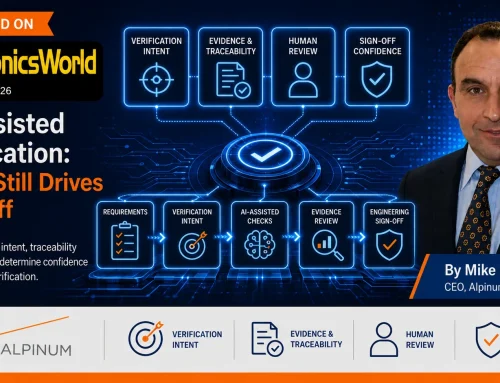
Verification intent connects the product specification to the evidence required for sign-off.
Without clear intent, an AI system has no reliable basis for deciding:
- Which scenarios matter
- Which states are legal
- Which transitions are forbidden
- Which corner cases create unacceptable risk
- Which coverage targets are meaningful
- When verification is complete
A language model can interpret text, but specifications often contain ambiguity, omissions, contradictions and assumptions shared informally between engineers.
An AI-generated test or property can therefore be:
- Valid SystemVerilog
- Accepted by the tool
- Successfully executed
- Technically irrelevant to the actual requirement
Engineers remain essential because they connect requirements, implementation and evidence.
A disciplined verification process should retain human approval for:
- Verification-plan scope
- Formal assumptions and constraints
- Coverage exclusions
- Waivers
- Specification interpretations
- Safety- and security-critical findings
- Closure and sign-off decisions
AI can prepare evidence, highlight patterns and recommend actions. It should not silently change the meaning of what is being verified.
Alpinum’s guide to verification planning from requirements to coverage closure explains why measurable traceability remains central even when AI assists the workflow.
Organisations facing wider verification challenges can also explore Alpinum’s ASIC and SoC design verification services.
Will AI Replace Analogue Design Engineers?
Analogue design presents a different automation challenge from digital design.
AI can assist analogue engineers with:
- Topology exploration
- Device sizing
- Parameter optimisation
- Simulation management
- Layout assistance
- Performance prediction
- Design-space exploration
However, analogue behaviour is closely connected to physical effects, process variation, noise, temperature, layout parasitics and operating conditions.
An apparently successful optimisation may fail when:
- Process corners change
- Parasitics are introduced
- Device matching degrades
- Noise increases
- Temperature varies
- The block is integrated into the wider system
Analogue engineers must understand the physical mechanisms behind the result and judge whether a model has explored the relevant operating space.
AI can accelerate simulation and optimisation. Engineering expertise remains necessary to define the topology, interpret results and understand why a design succeeds or fails.
Will AI Replace Semiconductor Manufacturing Engineers?
AI will automate parts of semiconductor manufacturing analysis, but it is unlikely to remove the need for manufacturing engineers.
Fabs produce large volumes of data from:
- Process equipment
- Wafer inspection
- Metrology
- Defect maps
- Yield records
- Maintenance systems
- Environmental monitoring
- Production scheduling
AI can help identify patterns, detect anomalies, predict equipment problems and improve the speed of analysis.
Digital twins and industrial AI can also allow engineers to explore changes virtually before applying them to physical production environments. Siemens describes semiconductor manufacturing AI as most valuable when models are connected to domain expertise, operational data and decision-making context.
Yet an anomaly is not an engineering conclusion.
A change in data may indicate:
- Process drift
- Equipment degradation
- Material variation
- Measurement noise
- A design-related sensitivity
- An inspection problem
- A temporary operating condition
Manufacturing engineers must determine which explanation is credible and what action is safe.
An incorrect decision can affect yield, product quality, equipment availability and customer delivery. AI can shorten the route from data to insight, but human engineers continue to own operational interpretation and production risk.
Where AI Already Adds Value in Semiconductor Engineering
AI provides the strongest immediate value in bounded workflows where the inputs, outputs and success criteria are clear.
Technical knowledge retrieval
Semiconductor projects generate large quantities of information:
- Specifications
- Design documents
- Tool manuals
- Bug reports
- Verification plans
- Waiver records
- Regression histories
- Design-review decisions
Engineers can lose substantial time searching for the correct information or reconstructing decisions from fragmented sources.
AI can improve retrieval, summarisation and cross-referencing, provided that access controls, versioning and source traceability are maintained.
Code and script assistance
AI can draft:
- Python utilities
- Tcl scripts
- Shell automation
- Testbench components
- Assertions
- Report-processing code
- Documentation
The output can reduce initial implementation time, particularly for repetitive or well-understood tasks.
Engineering review remains essential because generated code may:
- Misinterpret the interface
- Use outdated APIs
- Miss corner cases
- Introduce security weaknesses
- Produce plausible but incorrect behaviour
Regression triage and debugging
Regression environments generate large quantities of logs and failures.
AI can help:
- Group related failures
- Identify recurring signatures
- Prioritise likely root causes
- Summarise changes
- Recommend previous fixes
- Reduce duplicate investigation
AI assistance is especially valuable when it reduces the time engineers spend locating relevant evidence.
Root-cause ownership must remain with engineers, particularly when multiple failures share superficial symptoms but arise from different causes.
Coverage investigation
AI can identify:
- Persistently uncovered bins
- Repeatedly ineffective tests
- Correlations between failures and configurations
- Possible stimulus gaps
- Areas requiring additional review
However, AI should not automatically decide that an uncovered item is irrelevant or approve its exclusion.
Coverage is evidence only when it remains connected to requirements and risk.
Design optimisation
AI can accelerate design-space exploration across performance, power, area and implementation settings.
Faster exploration gives engineers more alternatives, but the final choice still depends on wider programme constraints.
An optimum result within one tool may not represent the optimum system-level decision.
The Semiconductor Trade-Off Problem AI Does Not Own
Semiconductor engineering is a multi-objective discipline.
Teams must balance:
- Power
- Performance
- Area
- Cost
- Schedule
- Reliability
- Security
- Safety
- Testability
- Manufacturability
- Software impact
- Verification effort
These objectives often conflict.
A design with the highest performance may consume too much power. A smaller implementation may be harder to verify. A late architectural change may improve one feature while threatening tape-out.
AI can:
- Generate alternatives
- Rank options
- predict selected outcomes
- highlight correlations
- recommend optimisation settings
AI cannot remove the responsibility to decide which compromise is acceptable.
Many programme decisions also involve information that is incomplete, uncertain or difficult to encode. Business priorities, customer commitments, team capability, supplier risk and regulatory obligations may all influence the technically preferred option.
The strongest use of AI is therefore to improve the quality and speed of engineering decisions—not to pretend that trade-offs no longer exist.
Are Semiconductors Needed for AI?
Yes. Modern AI systems depend on advanced semiconductor technology.
AI infrastructure requires:
- GPUs and specialist AI accelerators
- High Bandwidth Memory
- Networking silicon
- Storage controllers
- Power-management devices
- Advanced packaging
- High-speed interconnect
- Edge and automotive processors
AI may automate parts of semiconductor development, but the growth of AI also increases demand for the hardware that engineers must architect, design, verify and manufacture.
That demand creates additional engineering pressure:
- More complex accelerators
- Larger and more configurable SoCs
- Greater memory bandwidth
- Advanced packaging
- Chiplet integration
- Higher power density
- More software interaction
- More demanding verification
The relationship is circular.
AI supports semiconductor engineers, while semiconductor engineers create the devices that make AI possible.
For the market, technology and verification implications, read the dedicated Semiconductor Industry Outlook 2026.
What Skills Do Semiconductor Engineers Need to Use AI Effectively?
Engineers do not need to become full-time AI researchers. They need enough AI knowledge to use automation safely inside real engineering workflows.
The most valuable capability combines domain expertise, data literacy, automation and review discipline.
| Skill area | Why it matters |
| Semiconductor domain knowledge | Enables engineers to recognise whether AI output is technically credible |
| Verification strategy | Keeps tests, assertions and coverage connected to engineering intent |
| Python and scripting | Supports log processing, workflow automation, data analysis and tool integration |
| Data interpretation | Helps engineers distinguish evidence, correlation, noise and misleading patterns |
| Machine-learning fundamentals | Provides awareness of training data, bias, confidence, overfitting and model limitations |
| Prompt and context design | Helps engineers communicate specifications, constraints and expected outputs clearly |
| Output validation | Prevents plausible AI output from being accepted without technical evidence |
| Governance and traceability | Protects IP and ensures outputs remain reviewable and reproducible |
| System-level judgement | Allows engineers to evaluate cross-domain consequences and trade-offs |
The most valuable engineer will not simply know how to prompt a model.
The stronger engineer will know:
- Which problem should be automated
- Which data can be used
- Which output requires independent verification
- Which decisions cannot be delegated
- How success should be measured
- When the AI system should be stopped or escalated
A detailed skills pathway is available in How Semiconductor Engineers Can Learn AI and Machine Learning in 2026.
Engineers working specifically across architecture, RTL, verification and physical implementation can also explore AI-Driven Chip Design Skills: From Specification to Tape-out.
How Semiconductor Companies Should Adopt AI
The greatest AI risk is not that the technology fails completely.
A more dangerous outcome occurs when AI produces useful-looking results that teams trust too quickly.
Semiconductor organisations should introduce AI through controlled engineering adoption.
Start with a bounded problem
Strong initial use cases include:
- Regression summarisation
- Failure clustering
- Documentation retrieval
- Script generation
- Testbench scaffolding
- Coverage investigation
- Manufacturing anomaly analysis
A bounded pilot makes it possible to compare performance with an existing baseline.
Define the success metric
Measures may include:
- Time saved
- Reduction in duplicate investigation
- Improvement in triage accuracy
- Faster resolution of known failure classes
- Reduced manual reporting effort
- Improved coverage-analysis productivity
“Engineers liked the tool” is not a sufficient success criterion.
Protect engineering IP
AI systems may need access to:
- Specifications
- RTL
- Testbenches
- Logs
- Bug databases
- Customer information
- Tool outputs
Teams must define where data is processed, retained and accessed.
Keep outputs reviewable
Engineers should be able to determine:
- Which model was used
- Which inputs were provided
- Which files were accessed
- Which actions were taken
- Which outputs were generated
- Which engineer reviewed the result
Define approval boundaries
AI should not autonomously approve:
- Specification changes
- Formal assumptions
- Coverage waivers
- Safety findings
- Security exceptions
- Sign-off evidence
- Production release decisions
Measure assurance separately from productivity
A faster workflow is not automatically a more trustworthy workflow.
Productivity asks:
Did the team complete the task faster?
Assurance asks:
Did the process produce stronger, reviewable evidence?
Organisations planning controlled adoption can explore Alpinum’s AI adoption support for semiconductor verification teams.
What Will Change for Semiconductor Engineers?
The most likely workforce effect is task displacement combined with role elevation.
Engineers may spend less time on:
- Searching manuals
- Writing repetitive scripts
- Sorting regression failures
- Producing routine reports
- Repeating standard optimisation loops
- Manually reviewing large datasets
They may spend more time on:
- Architecture
- Requirements
- Verification intent
- Cross-domain decisions
- Reviewing AI outputs
- Managing exceptions
- Tool and workflow integration
- Governance
- Risk assessment
- Technical leadership
Junior engineers will also need a different development path.
Routine tasks have traditionally helped engineers understand tools, designs and failure modes. If organisations automate those tasks without replacing their learning value, they may weaken the pipeline that produces future technical leaders.
Teams must therefore use AI to accelerate learning rather than bypass it.
SEMI has argued that the industry still faces a significant talent requirement, estimating that one million additional skilled workers will be needed globally by 2030. The organisation also identifies major projected engineering shortages in Europe and Asia-Pacific. These estimates point towards continuing demand for semiconductor expertise, even as the content of engineering roles changes.
AI Will Raise the Skills Bar, Not Remove the Need for Engineers
AI is increasing the amount of semiconductor work the industry can attempt.
More capable automation enables:
- Larger designs
- More design alternatives
- Faster iteration
- More complex packaging
- More ambitious verification
- Greater use of data
- Shorter development schedules
These gains also raise expectations.
An engineering team that produces RTL faster must verify it faster. A team that explores more alternatives must evaluate more trade-offs. An organisation that automates more decisions needs stronger governance and traceability.
AI can therefore increase total engineering throughput while making expert judgement more valuable.
The future semiconductor engineer is unlikely to be replaced by a single AI system.
The more plausible outcome is an engineer who works with:
- AI assistants
- Domain-specific agents
- Deterministic EDA engines
- Automated verification infrastructure
- Searchable engineering knowledge
- Human review and approval workflows
The engineer’s role moves from performing every step manually towards defining intent, supervising execution and judging outcomes.
Conclusion: AI Will Reshape Semiconductor Engineering, Not Remove Accountability
Will AI replace semiconductor engineers?
Not as a complete profession.
AI will replace or compress selected tasks. It will accelerate documentation search, script generation, regression triage, debugging, optimisation and manufacturing analytics. Agentic systems will also execute longer and more complicated workflows.
However, semiconductor development still depends on human ownership of:
- Architecture
- Requirements
- Constraints
- Verification intent
- Engineering trade-offs
- Evidence interpretation
- Risk
- Sign-off
- Accountability
AI can generate an output. Engineers must decide whether the output is correct, relevant and safe to use.
The strongest semiconductor teams will not reject AI, nor will they delegate uncontrolled authority to it. They will introduce AI into bounded, measurable and reviewable workflows.
The future belongs to engineers who can combine automation with sound technical judgement.
Alpinum Consulting supports semiconductor organisations through AI in Design Verification services, design verification consulting and specialist semiconductor engineering training.
Continue Exploring
How Semiconductor Engineers Can Learn AI and Machine Learning
Build practical AI capability around semiconductor workflows, data analysis, automation, validation and governance.
AI in Design Verification: How to Pilot Safely
Identify bounded AI use cases while maintaining traceability, review discipline and sign-off confidence.
AI Agents in Production Chip Teams
Explore how agentic AI can support specification interpretation, RTL, verification planning, regression analysis and debugging.
Semiconductor Industry Outlook 2026
Review the effect of AI chips, HBM, chiplets, advanced packaging and verification complexity on the semiconductor market.
Formal Verification Services
Strengthen verification confidence through property checking, exhaustive analysis and formal methods.
Formal Verification Training
Develop practical expertise in assertions, property checking and formal-verification workflows.
FAQs
AI is unlikely to replace semiconductor engineers as a whole. It will automate selected repetitive tasks, while engineers remain responsible for architecture, requirements, verification intent, trade-offs, risk and sign-off.
AI will change VLSI workflows by assisting with RTL, verification, implementation and optimisation. VLSI engineers will still be needed to define architecture, manage constraints and evaluate system-level consequences.
AI can support chip designers with code generation, documentation search, design-space exploration and optimisation. Engineers will continue to own architecture, design intent, integration and accountability.
AI can help generate tests, analyse regressions, cluster failures and investigate coverage. Verification engineers remain responsible for deciding what must be verified, interpreting evidence and determining whether sign-off criteria have been met.
AI can accelerate topology exploration, sizing and simulation. Analogue engineers remain necessary to interpret physical behaviour, process variation, noise, parasitics and integration effects.
AI will automate parts of anomaly detection, yield analysis and process monitoring. Manufacturing engineers are still needed to interpret results, manage process risk and make production decisions.
AI can assist with documentation search, code and script generation, regression triage, log summarisation, failure clustering, testbench scaffolding, coverage analysis, routine optimisation and manufacturing-data analysis.
Engineers should develop skills in data interpretation, Python, automation, AI-output validation, verification strategy, machine-learning fundamentals, governance and system-level engineering judgement.
Yes. AI systems depend on increasingly advanced chips, memory, networking, packaging and power-management technologies. Growing AI demand creates additional semiconductor design, verification and manufacturing challenges.
AI may help prepare and analyse sign-off evidence, but responsibility should remain with qualified engineers. Sign-off requires judgement about requirements, assumptions, coverage, risk and the sufficiency of evidence.

Written by : Mike Bartley
Mike started in software testing in 1988 after completing a PhD in Math, moving to semiconductor Design Verification (DV) in 1994, verifying designs (on Silicon and FPGA) going into commercial and safety-related sectors such as mobile phones, automotive, comms, cloud/data servers, and Artificial Intelligence. Mike built and managed state-of-the-art DV teams inside several companies, specialising in CPU verification.
Mike founded and grew a DV services company to 450+ engineers globally, successfully delivering services and solutions to over 50+ clients.
Mike started Alpinum in April 2016 to deliver a range of start-of-the art industry solutions:
Alpinum AI provides tools and automations using Artificial Intelligence to help companies reduce development costs (by up to 90%!) Alpinum Services provides RTL to GDS VLSI services from nearshore and offshore centres in Vietnam, India, Egypt, Eastern Europe, Mexico and Costa Rica. Alpinum Consulting also provides strategic board level consultancy services, helping companies to grow. Alpinum training department provides self-paced, fully online training in System Verilog, UVM Introduction and Advanced, Formal Verification, DV methodologies for SV, UVM, VHDL and OSVVM and CPU/RISC-V. Alpinum Events organises a number of free-to-attend industry events
You can contact Mike (mike@alpinumconsulting.com or +44 7796 307958) or book a meeting with Mike using Calendly (https://calendly.com/mike-alpinum-consulting).
Stay Informed and Stay Ahead
Latest Articles, Guides and News
Explore related insights from Alpinum that dive deeper into design verification challenges, practical solutions, and expert perspectives from across the global engineering landscape.