
Anthropic has confirmed that it is building an internal team to design custom silicon for Claude. The company says hardware and software engineers will co-design chips and AI models so Claude can run faster and more efficiently at customer scale. Its current silicon recruitment also explicitly covers pre-silicon verification, hardware–software co-design, numerics, formal verification, DFT and first-silicon debug. [1], [2]
What Anthropic has not announced is equally important. There is no publicly confirmed Claude AI chip architecture, process node, foundry, memory system, packaging technology, tape-out date or production schedule. Nor has Anthropic confirmed whether its first internal design would principally target training, inference or both.
For semiconductor teams, the significant development is therefore not a finished processor. It is Anthropic taking more direct responsibility for the engineering boundary between models, software and silicon.
What Has Anthropic Actually Confirmed?
In April 2026, Reuters reported that Anthropic was exploring the possibility of developing its own AI chips but had not yet committed to a design or assembled a dedicated team. By 5 August, that position had materially changed: Anthropic confirmed that it was building an internal custom-silicon team. [1], [9]
Its Silicon Engineer vacancy gives the clearest public indication of the programme’s technical breadth. Anthropic is recruiting across front-end design, pre-silicon verification, physical design, DFT, analogue and mixed-signal engineering, technology and foundry interaction, CAD infrastructure, packaging, signal integrity and power integrity. [2]Subject Current evidence status What can responsibly be said Internal silicon team Confirmed Anthropic is building a custom-silicon team Claude connection Confirmed The chips are being co-designed in relation to Claude workloads Pre-silicon verification capability Confirmed It is explicitly included in Anthropic’s silicon recruitment Hardware–software co-design Confirmed The role works with inference, performance, kernel and infrastructure teams Numerical-format engineering Confirmed as a programme skill/project area Anthropic identifies compute-datapath numerical-format strategy as representative work Formal verification Confirmed as a programme skill/project area Anthropic identifies establishing a formal methodology as representative work DFT and production-test interface Confirmed as a programme skill/project area Test strategy and ATE hand-off appear in representative projects First-silicon debug Confirmed as a programme responsibility Silicon engineers are expected to support bring-up and debug Samsung discussions Credibly reported Samsung has been reported as a possible partner; no selection has been confirmed Training versus inference role Not publicly confirmed Anthropic’s wider workload spans both; the intended balance of the internal chip is unknown Process node Not publicly confirmed No responsible assumption can yet be made Foundry Not publicly confirmed No foundry has been publicly selected Memory architecture Not publicly confirmed HBM or another specific implementation should not be assumed Packaging/interconnect Not publicly confirmed No public design establishes either Tape-out or production schedule Not publicly confirmed Anthropic has provided no timetable
TechCrunch reported in July, citing The Information, that Anthropic had been in contact with Samsung concerning a potential collaboration. The same report said the intended use and characteristics of the chip remained undecided at that stage. Anthropic did not confirm a Samsung arrangement. [8]
That distinction matters. A silicon team is now real. A publicly specified and scheduled Claude AI chip product is not.
Why Would Anthropic Develop Internal Silicon Capability?
Anthropic’s stated objective is narrower than much of the competitive commentary surrounding the announcement. It says co-designing hardware and models can help Claude run faster and more efficiently at the scale required by customers. [1]
Its hardware organisation also describes compute hardware as a direct lever on capability, cost and reliability. [3]
Beyond those statements, several potential advantages can be identified as engineering implications rather than confirmed Anthropic motives.
A model developer operating at very large scale can observe its workload differently from a merchant-chip supplier serving many customers. It can see which operations dominate execution time, how software maps those operations onto existing accelerators, where memory traffic constrains useful throughput, which numerical formats are acceptable and where latency or power is being spent without improving model-level results.
Greater design authority creates the possibility of feeding that workload knowledge back into the hardware specification.
That does not automatically make a custom ASIC superior. Specialisation trades flexibility for optimisation. Workloads change, models evolve, compiler requirements move and silicon development cycles remain much longer than software-release cycles. A custom architecture must therefore be useful not only for the workload observed when the specification is written, but for the workloads expected when silicon actually reaches deployment.
Anthropic already has experience working deeply with external accelerator platforms. Its AWS collaboration includes work on low-level kernels and the Neuron software stack alongside Annapurna Labs, illustrating that model-to-hardware optimisation was already part of its engineering approach before the internal silicon team was announced. [4]
This also makes the new programme different from a simple make-versus-buy decision. The engineering question is how much architectural and implementation authority Anthropic wants to own while continuing to use external platforms.
Similar verification questions around inference-oriented specialised hardware are examined in Alpinum’s DeepSeek custom-silicon analysis. Here, however, the important issue is specifically how Anthropic’s stated model–hardware co-design approach changes verification boundaries.
From Model Development to Model–Hardware Co-Design
A conventional verification plan is often organised around a hierarchy: block, IP, subsystem and SoC.
A custom AI accelerator introduces another hierarchy above it.
A useful engineering chain is:
Model and workload requirements → numerical and performance targets → compiler/runtime contract → accelerator architecture → RTL and firmware → silicon/platform behaviour → model-level correlation
Each arrow is a verification boundary.
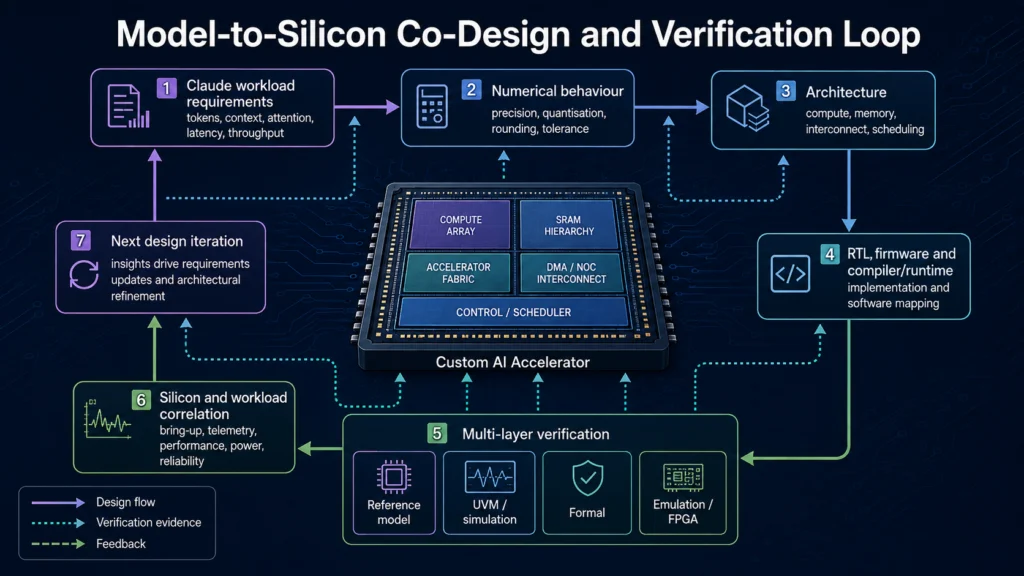
Fig 1: Model-to-silicon co-design requires verification evidence to remain aligned across workload requirements, numerical behaviour, architecture, RTL, firmware, compiler/runtime software and post-silicon results.
Suppose a model workload changes the dimensions, data types or execution patterns expected by the accelerator. The RTL might still satisfy its local specification while the system misses its latency target.
Suppose a compiler transforms an operation into a legal accelerator sequence but chooses a schedule that creates severe memory contention. Functional simulation may pass while deployment performance does not.
Suppose a new numerical implementation improves throughput but modifies accumulation or rounding behaviour. The arithmetic implementation could be locally correct while the model-level deviation exceeds an agreed acceptance envelope.
That is why model–hardware co-design does not remove verification work. It creates additional contracts that have to remain consistent.
The verification plan must connect architectural requirements to implementation evidence and also connect implementation behaviour back to the workload for which the hardware exists.
What Would Need to Be Designed and Verified?
Anthropic has not published the architecture of its custom silicon. The following are therefore verification domains that a credible custom-accelerator programme would need to address, not claims about features implemented in an Anthropic processor.
Compute architecture and datapaths
The implementation must establish what operations the accelerator supports, their legal operands, dependencies, numerical formats, exceptional behaviour and completion semantics.
Verification must then separate architectural intent from RTL implementation. Arithmetic blocks need directed and constrained-random corner cases, reference-model comparison and targeted formal properties where practical.
Memory and data movement
An accelerator is useful only if operands and results can reach the compute resources at the required rate.
The verification plan should cover addressing, transfers, buffering, contention, ordering, back-pressure, protection, error response and the interaction between compute scheduling and available bandwidth. Which external memory technology Anthropic might use is not public and should not be assumed.
Interconnect and scheduling
Requests crossing multiple engines or interfaces create ordering, arbitration and forward-progress risks. Verification needs to establish what may execute concurrently, what must remain ordered and what happens when resources become congested.
Firmware
Boot code, device initialisation, power management, recovery, resource configuration and low-level control can expose hardware behaviour that block-level RTL tests never encounter.
Firmware interfaces therefore need versioned specifications and tests that confirm register semantics, timing assumptions, error handling and backwards/forwards compatibility where required.
Compiler and runtime integration
A compiler is effectively generating programmes for the accelerator.
Its output must obey the hardware execution contract: supported operations, layouts, alignment, precision modes, dependencies, resource limits and synchronisation rules.
A hardware bug can appear to be a compiler problem. A compiler lowering bug can appear to be faulty RTL. Debug infrastructure needs enough visibility to distinguish them.
Telemetry and observability
Large systems require evidence after deployment.
Performance counters, error records, tracing, health telemetry and debug state need to be architected rather than added late. Verification should confirm that observability mechanisms themselves remain reliable during exceptional states.
Anthropic’s Hardware Systems role explicitly connects platform validation with telemetry and fleet-level reliability targets, reinforcing the importance of evidence beyond the individual RTL block. [3]
Error handling and recovery
Reset, timeout, malformed requests, poisoned or invalid data, failed resources and partial recovery paths deserve first-class verification objectives.
Recovery logic is often exercised far less frequently than normal processing, making assertions, fault injection and formal analysis particularly useful.
Security and access control
Accelerator systems can expose command processors, firmware interfaces, memory regions, privileged registers and debug facilities.
The required controls depend on the eventual architecture, but permission enforcement, illegal accesses, state isolation, secure configuration and debug restrictions should be traceable to explicit security requirements rather than inferred from normal functional behaviour.
Power and thermal management
Correct logic at nominal operating conditions is not enough if the system cannot sustain the intended workload.
Verification must connect power states, clocking, throttling, reset and protection mechanisms to architectural behaviour. At platform level, validation must establish that thermal and power-management policies interact correctly with real workloads.
Test and manufacturing considerations
DFT, scan strategy, memory test, test access and ATE interfaces affect both implementation and manufacturing evidence.
Anthropic’s own Silicon Engineer description includes design for test and specifically identifies test strategy and ATE hand-off as representative work. [2]
The resulting programme is therefore wider than “verify the AI math”. It must demonstrate that compute, control, software, memory, testability and platform behaviour form one coherent system.
Numerical Behaviour: When “Correct” Is Not Bit-Exact
AI accelerators make numerical verification unusually important because different layers of the system can use different definitions of correctness.
For a register field or protocol handshake, correct behaviour may be completely deterministic.
For an arithmetic operation, correctness depends on the specified representation and semantics: precision, rounding, saturation, overflow, exceptional values and the order in which calculations are performed.
For an entire model, the acceptance criterion may instead be that the accelerated implementation remains within an agreed model-level tolerance compared with a reference configuration.
IEEE 754 defines widely used floating-point formats, operations and exception behaviour, but AI inference also uses reduced-precision and quantised representations whose acceptance criteria need to be defined explicitly by the programme. [13]
Current inference software illustrates why this matters. NVIDIA’s TensorRT documentation, for example, describes different accuracy, range and performance behaviours for FP32, TF32, FP16 and BF16, while its quantisation support includes still lower-precision integer and floating-point representations. These are examples of general inference engineering, not evidence that Anthropic will use any particular format. [14], [15]
A practical verification example
Consider an illustrative accelerator that performs a large reduction using a reduced-precision input format.
A reference software model might calculate the same operation at higher precision. Depending on the accelerator specification, intermediate rounding and the order of accumulation can produce a result that differs by several representable steps without indicating an RTL defect.
The verification strategy therefore needs at least three levels of acceptance:
- Bit-exact checks where behaviour is defined bit-for-bit.
Encoding, conversion rules, saturation, exception flags and specified arithmetic primitives should match their architectural definition exactly. - Numerical tolerance where the architecture permits implementation-dependent deviation.
The allowed error must be quantified rather than described vaguely as “close enough”. - Model-level correlation.
Representative workloads must demonstrate that accumulated numerical differences do not violate the model-quality or application-level criteria agreed by the programme.
This distinction prevents two opposite mistakes: rejecting valid hardware because it is not identical to a higher-precision software implementation, or accepting incorrect hardware merely because a model appears to produce plausible output.
Anthropic’s job description is notable here because it specifically cites defending a compute-datapath numerical-format strategy as representative silicon work. [2]
Memory and Data Movement May Define the Real Verification Problem
Peak arithmetic throughput is only useful when the system can keep useful work flowing through the compute resources.
AI workloads move weights, activations, intermediate state, commands and results between storage and compute. The exact balance depends on the model and architecture, but the verification risks are familiar:
- Insufficient sustained bandwidth
- Unexpectedly high latency
- Inefficient data reuse
- Contention between requestors
- Incorrect ordering
- Buffer exhaustion
- Prolonged back-pressure
- Starvation under mixed traffic
- Malformed or failed transfers
- Recovery following detected errors
- Coherency problems where coherent agents are part of the design.
A short functional test can miss several of these conditions.
A memory subsystem may behave correctly for thousands of transactions and fail only after long-duration queue interaction, a rare retry sequence or a particular mixture of compute and data-movement traffic.
This is where performance verification and functional verification intersect.
A scoreboard may prove that every returned value is correct, yet the system may still fail its required service rate. Conversely, a benchmark can hit its throughput target while an ordering violation remains hidden because the workload does not expose it.
The specification therefore needs both correctness requirements and measurable performance envelopes.
That also means the performance model cannot be disconnected from verification. Predictions about bandwidth, contention and utilisation should be correlated first with RTL/emulation behaviour and later with silicon.
No reliable public source currently establishes whether Anthropic’s eventual design will use HBM, another memory technology, chiplets or any particular interconnect. Those decisions should remain outside the article until Anthropic or a directly responsible partner confirms them.
Verification Across RTL, Firmware, Compilers and Models
A conventional UVM environment remains highly useful, but isolated RTL verification would be insufficient for this class of programme.
Accellera’s UVM standard exists to support interoperable, reusable verification components, which is particularly valuable when interfaces and verification environments must be reused from IP to subsystem and SoC. [10]
For teams strengthening those foundations, Alpinum’s Design Verification for SystemVerilog and UVM Training covers simulation-based verification, stimulus generation, checking, assertions, functional coverage, UVM, verification planning, closure and IP-to-SoC application.
A cross-layer AI-accelerator strategy would normally combine several evidence sources.
Reference models
Reference models define expected architectural behaviour independently of the RTL.
One model may operate at a high architectural level while another captures the target numerical semantics more precisely. Keeping those responsibilities separate can make failures much easier to diagnose.
SystemVerilog and UVM simulation
Simulation remains central for interface behaviour, constrained-random interaction, scoreboarding, error injection, coverage and reproducible debugging.
The environment should test not just valid workloads but invalid sequences, resets, resource conflicts and recovery paths.
Assertions and formal verification
Assertions convert important rules into executable properties.
Formal methods can then prove selected behaviours across reachable state spaces without waiting for random simulation to encounter the required corner case.
Emulation
Large software workloads quickly exceed the practical speed of RTL simulation.
Emulation allows firmware, drivers and substantial workloads to interact with the hardware representation much earlier, while preserving significantly greater hardware visibility than final silicon. Industry co-emulation standards such as Accellera SCE-MI exist specifically to support hardware/software interaction in such environments. [12]
FPGA prototyping
Where the architecture permits useful mapping, FPGA prototypes can provide another route for early software development and workload testing.
A prototype does not reproduce ASIC timing, power or all physical behaviour, so its evidence must be interpreted within its abstraction limits.
Compiler and runtime validation
Compiler validation needs tests that establish whether graph transformations, scheduling, layout changes, operator lowering and generated instruction sequences comply with the hardware specification.
Tests should include combinations that stress resource limits and memory behaviour, not only isolated operators.
Software-driven verification
Real firmware, drivers and runtime software should eventually become part of the verification environment.
That is important because software often creates sequences no hand-written block test would naturally generate.
Performance modelling
Analytical and simulation models provide early estimates for throughput, latency, bandwidth and resource utilisation.
Their value increases when the programme maintains an explicit correlation process against RTL, emulation and silicon rather than allowing separate models to drift.
Coverage and closure
Coverage should show what has and has not been exercised or proven.
Accellera’s UCIS standard reflects the broader importance of interoperable coverage data in verification closure. [11]
For an AI accelerator, closure also requires evidence outside conventional RTL coverage: compiler test coverage, workload coverage, numerical corner cases, firmware scenarios, error injection and post-silicon correlation.
Post-silicon validation and production test
First silicon should not be the point at which the programme discovers what it needs to measure.
Bring-up sequences, observability, diagnostic modes, test hooks, workload-correlation methodology and production-test interfaces need to be considered before tape-out.
Anthropic’s recruitment language is unusually explicit on this point: the silicon role includes first-silicon bring-up and cross-domain debug as well as DFT/ATE hand-off. [2]
Verification Matrix for Custom AI Inference Silicon
The exact implementation will determine the final plan, but a useful programme-level matrix could look like this:
| Verification objective | Principal risk | Suitable methods | Required evidence |
| Arithmetic correctness | Incorrect operations or corner-case arithmetic | Reference models, directed tests, constrained random, assertions, formal | Bit-exact comparison for defined operations and documented exception behaviour |
| Numerical correlation | Valid RTL produces unacceptable model deviation | Numerical reference model, tolerance analysis, model workloads, differential testing | Defined error limits and model-level correlation results |
| Memory behaviour | Corruption, ordering errors, starvation or hidden bandwidth limits | UVM, assertions, stress traffic, performance modelling, emulation | Functional coverage, ordering evidence, stress results and model correlation |
| Interconnect | Protocol violations, deadlock or unfair arbitration | Protocol VIP, assertions, constrained random, formal | Protocol coverage, proofs for selected properties and recovery evidence |
| Control and scheduling | Lost work, incorrect dependencies or resource deadlock | Reference scheduler, simulation, assertions, formal | Requirement-linked tests/proofs and corner-case coverage |
| Firmware | Incorrect initialisation, reset, sequencing or recovery | Software-driven simulation, emulation, FPGA prototype, fault injection | Boot/recovery results, interface compliance and error-path evidence |
| Compiler/runtime | Incorrect lowering, scheduling, layout or synchronisation | Differential tests, operator suites, generated-program fuzzing, emulation | Compiler conformance results correlated with architectural reference |
| Security | Privilege bypass, unauthorised access or debug exposure | Threat modelling, assertions, formal, negative testing | Security-requirement traceability and property/test results |
| Power and thermal behaviour | Throttling or power-state transitions break functional expectations | Power-aware verification, workload tests, modelling, platform validation | State-transition coverage and sustained-workload evidence |
| Reliability and recovery | Rare faults cause corruption or unrecoverable service loss | Fault injection, formal for selected recovery logic, long-duration testing | Error-detection, containment, reset and recovery evidence |
| Performance | Correct silicon misses latency or throughput targets | Architectural models, simulation, emulation, workload profiling | Correlation between predicted and measured performance |
| Production and post-silicon validation | Manufacturing or silicon-specific failures escape pre-silicon verification | DFT, ATE, bring-up suites, diagnostics, silicon workload correlation | Test coverage, bring-up records, failure triage and pre/post-silicon correlation |
The purpose of such a matrix is not to prescribe a single methodology. It is to prevent an important requirement from having no identifiable owner or evidence source.
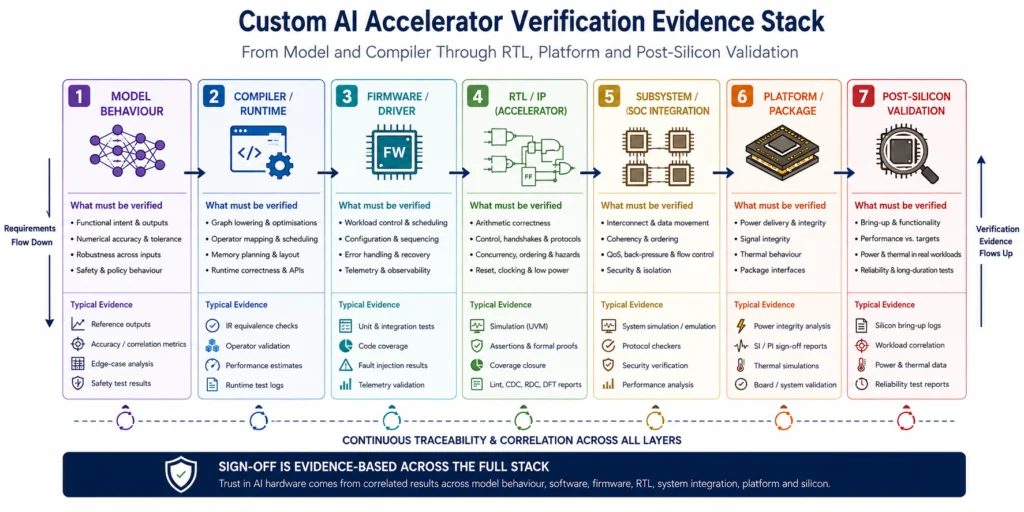
Fig 2: Custom AI accelerator sign-off requires evidence across model behaviour, software, firmware, RTL, system integration and post-silicon operation rather than an isolated RTL pass/fail result.
Where Formal Verification Adds Value and Where It Does Not
Formal verification is particularly effective where the required behaviour can be expressed as precise properties and the proof boundary can be constrained meaningfully.
Useful candidates in a custom accelerator can include:
- Arbitration and grant rules
- Request/response protocol behaviour
- Ordering requirements
- FIFO and queue safety
- Access-control properties
- Illegal-state prevention
- Register semantics
- Reset and initialisation
- Selected deadlock conditions
- Resource ownership
- Error containment
- Forward-progress properties under clearly defined assumptions.
Anthropic’s silicon vacancy specifically lists building a formal-verification methodology and deciding where formal is more appropriate than simulation as representative work. [2]
That wording is technically important because formal is not automatically the preferred method for every problem.
A proof is only as useful as the property, assumptions and abstraction boundary behind it. An over-constrained environment can prove behaviour that the real system does not guarantee. A poorly chosen full-system target can become computationally impractical.
Formal verification also does not replace realistic workload execution, compiler testing, firmware validation, analogue behaviour, physical implementation analysis, performance modelling, power analysis or thermal qualification.
For engineers building practical property-writing, proof-analysis and formal-coverage capability, Alpinum’s Formal Verification Training specifically covers SystemVerilog Assertions, constraints, proof analysis, debug, formal coverage and the use of formal alongside simulation.
The most defensible strategy is therefore complementary:
Prove what can be bounded and specified rigorously; simulate what benefits from broad dynamic exploration; emulate what needs software and workload scale; validate what depends on real silicon and the physical platform.
Why a Multi-Chip Strategy Still Matters
An internal Anthropic chip should not currently be interpreted as evidence that the company intends to replace every external accelerator platform.
Anthropic has explicitly said the custom-silicon effort is part of its multi-chip strategy. [1]
That position is consistent with its current infrastructure commitments.
In April 2026, Anthropic announced expanded AWS capacity spanning Trainium generations for training and deploying Claude. [5] It separately announced multiple gigawatts of next-generation Google TPU capacity expected from 2027 and said it runs Claude across a range of AI hardware. [6] In July, AMD and Anthropic announced plans involving up to two gigawatts of AMD Instinct MI450-series capacity, with collaboration around workloads and the ROCm software stack. [7]
For verification teams, heterogeneous deployment creates another requirement: correlation across targets.
If the same or closely related Claude workload can execute on several accelerator families, teams need to understand which behaviours must remain invariant and which may legitimately differ.
That can require:
- A common model-level reference
- Target-specific numerical tolerances
- Backend compiler conformance suites
- Equivalent operator and feature definitions
- Defined behaviour for unsupported operations
- Performance targets appropriate to each platform
- Telemetry that supports cross-platform diagnosis
- Regression suites capable of distinguishing hardware-specific faults from model or software changes.
This is another reason internal silicon does not simplify the engineering stack. It may provide more control over one target while increasing the importance of portable evidence across several targets.
What This Means for Semiconductor and Verification Engineers
The Anthropic programme illustrates a broader change in what senior verification engineers increasingly need to understand.
Deep SystemVerilog, UVM and assertion skills remain fundamental. But an engineer working on a custom AI accelerator also benefits from being able to reason across architectural performance, numerical representation, memory behaviour, firmware interfaces and the software that generates work for the hardware.
That does not mean every verification engineer becomes a compiler engineer or machine-learning researcher.
It means engineers need enough cross-domain understanding to identify when a failure has crossed a boundary.
A numerical mismatch may originate in the datapath, compiler or reference model. A performance regression may come from RTL scheduling, memory traffic or software mapping. A recovery failure may involve hardware state and firmware policy simultaneously.
Alpinum’s broader AI-driven chip-design skills analysis examines those changing engineering capabilities in more detail, so there is no need to recreate the complete career discussion here.
Anthropic also explicitly expects its new silicon engineers to explore Claude-assisted RTL review, coverage triage and specification-consistency workflows. [2]
That should not be confused with delegating sign-off to an AI system.
Generated RTL, properties, tests, review findings or coverage suggestions remain engineering inputs that require reproducibility, review and measurable evidence. Alpinum discusses those controls separately in its guide to safe AI adoption in design verification and its analysis of AI agents in production chip-design teams.
Practical Readiness Questions for Any Custom AI Chip Programme
Before a custom accelerator reaches implementation, a technical review should be able to answer questions such as these:
- Which workloads define the architecture?
Are they representative of the expected production workload when silicon becomes available? - Which requirements are architectural and which are current-model assumptions?
Can the design tolerate foreseeable model changes? - What numerical behaviour is required?
Which operations are bit-exact and where are tolerances permitted? - What independent reference models exist?
Do they share implementation code with the design under test in ways that could hide common-mode errors? - Who owns each interface contract?
Is ownership defined across RTL, firmware, compiler, runtime and infrastructure? - How will verification evidence trace back to requirements?
Can every important requirement point to a test, assertion, proof, review or other measurable result? - Which behaviours belong in simulation and which belong in formal verification?
Are proof assumptions documented and reviewed? - When will real firmware and compiler-generated workloads enter verification?
Is software integration early enough to influence the hardware? - How will memory and interconnect stress be generated?
Does testing include long-duration contention, back-pressure and recovery scenarios? - What constitutes coverage closure?
Does the definition extend beyond RTL code and functional coverage to numerical, software and workload evidence? - How will performance models be correlated with implementation?
Are throughput and latency predictions checked against RTL, emulation and eventually silicon? - How will power and thermal behaviour interact with functional operation?
Are throttling, reset and protection states part of the verification plan? - Which security properties require proof or dedicated negative testing?
Are privileged state, debug access and memory protection explicitly specified? - What is the reliability and recovery model?
Which faults are detected, contained, retried, reset or escalated? - What must be observable on first silicon?
Are counters, traces, diagnostics and production-test hooks sufficient to correlate silicon behaviour with pre-silicon expectations?
A programme that cannot answer these questions early does not merely have unfinished documentation. It has undefined verification boundaries.
Conclusion
Anthropic’s exact silicon roadmap remains private, but its move into internal chip design is now more concrete than the early exploration reported in April.
The company has confirmed a custom-silicon team, and its recruitment material shows that the scope reaches well beyond architecture. Pre-silicon verification, hardware–software co-design, numerical-format decisions, formal methodology, DFT, integration and first-silicon debug are all represented in the engineering work Anthropic is seeking to build. [1], [2]
The important semiconductor implication is the convergence of model development and hardware engineering.
When model characteristics can influence datapaths, numerical formats, memory behaviour and software mapping, verification must follow those dependencies across RTL, firmware, compilers, runtime software and real workloads. A block-level pass is necessary but cannot provide the complete evidence.
Anthropic’s continuing use of external accelerator platforms also shows why custom silicon should not be reduced to a supplier-replacement narrative. A multi-chip environment makes portability, correlation and consistent model behaviour part of the verification problem.
Ultimately, the competitive value of custom AI hardware will depend on more than architecture or peak compute. It will depend on whether the complete system can produce trustworthy, traceable evidence that its hardware, software and model behaviour remain aligned.
For teams assessing how AI-assisted methods can fit into controlled semiconductor-verification workflows, Alpinum’s AI in Design Verification services cover UVM/SystemVerilog workflows, coverage, traceability and engineering governance. Teams evaluating a live accelerator, ASIC or cross-layer verification programme can also discuss the project with Alpinum.
References
[1] Reuters, “Anthropic to build in-house chip design team for Claude, hire engineers,” Aug. 5, 2026. [Online]. Available:
https://www.reuters.com/business/anthropic-build-in-house-chip-design-team-claude-hire-engineers-2026-08-05/
Accessed: Aug. 11, 2026.
[2] Anthropic, “Silicon Engineer,” Anthropic Careers. [Online]. Available:
https://job-boards.greenhouse.io/anthropic/jobs/5286348008
Accessed: Aug. 11, 2026.
[3] Anthropic, “Hardware Systems Architect,” Anthropic Careers. [Online]. Available:
https://job-boards.greenhouse.io/anthropic/jobs/5286362008
Accessed: Aug. 11, 2026.
[4] Anthropic, “Powering the next generation of AI development with AWS,” Nov. 22, 2024. [Online]. Available:
https://www.anthropic.com/news/anthropic-amazon-trainium
Accessed: Aug. 11, 2026.
[5] Anthropic, “Anthropic and Amazon expand collaboration for up to 5 gigawatts of new compute,” Apr. 20, 2026. [Online]. Available:
https://www.anthropic.com/news/anthropic-amazon-compute
Accessed: Aug. 11, 2026.
[6] Anthropic, “Anthropic expands partnership with Google and Broadcom for multiple gigawatts of next-generation compute,” Apr. 6, 2026. [Online]. Available:
https://www.anthropic.com/news/google-broadcom-partnership-compute
Accessed: Aug. 11, 2026.
[7] Advanced Micro Devices, Inc., “AMD and Anthropic Announce Strategic Partnership to Deploy Up to 2 Gigawatts of AMD Instinct MI450 Series GPUs,” Jul. 22, 2026. [Online]. Available:
https://ir.amd.com/news-events/press-releases/detail/1292/amd-and-anthropic-announce-strategic-partnership-to-deploy-up-to-2-gigawatts-of-amd-instinct-mi450-series-gpus
Accessed: Aug. 11, 2026.
[8] L. Ropek, “Anthropic is discussing a new custom chip with Samsung,” TechCrunch, Jul. 2, 2026. [Online]. Available:
https://techcrunch.com/2026/07/02/anthropic-is-discussing-a-new-custom-chip-with-samsung/
Accessed: Aug. 11, 2026.
[9] M. A. Cherney and D. Seetharaman, “Anthropic weighs building its own AI chips, sources say,” Reuters, Apr. 9, 2026. [Online]. Available:
https://www.reuters.com/business/anthropic-weighs-building-it-own-ai-chips-sources-say-2026-04-09/
Accessed: Aug. 11, 2026.
[10] Accellera Systems Initiative, “Universal Verification Methodology (UVM).” [Online]. Available:
https://www.accellera.org/downloads/standards/uvm
Accessed: Aug. 11, 2026.
[11] Accellera Systems Initiative, “Unified Coverage Interoperability Standard (UCIS).” [Online]. Available:
https://www.accellera.org/downloads/standards/ucis
Accessed: Aug. 11, 2026.
[12] Accellera Systems Initiative, “Standard Co-Emulation Modeling Interface (SCE-MI).” [Online]. Available:
https://www.accellera.org/downloads/standards/sce-mi
Accessed: Aug. 11, 2026.
[13] IEEE Standards Association, “IEEE 754-2019: IEEE Standard for Floating-Point Arithmetic,” 2019. [Online]. Available:
https://standards.ieee.org/ieee/754/6210/
Accessed: Aug. 11, 2026.
[14] NVIDIA Corporation, “Accuracy Considerations — NVIDIA TensorRT.” [Online]. Available:
https://docs.nvidia.com/deeplearning/tensorrt/latest/inference-library/accuracy-considerations.html
Accessed: Aug. 11, 2026.
[15] NVIDIA Corporation, “Working with Quantized Types — NVIDIA TensorRT.” [Online]. Available:
https://docs.nvidia.com/deeplearning/tensorrt/latest/inference-library/work-with-quantized-types.html
Accessed: Aug. 11, 2026.
FAQs
Anthropic has confirmed that it is building an internal team to design custom chips for Claude. It has not announced a completed or deployed processor.
Not as a finished product. “Claude custom silicon” describes the announced design effort; Anthropic has not published a product specification, tape-out or production announcement.
Anthropic says co-designing chips and models could make Claude faster and more efficient at customer scale. Workload specialisation, economics and greater design control are reasonable industry implications, but should not all be presented as confirmed Anthropic motives.
This has not been publicly confirmed. Anthropic operates both training and inference workloads, and its silicon role explicitly collaborates with inference teams, but the company has not announced the intended balance for its internal processor.
It is an engineering process in which workload and model characteristics influence hardware and software decisions, while hardware constraints feed back into numerical formats, compilers, runtimes and model execution.
Correctness can span arithmetic semantics, model-level numerical tolerance, memory traffic, scheduling, firmware, compiler output, performance and recovery rather than only RTL functionality.
Formal methods can prove carefully specified properties of suitable blocks and interfaces, but they do not replace realistic software workloads, performance analysis, compiler validation, power/thermal analysis or post-silicon testing.
No such plan has been announced. Anthropic explicitly describes custom silicon as part of a multi-chip strategy and continues major commitments involving AWS, Google, NVIDIA and AMD technologies.
Strong RTL, SystemVerilog/UVM and assertion skills remain important, increasingly complemented by formal verification, numerical reasoning, memory/performance analysis and sufficient firmware/compiler understanding to debug cross-layer failures.
Anthropic has not published a tape-out, production or deployment timeline. Any specific availability date would currently be speculation.

Written by : Mike Bartley
Mike started in software testing in 1988 after completing a PhD in Math, moving to semiconductor Design Verification (DV) in 1994, verifying designs (on Silicon and FPGA) going into commercial and safety-related sectors such as mobile phones, automotive, comms, cloud/data servers, and Artificial Intelligence. Mike built and managed state-of-the-art DV teams inside several companies, specialising in CPU verification.
Mike founded and grew a DV services company to 450+ engineers globally, successfully delivering services and solutions to over 50+ clients.
Mike started Alpinum in April 2016 to deliver a range of start-of-the art industry solutions:
Alpinum AI provides tools and automations using Artificial Intelligence to help companies reduce development costs (by up to 90%!) Alpinum Services provides RTL to GDS VLSI services from nearshore and offshore centres in Vietnam, India, Egypt, Eastern Europe, Mexico and Costa Rica. Alpinum Consulting also provides strategic board level consultancy services, helping companies to grow. Alpinum training department provides self-paced, fully online training in System Verilog, UVM Introduction and Advanced, Formal Verification, DV methodologies for SV, UVM, VHDL and OSVVM and CPU/RISC-V. Alpinum Events organises a number of free-to-attend industry events
You can contact Mike (mike@alpinumconsulting.com or +44 7796 307958) or book a meeting with Mike using Calendly (https://calendly.com/mike-alpinum-consulting).
Stay Informed and Stay Ahead
Latest Articles, Guides and News
Explore related insights from Alpinum that dive deeper into design verification challenges, practical solutions, and expert perspectives from across the global engineering landscape.