
Architect Labs says its AI system designed and verified Redwood, an AI inference accelerator, in under two weeks from a high-level specification written by two human architects. The company reports that AI generated the RTL, UVM environments, formal proofs, firmware and kernels. Redwood Nano now runs on FPGA hardware. But the proposed ASIC has not been manufactured, making the quality and independence of the reported verification evidence a more important question than the headline development time.
What Architect Labs Claims About Redwood
Architect Labs announced Redwood on 27 August 2026, describing it as a low-power, low-latency AI accelerator generated end-to-end by its AI system. Its company-authored preprint states that two human architects provided the high-level specification and that there was “no human intervention below the specification” while the system generated the downstream engineering artefacts.
That distinction matters. The reported process did not begin from an unconstrained prompt asking an AI to invent a processor. Humans still defined the workload and architectural intent. What Architect Labs says it automated is much of the engineering below that boundary.
The company also calls Redwood “production-worthy”. That is Architect Labs’ description, not an independently established production-readiness result. Independent reporting confirms that the current implementation has been exercised on FPGA hardware and that Redwood has not yet been manufactured as an ASIC.
What the AI System Reportedly Generated
The Redwood preprint reports generation of:
- A performance model
- RTL
- UVM verification environments
- Formal proofs
- Firmware
- Software kernels
Architect Labs additionally reports rapid re-generation and re-verification after specification changes. These are substantial claims because they span architecture implementation, dynamic verification, formal verification and hardware–software co-design rather than automating one isolated EDA task.
They are nevertheless reported results from a company-authored preprint. Publicly available material reviewed for this article does not provide the RTL repository, complete UVM environment, property set, formal assumptions, regression database or sign-off package necessary for an independent engineering reproduction.
Redwood Verification Evidence: Reported, Demonstrated and Still Required
| Area | Publicly reported evidence | Current evidence status | What remains necessary for credible sign-off |
| Human-written architectural specification | High-level specification written by two architects | Reported in company preprint | Controlled requirements baseline, review history and acceptance criteria |
| AI-generated RTL | AI reportedly generated RTL below specification level | Company-reported; RTL not publicly qualified independently | RTL review, lint, CDC/RDC, synthesis, equivalence and implementation evidence |
| AI-generated UVM environment | UVM environments reportedly generated | Company-reported | Environment qualification, checking independence, regression and negative-test evidence |
| AI-generated assertions/formal properties | Formal-proof collateral reported | Underlying property set not publicly available | Requirement-to-property traceability and property review |
| Formal proofs | Company reports use of formal verification | Proof scope and assumptions insufficiently disclosed publicly | Proof-status details, constraints, abstractions, vacuity and reachability review |
| Functional coverage | Company says blocks achieved more than 95% code and functional coverage | Reported metric, not completeness proof | Per-metric goals, bins, exclusions, waivers and closure rationale |
| FPGA implementation | Redwood Nano operates on AMD Versal FPGA hardware | Demonstrated at prototype level; independently reported | Reproducible FPGA results and continued system stress testing |
| Firmware, drivers and kernels | AI-generated software stack reported | Demonstrated sufficiently to run workloads on FPGA | Broader error, recovery, concurrency and compatibility validation |
| Projected ASIC performance | 1.75× throughput comparison reported | Projection, not manufactured-silicon measurement | Fabricated ASIC benchmarking |
| Projected power | 1.9× lower power and 3.4× performance/W reported | Projection based on Samsung 8 nm-class modelling | Post-layout and eventually measured silicon power |
| Physical implementation | Company says it intends to continue towards GDS | Not publicly demonstrated as completed sign-off | STA, routing, SI, IR-drop, EM, power and physical verification |
| Tape-out | Future tape-outs discussed | Not reported complete | Foundry-ready release package and sign-off |
| Manufactured silicon | None reported | Not yet manufactured | Fabrication |
| Silicon bring-up | None | Not applicable yet | Post-silicon functional, performance and debug evidence |
| Reliability and production readiness | “Production-worthy” used by company | Not independently established | Qualification, reliability, yield, production test and residual-risk acceptance |
The performance distinction is particularly important. Architect Labs projects Redwood onto a Samsung 8 nm process class and reports 1.75× throughput, 1.9× lower power and 3.4× performance per watt against its measured Jetson baseline. These are projected ASIC comparisons; they are not measurements from manufactured Redwood silicon.
Likewise, projecting a design onto Samsung 8 nm does not mean Samsung will manufacture Redwood. Architect Labs has separately discussed future TSMC tape-outs, while independent reporting says manufacturing timing remained undecided. Public information reviewed here does not establish a TSMC process node, completed tape-out, manufacturing agreement or production commitment.
Why an FPGA Demonstration Is Not Manufactured Silicon
FPGA execution is meaningful evidence. It can reveal integration errors that simulation misses, exercise real firmware and drivers, run sustained workloads and expose timing-sensitive hardware–software interactions at useful scale. Jon Peddie Research describes Redwood as a genuine FPGA prototype rather than purely a simulation result.
But FPGA success does not automatically establish ASIC success.
An FPGA prototype does not prove final ASIC:
- Static timing closure
- Clock-tree behaviour
- Power integrity
- Signal integrity
- Physical-rule closure
- DFT implementation
- Manufacturability
- Process variation
- Production yield
- Thermal behaviour
- Long-term reliability
Those questions emerge from synthesis, physical implementation, sign-off and ultimately fabricated silicon. FPGA validation should therefore be treated as stronger evidence than software-only simulation, but weaker evidence than ASIC implementation and post-silicon validation.
Does 95% Coverage Mean Redwood Is Fully Verified?
No. Architect Labs says its blocks achieved more than 95% code and functional coverage. The preprint abstract describes every block as reaching 95% coverage using commercial EDA tools, the company’s proprietary formal engine and hardware-in-the-loop validation.
That tells us more than an unexplained “95%” number, because code and functional coverage are at least named. It still does not establish 95% correctness or 95% verification completeness.
Different metrics answer different questions:
| Metric | What it can indicate | What it cannot establish alone |
| Code coverage | Which RTL structures executed | Whether requirements were checked correctly |
| Functional coverage | Whether defined scenarios/bins occurred | Whether the coverage model contains every important requirement |
| Assertion coverage | Assertion activity and outcomes | Whether the assertions themselves are sufficient |
| Formal coverage | What portions of behaviour/property space relate to proofs | Whole-chip functional correctness |
| Requirement coverage | Traceability from requirements into evidence | Quality of the underlying requirement itself |
| Verification completeness | Engineering judgement across all evidence | Cannot be reduced safely to one universal percentage |
Without disclosure of goals, exclusions, waivers, cross coverage, unreachable bins and closure rationale, a single percentage cannot carry a production-readiness conclusion.
Common-Mode Verification Failure: When One AI Produces Both Sides of the Evidence
This is the most interesting engineering question raised by Redwood.
Traditional verification creates at least some organisational and intellectual separation between implementation and checking. A designer interprets a requirement into RTL; a verification engineer may independently interpret the same requirement into tests, assertions and a reference model. When those interpretations disagree, the disagreement itself can uncover an ambiguous specification or implementation defect.
Now consider an AI system that interprets one specification and produces:
- RTL
- UVM stimulus
- The scoreboard
- A reference model
- Assertions
- Coverage
- Firmware
- Pass/fail criteria
A single misunderstanding can propagate through every artefact.
Imagine a generic protocol requirement stating that a response must occur no later than the sixteenth cycle after a request. The AI mistakenly interprets the rule as permitting the response on the seventeenth cycle. It then generates RTL implementing that interpretation, a reference model expecting it, a UVM checker accepting it, and an assertion expressing exactly the same off-by-one rule. Simulation passes. The scoreboard agrees. The property proves. Coverage closes. The verification system is internally consistent and functionally wrong against the intended requirement.
This example is not a claim about Redwood. It illustrates the common-mode failure mechanism created whenever implementation and evidence derive from the same mistaken interpretation.
Semiconductor Engineering highlighted essentially this risk in August 2026: AI-generated properties may encode the model’s own misreading of a specification, and a weak or vacuous property can pass while checking little of value. It argues that completeness must be established independently.
The distinctions are therefore critical:
- Internal consistency: the generated artefacts agree.
- Functional correctness: the implementation matches actual requirements.
- Verification completeness: the evidence addresses enough of the relevant behaviour and risk.
- Independent evidence: important checks do not merely reproduce the implementation’s assumptions.
- Production sign-off: an accountable authority accepts the complete evidence and residual risk.
Self-consistency is useful. It is not a substitute for the other four.
Controls for Independently Reviewing AI-Generated Verification
| Risk | Why self-checking may miss it | Independent control | Evidence expected |
| Requirement misinterpretation | Same interpretation feeds RTL and tests | Independent specification review | Reviewed requirement baseline and issue log |
| Reference-model common mode | Model reproduces RTL semantics | Independently derived model or golden algorithm | Model provenance and comparison results |
| Weak assertions | Property can encode the wrong obligation | Manual/property-team review | Requirement-to-property mapping |
| Over-constraint | Legal behaviour may be excluded from proof | Constraint and assumption review | Reviewed assumptions plus reachability results |
| Vacuous proof | Antecedent may never occur | Vacuity analysis | Non-vacuity results and meaningful witness traces |
| Missing negative behaviour | Generator may optimise for expected paths | Defect injection and adversarial tests | Mutation/defect-detection results |
| Misleading coverage closure | Generated model may omit the missing requirement | Coverage-gap and waiver review | Reviewed coverage plan and closure rationale |
| Silent regeneration drift | AI artefacts can change after model/prompt changes | Provenance and regression control | Model, tool, prompt, configuration and artefact versions |
This is where controlled AI-assisted design verification becomes different from merely generating more verification code: the review and evidence boundary matters as much as generation speed.
What Must Be Reviewed in AI-Generated RTL
Syntactically valid, synthesizable RTL is not the same as correct RTL.
An AI-generated design still needs scrutiny of specification interpretation, microarchitectural choices, reset behaviour, clocking, legal and illegal states, exception handling and parameter combinations. Static and implementation-oriented review should include lint, CDC, RDC, synthesis and equivalence checks. More advanced ASIC flows also need power-intent validation, DFT awareness and change-impact analysis.
A regenerated block can also create indirect errors. A small specification change may alter interface timing, reset dependencies or assumptions in another block. Fast generation therefore does not remove the importance of controlled diffing, regression ownership and requirements traceability.
Can an AI-Generated UVM Environment Be Independent?
UVM standardises reusable verification environments and components, but compliance with the methodology says nothing by itself about the correctness of the verification intent. Accellera specifically positions UVM around interoperability and reusable verification components.
An AI can generate perfectly recognisable agents, sequencers, drivers, monitors, sequences, scoreboards, configuration objects, factory usage and functional coverage. That environment may compile and run.
The harder questions are whether:
- The monitor observes behaviour correctly
- The scoreboard uses an independent expectation
- Sequences explore invalid as well as normal behaviour
- Error injection is meaningful
- The reference model has independent provenance
- Coverage represents requirements rather than convenient implementation states
- Regressions reliably fail when the DUT is deliberately damaged
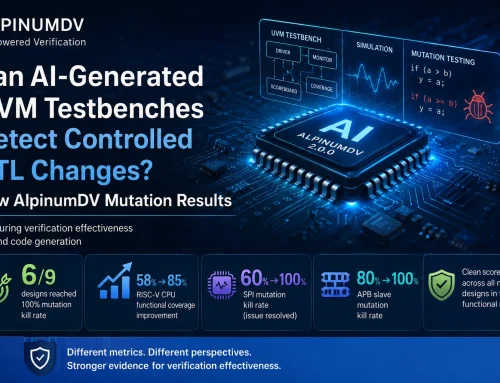
Testbench qualification is therefore increasingly important. Mutation or controlled defect-injection testing asks whether a verification environment actually distinguishes intentionally corrupted RTL from expected behaviour. Alpinum has separately published bounded mutation-testing results for AI-generated UVM environments, while explicitly noting that mutation kill rates are not equivalent to tape-out readiness.
Engineers responsible for reviewing generated environments still need the skills covered by practical SystemVerilog and UVM training.
What AI-Generated Formal Proofs Actually Establish
A formal engine can mathematically establish a property over the behaviours represented by the model under the assumptions and constraints supplied to it. It does not automatically establish that the entire accelerator is correct.
For AI-generated properties, reviewers need to ask:
- Is the property itself correct?
- Is the property set complete enough?
- Are assumptions excluding legal behaviour?
- Are environmental constraints too weak?
- Is a proof vacuous?
- Is the relevant state reachable?
- Was the result bounded or unbounded?
- Which results were inconclusive?
- What abstractions were introduced?
- What does proof coverage show?
- Can every important property be traced to a requirement?
Over-constraint can turn a difficult problem into an apparently easy proof by excluding the behaviour that would expose the defect. Under-constraint can instead create impossible environmental behaviour and noisy counterexamples. Vacuity can allow a property to pass because its triggering condition never happens.
That is why AI-generated formal collateral should undergo independent formal property and proof review. Semiconductor Engineering similarly recommends treating generated properties as drafts and retaining provenance back to the specification.
Specification Quality, Assumptions and Missing Intent
Redwood also highlights a less fashionable problem: AI automation makes specification quality more important, not less.
A specification can describe normal operations thoroughly while omitting reset recovery, simultaneous events, timeout boundaries, illegal opcodes, saturation behaviour, resource exhaustion or error containment. If an autonomous system generates everything downstream from that source, undocumented intent may disappear from every generated artefact simultaneously.
Human ownership should therefore include requirements and acceptance criteria, independent specification review, requirements-to-test traceability and requirements-to-property traceability.
Firmware, Drivers and Hardware,Software Co-Verification
Generating firmware and kernels alongside the RTL has genuine value. Hardware–software mismatches frequently appear around register semantics, ordering, interrupts, descriptor formats, memory visibility and error recovery.
FPGA execution can provide especially useful evidence here because real software is interacting with real programmable hardware. But an AI-created driver and AI-created RTL can suffer from the same common-mode problem. If both share an incorrect interpretation of a register or ordering rule, successful end-to-end execution may still fail to expose it.
Independent software tests, boundary cases, recovery tests and interface traceability therefore remain necessary.
From FPGA Prototype to ASIC Sign-Off
The next stage is where Redwood’s most consequential evidence would emerge.
Before fabricated silicon, an ASIC programme normally needs confidence across logical verification and physical implementation: synthesis, constraints, equivalence, STA, CDC/RDC, power intent, DFT, physical verification, power integrity and release control.
That is why an FPGA demonstration and an ASIC sign-off package answer different questions. Organisations evaluating a similar flow should demand independent pre-silicon verification evidence rather than infer tape-out readiness from successful FPGA execution.
Evidence Engineering Leaders Should Request Before Accepting an AI-Generated Chip for Tape-Out
- Approved requirements baseline
- Requirements-to-design traceability
- Requirements-to-verification traceability
- Independent RTL review
- Static-analysis results
- CDC and RDC results
- Simulation regression evidence
- UVM testbench qualification
- Defect-injection or mutation results
- Formal-property review
- Assumption and constraint review
- Vacuity and reachability results
- Coverage definition and closure rationale
- Independent reference-model evidence
- Equivalence results
- FPGA validation evidence
- Firmware and driver validation
- Physical-design sign-off
- DFT and production-test planning
- Waivers and named residual-risk ownership
- Reproducible logs and evidence package
- Independent final acceptance authority
For AI-generated artefacts, that package should additionally record model versions, prompts or structured inputs where applicable, tool versions, configuration, regeneration history and the exact artefact revision used for sign-off.
What Redwood Means for Verification Engineers
Redwood matters even before ASIC fabrication because it demonstrates how much of the creation side of semiconductor engineering may become automatable.
That shifts the engineering bottleneck. If RTL, tests and properties become cheaper to create, more experienced engineering time may move towards specification quality, testbench qualification, evidence independence, formal assumptions, coverage interpretation, provenance and final acceptance.
AI may accelerate the production of RTL, tests and properties, but engineers still need the SystemVerilog, UVM and formal-verification knowledge required to review those artefacts and decide whether the resulting evidence is credible. The same logic applies to formal verification training for engineering teams: automation increases the value of knowing what a proof does and does not establish.
Alpinum Perspective
Redwood is an important and potentially valuable demonstration. The reported ability to move from a human-written architecture specification to RTL, verification collateral, software and a functioning FPGA implementation on such a compressed schedule deserves technical attention.
The more important lesson, however, is not simply that AI can generate engineering artefacts quickly. Speed of generation is not the same as strength of evidence.
When one system produces both the implementation and the mechanisms used to judge that implementation, internal consistency can be mistaken for independent verification. Strong AI-assisted flows therefore need explicit mechanisms for independent requirements review, reference models, property and constraint review, defect injection, traceability, provenance and accountable sign-off. Fabricated Redwood silicon will provide another important evidence point if and when it arrives. Until then, the FPGA implementation should be valued for what it demonstrates without treating projected ASIC characteristics as measured silicon results.
AI changes how verification work may be performed. It does not remove the need for engineers who can judge design intent, evidence quality and residual risk.
Key Takeaways
- Architect Labs’ two-week design-and-verification timeline is a company-reported result, not an independently reproduced chip-development benchmark.
- Redwood has reached working FPGA hardware, which is important evidence, but the proposed ASIC has not yet been manufactured.
- The reported 1.75× throughput, 1.9× lower power and 3.4× performance-per-watt results are ASIC projections, not measurements from Redwood silicon.
- More than 95% code and functional coverage does not establish 95% correctness or production readiness.
- AI-generated formal proofs remain dependent on property correctness, assumptions, constraints, reachability and completeness.
- The central technical risk is common-mode verification failure when the same AI misunderstanding enters the RTL, reference model, UVM environment, assertions and coverage.
- AI can materially reduce artefact-generation time while leaving independent engineering sign-off essential.
References
[1] Architect Labs, “Introducing Redwood,” 27 August 2026. https://architectlabs.com/
[2] Architect Labs, “Redwood: A Frontier AI Accelerator Designed, Verified, and Deployed from Scratch in 2 Weeks by AI,” arXiv:2608.26418, 26 August 2026. https://arxiv.org/abs/2608.26418
[3] G. Weiss, “The chips powering AI can take years to design. This startup says AI did it in 2 weeks,” Business Insider, 27 August 2026. https://www.businessinsider.com/architect-labs-ai-redwood-chip-design-2026-8
[4] B. Bailey, “From Spec To Formal Properties,” Semiconductor Engineering, 27 August 2026. https://semiengineering.com/from-spec-to-formal-properties/
[5] Accellera Systems Initiative, “Download UVM Standard Universal Verification Methodology.” https://www.accellera.org/downloads/standards/uvm
[6] J. Peddie, “Redwood tests AI-designed silicon,” Jon Peddie Research, 1 September 2026. https://www.jonpeddie.com/techwatch/redwood-tests-ai-designed-silicon/
FAQs
Redwood is an AI inference accelerator developed by Architect Labs. The company says an AI system generated its detailed RTL, verification collateral and software from a high-level specification written by two human architects. Its Redwood Nano implementation currently operates on FPGA hardware.
Architect Labs reports that the work below the human-written high-level specification including RTL, UVM environments, formal proofs, firmware and kernels was generated in under two weeks. The timeline comes from Architect Labs and its company-authored preprint; it has not been independently reproduced as a complete ASIC development flow.
No manufactured Redwood ASIC has been publicly demonstrated as of 3 September 2026. Independent reporting describes the current implementation as FPGA-based and says manufacturing remains a future step.
Architect Labs reports more than 95% code and functional coverage across blocks. That is useful verification evidence, but it does not mean 95% correctness or 95% verification completeness. Assessing closure requires the coverage models, exclusions, goals, waivers, unhit scenarios and requirements traceability
AI can generate UVM agents, sequences, drivers, monitors, scoreboards, coverage and other components. Completeness is a separate question: the generated environment must still be qualified against requirements, negative cases, independent reference behaviour and deliberate defects.
A proof result can be mathematically sound while the property being proved is wrong, incomplete or vacuous. Engineers therefore need to review the properties, assumptions, constraints, proof scope, reachability and requirement traceability.
Teams need evidence spanning requirements, RTL review, static analysis, simulation, testbench qualification, formal verification, coverage closure, reference-model independence, FPGA and software validation, equivalence, physical implementation, DFT, waivers and accountable final sign-off. AI provenance should also be reproducible.

Written by : Mike Bartley
Mike started in software testing in 1988 after completing a PhD in Math, moving to semiconductor Design Verification (DV) in 1994, verifying designs (on Silicon and FPGA) going into commercial and safety-related sectors such as mobile phones, automotive, comms, cloud/data servers, and Artificial Intelligence. Mike built and managed state-of-the-art DV teams inside several companies, specialising in CPU verification.
Mike founded and grew a DV services company to 450+ engineers globally, successfully delivering services and solutions to over 50+ clients.
Mike started Alpinum in April 2016 to deliver a range of start-of-the art industry solutions:
Alpinum AI provides tools and automations using Artificial Intelligence to help companies reduce development costs (by up to 90%!) Alpinum Services provides RTL to GDS VLSI services from nearshore and offshore centres in Vietnam, India, Egypt, Eastern Europe, Mexico and Costa Rica. Alpinum Consulting also provides strategic board level consultancy services, helping companies to grow. Alpinum training department provides self-paced, fully online training in System Verilog, UVM Introduction and Advanced, Formal Verification, DV methodologies for SV, UVM, VHDL and OSVVM and CPU/RISC-V. Alpinum Events organises a number of free-to-attend industry events
You can contact Mike (mike@alpinumconsulting.com or +44 7796 307958) or book a meeting with Mike using Calendly (https://calendly.com/mike-alpinum-consulting).
Stay Informed and Stay Ahead
Latest Articles, Guides and News
Explore related insights from Alpinum that dive deeper into design verification challenges, practical solutions, and expert perspectives from across the global engineering landscape.