
Introduction
On 30 September 2026, OpenAI and Synopsys announced GPT-Synopsys, a specialised AI model intended to operate electronic design automation (EDA) tools and support semiconductor design and verification workflows [1].
The announcement introduces an important development in GPT-Synopsys chip design: moving beyond AI-generated engineering suggestions towards agents that can execute tools, analyse results, modify implementations and repeat design iterations. This creates opportunities for automating engineering tasks. However, it also raises a fundamental verification question: does completing an EDA workflow establish that the resulting design is correct?
The answer is no.
Synthesis can complete successfully while preserving a functional defect. Simulation can pass despite missing a critical operating condition. Formal verification can prove a property under assumptions that exclude the behaviour engineers intended to examine. Consequently, the engineering significance of GPT-Synopsys extends beyond automated tool operation. Semiconductor teams must determine how to validate generated artefacts, maintain independent verification evidence and preserve accountable sign-off decisions.
What Did OpenAI and Synopsys Announce About GPT-Synopsys?
The official announcement describes a multi-year partnership to develop GPT-Synopsys, combining OpenAI’s AI models with Synopsys EDA technology and semiconductor engineering expertise. OpenAI will license Synopsys EDA tools for model development. The companies intend to create a specialised system that can reason about semiconductor design and verification tasks while operating engineering tools directly [1].
The announced development direction includes agents that execute tools, interpret analysis reports, modify designs and iterate towards engineering objectives such as power, performance and area (PPA) optimisation. Synopsys also states that GPT-Synopsys will run on OpenAI-hosted infrastructure, integrate with Synopsys.ai and Synopsys Autopilot, and interoperate with customer agent systems. Early technology engagements with semiconductor customers are underway.
What Remains Undemonstrated?
The announcement establishes the intended capabilities, but it does not provide independent technical evidence that GPT-Synopsys can achieve complete verification closure or autonomous silicon sign-off. In particular, it does not publish independently assessed results covering defect-detection completeness, systematic requirements coverage or production sign-off effectiveness. Furthermore, the announcement does not establish general availability across complete semiconductor design programmes.
Engineering leaders should therefore distinguish between three stages: announced capability, demonstrated workflow performance and qualified production use. That distinction matters because successful automation does not itself demonstrate verification correctness. For wider context on integrating agents into engineering organisations, see Alpinum’s analysis of AI agents in production chip teams.
Why GPT-Synopsys Chip Design Workflows Must Separate Tool Execution from Correctness
EDA tools evaluate designs against supplied models, constraints and verification objectives. Their outputs are meaningful only within those conditions. An AI agent might modify RTL, launch synthesis, analyse timing and report an improvement in critical-path delay. However, that improvement does not establish that the revised implementation preserves its original functional behaviour.
For example, an optimisation might change a pipeline-control condition, alter reset sequencing or introduce a protocol violation that the available regression does not exercise. Likewise, an AI agent could run formal verification successfully while using overly restrictive environmental assumptions. The tool result might be valid, but the engineering conclusion could still be wrong.
Therefore, engineers must distinguish three outcomes:
- Tool execution: The requested EDA operation completed.
- Verification result: A defined test or property passed under specific conditions.
- Engineering acceptance: The evidence adequately supports the applicable design requirements.
These outcomes are related, but they are not interchangeable.
AI-Driven EDA Execution Versus Independent Verification
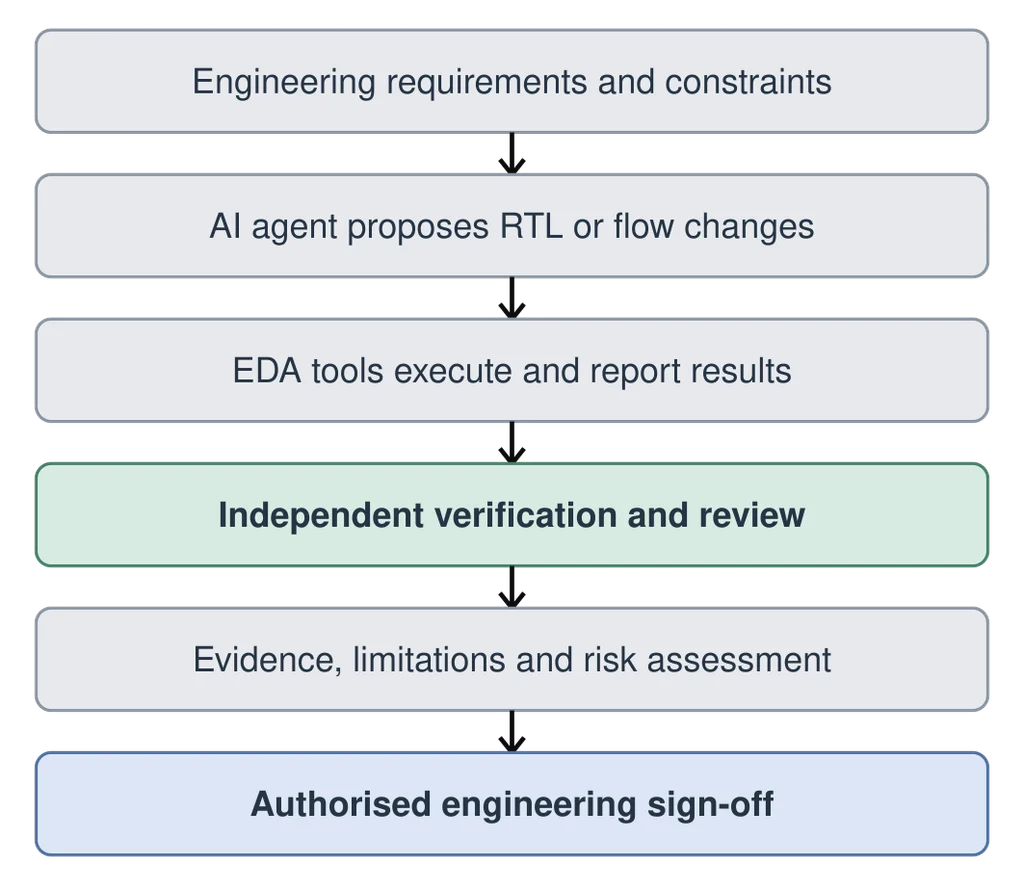
Figure 1 illustrates the separation between an automated EDA workflow and the engineering process that evaluates its results.
An AI agent can modify RTL, execute EDA tools and interpret reports. Independent verification checks the resulting implementation against requirements before authorised engineering sign-off.
The central requirement is to retain a controlled relationship between each design revision, the constraints used and the evidence generated.
Engineering Example: When AI-Assisted EDA Optimisation Passes but RTL Behaviour Changes
Consider a hypothetical GPT-Synopsys-assisted workflow involving an AXI-based DMA controller. An engineering team asks an AI agent to optimise implementation timing without changing the controller’s functional behaviour. The agent modifies RTL, executes synthesis and timing analysis, and reports improved timing under the configured constraints. It then runs the existing simulation regression, which completes successfully.
However, the modified RTL contains a protocol error. Under a particular backpressure condition, the controller changes its write-address value while AWVALID remains asserted and AWREADY remains deasserted. This violates the AXI requirement to keep the relevant transfer information stable while the receiving interface has not accepted the transfer [2].
The original regression does not detect the problem because its stimulus rarely exercises prolonged backpressure during the affected controller state. The synthesis and timing results may remain valid for the analysed implementation. Nevertheless, they do not establish protocol correctness.
Detecting the Defect with SystemVerilog Assertions
An independent verification engineer can introduce an assertion to check whether the write address remains stable during a stalled transfer.
The following example illustrates the relevant property:
property p_axi_address_stable;
@(posedge ACLK)
disable iff (!ARESETn)
(M_AXI_AWVALID && !M_AXI_AWREADY)
|=> M_AXI_AWVALID &&
$stable(M_AXI_AWADDR);
endproperty
assert property (p_axi_address_stable);
The property checks that a stalled AXI write-address transfer retains both AWVALID and the address value at the following clock edge. It does not represent a complete AXI protocol checker. A production environment must also validate the remaining applicable payload signals, legal channel behaviour and reset conditions. Formal verification can examine this property across permitted input sequences, provided the assumptions do not exclude the problematic backpressure condition. Alternatively, a UVM regression can apply sustained backpressure and use an independent protocol monitor to identify the violation. Both approaches demonstrate why the completeness of the verification environment matters as much as successful tool execution.
This is an illustrative engineering scenario, not a reported GPT-Synopsys product failure.
Why AI-Generated RTL and Verification Artefacts Require Independent Review
AI-generated RTL can contain familiar design errors, including incorrect state transitions, width mismatches, invalid reset behaviour and incomplete protocol handling. However, AI-assisted verification introduces an additional concern: common-mode errors. Suppose the same AI model generates both an RTL implementation and its verification scoreboard from an incomplete interpretation of a specification. The implementation and scoreboard may agree even though both violate the original requirement.
Consequently, simulation can report success without demonstrating the intended behaviour. A similar problem arises when an agent generates constrained-random stimulus and functional coverage from the same incomplete requirements. The testbench may never generate a relevant corner case, while the coverage model also omits that condition. Therefore, independent verification should assess not only the generated RTL but also the stimulus constraints, reference models, assertions and coverage objectives.
Common-Mode Errors in AI-Generated Design and Verification
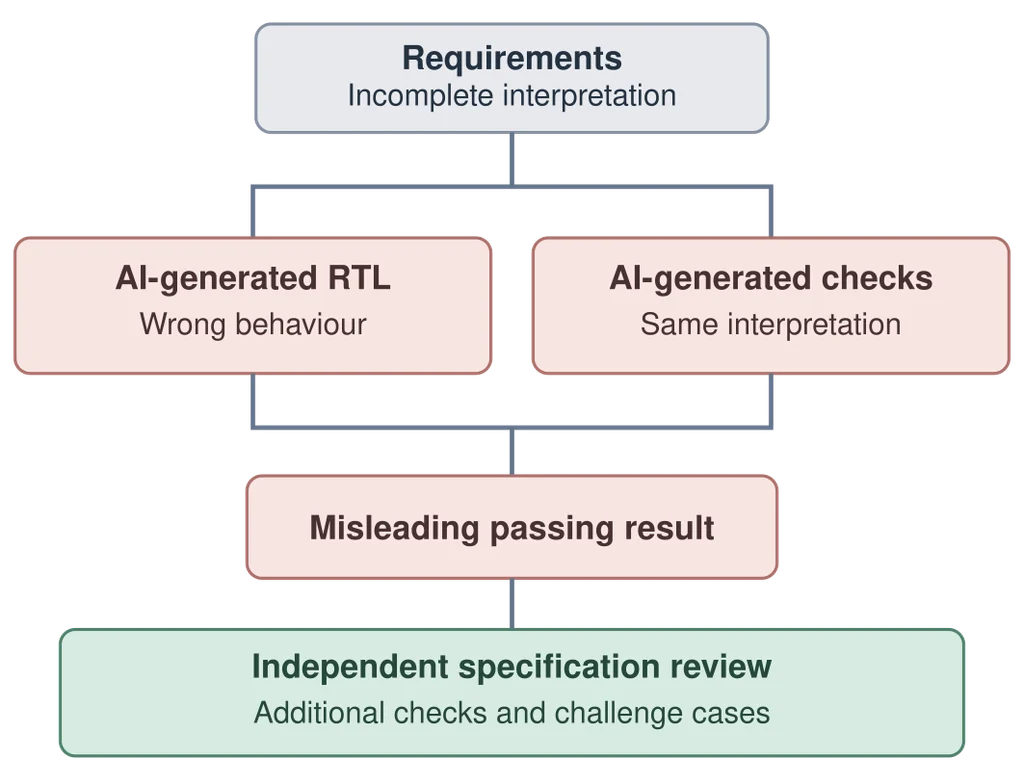
Figure 2 shows how an incorrect requirement interpretation can influence both the generated implementation and the checker.
When AI-generated RTL and verification artefacts share an incorrect assumption, their agreement may produce misleading passing results. Independent specification review and complementary checks reduce this risk.
Independence does not require every artefact to be written manually. Instead, engineers must establish that relevant checks do not merely reproduce the same underlying interpretation.
This principle is central to AI-assisted verification and engineering intent.
Verification Sign-Off in GPT-Synopsys-Assisted EDA Workflows
Verification sign-off becomes more complex when an AI agent can modify RTL, launch EDA tools and interpret the resulting reports.Each automated iteration must preserve an auditable connection between the design revision, verification configuration, tool results and engineering requirements.
For example, an AI agent might modify RTL, execute a regression and report that all tests pass. However, that result does not establish whether the agent changed verification constraints, excluded failing scenarios or weakened assertions during the same iteration. Engineering teams should therefore separate design modification privileges from verification acceptance criteria.
They should preserve controlled baselines, track changes to assumptions and constraints, and independently review the evidence supporting each proposed design revision. At minimum, an engineering evidence record should identify the RTL revision, tool and verification-environment versions, relevant configurations, constraints, random seeds where applicable, test results and outstanding exceptions. Formal proof results also require interpretation. A property can pass under assumptions that exclude relevant behaviour, while simulation coverage can appear satisfactory despite an omitted requirement.
Furthermore, an AI-generated summary must not replace original logs, proof results, coverage databases or reviewable change records.
Evidence-Based Verification Sign-Off
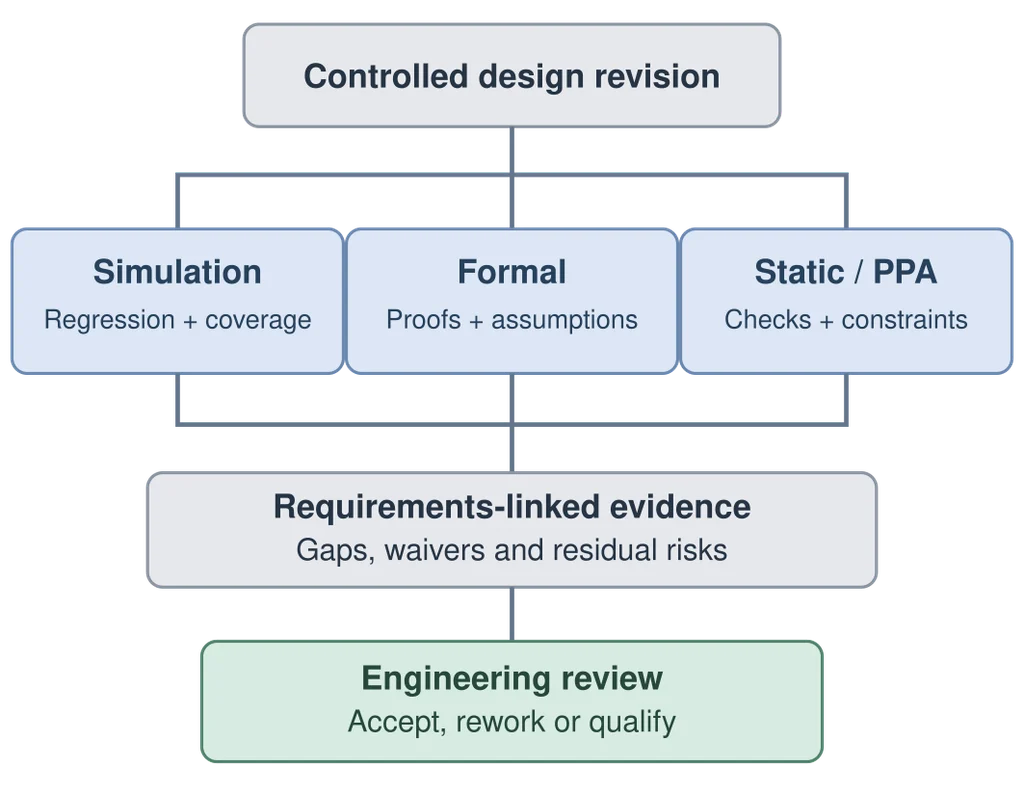
Figure 3 illustrates how engineering teams can combine multiple verification methods into a traceable sign-off process.
A controlled design revision undergoes simulation, formal verification and relevant static or implementation analysis. Engineers then review requirements-linked evidence, unresolved gaps and residual risks before accepting the design.
The figure emphasises that verification closure is a decision supported by evidence, not simply an automated status reported by an agent.
Why SystemVerilog, UVM and Formal Verification Expertise Still Matter
AI-assisted EDA workflows may change how engineers create and execute verification artefacts. However, they do not eliminate the expertise required to judge whether those artefacts are correct. SystemVerilog knowledge remains essential for understanding RTL semantics, assertions, randomisation constraints and the difference between simulation and synthesis behaviour. UVM expertise remains important because effective verification environments require correctly implemented stimulus generation, protocol monitors, reference models, scoreboards and functional coverage.
IEEE 1800.2 provides a standardised basis for reusable UVM verification environments [3]. Formal verification expertise is equally important when AI generates assertions or selects environmental assumptions. Engineers must distinguish a meaningful proof from a vacuous result, an unreachable scenario or a property that passes only because its assumptions exclude a relevant failure. The broader challenge is not simply generating more verification artefacts. It is establishing whether those artefacts meaningfully support the requirements.
For engineers developing these capabilities, Alpinum’s SystemVerilog and UVM training programme provides additional technical context.
What Should Semiconductor Teams Evaluate Before Using AI-Assisted EDA Workflows?
Engineering teams considering GPT-Synopsys or comparable AI-assisted workflows should begin with bounded activities and established verification baselines. A suitable evaluation could use an IP block with an existing specification, controlled RTL revision and independently maintained verification environment. The team could then compare AI-assisted design iterations against the baseline using simulation, formal properties and implementation analysis.
The evaluation should examine defect detection, review effort, coverage stability, reproducibility and changes to constraints or assumptions. It should also establish which operations require explicit engineering approval. For instance, teams may permit an agent to launch a regression while preventing it from independently modifying sign-off requirements or accepting verification waivers. Data governance also matters. Synopsys describes planned enterprise controls for GPT-Synopsys, including encryption, permissions, audit capabilities and restrictions on customer-data training [1].
Nevertheless, each organisation must evaluate those controls against its own design confidentiality, security and contractual requirements. The objective is to determine whether AI-assisted workflows produce verifiable engineering value without weakening the evidence required for acceptance.
How AlpinumDV Fits into AI-Assisted Verification
GPT-Synopsys is intended to support AI-driven semiconductor design and EDA execution. AlpinumDV 2.0.0 addresses a related but different engineering task: generating, executing and evaluating UVM verification environments from specifications and RTL.
AlpinumDV supports test planning, reference-model generation, SystemVerilog assertions, simulation, functional coverage and defect analysis. Its published evaluation also uses mutation testing to examine whether generated verification environments detect controlled RTL changes.
These activities provide useful verification evidence, but they do not independently establish complete design correctness. AI-generated reference models, assumptions and coverage objectives still require assessment against the original requirements.
Engineers can explore AlpinumDV and the Online Submission Portal for examples of structured verification workflows and tool-supported exercises.
Conclusion: GPT-Synopsys Does Not Remove the Need for Engineering Sign-Off
The OpenAI and Synopsys announcement represents an important proposed development in AI-assisted semiconductor engineering. Its intended capabilities extend from suggesting design changes towards directly operating EDA tools, interpreting results and iterating on design objectives. However, an AI agent’s ability to execute a workflow does not establish that the resulting implementation satisfies its requirements.
AI-generated RTL, verification environments, formal properties and engineering reports still require independent assessment. Furthermore, semiconductor teams must preserve reproducibility, traceability, requirements coverage and accountable sign-off decisions. The essential engineering question is therefore not how many EDA activities an AI agent can complete. It is whether the resulting evidence provides sufficient confidence to accept the design.
Further Technical Reading
AI-assisted EDA workflows increase the importance of engineering evidence, verification methods and controlled tool integration.
Readers seeking additional technical context can explore Alpinum’s AI in Design Verification, SystemVerilog and UVM Training and Formal Verification Training pages.
References
[1] Synopsys, Inc., 30 September 2026. https://investor.synopsys.com/news/news-details/2026/OpenAI-and-Synopsys-Announce-GPT-Synopsys-Frontier-Intelligence-to-Revolutionize-Chip-Design/default.aspx
[2] Arm Limited, Protocol requirements for VALID/READY handshakes and transfer stability. https://developer.arm.com/documentation/ihi0022/latest/
[3] Accellera Systems Initiative, https://accellera.org/downloads/standards/uvm
FAQs
GPT-Synopsys is a specialised AI model announced by OpenAI and Synopsys on 30 September 2026. It is being developed to operate Synopsys EDA tools and assist with semiconductor design and verification workflows. The announcement describes intended capabilities rather than independently demonstrated autonomous silicon sign-off.
An AI-assisted workflow can execute verification tools and analyse their results. However, correct execution does not establish complete functional correctness. Engineers must assess whether the verification environment covers relevant requirements, corner cases and assumptions.
AI-generated RTL may contain functional defects or incorrect interpretations of design requirements. If the same AI system generates both the RTL and its checker, both can share an error. Independent verification helps identify these common-mode failures.
EDA automation performs tool operations such as simulation, synthesis and formal analysis. Verification sign-off determines whether the resulting evidence adequately supports the specified design behaviour, taking account of coverage gaps, assumptions and residual risks.
Formal verification can identify violations of specified properties and, where applicable, prove properties under defined assumptions. However, engineers must validate the properties, assumptions and proof results. A proof cannot establish requirements that the verification model does not express.
AI may automate portions of testbench generation, regression execution and results analysis. However, engineers still need SystemVerilog, UVM and formal-verification knowledge to evaluate design semantics, check verification quality and make sign-off decisions.
Key risks include incorrect requirement interpretations, common-mode errors, insufficient verification coverage, over-constrained formal environments, uncontrolled design changes and misleading generated reports.
Teams should retain controlled design revisions, configuration records, simulation and formal results, coverage information, reviewed constraints, defect status and documented exceptions. These records support independent review and reproducibility.

Written by : Mike Bartley
Mike started in software testing in 1988 after completing a PhD in Math, moving to semiconductor Design Verification (DV) in 1994, verifying designs (on Silicon and FPGA) going into commercial and safety-related sectors such as mobile phones, automotive, comms, cloud/data servers, and Artificial Intelligence. Mike built and managed state-of-the-art DV teams inside several companies, specialising in CPU verification.
Mike founded and grew a DV services company to 450+ engineers globally, successfully delivering services and solutions to over 50+ clients.
Mike started Alpinum in April 2016 to deliver a range of start-of-the art industry solutions:
Alpinum AI provides tools and automations using Artificial Intelligence to help companies reduce development costs (by up to 90%!) Alpinum Services provides RTL to GDS VLSI services from nearshore and offshore centres in Vietnam, India, Egypt, Eastern Europe, Mexico and Costa Rica. Alpinum Consulting also provides strategic board level consultancy services, helping companies to grow. Alpinum training department provides self-paced, fully online training in System Verilog, UVM Introduction and Advanced, Formal Verification, DV methodologies for SV, UVM, VHDL and OSVVM and CPU/RISC-V. Alpinum Events organises a number of free-to-attend industry events
You can contact Mike (mike@alpinumconsulting.com or +44 7796 307958) or book a meeting with Mike using Calendly (https://calendly.com/mike-alpinum-consulting).
Stay Informed and Stay Ahead
Latest Articles, Guides and News
Explore related insights from Alpinum that dive deeper into design verification challenges, practical solutions, and expert perspectives from across the global engineering landscape.