
Cadence has expanded its ChipStack AI Super Agent with an RTL Generation Agent that moves agentic AI further into front-end digital design. Announced on 22 September 2026, the new capability covers power, performance and area (PPA)-driven specification-to-RTL generation, RTL analysis and refinement through natural-language prompts. Cadence says the workflow builds on the ChipStack platform it introduced earlier in 2026 and extends autonomous verification and debug into RTL creation and optimisation [1], [2].
The immediate headline is faster RTL development. The more important engineering question is what happens to verification when an AI agent can interpret requirements, create or modify RTL, invoke EDA tools and iterate against PPA goals. The answer is not that verification becomes less important. It is that requirements traceability, independent checking, coverage, formal reasoning, change analysis and accountable sign-off become more valuable because generation speed and verification evidence are different things.
| Quick answer: What does AI-generated RTL change for verification? AI-generated RTL can compress the path from specification to implementation, but it does not remove the need for independent evidence. Teams still need to show that generated or modified RTL matches approved intent, behaves correctly under realistic and corner-case conditions, satisfies structural and implementation constraints, and meets explicit sign-off criteria. Agentic EDA therefore increases the value of traceability, UVM-based simulation, assertions and formal analysis, coverage, equivalence or change checking, and engineering review. |
What Cadence Announced
Cadence describes the RTL Generation Agent as a new capability within ChipStack AI Super Agent for front-end digital design and verification. According to the company, the agent converts high-level specifications into RTL, analyses and refines existing RTL, and uses established EDA technologies to optimise PPA. It can also support RTL updates when architecture, functional or PPA requirements change [1].
The announcement matters because it connects code generation to a broader agentic workflow rather than treating RTL creation as an isolated large-language-model task. Cadence’s product material describes ChipStack as coordinating specialised agents across RTL generation, testbench creation, regression orchestration and debug, while maintaining shared design context and using trusted EDA tools [3].
- Spec-to-RTL generation: translating high-level design intent into synthesizable RTL under PPA goals.
- RTL refinement and upgrade: modifying existing RTL when requirements or PPA targets change.
- Tool-connected evaluation: using implementation and verification engines to measure the consequences of generated changes rather than relying only on model output.
Cadence says the expanded ChipStack and InnoStack capabilities are expected to be available to select early-access customers in the fourth quarter of 2026 [1].
How Should Engineers Interpret the Reported Early Results?
Cadence reports that early evaluations of the RTL Generation Agent produced an average 24% area reduction and 18% power reduction compared with pure foundation-model code generation while maintaining what the company describes as 100% functional accuracy [1]. These are significant vendor-reported results, but they should be interpreted within the scope of the published evaluation rather than as a universal statement about AI-generated RTL.
The public announcement does not disclose every evaluated block, verification plan, coverage target, assumption or sign-off criterion. “Functional accuracy” in an early evaluation is therefore not equivalent to saying that arbitrary generated RTL is automatically ready for tape-out. Production readiness can also depend on reset and clock-domain behaviour, low-power intent, structural checks, timing, security, safety, software interaction and system-level behaviour. The useful signal is that agentic flows are increasingly coupling generation with trusted engineering engines instead of treating a language model as the final authority.
Why Agentic Spec-to-RTL Moves the Verification Boundary Upstream
In a conventional flow, engineers interpret requirements, define microarchitecture, write RTL, review it and progressively build verification evidence. An agentic workflow can compress parts of that sequence by interpreting a natural-language objective, producing RTL, executing engineering tools, analysing results and refining the design. That can accelerate iteration, but it also creates a new dependency on how faithfully the workflow preserves the original design intent.
This is why requirements traceability remains central. Alpinum’s verification-planning guidance makes the same underlying point: coverage only becomes meaningful when it maps back to real requirements and verification intent. If an AI agent misinterprets an ambiguous requirement and then generates both the implementation and the checks from the same interpretation, internally consistent evidence can still validate the wrong behaviour.
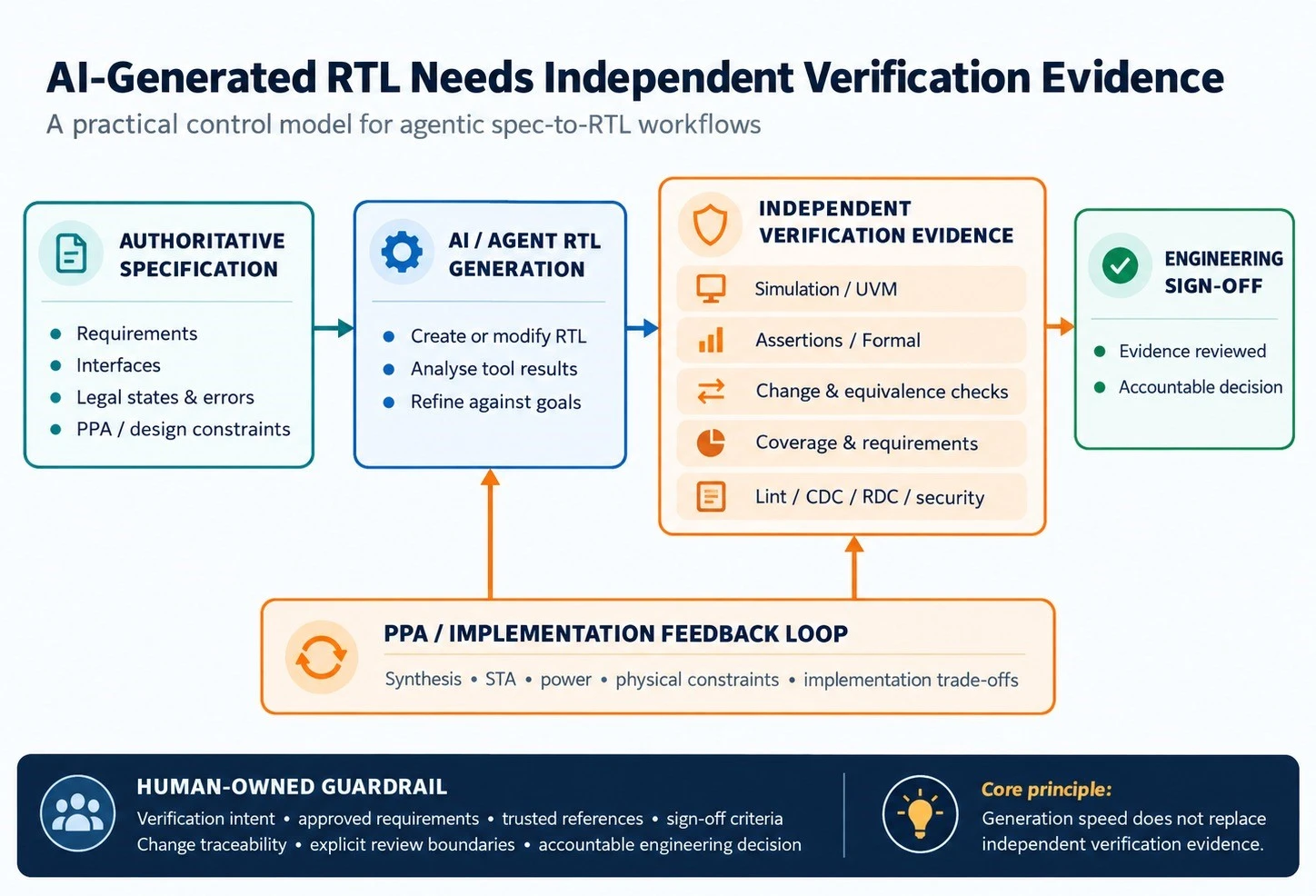
Figure 1. A practical control model for agentic spec-to-RTL: authoritative requirements feed generation, while independent verification evidence and PPA feedback support an accountable engineering sign-off decision. Source: Alpinum analysis.
What Still Needs Independent Verification When an Agent Writes the RTL?
A credible workflow needs evidence that is not reducible to “the agent ran successfully”. The exact mix depends on the design, but verification teams should be able to explain which evidence supports each critical requirement and which assumptions remain open. UVM remains a standard foundation for reusable simulation-based verification environments, while formal, static and implementation checks provide different forms of evidence [6].
| Evidence layer | Question to answer | Typical techniques |
| Requirement traceability | Does the generated behaviour correspond to approved intent? | Requirement mapping, review, reference behaviour |
| Dynamic verification | Does the design behave correctly under realistic and stressed scenarios? | UVM, constrained-random, regressions, scoreboards |
| Property-based evidence | Do critical invariants hold within the formal model and its assumptions? | Assertions, property checking, formal apps |
| Change control | Did an AI modification alter anything outside the requested scope? | Equivalence, targeted regression, impact analysis |
| Coverage | Which intended behaviours have evidence, and what remains open? | Functional coverage, assertion coverage, requirements closure |
| Structural / integration | Are clock, reset, structural and security risks controlled? | Lint, CDC/RDC, security checks, interface rules |
| Implementation / PPA | Do generated changes still satisfy implementation constraints? | Synthesis, STA, power analysis, physical feedback |
Why an Agent Should Not Be Its Own Only Judge
Agentic EDA introduces a subtle methodological risk when the same interpretation of a requirement drives implementation, test generation and result interpretation. A generated design can pass generated tests while still diverging from the approved specification if the original interpretation was wrong. The solution is not to ban automation; it is to anchor automated work to independent sources of truth.
Useful anchors include approved specifications, architectural reference models, protocol standards, human-reviewed assertions, independently defined coverage goals and sign-off criteria that are not silently rewritten by the same agent that changes the RTL. This is consistent with the wider industry direction. Siemens, for example, describes self-verifying EDA agents whose decisions are continuously checked against deterministic, physics-based EDA engines rather than accepted from the AI layer alone [4].
For teams assessing where this boundary should sit, Alpinum’s AI in Design Verification: Where It Helps, Where It Hurts, and How to Pilot Safely provides a broader adoption framework centred on bounded use cases, traceability and explicit human sign-off.
AI-Generated Changes Make Regression and Equivalence Strategy More Important
Cadence’s announcement is particularly interesting because the agent is not limited to creating new RTL; it can also update existing RTL when requirements or PPA targets change [1]. That makes change-aware verification essential. The engineering question is no longer only “does the new version work?” but also “what changed, why did it change, and what behaviour must remain invariant?”
Consider an agent that modifies arbitration logic to improve throughput. The intended performance objective may be achieved, but verification still needs to check priority rules, starvation limits, ordering behaviour, reset recovery, error handling and any software-visible side effects. Depending on the transformation, teams may use targeted regression, assertions, property checking or equivalence techniques to establish that unrelated behaviour was preserved.
This is where formal verification services can complement simulation. Formal methods can prove or refute selected properties within a defined model and its assumptions, making them useful for control-heavy behaviours such as arbitration, protocol compliance, security policy, deadlock freedom and forward progress.
Coverage Still Measures Evidence, Not Activity
AI can generate more tests, more assertions and more candidate fixes. That does not make test count, assertion count or raw coverage percentage equivalent to sign-off confidence. Coverage is useful when it is connected to verification intent: which requirement is represented, which behaviour has been exercised or proven, which risk has been reduced, and which meaningful gaps remain.
This distinction is especially important in agentic workflows because automated systems can create large volumes of artefacts quickly. A mature team should resist the temptation to equate more generated activity with stronger verification. The better question is whether the additional artefacts improve the quality and completeness of evidence.
Alpinum’s AI-driven chip design skills guide reaches the same conclusion from a lifecycle perspective: AI-assisted design still depends on requirements clarity, verification discipline, implementation awareness and accountable tape-out decisions.
What the Honda Evaluation Signals for Automotive SoCs
Cadence says Honda R&D is evaluating the RTL Generation Agent on advanced automotive SoCs, where the combination of tight power and cost envelopes, software-defined vehicle development and safety-critical requirements creates strong pressure to improve productivity [1]. The significance is not that automotive verification can be automated away. It is that faster design iteration will need an assurance process capable of keeping up.
For safety-relevant designs, teams may need to demonstrate traceability from requirements to implementation and verification evidence, controlled change review, repeatable tool execution and clear human ownership of release decisions. AI can accelerate exploration and implementation, but assurance depends on what can be reviewed, reproduced and defended.
Agentic EDA Is Becoming an Industry Direction, Not a Single-Vendor Experiment
Cadence is one part of a broader shift. Siemens has described long-running self-verifying EDA agents that orchestrate multi-tool workflows while validating decisions against deterministic engineering engines [4]. On 23 September 2026, Synopsys and TSMC announced work on agentic AI workflows across analog, digital and multi-die design alongside A14, CoWoS and advanced IP enablement [5].
The shared direction is more important than any individual product claim: AI is moving from point assistance into workflow orchestration. That means design and verification organisations need an explicit answer to three questions: what may the agent change, what trusted tools or references must check that change, and who owns the final engineering decision?
Alpinum’s recent Agentic AI in Design Verification article covers this broader multi-step verification trend. This Cadence-focused article intentionally takes a narrower search and engineering intent: spec-to-RTL generation, AI-generated RTL verification and sign-off evidence.
What Verification Leaders Should Do Before Adopting AI RTL Generation
The right adoption plan is not to begin with a target such as “automate RTL”. Start by defining the control boundaries around one workflow and deciding what evidence an engineer must see before accepting an AI-generated change. A useful first review should cover:
- Authoritative input: identify the specification, constraints and reference behaviour that the agent may use, and define how ambiguous requirements are escalated.
- Independent checks: decide which UVM regressions, assertions, formal properties, equivalence checks and implementation analyses must run after generated changes.
- Change traceability: retain enough information to reproduce what the agent changed, which tool results drove the change and which version was reviewed.
- Coverage and closure: connect generated tests and properties to requirements rather than treating additional artefacts as automatic evidence.
- Human sign-off: document which decisions remain accountable engineering decisions even when the underlying analysis is largely automated.
This approach makes productivity measurable without weakening sign-off. It also gives teams a way to compare agentic workflows fairly: not only by how much RTL they generate, but by how quickly they produce reviewable, traceable and defensible engineering evidence.
Alpinum Perspective: From Faster Generation to Stronger Evidence
Alpinum’s AI in Design Verification services are built around the same principle: AI should accelerate engineering work without obscuring verification intent, traceability or sign-off responsibility. The objective is not full automation for its own sake; it is a shorter, more controlled path from specification to evidence.
The Alpinum Tools hub includes AlpinumDV, which turns design specifications and RTL into structured verification artefacts such as test plans, coverage models, assertions, reference models and UVM components before running simulation and supporting coverage closure. For teams that need to strengthen the underlying methodology, Alpinum also provides Design Verification for SystemVerilog/UVM Training and formal verification services.
Cadence’s latest ChipStack development is therefore best read as a signal about where semiconductor workflows are heading. As AI moves deeper into implementation, verification teams need to make independent evidence easier to generate, easier to review and harder to bypass.
References
[1] Cadence Design Systems, Inc., “Cadence Expands ChipStack AI Super Agent with a New Agent for RTL Generation and Early PPA Optimization,” Cadence Newsroom, Sep. 22, 2026. [Online]. Available: https://newsroom.cadence.com/press-releases/press-release-details/2026/Cadence-Expands-ChipStack-AI-Super-Agent-with-a-New-Agent-for-RTL-Generation-and-Early-PPA-Optimization/default.aspx
[2] Cadence Design Systems, Inc., “Cadence Unleashes ChipStack AI Super Agent, Pioneering a New Frontier in Chip Design and Verification,” Cadence Newsroom, Feb. 17, 2026. [Online]. Available: https://www.cadence.com/en_US/home/company/newsroom/press-releases/pr/2026/cadence-unleashes-chipstack-ai-super-agent-pioneering-a-new.html.html
[3] Cadence Design Systems, Inc., “Cadence ChipStack AI Super Agent,” Product brief, 2026. [Online]. Available: https://www.cadence.com/en_US/home/resources/product-briefs/cadence-chipstack-ai-super-agent-pb.html
[4] E.-J. Crozier, “Self-verifying, long-running EDA AI agents that engineers can trust,” Siemens EDA, Jul. 29, 2026. [Online]. Available: https://blogs.sw.siemens.com/cicv/2026/07/29/self-verifying-eda-ai-agents/
[5] Synopsys, Inc., “Synopsys and TSMC Partner to Accelerate AI Systems Innovation with Agentic AI and Advanced Design,” Synopsys Newsroom, Sep. 23, 2026. [Online]. Available: https://news.synopsys.com/2026-09-23-Synopsys-and-TSMC-Partner-to-Accelerate-AI-Systems-Innovation-with-Agentic-AI-and-Advanced-Design
[6] Accellera Systems Initiative, “Universal Verification Methodology (UVM),” Accellera Standards, accessed Sep. 25, 2026. [Online]. Available: https://accellera.org/downloads/standards/uvm
FAQs
It is a new agent within Cadence ChipStack AI Super Agent that supports PPA-driven spec-to-RTL generation, RTL analysis, refinement and updates using natural-language prompts. Cadence announced it on 22 September 2026 [1].
Cadence says the agent can convert high-level specifications into RTL and can revise existing RTL when architecture, functional or PPA requirements change. Engineers still need appropriate verification and sign-off evidence before relying on generated implementations [1].
No general conclusion like that can be drawn from the public announcement. Cadence reports 100% functional accuracy in its early evaluations, but production sign-off can require additional functional, structural, formal, timing, power, security, safety and system-level evidence [1].
A coding assistant usually responds to a bounded request. An agentic workflow can pursue a broader engineering objective by planning tasks, invoking tools, analysing results and deciding which permitted action should happen next.
Formal verification can prove or refute selected properties within a defined model and its assumptions. That makes it useful for control, ordering, protocol, security and forward-progress behaviours that may be difficult to explore thoroughly with simulation alone.
The near-term shift is more likely to be in task allocation. Faster RTL generation can increase the volume and frequency of designs and changes that need verification, making requirements reasoning, verification planning, formal skills, coverage interpretation and sign-off judgement more important.

Written by : Mike Bartley
Mike started in software testing in 1988 after completing a PhD in Math, moving to semiconductor Design Verification (DV) in 1994, verifying designs (on Silicon and FPGA) going into commercial and safety-related sectors such as mobile phones, automotive, comms, cloud/data servers, and Artificial Intelligence. Mike built and managed state-of-the-art DV teams inside several companies, specialising in CPU verification.
Mike founded and grew a DV services company to 450+ engineers globally, successfully delivering services and solutions to over 50+ clients.
Mike started Alpinum in April 2016 to deliver a range of start-of-the art industry solutions:
Alpinum AI provides tools and automations using Artificial Intelligence to help companies reduce development costs (by up to 90%!) Alpinum Services provides RTL to GDS VLSI services from nearshore and offshore centres in Vietnam, India, Egypt, Eastern Europe, Mexico and Costa Rica. Alpinum Consulting also provides strategic board level consultancy services, helping companies to grow. Alpinum training department provides self-paced, fully online training in System Verilog, UVM Introduction and Advanced, Formal Verification, DV methodologies for SV, UVM, VHDL and OSVVM and CPU/RISC-V. Alpinum Events organises a number of free-to-attend industry events
You can contact Mike (mike@alpinumconsulting.com or +44 7796 307958) or book a meeting with Mike using Calendly (https://calendly.com/mike-alpinum-consulting).
Stay Informed and Stay Ahead
Latest Articles, Guides and News
Explore related insights from Alpinum that dive deeper into design verification challenges, practical solutions, and expert perspectives from across the global engineering landscape.