Alpinum provides industry-leading AI-driven design verification (DV) services, powered by a specialised team of verification engineers with deep expertise in UVM/SystemVerilog and agentic AI development. We bridge the gap between traditional hardware engineering and cutting-edge artificial intelligence, delivering both production-grade engineering support and comprehensive technical training.
Our methodology leverages four core AI pillars for RTL and DV optimisation:
- Generative AI: For automated code and testbench synthesis.
- Machine Learning: For predictive analytics and pattern recognition in complex designs.
- Reinforcement Learning: For autonomous coverage steering and dynamic environment optimization.
- Genetic Algorithms: For sophisticated corner-case mutation and architectural exploration.
AI in DV Services and Engineering Support
Featured AI in DV Technical Projects
Alpinum AI in DV Tools
Alpinum’s AI in DV services are supported by a growing set of practical AI-assisted verification tools. These tools are designed to help engineering teams explore targeted simulation, requirements-to-assertion workflows, coverage improvement and AI-assisted debug within controlled engineering environments.
AlpinumDV is being prepared as an end-to-end AI design verification tool for targeted simulation, rapid feedback, coverage support and failure triage.
SVA-to-Req Mapping AI supports bidirectional translation between natural language requirements and SystemVerilog Assertions, helping teams bridge engineering intent and formal verification code.
These tools are positioned separately from Alpinum’s consulting services and are part of the wider Alpinum Tools roadmap.
EDA & AI Engineering Expertise
Alpinum maintains a deep technical stack across industry-standard EDA tools and LLM engineering frameworks:
- EDA Simulation: Expert-level proficiency in Synopsys VCS, Cadence Xcelium, and Siemens QuestaSim, integrated via unified automation for simulation and coverage.
- AI & LLM Tooling: Advanced implementation of MooresLab AI, Anthropic API (Claude Code), and customized local LLMs for secure, on-premise deployment.
- Automated Pipelines: Python-based RAG pipelines and LangChain integration for intelligent spec ingestion and self-correcting code generation.
Together, these capabilities let Alpinum support real-world AI-driven design verification, from spec ingestion through to compiled, simulated, and self-correcting UVM testbenches.
Applying the “AI in DV” maturity model in practice
The maturity model is most effective when applied within real engineering environments. It evaluates current AI usage, verification capabilities, and workflow-level opportunities for improvement. This creates a clear baseline for decision-making and avoids premature tool selection. In practice, this is supported by a focused capability assessment conducted with engineering teams. Structured input and targeted discussions are used to understand workflows, constraints, and priorities.
What to look for in an “AI in DV” approach
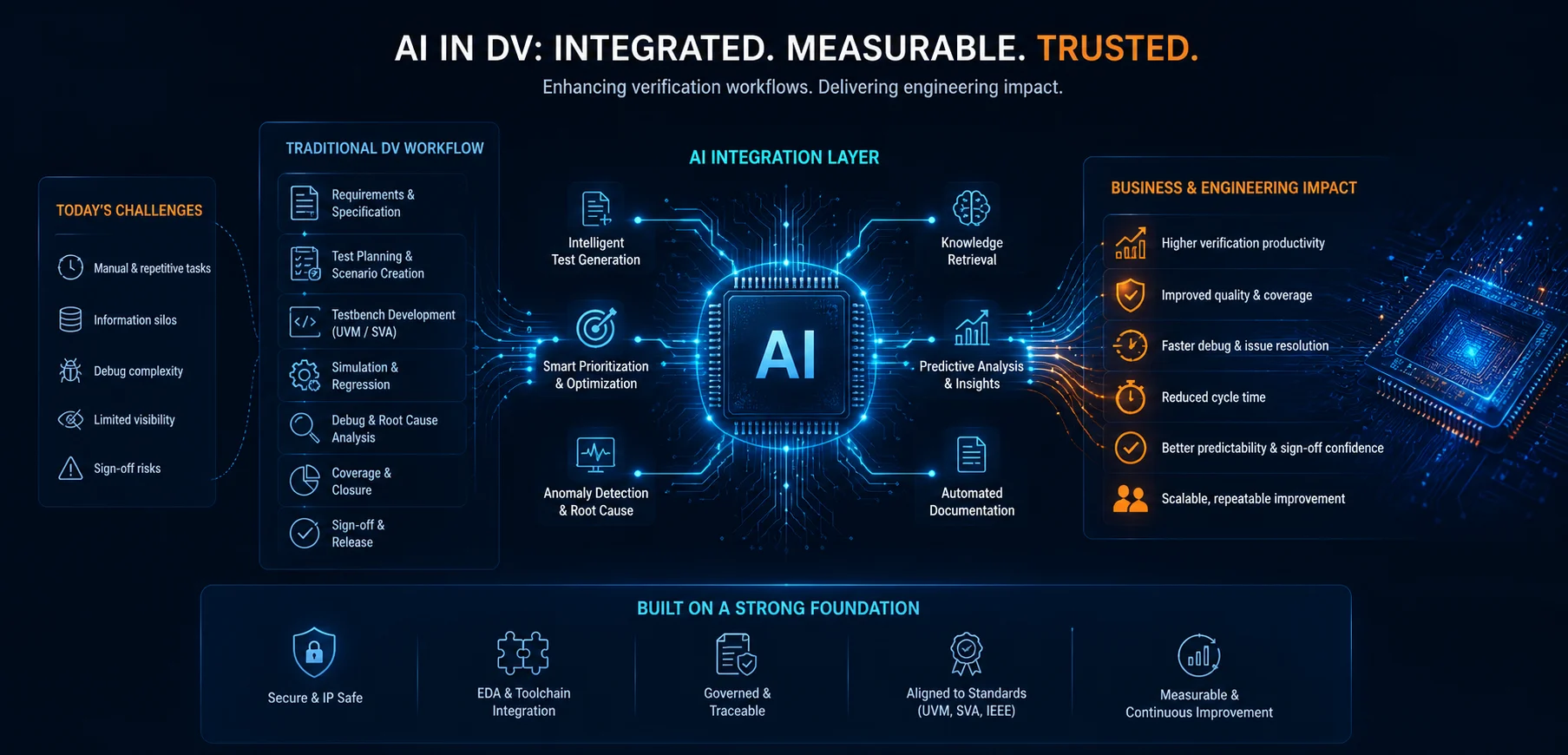
A credible approach to AI in design verification is not defined by access to tools or models. It is defined by the ability to deliver measurable improvements within real workflows, integrate into existing EDA environments, and maintain traceability to requirements and failures. Governance, security, and IP protection must be built into the approach, not added later.
Outputs must align with established standards such as UVM and assertion-based verification. Equally important is transferring capability to internal teams, ensuring that knowledge remains within the organisation after adoption. Without these elements, AI introduces risk into sign-off rather than improving it.
Strategic Partnership: MooresLab AI
Through a strategic alliance with MooresLab AI, we deliver VerifAgent an AI-powered environment purpose-built for semiconductor engineering. VerifAgent automates the complete DV lifecycle, from initial test plan generation to coverage closure and debugging.
Optimized specifically for hardware workflows, the platform possesses native intelligence regarding:
- SystemVerilog, UVM, and SVA methodologies.
- Industry EDA toolchains, including Xcelium, VCS, and Questa.
- Structured verification methodologies for large-scale silicon programs.
Measurable Business Impact:
- 7x Acceleration in verification cycles.
- 85% Reduction in total engineering costs.
- Enhanced Quality in bug detection and functional coverage.
Through our partnership, Alpinum works closely with MooresLab AI to drive adoption across Europe and Asia. We combine MooresLab’s cutting-edge AI platform with Alpinum’s deep verification expertise, regional presence, and customer network. Together, we help semiconductor teams move faster, reduce complexity, and unlock scalable AI-powered verification workflows.
Explore More:
Explore MooresLab AI
Run Debug animation showing a practical debug flow from setup and failure review through to AI-assisted analysis.
Review Coverage animation showing how AI-assisted workflows can support faster interpretation of coverage results and closure decisions.
Start with a structured “AI in DV” baseline
The FREE “AI in DV” Capability Assessment provides a structured baseline for decision-making. It identifies where AI can deliver value, what the risks are, and what the most effective next step should be. Understand current verification capability, identify workflow gaps, and define the right first step for controlled AI adoption in semiconductor engineering.