
Verification continues to be one of the biggest schedule pressures in semiconductor engineering. As designs become more complex and projects span IP, subsystem, and SoC levels, teams face the same recurring challenge: how to increase productivity without compromising quality, rigour, or sign-off confidence.
That challenge is where Moores Lab AI is positioning its platform. Rather than presenting AI as a generic coding shortcut, the company frames it as a practical engineering workflow that can support functional verification, regression debugging, and coverage closure in a more structured and scalable way. On its public site, Moores Lab AI positions itself around speeding silicon engineering, says it is deployed at 15+ chip companies worldwide, and highlights faster, cheaper, better verification outcomes.
For teams already exploring AI in DV, this discussion is more useful than broad claims about automation. The real question is whether a platform can help verification teams move faster in the places that consume the most time: planning, implementation, debugging, and closure. Alpinum’s own AI in DV positioning also centres on practical workflow improvements rather than generic AI hype, making this a natural area for evaluation and discussion.
Verification is still the long pole
In many semiconductor programmes, functional verification remains the longest and most resource-intensive phase of the development cycle. Teams need to translate specifications into verification plans, build maintainable UVM testbenches, implement meaningful test cases, analyse regression failures, and then drive coverage towards closure.
The issue is not simply that verification takes time. Each stage creates downstream effort. A slow planning phase delays implementation. A heavy manual testbench phase increases reliance on senior engineers. Noisy regressions consume valuable debug time. Coverage gaps stay open not because teams ignore them, but because interpreting what to do next takes too long.
That is why the conversation around AI in design verification is becoming more specific. The most valuable tools are not the ones that promise vague automation. They are the ones that fit real engineering workflows and help teams progress through the work more effectively.
A more practical view of functional verification
Moores Lab AI positions VerifAgent around one of the most demanding parts of the engineering flow: building and advancing functional verification in a practical timeframe. The company describes VerifAgent as its flagship AI-powered verification agent and says it automates the creation of test plans, UVM testbenches, test cases, scoreboards, functional coverage and assertions.
The traditional functional verification path is familiar to most teams. It moves from planning to testbench development, then to implementation and coverage work, and finally to closure. Moores Lab AI offers an alternative path, enabling the same flow through AI-driven automation and workflow acceleration. Customers receive a complete IP verification package that outlines a phased process from kick-off and IP qualification through test plan, testbench, and stimulus generation, to final delivery.
Instead of treating verification as a single large manual block, the platform is designed to support the creation of the core outputs teams need to make progress, including test plans, UVM testbenches, scoreboards, checkers, assertions, functional coverage, and implemented tests. Moores Lab AI also publicly states that manual UVM verification, which typically takes 6 to 12 months, can be completed in under a month, with verification cost reduction of up to 86%.

Figure 1: VerifAgent positions functional verification as a much shorter and more efficient workflow than a traditional multi-month flow.
This matters because the value of acceleration is not only about speed. It is also about freeing experienced engineers to spend more time reviewing intent, validating correctness, examining corner cases, and improving quality, rather than repeatedly performing the same construction tasks.
From regression fails to root-cause insight
Functional verification speed is only one part of the problem. Debug is often where schedules slow down further.
Regression environments can generate large volumes of failures, but not all failures deserve equal attention. Some are duplicates. Some are symptoms of the same underlying issue. Some are best resolved in the testbench, while others indicate a genuine RTL defect. The engineering burden comes from finding the signal inside that noise.
This is where Moores Lab AI positions DebugAgent as a useful next step in the verification workflow. Rather than treating debug as a manual hunt across disconnected artefacts, the workflow is better understood as a guided sequence: ingest regression results, cluster related failures, identify the most useful representative test, analyse logs, waves, RTL, and specification context, and drive towards a clearer root cause view.
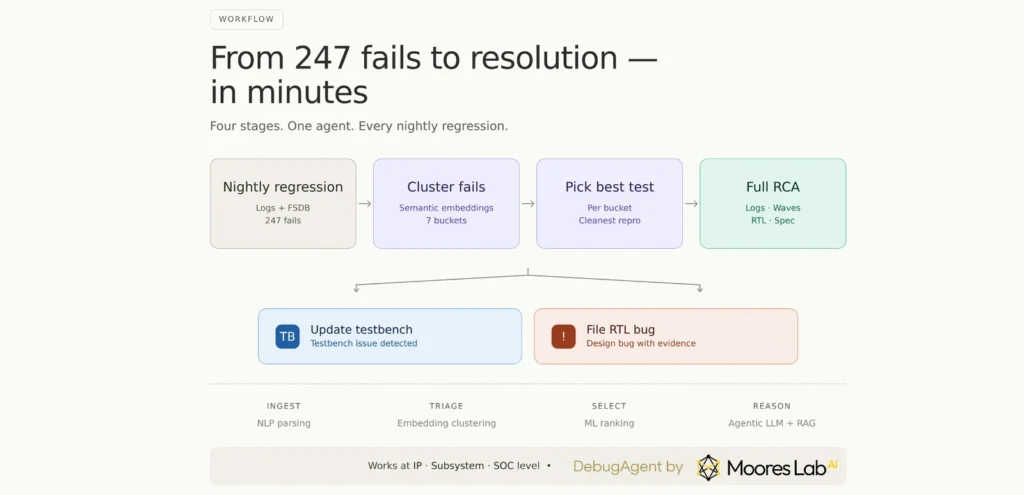
Figure 2: DebugAgent workflow showing how regression failures can be narrowed from bulk fail data to a clearer root-cause path.
That structure is valuable because it reflects how experienced engineers already think. They do not just want a summary of failures. They want help narrowing the problem, identifying the cleanest reproduction path and building confidence in the explanation.
Run Debug animation showing a practical debug flow from setup and failure review through to AI-assisted analysis.
Coverage closure needs actions, not just percentages
Coverage is another area where engineering effort can expand rapidly. A report can show a gap, but the more important question is what the team should do next. Is a new test required? Is a constraint or environment adjustment needed? Is the gap legal but unexercised? Is the item irrelevant and better handled as an exclusion?
This is why coverage support must go beyond displaying metrics. Moores Lab AI publicly includes coverage analysis within the IP development flow it supports, alongside architecture specification, RTL design, functional verification, simulation and debug. It also presents functional coverage as part of the complete IP verification package delivered by VerifAgent.
That is useful because coverage closure is rarely a pure reporting problem. It is a decision-making problem. Teams need to understand whether they should add test cases, update environments or approve exclusions. Any AI-driven assistance becomes valuable when it shortens the path from coverage results to engineering action.
Review Coverage animation showing how AI-assisted workflows can support faster interpretation of coverage results and closure decisions.
Why workflow fit matters more than hype
Many semiconductor teams are interested in AI, but interest alone does not drive adoption. Tools must fit existing engineering environments and respect the realities of verification work. That includes compatibility with established flows, support for different project levels, sensitivity to IP concerns and the need for engineers to review and trust the outputs.
Moores Lab AI speaks directly to that point. It says VerifAgent integrates with major EDA tools, including Synopsys, Cadence and Siemens, and that on-prem deployment is supported for IP-sensitive environments. The platform supports the IP block silicon development flow across architecture specification, RTL design, functional verification, simulation and debug, and coverage analysis.
This is also why Alpinum’s role matters. Alpinum is working closely with Moores Lab AI to support rollout and adoption across Europe and Asia, while Alpinum’s AI in DV and AI Adoption positions the company for practical workflow fit, secure rollout, and measurable adoption support.
Early value signals matter
Any team evaluating a new platform will want to see evidence that it can produce real results. The most useful proof points are not slogans alone, but signals that the workflow can reduce engineering effort and improve productivity in meaningful ways.
Moores Lab AI highlights 7x faster time to market, up to 86% cost reduction, typical productivity gains of 92–97%, 150–200+ engineering hours saved per project, and 1–5 critical bugs caught early. Those are vendor-stated performance indicators, not guarantees for every project, but they do show the kind of outcomes the company is using to frame the value proposition.
For engineering managers and technical leads, that is where the discussion becomes practical. The key questions are where time is saved, how quality is protected, and whether the workflow aligns with how their teams already operate.
Why this matters for AI in DV
The wider industry discussion around AI in DV is moving away from generic curiosity and towards practical adoption. Teams are starting to ask better questions: which verification activities are suitable for AI support, where manual engineering effort can be reduced without lowering quality, how AI outputs should be reviewed, and what kind of pilot can prove value without adding unnecessary risk.
That is why the Moores Lab AI approach is relevant. It contributes to a grounded view of AI in verification: not as a black-box replacement for engineers, but as workflow support aimed at speeding up bounded, reviewable and high-effort tasks.
For organisations that want to explore AI in DV responsibly, that is the right direction. The goal is not blind automation. The goal is measurable capability improvement.
Final thoughts
Verification remains a long pole because it combines planning, implementation, debugging, and closure into one demanding engineering discipline. Improving only one part of that chain is rarely enough. Real gains come when the workflow as a whole becomes more efficient.
Moores Lab AI’s positioning around functional verification, debug, and coverage closure is interesting for exactly that reason. It presents a workflow-level view of improvement rather than a narrow feature story, and Alpinum’s own AI in DV and partner positioning make it a sensible context for further discussion and evaluation.
The next step for most organisations is not to make sweeping assumptions. It is to start a practical discussion, review the workflows, examine the outputs, and evaluate where the technology could support real engineering improvement.
Explore Moores Lab AI with Alpinum
Interested in seeing how Moores Lab AI could support your verification flow? Speak with Alpinum to discuss fit for your IP, subsystem or SoC environment, review the product visuals and workflow materials, and decide the best next step for evaluation.
Frequently Asked Questions
Moores Lab AI positions itself as an AI-driven silicon engineering company focused on helping teams move faster across chip design and verification workflows. They highlight products such as MooreIP and MooreSoC, with VerifAgent presented as their flagship AI-powered verification agent.
Moores Lab AI says VerifAgent automates the creation of test plans, UVM testbenches, test cases, scoreboards, functional coverage and assertions.
In this blog context, DebugAgent is presented as supporting a more structured path from regression failures towards root-cause understanding, including failure clustering, representative test selection and evidence review across logs, waves, RTL and specification context.
Coverage closure is difficult because it is not only a reporting issue. Teams must interpret results and decide whether to add tests, update environments, or approve exclusions. That decision-making process often consumes significant engineering time.
It is relevant because it reflects a practical use of AI in design verification: helping engineers reduce time spent on high-effort, reviewable tasks while maintaining control over the verification process.

Written by : Mike Bartley
Mike started in software testing in 1988 after completing a PhD in Math, moving to semiconductor Design Verification (DV) in 1994, verifying designs (on Silicon and FPGA) going into commercial and safety-related sectors such as mobile phones, automotive, comms, cloud/data servers, and Artificial Intelligence. Mike built and managed state-of-the-art DV teams inside several companies, specialising in CPU verification.
Mike founded and grew a DV services company to 450+ engineers globally, successfully delivering services and solutions to over 50+ clients.
Mike started Alpinum in April 2016 to deliver a range of start-of-the art industry solutions:
Alpinum AI provides tools and automations using Artificial Intelligence to help companies reduce development costs (by up to 90%!) Alpinum Services provides RTL to GDS VLSI services from nearshore and offshore centres in Vietnam, India, Egypt, Eastern Europe, Mexico and Costa Rica. Alpinum Consulting also provides strategic board level consultancy services, helping companies to grow. Alpinum training department provides self-paced, fully online training in System Verilog, UVM Introduction and Advanced, Formal Verification, DV methodologies for SV, UVM, VHDL and OSVVM and CPU/RISC-V. Alpinum Events organises a number of free-to-attend industry events
You can contact Mike (mike@alpinumconsulting.com or +44 7796 307958) or book a meeting with Mike using Calendly (https://calendly.com/mike-alpinum-consulting).
Stay Informed and Stay Ahead
Latest Articles, Guides and News
Explore related insights from Alpinum that dive deeper into design verification challenges, practical solutions, and expert perspectives from across the global engineering landscape.