
What the EE Times Chiplets Virtual Conference Signals for Multi-Die Design
Chiplets are moving from an attractive architectural concept to a practical approach for building the next generation of AI, cloud, networking, and high-performance computing systems. The upcoming EE Times Chiplets Virtual Conference, The Road to Chiplet Scalability, taking place on 23–24 June 2026, reflects this shift: the industry is now focused on how multi-die designs can move into real production at scale.
Why Chiplet Scalability Is Not Just a Packaging Problem
However, scalability will not be achieved through advanced packaging alone. As more companies adopt 2.5D and 3D heterogeneous integration, the real challenge becomes ensuring that multiple chiplets, often developed by different vendors and using different technologies, can operate together reliably as one complete System-in-Package (SiP), which is why design verification services and manufacturing tests become central.
From D2D Interoperability to Verification Confidence
Alpinum has already explored this challenge through its work around the Open Compute Project’s Universal D2D Link Layer with UCIe. The OCP Universal D2D Transaction and Link Layer specification is important because it supports a more flexible chiplet ecosystem by abstracting transaction and link-layer behaviour from physical interface choices, thereby supporting the industry’s move towards interoperable, reusable and scalable chiplet-based architectures.
But interoperability at the architecture level must be matched by confidence at the verification and test level.
The SiP Verification Gap: What Does a “Verified” Chiplet Really Mean?
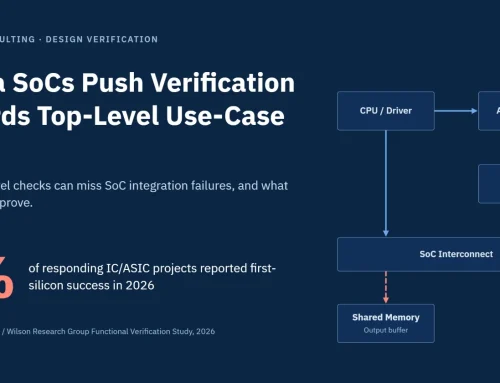
In a traditional monolithic SoC, verification teams usually work within a more controlled design environment. In a chiplet-based SiP, the system integrator must combine independently designed functional blocks, die-to-die interfaces, interposers, package-level connectivity, software workloads and manufacturing test flows. Even when each chiplet is functionally correct in isolation, new risks can appear at the integration level.
These risks include protocol interoperability, simulation scalability, coverage closure, cache coherency, latency, power and clock management, bit error rates, cross-chiplet security and uncertainty around what should be delivered by each IP or VIP supplier. In simple terms, the industry still needs clearer answers to the question: What does a “verified” chiplet really mean when it is delivered into a multi-vendor SiP environment?
From Pre-Silicon Verification to Post-Silicon Manufacturing Test
Alpinum is already contributing to this discussion through work connected with the Open Compute Project. Mike Bartley and industry colleagues have contributed to the OCP white paper activity covering both System-in-Package verification and System-in-Package testing. This work examines the practical engineering issues that must be addressed to enable chiplets to be integrated, validated, and manufactured at scale.
On the verification side, this includes pre-silicon methodologies for multi-chiplet systems, simulation and emulation strategies, IP/VIP deliverables, system-level integration, compatibility and security. On the testing side, the focus extends into post-silicon manufacturing concerns, including Known Good Die and Known Good Chiplet approaches, DFT, package-level validation, BIST, JTAG, IEEE 1838/1687-related considerations and the cost/yield trade-offs of partial assembly testing.
Why Verification and Test Must Scale Together
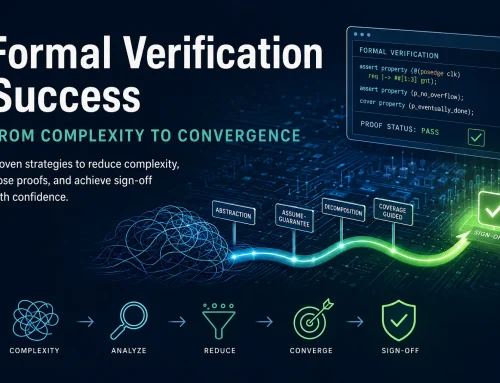
This end-to-end view matters because chiplet success depends on continuity between pre-silicon verification and post-silicon test. A design that is difficult to model, debug, access or test before production will also be difficult to manufacture reliably and economically, which is why advanced methods such as formal verification, emulation and system-level validation are becoming increasingly important for complex semiconductor programmes.
Alpinum, OCP and the Future of Scalable Chiplet Integration
Alpinum has also supported wider industry discussion through Verifying Chiplet-based Systems, a DV Club session focused on the challenges, methodologies and practical realities of chiplet verification.
The EE Times event is therefore timely. As the ecosystem discusses architecture, packaging, interoperability and deployment lessons, verification and test must remain part of the scalability conversation from the beginning. For organisations developing or integrating chiplet-based systems, the key question is no longer only “can we package multiple dies together?” It is: can we verify, validate, test and trust the complete system before cost, schedule or yield risks become unacceptable?
Register now for this free Virtual Event
Alpinum helps semiconductor teams address these challenges through practical verification expertise, methodology improvement, training services and industry-focused engineering support.
Need Support with Chiplet, SiP or Advanced Verification Readiness?
Speak to Alpinum about practical verification and test strategies for complex semiconductor systems.
For discussion, collaboration, or technical engagement, contact Alpinum Consulting here: https://alpinumconsulting.com/contact-us/

Written by : Mike Bartley
Mike started in software testing in 1988 after completing a PhD in Math, moving to semiconductor Design Verification (DV) in 1994, verifying designs (on Silicon and FPGA) going into commercial and safety-related sectors such as mobile phones, automotive, comms, cloud/data servers, and Artificial Intelligence. Mike built and managed state-of-the-art DV teams inside several companies, specialising in CPU verification.
Mike founded and grew a DV services company to 450+ engineers globally, successfully delivering services and solutions to over 50+ clients.
Mike started Alpinum in April 2016 to deliver a range of start-of-the art industry solutions:
Alpinum AI provides tools and automations using Artificial Intelligence to help companies reduce development costs (by up to 90%!) Alpinum Services provides RTL to GDS VLSI services from nearshore and offshore centres in Vietnam, India, Egypt, Eastern Europe, Mexico and Costa Rica. Alpinum Consulting also provides strategic board level consultancy services, helping companies to grow. Alpinum training department provides self-paced, fully online training in System Verilog, UVM Introduction and Advanced, Formal Verification, DV methodologies for SV, UVM, VHDL and OSVVM and CPU/RISC-V. Alpinum Events organises a number of free-to-attend industry events
You can contact Mike (mike@alpinumconsulting.com or +44 7796 307958) or book a meeting with Mike using Calendly (https://calendly.com/mike-alpinum-consulting).
Stay Informed and Stay Ahead
Latest Articles, Guides and News
Explore related insights from Alpinum that dive deeper into design verification challenges, practical solutions, and expert perspectives from across the global engineering landscape.