
Simulation is the starting point for most verification engineers.
Engineers create stimulus, execute test scenarios, inspect waveforms, analyse failures and measure coverage. These skills remain essential, but simulation answers a particular kind of question:
What happened in the scenarios that were executed?
Formal verification asks a different question:
Can the defined property ever be violated in any reachable behaviour permitted by the model and its constraints?
That difference changes more than the tool being used. It changes how engineers express design intent, construct the verification environment, interpret results and decide whether the available evidence is sufficient.
Formal verification does not require engineers to abandon simulation. The strongest verification strategies use both methods deliberately. Simulation remains valuable for realistic traffic, software interaction, performance behaviour and system-level scenarios. Formal verification is particularly valuable when engineers need exhaustive analysis of a defined property, deep corner-case exploration or evidence that a critical behaviour cannot fail under stated assumptions. [3]
For engineers who want to make that transition practically, Alpinum’s Formal Verification Training progresses from formal fundamentals and SystemVerilog Assertions through property proving, counterexample debug, coverage, block-level formal verification, specialised applications, reuse, advanced techniques and AI-assisted workflows.
What Does “Mathematical Proof” Mean in Hardware Verification?
The phrase can create the wrong impression unless it is used carefully. Formal verification does not automatically prove that an entire chip is correct under every possible interpretation of its specification. Instead, a formal tool analyses a mathematical model of the design and attempts to determine whether a defined property holds across every reachable state permitted by the assumptions and constraints supplied to the tool.
A credible proof claim therefore depends on four elements:
| Element | Engineering question |
| Design model | Is the correct RTL, abstraction, configuration or implementation being analysed? |
| Property | Does the assertion express the intended requirement accurately? |
| Constraints | Do the assumptions represent legal environmental behaviour without excluding genuine failures? |
| Proof result | Has the property been proven, falsified or left unresolved? |
A property can be mathematically proven and still provide misleading confidence if it checks the wrong requirement or if unrealistic assumptions prevent the relevant failure from being explored.
Formal-verification capability should therefore not be measured simply by the number of assertions written or the number of green proof results. Engineers must understand specification intent, property quality, environmental modelling, reachability, coverage and proof completeness.
Simulation and Formal Verification Answer Different Questions
Simulation and formal verification should not be framed as competing alternatives.
| Simulation-based verification | Formal verification |
| Executes selected scenarios | Explores the state space permitted by the model |
| Requires stimulus or tests | Can analyse properties without conventional test vectors |
| Shows behaviour for executed traces | Determines whether a property can be violated |
| Scales effectively to realistic system workloads | May face convergence limits as state-space complexity grows |
| Supports performance and software-driven scenarios | Excels at targeted control and difficult corner cases |
| Measures sampled behaviour and coverage | Produces proven, failed or unresolved outcomes |
| Finds bugs reached by the regression | Can expose behaviours that are exceptionally difficult to stimulate |
Formal techniques can also address equivalence checking, connectivity, low-power control, security, functional safety, datapath validation and register behaviour rather than only user-written property checking. Modern formal platforms therefore provide specialised applications for different verification objectives.
The engineering decision is not simply “simulation or formal”. It is:
Which verification question is each method best equipped to answer, and how will the evidence be combined?
Organisations making this decision at programme level should also consider the wider strategic issues in adopting formal verification, including workforce capability, methodology integration, proof scalability and sign-off expectations.
Why Simulation Experience Is Still Valuable
An experienced simulation engineer already possesses several capabilities that transfer directly into formal verification:
- Understanding of RTL behaviour
- Familiarity with clocks, resets and protocols
- Experience reading waveforms
- Knowledge of verification planning
- Understanding of assertions and checkers
- Experience distinguishing DUT defects from testbench problems
- Familiarity with coverage and closure
- Appreciation of legal and illegal operating modes
The main transition is from stimulus-driven thinking to property-driven thinking.
In simulation, the engineer often begins by asking:
What test should I run to reach this condition?
In formal verification, the engineer asks:
What behaviour must always hold, which environmental assumptions are legitimate, and can the tool prove or disprove the property?
This shift requires precision. Informal expectations must become executable properties.
The Practical Learning Path from Simulation to Proof
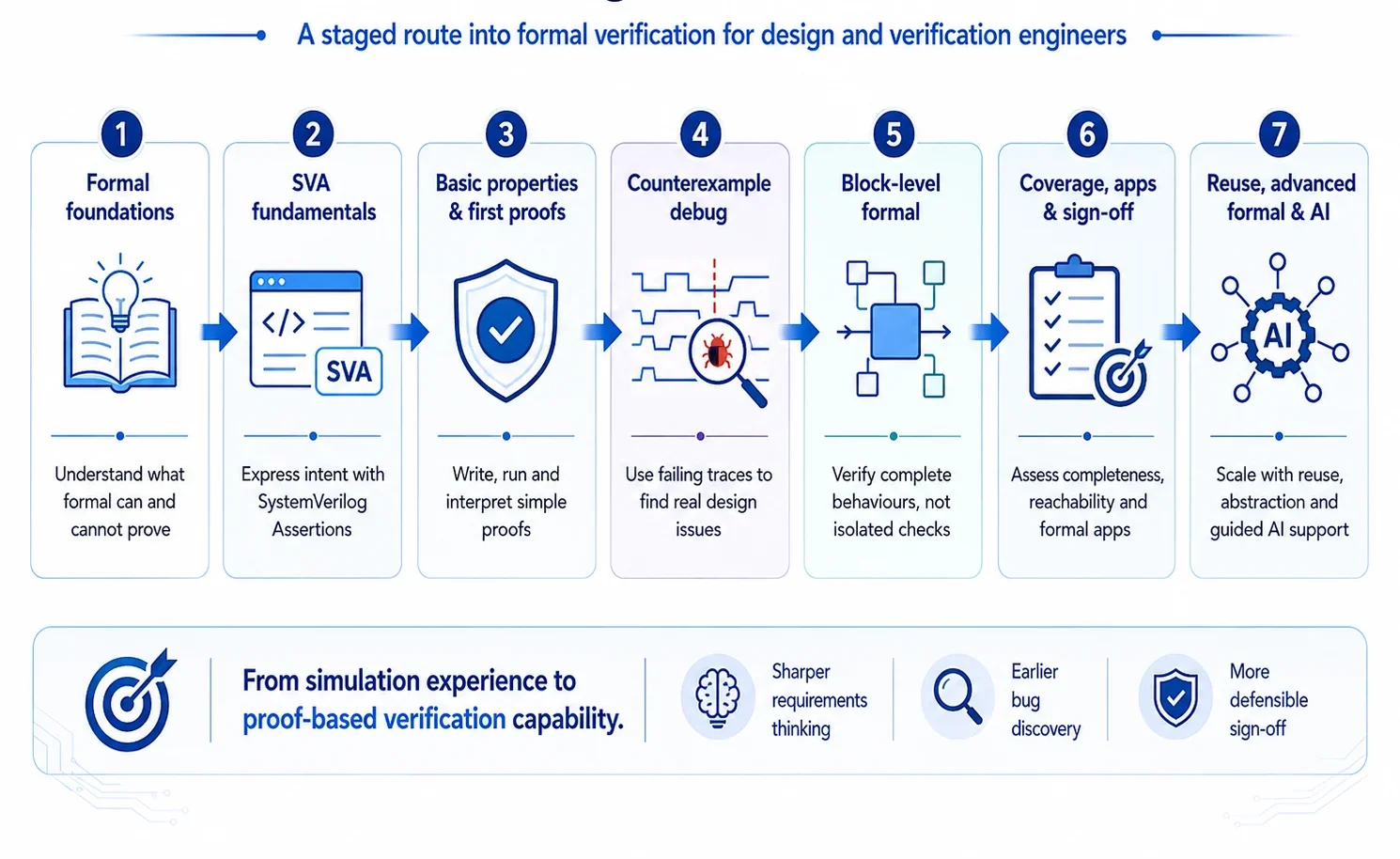
Figure 1: A staged learning path from simulation experience and SystemVerilog Assertions to block-level proof, formal coverage, sign-off, reuse and advanced formal verification.
The transition can be organised into seven stages.
Stage 1: Understand What Formal Can and Cannot Prove
Before writing properties, engineers should understand the formal model. A formal engine typically treats unconstrained inputs symbolically. Instead of choosing one input value in one simulation cycle, it reasons about the possible values and sequences permitted by the model. This allows formal analysis to explore behaviours that a manually written or constrained-random regression may never generate.
However, exhaustive analysis is always relative to:
- The selected design model
- The property being evaluated
- The reachable state space
- Environmental assumptions
- Tool capacity
- Any abstractions introduced
- Reset and initial-state modelling
- The chosen configuration
The first learning objective is therefore not syntax. It is understanding the boundary of the claim.
An engineer should be able to say:
“This property is proven for these reachable behaviours under these assumptions.”
That is more precise than saying:
“Formal proved the design.”
Stage 2: Express Design Intent with SystemVerilog Assertions
SystemVerilog Assertions provide a standard language for expressing temporal and logical hardware behaviour. IEEE 1800-2023 includes assertions alongside coverage, object-oriented programming and constrained-random verification features. [1]
A useful property may describe requirements such as:
- A request must eventually receive an acknowledgement.
- A FIFO must not return data that was never written.
- Two mutually exclusive grants must never be active together.
- Reset must place the controller in a legal state.
- A protected register must not change without authorisation.
- A protocol response must occur within a defined number of cycles.
- A state transition must be impossible unless its guard condition holds.
Engineers should begin with basic combinational and sequential properties before attempting complex temporal expressions.
Those who need a stronger language foundation can first develop the relevant assertion, interface, coverage and testbench skills through Alpinum’s SystemVerilog Training.
Our Formal Verification Training roadmap follows the same progression. Day 1 introduces formal verification and SVA through a synchronous FIFO and X-propagation exercise. Day 2 moves into formal-versus-simulation property writing, basic proof, advanced SVA, reachability and more complex assertions.
A Property Is More Than an Assertion Statement
A complete formal property normally sits within a wider verification model containing:
- Assumptions about the environment
- Assertions describing required behaviour
- Cover properties testing reachability
- Reset and initial-state modelling
- Clock definitions
- Abstraction decisions
- Supporting helper logic
- Parameter and configuration choices
The engineer must understand the difference between constraining the environment and constraining away a bug. Suppose a bus target only accepts requests when ready is high. An invalid assumption might state that requests occur only when ready is already high. That may make the proof easier, but it could exclude the exact back-pressure behaviour the interface is required to support. A defensible model constrains only behaviour that the protocol or system architecture genuinely prohibits.
Stage 3: Interpret the Three Main Proof Outcomes
A formal run does not produce only “pass” or “fail”.
The three important outcomes are:
| Formal result | Meaning | Engineer’s next action |
| Proven | No violation was found across the analysed reachable state space | Review the property, assumptions, activation, reachability and completeness |
| Failed | A trace violating the property was found | Debug the counterexample and determine whether the DUT, property or assumptions are incorrect |
| Unproven | The engine has not established proof or failure within the available capacity | Analyse complexity and select an appropriate convergence strategy |
Proven Does Not Automatically Mean Complete
A proven assertion may be:
- Too weak
- Vacuously true
- Based on an unreachable antecedent
- Protected by excessive assumptions
- Checking only one part of the requirement
- Proving behaviour in an incorrect configuration
Proof review must therefore establish whether the property activated meaningfully and whether all relevant dimensions of the requirement were represented.
Failed Does Not Automatically Mean the RTL Is Wrong
A counterexample may reveal:
- A genuine DUT defect
- A property-writing error
- Missing reset assumptions
- An illegal environmental trace
- Incorrect clocking or sampling
- A misunderstanding of the specification
- A modelling artefact
The engineer must classify the failure before changing the design.
Unproven Does Not Mean the Property Is False
An unresolved result means that the proof has not converged.
Possible responses include:
- Decomposing the property
- Reducing unnecessary state
- Strengthening legitimate assumptions
- Introducing abstractions
- Using cut points
- Reducing widths for exploratory analysis
- Applying assume–guarantee reasoning
- Replacing irrelevant blocks with formal models
- Selecting a more suitable formal application
Practical formal training must teach engineers to distinguish a failed proof from a proof that has not yet converged.
Stage 4: Learn Counterexample-Driven Debug
One of formal verification’s most practical benefits is its ability to return a precise sequence demonstrating how a property can fail. A counterexample is not merely a red waveform. It is a proof artefact showing one permitted path from the initial formal model to a property violation.
Effective formal debug requires the engineer to ask:
- Was the property interpreted as intended?
- Is the initial state realistic?
- Is the environment permitted to behave this way?
- Is the counterexample exposing a DUT defect?
- Is the failure caused by an incomplete assumption?
- Is helper logic or sampling introducing an error?
- Can the trace be reproduced in simulation?
Counterexamples can also be converted into directed simulation scenarios, creating a useful feedback loop between formal and dynamic verification. A witness similarly demonstrates a sequence in which a required or covered behaviour occurs. The objective is not simply to make a property turn green. It is to understand why the failure occurred and whether the chosen resolution preserves the original verification intent.
Stage 5: Verify a Complete Block
Individual properties teach syntax and proof mechanics. Block-level formal verification teaches methodology.
A complete formal testbench must normally address:
- Legal input behaviour
- Reset and initialisation
- Safety properties
- Progress or liveness behaviour
- Data integrity
- Ordering
- Protocol compliance
- Illegal-state prevention
- Error handling
- Configuration modes
- Reachability
- Property and constraint coverage
This is where engineers encounter the difference between proving a few isolated checks and establishing a defensible verification argument.
A FIFO, for example, may need properties covering:
- No read when empty
- No write when full
- Correct count movement
- Data ordering
- Data integrity
- Pointer consistency
- Flag correctness
- Reset behaviour
- Simultaneous read/write conditions
- Reachability of full and empty states
A single property cannot establish all of this.
The updated programme moves into full block verification before addressing formal’s position in the wider design flow, sequential and logical equivalence concepts, connectivity checking, low-power analysis, testbench assessment and the AHAA methodology.
Alpinum’s article on the AHAA model for structuring formal verification explains how Bug Avoidance, Bug Hunting, Bug Absence and Bug Analysis require different objectives and completion criteria.
Stage 6: Measure Formal Coverage and Sign-Off Quality
A formal proof may be exhaustive for a particular property within its model, but the verification plan can still be incomplete because important behaviours were never represented as properties.
Formal closure therefore requires more than counting proven assertions.
Engineers may need to examine:
- Property activation
- Vacuity
- Reachability
- Cone of influence
- Unchecked outputs
- Unconstrained inputs
- Over-constraint
- Under-constraint
- Mutation or fault-detection capability
- Code or structural coverage correlation
- Requirements-to-property traceability
- Unresolved proof risk
- Review and waiver evidence
Formal testbench-analysis applications exist because proof completeness and verification completeness are not the same. For example, modern platforms provide capabilities to identify missing or ineffective properties and constraints as part of sign-off assessment.
A credible sign-off statement should identify:
- Which requirements were formally addressed
- Which properties were proven
- Which properties failed and were resolved
- Which properties remained unresolved
- Which assumptions were used
- Which abstractions or exclusions were accepted
- Which residual risks remain
- Which behaviours are covered by simulation or another method
Formal results should become part of the wider verification evidence rather than remain an isolated tool report.
Alpinum’s guide to verification planning from requirements to coverage closure explains how requirements should connect to measurable verification artefacts, coverage and defensible sign-off evidence.
Stage 7: Use Formal as Part of the Verification Flow
Formal verification delivers greater value when it is integrated throughout the design lifecycle.
Formal for Designers
Designers can use formal applications early for:
- RTL visualisation
- Dead-code analysis
- Reachability analysis
- X-propagation
- Basic assertion checking
- Connectivity checks
- Register analysis
- Early control-logic verification
These activities can identify defects before a complete simulation environment exists.
Formal for Verification Engineers
Verification teams can use formal for:
- Property checking
- Assertion reuse
- Corner-case exploration
- Coverage-hole analysis
- Counterexample generation
- Block-level sign-off
- Security and safety properties
- Protocol verification
- Low-power control verification
Formal Alongside Simulation
Properties written for formal can also run as assertions in simulation. Simulation failures can motivate new formal properties, while formal counterexamples can become directed regression tests. Accellera’s assertion resources describe SVA as a reusable methodology element spanning assertion checking, coverage and formal analysis rather than a feature limited to one tool flow. [2]
The Main Formal Applications Engineers Should Understand
Formal verification is broader than manually writing assertions.
The updated Alpinum programme introduces ten formal-application areas:
| Formal application | Engineering purpose |
| X-Propagation | Identify unsafe or unexpected X behaviour |
| Reachability | Determine whether important states or conditions can occur |
| Formal Coverage Analysis | Investigate coverage gaps, completeness and unreachable behaviour |
| Connectivity Checking | Verify intended signal, register and interconnect relationships |
| Formal Low Power | Check power-aware control and structural behaviour |
| Formal Testbench Analysis | Assess property, assumption and constraint quality |
| Formal Security Verification | Prove security-control and information-flow properties |
| Functional Safety | Analyse safety mechanisms, fault detection and diagnostic behaviour |
| Datapath Validation | Verify arithmetic and data-transformation correctness |
| Formal Register Verification | Check register behaviour and specification consistency |
Teams that need direct project support in these areas can explore Alpinum’s Formal Verification Services for ASIC and SoC development.
Several of these application areas also connect to deeper supporting resources:
- Formal security verification in SoC design explains how source, asset and allowed-path modelling supports confidentiality and integrity analysis.
- Formal verification for ISO 26262 safety compliance examines the use of proof-based evidence for safety mechanisms, recovery logic and freedom from interference.
- Using formal verification in RISC-V verification explores applications across privilege handling, control logic, processors and SoC integration.
The programme’s practical examples include a synchronous FIFO, ALU, up/down counter, two-transaction FIFO, selection block, APB4 interface, single-cycle RISC-V design, arbiter and traffic-light state machine. This breadth matters because engineers should learn how to select the appropriate formal approach rather than forcing every verification objective into general-purpose property checking.
Which Designs Are Best Suited to Formal Verification?
Formal is often particularly effective for control-oriented logic with a clearly definable behavioural contract, including:
- Arbiters
- FIFOs
- State machines
- Protocol controllers
- Register blocks
- Security controls
- Access-control logic
- Reset and boot sequencing
- Interrupt controllers
- Low-power control logic
- Cache or coherency invariants
- Safety mechanisms
- Deadlock and forward-progress properties
Large memories, wide datapaths, complex software-driven behaviour and very large unrestricted state spaces may require decomposition, abstraction, specialised applications or complementary simulation.
The right question is not simply:
“Is this design too large for formal?”
A stronger question is:
“Which properties, blocks, abstractions or formal applications can verify this risk more effectively than simulation?”
Formal Reuse: From Block Proof to Project Capability
Formal properties become more valuable when they can be reused.
Possible reuse routes include:
- Assertions running in both formal verification and simulation
- Interface properties packaged as assertion-based verification IP
- Block-level guarantees used as subsystem assumptions
- Parameterised properties reused across configurations
- Properties retained for regression after RTL changes
- Requirements linked to reusable property libraries
- Formal models reused across product generations
Assume–guarantee reasoning becomes particularly important when scaling formal analysis. A block-level guarantee can become an assumption at a higher level, provided that the relationship is controlled, traceable and reviewed.
Formal reuse therefore depends on:
- Clear property ownership
- Stable interfaces
- Requirements traceability
- Configuration management
- Review standards
- Documentation of assumptions
- Regression discipline
It is a methodology capability, not merely a code-reuse exercise.
Where Does AI Fit into Formal Verification?
AI can assist formal-verification workflows, but it does not remove the need for formal expertise.
The updated course includes AI in Verification, AI in Formal, SVA-to-requirements mapping and a Formal Applications Advisor.
Potentially useful applications include:
- Drafting candidate assertions from structured requirements
- Suggesting formal applications for a verification objective
- Mapping properties back to requirements
- Explaining counterexample traces
- Summarising proof results
- Identifying repetitive property patterns
- Supporting regression triage
- Highlighting possible gaps in property sets
- Assisting with documentation
However, AI-generated formal content must remain untrusted until an engineer has reviewed it.
A plausible assertion may:
- Reverse cause and effect
- Use the wrong sampling event
- Be too weak
- Be impossible to trigger
- Ignore reset behaviour
- Misrepresent protocol timing
- Introduce an unsafe assumption
- Prove a different requirement from the intended one
AI can reduce low-risk implementation effort, but engineers must retain ownership of requirement interpretation, property quality, assumptions, proof review and the sign-off decision.
Alpinum’s guide to piloting AI in Design Verification safely provides a broader framework for bounded use cases, measurable evidence, traceability and explicit human review.
Common Mistakes When Learning Formal Verification
Writing Properties Before Understanding the Requirement
Formal syntax cannot repair ambiguous intent.
The engineer should first state the required behaviour clearly in natural language, identify its preconditions and exceptions, and only then encode it as a property.
Treating Assumptions as a Way to Force Convergence
Every assumption removes behaviour from the analysis.
An assumption should represent a legitimate environmental rule, not a convenient method for hiding a failure or reducing runtime.
Accepting “Proven” Without Checking Activation
A property that never activates may pass without checking meaningful behaviour.
Cover properties and reachability analysis help determine whether the antecedent and important operating scenarios are reachable.
Treating Every Unresolved Result as a Tool Problem
An unproven result may reflect state-space complexity, but it can also indicate weak decomposition, poor modelling, unnecessary state, an unsuitable property or missing abstractions.
Attempting Whole-SoC Proof Too Early
Formal capability normally develops more reliably through targeted blocks, interfaces and critical behaviours before scaling into subsystem and SoC-level reasoning.
Measuring Progress Only by Property Count
Ten strong, traceable properties can provide more confidence than hundreds of weak, redundant or unreachable assertions.
Positioning Formal as a Replacement for Simulation
Formal and simulation produce different forms of evidence.
Removing simulation simply because formal is available can leave realistic workloads, software interactions, analogue effects and system-level scenarios insufficiently explored.
A Recommended Formal-Verification Learning Path
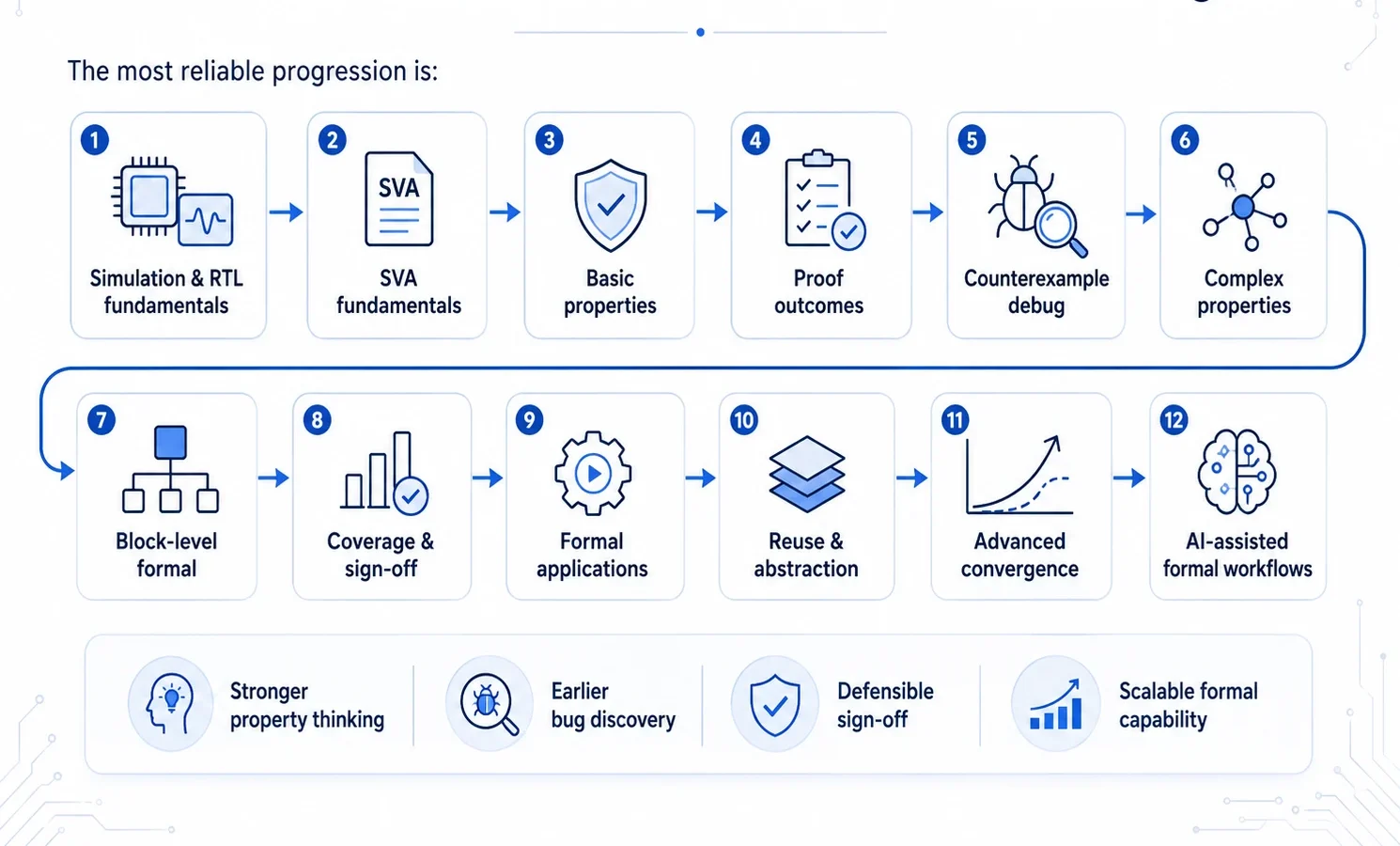
An engineer should be able to demonstrate each stage through practical work:
| Learning stage | Evidence of competence |
| SVA fundamentals | Can write and explain basic temporal properties |
| Basic proof | Can configure and prove a property on a small RTL block |
| Failure debug | Can classify and explain a counterexample |
| Constraint modelling | Can justify each environmental assumption |
| Complex properties | Can encode multi-cycle protocol behaviour |
| Block-level formal | Can create a coherent set of properties and assumptions |
| Sign-off | Can assess coverage, vacuity, reachability and unresolved risk |
| Reuse | Can reuse properties across simulation, formal or hierarchy |
| Advanced proof | Can apply decomposition and abstraction appropriately |
| AI-assisted work | Can review AI suggestions without transferring engineering ownership |
Learning Formal Verification by Doing
Formal verification cannot be learned reliably through slides alone.
Engineers need to:
- Write properties
- Run proofs
- Receive counterexamples
- Make and correct mistakes in assumptions
- Investigate vacuity
- Resolve syntax and semantic problems
- Compare simulation and formal behaviour
- Examine unresolved proofs
- Apply coverage analysis
- Review sign-off evidence
This reflects the broader principle explained in Alpinum’s article on learning by doing in semiconductor verification training: engineers develop confidence by applying concepts, debugging mistakes and reviewing real results rather than through passive instruction alone.
Alpinum’s formal training roadmap provides six days and 24 hours of structured training with more than 21 demonstrations and tools. Design examples, formal applications and AI-tool exercises are paired with equivalent exercises through the Alpinum Online Submission Portal, allowing learners to configure formal runs, use prepared examples, review execution logs and results, and apply the methods within a controlled training environment.
This practical structure supports a central requirement of formal training: engineers must learn not only how a technique is described, but also how to judge whether its outcome is technically meaningful.
From Simulation Engineer to Formal Practitioner
The transition from simulation to formal verification is not a rejection of existing verification experience. It is an extension of it. Simulation engineers already understand designs, interfaces, failures, checking and coverage. Formal verification adds another way to express requirements, explore state space and generate proof-oriented evidence.
The engineer’s progression should therefore be to:
- Preserve simulation expertise.
- Learn property-based thinking.
- Express intent precisely using SVA.
- Model the legal environment.
- Interpret proven, failed and unproven outcomes.
- Debug counterexamples.
- Assess coverage and completeness.
- Integrate formal with simulation and the wider verification plan.
- Scale through applications, reuse and abstraction.
- Use AI only within explicit engineering controls.
The goal is not to make every engineer a mathematical specialist.
The goal is to help engineers recognise where proof adds value, create credible formal models, interpret results accurately and use formal evidence responsibly within real semiconductor projects.
Build Practical Formal Verification Capability
Alpinum’s Formal Verification Training provides a structured route from introductory concepts and SystemVerilog Assertions to complex properties, debug, coverage, block-level verification, specialised applications, reuse, advanced techniques and AI-assisted workflows.
The programme includes:
- Six structured training days
- 24 hours of teaching and practical work
- SystemVerilog Assertions
- Basic and complex property proving
- Counterexample debug
- Formal coverage and sign-off
- Block-level formal verification
- SEC and LEC concepts
- X-propagation, reachability and connectivity
- Low-power, security and functional-safety applications
- Datapath and register verification
- Formal reuse and advanced proof techniques
- AI in Verification and AI in Formal
- Online exercises and submission workflows
Explore Formal Verification Training
Teams comparing this programme with Alpinum’s wider learning options can also explore the complete range of semiconductor verification training courses.
References
[1] IEEE Standards Association, IEEE Standard for SystemVerilog—Unified Hardware Design, Specification, and Verification Language, IEEE Std 1800-2023, Feb. 28, 2024. [Online]. Available: https://standards.ieee.org/ieee/1800/7743/.
[2] Accellera Systems Initiative, “Tutorial: SVA Advanced Topics: SVAUnit and Assertions for Formal,” presented at DVCon U.S. 2016, San Jose, CA, USA, Feb. 29, 2016. [Online]. Available: https://www.accellera.org/resources/videos/systemverilog-assertions-tutorial-2016.
[3] N. Tusinschi, “Understanding Formal Verification,” Verification Horizons, Siemens Digital Industries Software, Sep. 5, 2024. [Online]. Available: https://blogs.sw.siemens.com/verificationhorizons/2024/09/05/understanding-formal-verification/.
[4] Cadence Design Systems, Inc., “Jasper Formal Property Verification App.” [Online]. Available: https://www.cadence.com/en_US/home/tools/system-design-and-verification/formal-and-static-verification/jasper-verification-platform/formal-property-verification-app.html. Accessed: Aug. 5, 2026.
[5] Synopsys, Inc., “VC Formal: Formal Verification Solution.” [Online]. Available: https://www.synopsys.com/verification/static-and-formal-verification/vc-formal.html.
[6] M. Bartley, “Strategic Issues in Adopting Formal Verification,” Alpinum Consulting, Mar. 31, 2026, updated Apr. 26, 2026. [Online]. Available: https://alpinumconsulting.com/blogs/verification/strategic-issues-adopting-formal-verification/.
[7] M. Bartley, “Verification Planning That Actually Works: From Requirements to Coverage Closure,” Alpinum Consulting, Apr. 5, 2026, updated Apr. 26, 2026. [Online]. Available: https://alpinumconsulting.com/blogs/verification/verification-planning-to-coverage-closure/. Accessed: Aug. 5, 2026.
[8] Alpinum Consulting, “Formal Verification Training.” [Online]. Available: https://alpinumconsulting.com/formal-verification-training/.
FAQs
| Question | Answer |
| What is formal verification? | Formal verification uses mathematical analysis to determine whether defined properties hold across the reachable behaviours permitted by a design model and its constraints. |
| How is formal verification different from simulation? | Simulation executes selected test scenarios, while formal verification analyses whether a defined property can be violated across the permitted state space. |
| Does formal verification prove an entire design is correct? | Not automatically. It proves specific properties within a defined model and under stated assumptions. Verification completeness still depends on property quality, constraints, coverage and review. |
| What are SystemVerilog Assertions? | SystemVerilog Assertions are language constructs used to express temporal and logical design behaviour for checking in simulation and formal verification. |
| What does a proven formal property mean? | It means no violation exists within the analysed reachable state space under the supplied assumptions and design model. |
| What is a formal counterexample? | A counterexample is a trace showing how the formal model can reach a state that violates an assertion. |
| What does unproven mean in formal verification? | It means the formal engine has not established either proof or failure within the available resources or analysis conditions. It does not mean the property is false. |
| Can formal verification replace simulation? | Usually no. Formal and simulation are complementary. Formal is suited to exhaustive property analysis, while simulation remains important for realistic traffic, software interaction and system behaviour. |
| Which designs are suitable for formal verification? | Formal is often effective for control logic, state machines, FIFOs, arbiters, protocols, security controls, register behaviour, low-power control and safety properties. |
| Do engineers need advanced mathematics to learn formal verification? | Engineers need disciplined logical and temporal reasoning more than advanced mathematical derivation. Practical skill comes from writing properties, modelling assumptions and interpreting proof results. |
| Does the training include AI in Formal Verification? | Yes. The updated programme includes AI in Verification, AI in Formal, SVA-to-requirements mapping and a Formal Applications Advisor. |
| Is practical work included? | Yes. The roadmap includes design examples, formal applications, AI-tool demonstrations and corresponding online-submission exercises across the six-day programme. |

Written by : Mike Bartley
Mike started in software testing in 1988 after completing a PhD in Math, moving to semiconductor Design Verification (DV) in 1994, verifying designs (on Silicon and FPGA) going into commercial and safety-related sectors such as mobile phones, automotive, comms, cloud/data servers, and Artificial Intelligence. Mike built and managed state-of-the-art DV teams inside several companies, specialising in CPU verification.
Mike founded and grew a DV services company to 450+ engineers globally, successfully delivering services and solutions to over 50+ clients.
Mike started Alpinum in April 2016 to deliver a range of start-of-the art industry solutions:
Alpinum AI provides tools and automations using Artificial Intelligence to help companies reduce development costs (by up to 90%!) Alpinum Services provides RTL to GDS VLSI services from nearshore and offshore centres in Vietnam, India, Egypt, Eastern Europe, Mexico and Costa Rica. Alpinum Consulting also provides strategic board level consultancy services, helping companies to grow. Alpinum training department provides self-paced, fully online training in System Verilog, UVM Introduction and Advanced, Formal Verification, DV methodologies for SV, UVM, VHDL and OSVVM and CPU/RISC-V. Alpinum Events organises a number of free-to-attend industry events
You can contact Mike (mike@alpinumconsulting.com or +44 7796 307958) or book a meeting with Mike using Calendly (https://calendly.com/mike-alpinum-consulting).
Stay Informed and Stay Ahead
Latest Articles, Guides and News
Explore related insights from Alpinum that dive deeper into design verification challenges, practical solutions, and expert perspectives from across the global engineering landscape.