
Directed tests remain valuable because they reproduce known scenarios precisely, provide controlled bring-up and make specific failures easier to debug. Constrained-random verification adds varied legal transactions that can expose interactions a manually written test suite may miss. SystemVerilog provides the randomisation mechanisms, while UVM structures stimulus, monitoring, checking and coverage. Mature verification environments usually use both. The practical migration is therefore incremental, not a wholesale rewrite of every existing test.
What Is Directed Testing?
A directed test deliberately applies a known stimulus sequence to exercise a particular requirement, operating mode, bug fix or boundary condition. It may reset a DUT, configure it, perform a specific operation and check an expected response.
This is particularly useful during RTL bring-up, protocol debug and regression of known risks. When a failure occurs, the engineer knows what scenario was intended, which can shorten diagnosis.
The limitation appears when every new combination requires another hand-written procedure. Addresses, packet types, timing relationships, back-pressure, errors, resets and concurrent activity multiply quickly. Test code can also become tightly coupled to pin-level implementation, making maintenance difficult.
The problem is therefore not that directed tests are obsolete. It is that a purely directed verification strategy becomes expensive when the verification space can no longer be represented by a manageable set of individually authored scenarios.
What Is Constrained-Random Verification?
SystemVerilog directly supports object-oriented testbenches, assertions, coverage and constrained-random verification under IEEE 1800-2023.
Instead of manually assigning every field, a transaction object can declare randomisable properties using rand or, where appropriate, randc. Constraint blocks express relationships and limits so generated values represent legal or deliberately selected illegal verification scenarios.
The distinction between random and useful constrained-random stimulus matters. A stream of arbitrary values is not a verification strategy. Constraints should model protocol legality, configuration dependencies and verification intent while still allowing exploration of combinations that are difficult to enumerate manually.
Distributions can bias generation towards boundary conditions or under-exercised cases. Seeds should be recorded so a failing random test can be reproduced. randc is useful only where cycling through a manageable value domain is meaningful; it is not a substitute for coverage planning or exhaustive exploration.
Random stimulus is not exhaustive, and simply running more seeds does not automatically improve verification.
Directed Testing vs Constrained-Random Verification
| Decision area | Directed testing | Constrained-random verification | Recommended combined approach |
| Stimulus | Explicit scenarios | Generated transactions within constraints | Keep deterministic scenarios and add controlled variation |
| Primary strength | Precision and repeatability | Exploration of combinations and interactions | Use each where its strength matters |
| Known scenarios | Excellent | Can reproduce them but may be unnecessary | Retain directed tests for known requirements and risks |
| Unexpected interactions | Limited by what engineers anticipate | Better opportunity to expose unplanned combinations | Use randomised regressions after basic correctness |
| Reproducibility | Naturally deterministic | Requires seed/configuration capture | Record seed, test and configuration for every failure |
| Debug | Often simpler initially | May involve longer causal chains | Reproduce failing seed, then minimise to a targeted case |
| Checking | Often test-specific | Must be automated and independent at scale | Reuse common checkers for both stimulus styles |
| Functional coverage | Shows what individual tests deliberately target | Measures what random runs actually reached | Use one requirements-led model across both |
| Maintenance | Can become repetitive | Constraints and transactions centralise intent | Migrate duplicated stimulus mechanics into reusable layers |
| Reuse | Possible but often limited by procedural coupling | Better supported by transaction abstraction | Reuse proven transactors and passive checking, not assumptions |
| Best project stage | Bring-up, smoke, known-risk and bug regression | Broader exploration and coverage closure | Directed first where clarity matters; randomise when the infrastructure can check it |
| Completion evidence | Passing named tests | Passing regression plus coverage evidence | Requirements, checks, coverage, qualification and residual-risk review |
Doulos similarly describes directed testing and constrained-random testing as different parts of a verification-plan-driven workflow, with coverage used to establish what random tests actually exercised.
Why Moving Directly from Procedural Tests to Full UVM Often Fails
A procedural testbench may mix four concerns in one task: deciding the scenario, driving pins, sampling responses and judging correctness. Re-implementing that task inside UVM classes without first separating those responsibilities merely transfers the coupling.
Engineers can then spend time debugging factories, configuration paths and sequence control while the real problem remains an unclear transaction model or unreliable checker.
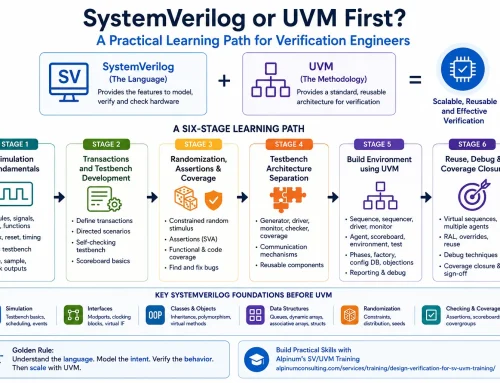
That is why knowledge of verification-focused SystemVerilog matters before UVM architecture becomes productive. Alpinum’s existing SystemVerilog or UVM First? learning path covers the prerequisite question in detail. The migration problem addressed here begins one step later: how to refactor useful verification capability that already exists.
A Ten-Stage Migration from Directed Tests to Constrained-Random UVM
Stage 1: Preserve Valuable Directed Tests
Change: classify the existing test suite instead of replacing it. Keep: basic reset, smoke, specification examples, historically important bug regressions and scenarios that give unusually clear debug evidence. Why: these tests form a stable behavioural baseline while the infrastructure changes. Common failure: translating every test into random stimulus simply to make the environment appear more sophisticated. Evidence: the retained suite still produces the same expected pass/fail outcomes after testbench refactoring.
Directed tests should remain first-class regression assets when they represent requirements or known risks.
Stage 2: Define Transaction Objects
Change: represent operations as data rather than sequences of signal assignments. A bus transaction, for example, may contain operation type, address, payload, byte enabled and response information. SystemVerilog classes, queues, dynamic arrays and associative arrays become useful here.
Keep: the original scenario intent. Why: one transaction can be created deterministically today and randomised later without changing the driver. Common failure: creating an object that simply mirrors every pin rather than representing protocol meaning. Evidence: existing directed scenarios can be expressed using transactions without changing DUT behaviour.
Stage 3: Separate Scenario Intent from Pin-Level Driving
Change: move cycle-level protocol mechanics into a driver or transactor. The test should request “write transaction A”, not toggle valid, ready, address and data signals itself. SystemVerilog interfaces and clocking blocks provide the signal boundary; class-based components can access that interface through a virtual interface.
Keep: deterministic transaction sequences. Why: protocol timing can then change without rewriting every scenario. Common failure: leaving scenario policy inside the driver. Evidence: several tests use the same driver without modifying it, and the same transaction API can generate both directed and future random traffic.
Stage 4: Add Monitors and Independent Checking
A driver describes what the testbench attempted to apply. A monitor should reconstruct what was actually observed at the DUT interface. That distinction matters because relying solely on intended stimulus can conceal errors in the driver or connection.
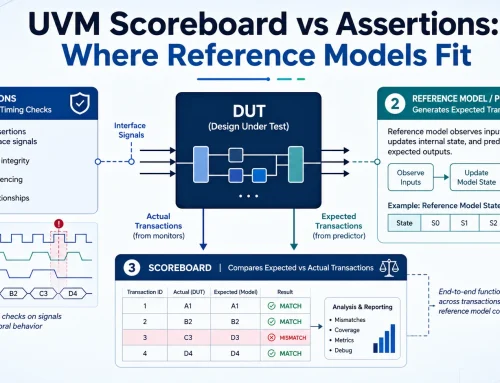
Observed transactions can travel through analysis ports or equivalent transaction-level paths to scoreboards, coverage collectors and reference models. SVA should be used where temporal protocol rules, invariants and local relationships are naturally expressed as properties.
A scoreboard should not mechanically reproduce the DUT implementation. A useful reference model should derive expected behaviour from the specification at an appropriate level of abstraction. Alpinum’s UVM Scoreboard vs Assertions: Where Reference Models Fit examines this allocation in detail.
Evidence: deliberately incorrect responses are rejected independently of how the stimulus was generated.
Stage 5: Introduce Controlled Randomisation and Meaningful Constraints
Only after stimulus and checking are separated should randomisation become a primary stimulus mechanism.
Change: make selected transaction fields randomisable and encode legality in constraints. Add distributions or inline constraints to target boundaries, rare modes and combinations relevant to the verification plan. Keep: the ability to create an exact transaction whenever required. Why: constrained randomisation broadens exploration without giving up control. Common failure: over-constraining the generator until it repeatedly exercises comfortable scenarios, or under-constraining it so that regressions waste time on meaningless inputs. Evidence: seed-based regressions produce reproducible, legal and measurably varied transactions.
Stage 6: Use Functional Coverage to Guide Verification
Functional coverage should represent planned verification intent rather than everything that is easy to count. Coverpoints can describe transaction types, states, boundary values or operating modes; bins classify meaningful ranges; crosses capture combinations that the specification makes significant.
Sampling also matters. Sampling a covergroup every clock may count values that were never accepted as transactions. Sampling at transaction acceptance, completion or another defined semantic event often produces more defensible evidence.
Code coverage asks what RTL structures were exercised. Functional coverage asks whether planned behaviours occurred. Neither establishes correctness by itself. High functional coverage is particularly dangerous if the checker is incapable of recognising an incorrect result.
Evidence: coverage holes lead to a clear decision,change constraints, add a targeted test, improve observability, justify an exclusion or revise the coverage model, rather than merely running more seeds.
Stage 7: Build the First Reusable UVM Agent
SystemVerilog can perform everything described above without UVM. UVM becomes useful when a project benefits from standard component lifecycles, configuration, transaction communication and reusable interface-level verification components.
IEEE 1800.2 defines the UVM base class library and methodology on top of SystemVerilog; UVM is not a simulator.
A first active agent normally brings together a sequencer, driver and monitor for one interface. Sequence items represent transactions; sequences create transaction streams; the sequencer arbitrates requests; and the driver performs the sequencer-driver handshake before translating each item into interface activity.
The environment can then connect monitor analysis ports to checking and coverage using TLM. Factory registration, build/connect/run phases and uvm_config_db are valuable once they solve real construction and configuration problems rather than being added as decoration.
For a broader description of the architecture itself, see What Is UVM in Design Verification?.
Evidence: the agent can be configured, used by several tests and switched to passive observation when another component owns stimulus.
Stage 8: Add Advanced Sequences, Multiple Agents and RAL Only When Needed
Virtual sequences become useful when one scenario must coordinate several interface-level sequencers. Multiple agents are justified when the DUT genuinely exposes several interfaces or roles. UVC packaging becomes valuable when a stable protocol capability must move between environments.
RAL is similarly a later-stage abstraction: it helps when register modelling, address maps, prediction, front-door/back-door access and reusable register sequences have become a significant part of the verification problem.
These mechanisms should follow a real coordination or reuse requirement. Adding them prematurely increases indirection without improving verification evidence.
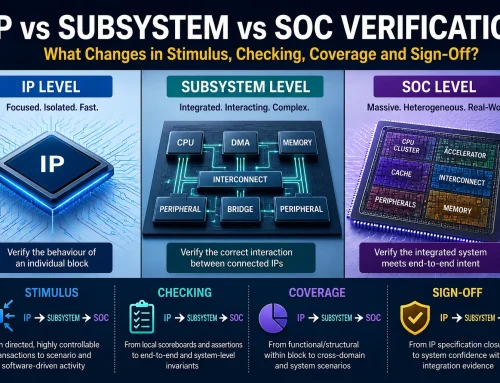
When components move from IP to subsystem or SoC, active agents may become passive and system-level software may assume stimulus control. Alpinum’s IP vs Subsystem vs SoC Verification analysis explains why reuse should preserve proven capability without blindly preserving lower-level assumptions.
Stage 9: Qualify and Debug the Verification Environment
Coverage should not be trusted until the environment itself has been challenged.
Deliberately inject representative defects or mutations: corrupt data, drop a response, break ordering, violate reset behaviour or alter a status condition. Then confirm that the relevant assertion, scoreboard or reference-model path fails for the right reason.
This is also where UVM debug infrastructure becomes useful: topology printing, factory and configuration-database dumps, controlled reporting and transaction recording can reveal what the environment actually built and how transactions moved through it. Alpinum’s official outline explicitly includes mutation testing, testbench qualification and these UVM debug mechanisms.
Evidence: known injected defects are detected, localised and reported in a form engineers can act upon.
Stage 10: Define Regression, Coverage and Sign-Off Evidence
A passing regression is not proof of completeness.
The final migration step is to connect verification requirements with the stimulus capable of exercising them, the checker or assertion capable of detecting failure, coverage showing whether relevant scenarios occurred, regression results, justified exclusions and known residual risk.
Sign-off should therefore answer more than “Did all tests pass?” It should establish why the verification team believes the planned behaviours were stimulated and observed, why incorrect behaviour would have been detected, which objectives remain open and which residual risks have been accepted.
That relationship between requirements, stimulus, checking, coverage, debug and risk is more defensible than either test count or coverage percentage alone.
When UVM Is and Is Not the Right Choice
UVM is worth considering when an environment needs a stable transaction-level interface, multiple tests sharing the same transactors, configurable active/passive behaviour, reusable protocol components, several analysis consumers, multi-agent coordination, large regressions or reuse across integration levels.
It can be excessive for a small, stable block with a short project life, a narrow deterministic state space and little expected reuse. In such cases, a concise self-checking SystemVerilog testbench, assertions and where appropriate formal verification may provide clearer engineering value.
Using UVM classes does not automatically make a testbench reusable. Reuse comes from carefully chosen abstraction boundaries, controlled configuration, independent observation and a stable transaction contract.
Practical Migration Checklist
Before declaring the migration successful, confirm that:
- Important directed smoke tests and known-bug regressions still run
- Scenario intent is represented at transaction level rather than embedded in signal manipulation
- Pin-level protocol behaviour is isolated in drivers/interfaces
- Monitors observe DUT activity independently of the stimulus source
- Checkers and reference models derive expected behaviour independently enough to detect relevant faults
- Constraints define legal and useful stimulus rather than arbitrary randomness.
- Every random failure records enough seed and configuration information to reproduce it
- Functional coverage maps to verification requirements and has a defined sampling strategy
- The environment has been challenged with intentional faults or mutations.
- Sign-off evidence links requirements, stimulus, checks, coverage, debug status and residual risk
Signs That a Team Needs Structured SystemVerilog and UVM Capability
The strongest signal is not simply “we have many tests”. It is repeated engineering friction: every new scenario requires editing low-level tasks; stimulus and checking are coupled; failures cannot be reproduced reliably; coverage does not map to requirements; multiple engineers implement different versions of the same protocol behaviour; or subsystem integration requires rebuilding components that should have been reusable.
Those problems call for connected capability across SystemVerilog classes and interfaces, constrained randomisation, SVA, coverage, UVM architecture, sequence control, TLM, checking, debug and verification planning.
Build Practical SystemVerilog and UVM Capability
Moving from directed tests to constrained-random UVM requires more than learning UVM class names or copying an environment template. Engineers need to understand stimulus modelling, constraints, independent checking, assertions, functional coverage, UVM architecture, reuse, debug and verification closure as one workflow.
Alpinum’s Design Verification Training with SystemVerilog and UVM follows that progression. The current programme includes a self-paced SystemVerilog foundation module followed by four weeks of live teaching, with Moodle quizzes, guided demonstrations and graded practical exercises. Its published curriculum progresses from directed testbenches and randomisation through coverage, UVM agents, sequences, TLM, scoreboards, advanced UVM, RAL, debug, testbench qualification and IP-to-SoC verification.
Explore the SystemVerilog and UVM Training Programme
Key Takeaways
Directed and constrained-random verification solve different problems and should normally coexist. The safest migration preserves valuable deterministic tests, abstracts stimulus into transactions, separates observation and checking, introduces randomisation only when failures can be detected and reproduced, and lets coverage guide rather than replace engineering judgement.
UVM should enter when its architecture solves a genuine organisation, configuration or reuse problem. Coverage should be trusted only after the checking environment has itself been qualified. Verification sign-off then becomes an evidence argument rather than a test-count exercise.
References
[1] IEEE Standards Association. IEEE 1800-2023 IEEE Standard for SystemVerilog Unified Hardware Design, Specification, and Verification Language. https://standards.ieee.org/ieee/1800/7743/
[2] IEEE Standards Association. IEEE 1800.2-2020 IEEE Standard for Universal Verification Methodology Language Reference Manual. https://standards.ieee.org/ieee/62530-2/11429/1800.2/7567/
[3] Accellera Systems Initiative. Download UVM Standard Universal Verification Methodology. The current page also provides IEEE 1800.2 reference implementations. https://accellera.org/downloads/standards/uvm
[4] Doulos. UVM Verification Primer. Particularly relevant to verification planning, directed testing, constrained-random stimulus and coverage-driven feedback. https://www.doulos.com/knowhow/systemverilog/uvm/uvm-verification-primer/
[5] Alpinum Consulting. SystemVerilog & UVM Design Verification Training Course Outline. https://alpinumconsulting.com/wp-content/uploads/Alpinum-SystemVerilog-UVM-Design-Verification-Outline.pdf
FAQs
Directed verification applies scenarios chosen explicitly by an engineer. Constrained-random verification generates varied transactions subject to rules that describe legal or otherwise purposeful stimulus. Directed tests are strong for known cases and debug; constrained randomisation is useful for exploring combinations. Most substantial environments benefit from both.
No. UVM sequences can generate deterministic as well as randomised scenarios. Directed smoke tests, specification examples and regressions for known bugs can remain valuable within a UVM environment. Alpinum’s existing UVM guide also explicitly recommends combining directed and constrained-random approaches.
Yes. Constrained randomisation is a SystemVerilog language capability defined by IEEE 1800. UVM provides a methodology and base-class architecture for organising larger verification environments; it is not required merely to use random variables, constraints, covergroups or assertions.
Adoption becomes more compelling when several tests need common transaction-level stimulus, drivers and monitors; when active/passive reuse matters; when multiple components need TLM communication; or when the environment must scale across interfaces or integration levels. A small short-lived bench may not justify the extra architecture.
They do not need to master the entire language first, but they should understand the parts UVM relies upon: classes, object handles, inheritance, interfaces and virtual interfaces, dynamic data structures, constrained randomisation and simulation behaviour. Coverage and assertions should also be understood as verification mechanisms rather than merely syntax.
Extending classes from UVM does not guarantee reuse. Reuse depends on stable transaction abstractions, protocol mechanics isolated from scenario policy, configuration rather than hard-coded assumptions, independent monitoring, sensible active/passive modes and clearly defined checking and analysis interfaces.
Functional coverage measures whether verification-plan behaviours and combinations actually occurred. Coverage holes can indicate that constraints need adjustment, a directed test is required, a scenario is unreachable, observability is inadequate or an exclusion requires justification. Coverage does not establish that the checker is correct.
There is no defensible universal duration. It depends on SystemVerilog experience, existing testbench quality, protocol complexity, number of interfaces, checking architecture and reuse objectives. A safer measure is evidence: move to each new abstraction only after the previous stage can still generate, observe, check and reproduce the required behaviour.

Written by : Mike Bartley
Mike started in software testing in 1988 after completing a PhD in Math, moving to semiconductor Design Verification (DV) in 1994, verifying designs (on Silicon and FPGA) going into commercial and safety-related sectors such as mobile phones, automotive, comms, cloud/data servers, and Artificial Intelligence. Mike built and managed state-of-the-art DV teams inside several companies, specialising in CPU verification.
Mike founded and grew a DV services company to 450+ engineers globally, successfully delivering services and solutions to over 50+ clients.
Mike started Alpinum in April 2016 to deliver a range of start-of-the art industry solutions:
Alpinum AI provides tools and automations using Artificial Intelligence to help companies reduce development costs (by up to 90%!) Alpinum Services provides RTL to GDS VLSI services from nearshore and offshore centres in Vietnam, India, Egypt, Eastern Europe, Mexico and Costa Rica. Alpinum Consulting also provides strategic board level consultancy services, helping companies to grow. Alpinum training department provides self-paced, fully online training in System Verilog, UVM Introduction and Advanced, Formal Verification, DV methodologies for SV, UVM, VHDL and OSVVM and CPU/RISC-V. Alpinum Events organises a number of free-to-attend industry events
You can contact Mike (mike@alpinumconsulting.com or +44 7796 307958) or book a meeting with Mike using Calendly (https://calendly.com/mike-alpinum-consulting).
Stay Informed and Stay Ahead
Latest Articles, Guides and News
Explore related insights from Alpinum that dive deeper into design verification challenges, practical solutions, and expert perspectives from across the global engineering landscape.