
A move into design verification does not always begin immediately after university.
Engineers may be preparing to move from RTL design, FPGA, embedded software, validation or another technical discipline. Graduates may want to strengthen practical verification skills before entering industry. University students may be preparing for postgraduate study or placements. Others already have an offer for a new role and want to close specific knowledge gaps before their start date.
These situations have something important in common: the learning objective is tied to a real milestone.
The question is therefore not simply: Which verification topics should I learn?
A more useful question is: What do I need to be able to do by the time I begin my next role, project or stage of study, and how should I build those capabilities in the time available?
For design verification, this normally means moving beyond isolated knowledge of SystemVerilog or UVM and developing an understanding of the complete verification workflow: requirements, stimulus, checking, assertions, coverage, debug, reuse and verification closure.
For engineers who need a structured route through these areas, Alpinum’s Design Verification Training with SystemVerilog and UVM progresses from foundations into practical IP-, subsystem- and SoC-level verification.
Explore Design Verification Training with SystemVerilog and UVM
Key learning points
| If you are preparing for… | Your priority should be… |
| A first design verification role | Build a structured foundation in SystemVerilog, assertions, coverage, UVM and debug |
| A move from design or FPGA into verification | Add verification methodology, stimulus, checking, coverage and testbench architecture |
| A move from simulation into formal verification | Develop property-writing, proof, constraint, counterexample and formal-coverage skills |
| CPU or SoC verification work | Combine verification fundamentals with processor architecture, RISC-V and system-level verification |
| University or postgraduate study | Build foundations early and connect theory to practical verification workflows |
| A new job with a fixed start date | Work backwards from the role requirements and prioritise the most important capability gaps |
The objective is not to learn every verification technology before starting a new role. It is to create a defensible progression from fundamentals to the skills you are most likely to use.
1. Start with the role, not the tool
A common learning mistake is to begin with a list of technologies:
SystemVerilog → UVM → SVA → formal → RISC-V → Python → AI.
The list may contain useful topics, but it does not yet define a learning plan.
Start instead with the engineering work you expect to perform.
For example, someone joining a simulation-based verification team may need to understand how to:
- Interpret RTL and specifications
- Identify what needs to be verified
- Generate meaningful stimulus
- Build self-checking testbenches
- Write assertions
- Define functional coverage
- Understand UVM components and transactions
- Debug failing tests
- Distinguish DUT problems from testbench problems
- Review coverage and decide what remains unverified
That creates a much more useful learning sequence.
The same principle applies to specialists. Someone preparing for formal verification needs a different depth of property-writing and proof-analysis capability. Someone moving towards RISC-V CPU verification needs additional architectural understanding.
Training should follow the engineering problem, rather than becoming a collection of disconnected courses.
2. Build the SystemVerilog foundation first
For most engineers entering modern digital design verification, SystemVerilog is a logical starting point.
The IEEE SystemVerilog standard covers far more than RTL syntax. It includes verification-oriented capabilities such as assertions, coverage, object-oriented programming and constrained-random verification.
IEEE 1800-2023 SystemVerilog Standard
An engineer preparing for verification work should therefore become comfortable with areas such as:
- SystemVerilog data types and interfaces
- Tasks and functions
- Classes and object-oriented programming
- Randomization and constraints
- Queues and dynamic structures
- Assertions
- Cover groups and functional coverage
- Communication between testbench components
But learning SystemVerilog syntax alone is not the destination.
The important next step is understanding why those language features exist within a verification environment.
For example, randomisation is useful because it can help explore a larger behavioural space. Functional coverage helps determine whether important scenarios occurred. Assertions express behaviours that must hold. Classes enable reusable verification components.
This relationship between language and verification intent is what turns syntax knowledge into usable engineering capability.
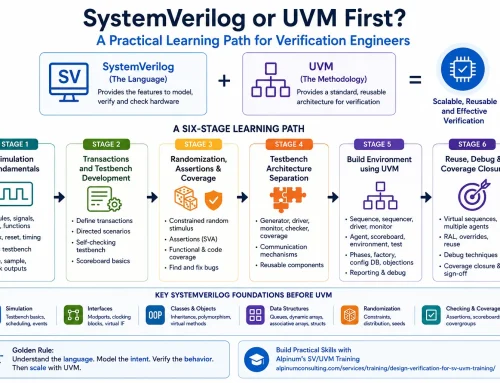
SystemVerilog or UVM First? A Practical Learning Path for Verification Engineers
3. Learn the complete verification loop
A verification engineer does more than write tests.
A useful learning path should eventually connect the entire verification cycle:
Understand the design → identify verification features → plan → generate stimulus → check behaviour → measure coverage → debug failures → review evidence → close verification
This wider workflow matters because even a technically correct testbench can provide poor verification confidence if it is checking the wrong behaviours.
An engineer preparing for a new role should therefore practise asking questions such as:
- What requirement is this test addressing?
- What could fail?
- What stimulus is required to expose that failure?
- How will the expected result be calculated?
- What should be asserted?
- What should be measured with coverage?
- What would constitute sufficient evidence?
- How would a failure be debugged?
These questions move learning away from memorising APIs and towards verification reasoning.
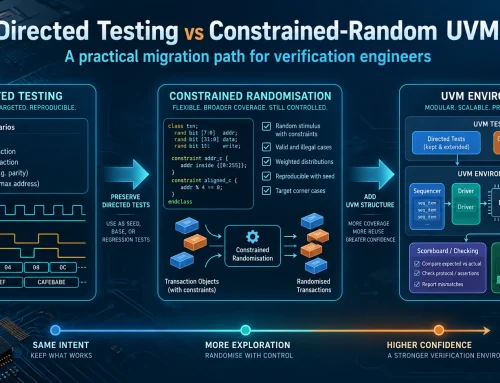
4. Move from directed tests towards structured verification
Early verification exercises often use simple directed tests.
That is useful. It allows an engineer to understand the relationship between inputs, outputs and expected behaviour without introducing unnecessary complexity.
The progression should then expand towards:
Stimulus
Learn how to create meaningful input behaviour rather than simply generating random values.
Checking
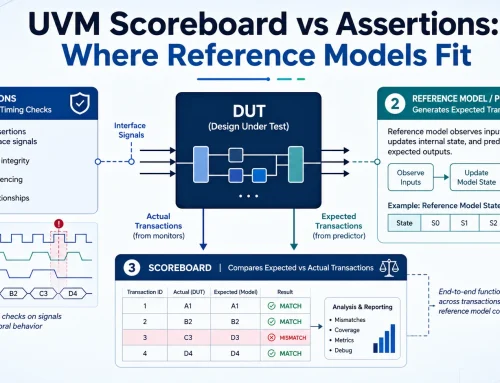
Develop scoreboards, reference models and other mechanisms for deciding whether the DUT behaved correctly.
Assertions
Express important temporal or logical behaviour directly.
Functional coverage
Measure whether the behaviours identified in the verification plan have actually been exercised.
Debug
Trace failures from symptoms back through stimulus, checking, protocol behaviour, RTL and testbench architecture.
This sequence provides the foundation needed before UVM becomes genuinely useful.
5. Learn UVM as a methodology, not a collection of classes
UVM is widely used because verification environments need to be reusable, scalable and structured.
The Accellera UVM Working Group describes its objective as enabling modular, scalable and reusable verification environments, while the IEEE UVM standard addresses interoperability and reuse of verification components.
Accellera Universal Verification Methodology Working Group
For someone preparing for a design verification role, useful UVM capability includes understanding:
- Transactions and sequence items
- Sequences and sequencers
- Drivers
- Monitors
- Agents
- Scoreboards
- Configuration
- Factories
- Phases and objections
- Register abstraction
- Virtual sequences
- Testbench reuse
- Debug
But knowing the names of these classes is insufficient.
Why does this component exist?
What verification responsibility does it own?
How does information move through the environment?
Which parts can be reused when the DUT changes?
Where would you look when a test fails?
That is much closer to the reasoning expected in engineering work.
What Is UVM in Design Verification?
6. Do not leave debug until the end
Verification engineers spend substantial time understanding why something failed.
A test may fail because of:
- An RTL defect
- Incorrect stimulus
- A scoreboard error
- An assertion problem
- An incorrect model
- Reset sequencing
- Configuration
- Timing
- An integration problem
- An invalid assumption
A useful training path should therefore develop debugging as a core engineering skill, not as an afterthought.
Start with simple waveform analysis and progressively introduce:
- Protocol tracing
- Assertion-based debug
- Regression triage
- Failure reproduction
- Seed management
- Root-cause isolation
- Subsystem interaction
- Counterexample analysis where formal methods are used
Someone beginning a new role who can reason systematically about failures will generally be more useful than someone who has memorised a large number of language constructs but cannot diagnose why their environment is failing.
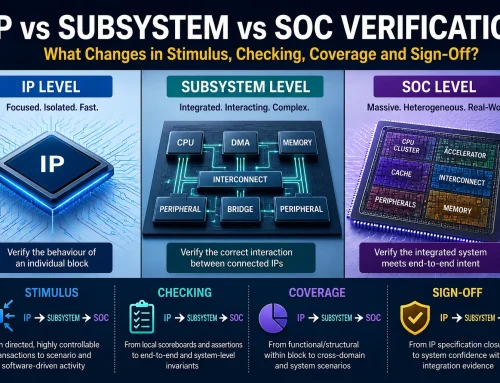
7. Understand how verification changes from IP to SoC
Another important transition is understanding that verification does not simply become “more UVM” as designs grow.
At IP level, a verification environment may have direct control over almost every relevant interface.
At subsystem level, interaction becomes increasingly important.
At SoC level, processors, interconnect, memory, peripherals, accelerators and software can all interact, while direct controllability and observability may decrease.
The verification strategy therefore evolves.
Alpinum’s analysis of IP, subsystem and SoC verification explains how stimulus, checking, coverage, debug and sign-off expectations change with hierarchy.
Read: IP, Subsystem and SoC Verification, What Changes?
This is especially useful for engineers who already understand basic UVM but want to prepare for larger project environments.
8. Work backwards from your start date
When someone already knows when a new role, placement, project or programme begins, a useful strategy is to work backwards from that date.
The following is an illustrative planning model, rather than a fixed course schedule.
If you have several months
Build a broad foundation:
Foundations → SystemVerilog → verification methodology → SVA → coverage → UVM → practical exercises → debug → specialist topics
This gives time to revisit weak areas and practise.
If you have six to eight weeks
Prioritise the skills most directly connected to the role.
For a new design verification position, that could mean:
SystemVerilog verification features → checking → assertions → coverage → core UVM → debug
Avoid spreading limited time across too many specialist subjects.
If you have only a few weeks
Perform a gap analysis.
If you already understand RTL and SystemVerilog but have limited UVM experience, concentrate on UVM architecture and verification workflow.
If you already use simulation but are joining a formal-verification team, focus on properties, assumptions, proof outcomes and counterexample debug.
If your new team works on CPUs, build the relevant processor and RISC-V context rather than repeating material you already understand.
If you have already started the role
Training can still be valuable.
Use real engineering experience to identify specific gaps and address them deliberately rather than attempting to relearn the entire discipline.
Prioritise the knowledge gap that will most affect your ability to contribute to the work ahead.
9. Choose the delivery model that fits the objective
Career transitions and study preparation often have constraints that corporate training plans do not.
Someone may be:
- Working full-time
- Finishing a degree
- Moving countries
- Waiting to start a new job
- Supporting family responsibilities
- Operating in a different time zone
For this reason, delivery format matters
Alpinum currently provides different training models across its portfolio, including live online programmes and selected on-demand training. Availability varies by course, so learners should check the current training hub rather than assume that every course follows the same delivery model.
View Current Semiconductor Training Options and Registration
This distinction is important.
An on-demand programme can be useful when scheduling flexibility is the main constraint.
Instructor-led training may be more appropriate when a learner benefits from a structured timetable, interaction, demonstrations and review.
The right choice depends on the target capability, existing experience and time available.
10. Add practical work as early as possible
Watching training content can develop familiarity.
It does not automatically develop engineering capability.
A useful learning programme should include opportunities to:
- Write code
- Create stimulus
- Run tests
- Inspect waveforms
- Analyze failures
- Develop assertions
- Measure coverage
- Modify a testbench
- Debug unexpected behavior
- Explain the resulting evidence
Alpinum’s Design Verification with SystemVerilog and UVM programme, for example, combines teaching with quizzes, guided demonstrations and graded exercises, while its training infrastructure also includes an online submission environment for structured exercises.
Explore the Alpinum Online Submission Portal
For career preparation, practical exercises have another benefit: they expose gaps quickly.
It is easy to believe you understand constrained randomisation, assertions or UVM configuration while watching an explanation.
Trying to implement and debug the same concept independently provides a much stronger test of understanding.
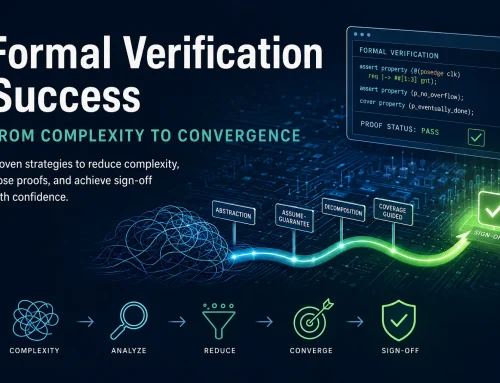
11. Add formal verification when the role requires deeper proof-based reasoning
Formal verification is not simply “advanced simulation”.
Simulation executes selected behaviours. Formal verification can analyse whether a defined property can be violated across the behaviours permitted by the mathematical model and its constraints.
That changes the engineering mindset.
An engineer moving from simulation into formal needs to develop capability in areas such as:
- SystemVerilog Assertions
- Property definition
- Assumptions and constraints
- Reachability
- Proof outcomes
- Counterexample debug
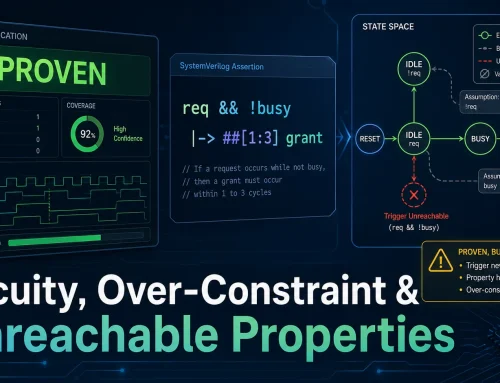
- Vacuity
- Over-constraint
- Proof convergence
- Formal coverage
- Completeness and sign-off
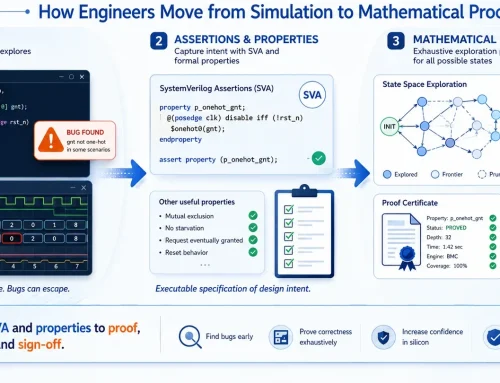
Alpinum’s learning guide explains this transition from simulation-based thinking into property- and proof-based verification.
Read: From Simulation to Formal Proof , A Practical Learning Path
Engineers who need structured practical development can then explore:
12. Add CPU and RISC-V knowledge when the target role requires it
A verification engineer moving towards CPU or SoC work also needs to understand what is being verified.
That may include:
- Instruction execution
- Architectural state
- Privilege behavior
- Exceptions and interrupts
- Memory interaction
- Pipelines
- Caches
- Processor integration
- Software-driven verification
- System-level behavior
For engineers working specifically with RISC-V, the ratified specifications maintained by RISC-V International provide the authoritative architectural reference.
RISC-V Ratified Specifications Library
Alpinum’s RISC-V Verification Training builds from processor and verification concepts towards CPU- and SoC-level verification practice. It is intended for audiences that include graduate recruits, placement students and engineers moving into CPU or RISC-V verification.
Explore RISC-V Verification Training
13. Students can start building industry context before graduation
University study provides an important theoretical foundation, but students preparing for design verification careers can strengthen that foundation by connecting it to real verification workflows.
Useful areas to explore before entering industry include:
- RTL interpretation
- SystemVerilog
- Assertions
- Constrained-random verification
- UVM
- Functional coverage
- Verification planning
- Debugging
- CPU and SoC concepts
- formal verification
Students should not try to learn every area simultaneously.
A better objective is to understand the verification lifecycle and then build depth around the technologies most relevant to the placement, dissertation, postgraduate course or role they are targeting.
Alpinum provides reduced-price access to selected online training programmes for eligible university students using a valid academic email address.
Apply for the University Student Access Programme
14. How do you know whether you are ready for the next step?
No checklist can guarantee readiness for a job, and training should not be treated as a substitute for engineering experience.
A more practical self-assessment is to ask whether you can perform and explain the core activities.
Can I explain what verification is trying to establish?
Not simply “find bugs”, but how requirements are converted into verification objectives and evidence.
Can I read a small RTL design and identify what needs testing?
This connects design understanding with verification planning.
Can I generate meaningful stimulus?
Including directed and constrained-random approaches where appropriate.
Can I determine whether the DUT behaved correctly?
Through checking, reference models, scoreboards or assertions.
Can I write and interpret basic SVA?
Assertions are valuable in both simulation and formal verification.
Can I define useful functional coverage?
Coverage should correspond to verification intent, not merely produce a percentage.
Do I understand the architecture of a UVM environment?
You should understand the responsibilities of the major components and the way transactions and information move between them.
Can I debug a failure?
Can you distinguish a DUT bug from a testbench, model, stimulus or configuration problem?
Can I explain what remains unverified?
Verification engineering includes recognising the limits of the available evidence.
If several of these answers are “not yet”, they provide a useful starting point for the learning plan.
15. A practical pathway for different career goals
| Career objective | Suggested learning direction |
| Enter design verification | SystemVerilog → verification methodology → SVA → coverage → UVM → debug |
| Move from RTL design into verification | Verification planning → stimulus/checking → SVA → coverage → UVM |
| Move into advanced UVM | UVM architecture → sequences → reuse → RAL → multi-agent environments → debug |
| Move from simulation into formal | SVA → properties → assumptions → proof → counterexamples → formal coverage |
| Prepare for CPU/RISC-V verification | DV foundations → CPU architecture → RISC-V → CPU verification → SoC verification |
| Prepare for SoC verification | IP verification → subsystem integration → software-driven/system verification → closure |
This does not mean every engineer must follow exactly the same sequence. Existing knowledge should always be taken into account.
Flexible learning should still be structured learning
Flexibility is valuable when training needs to fit around a job, university study or an upcoming start date.
But flexibility should not mean learning without direction.
The strongest approach combines:
a defined destination + an honest skills-gap assessment + a logical learning sequence + practical application + review
That creates a much better preparation strategy than attempting to complete as many courses as possible before a deadline.
For someone moving into design verification, the goal should be to arrive with a usable mental model of the verification process and enough practical capability to continue learning productively inside the engineering team.
Build your verification learning path
If you are preparing for a new engineering role, career transition, university programme or a move into a specialist verification area, start by identifying the capability you need rather than simply selecting the next available course.
Alpinum’s semiconductor training portfolio covers practical learning across:
- SystemVerilog
- UVM
- SystemVerilog Assertions
- Design verification
- Formal verification
- RISC-V verification
- Hardware and software security;
- Functional safety
- Low-power verification
- AMS and mixed-signal verification
- Software development and AI-assisted engineering workflows
Different programmes use different delivery formats, including live online and selected on-demand options. Current availability and registration information are maintained through the main training hub.
Preparing for your next engineering step?
Review the available training routes and select the pathway that best matches your current experience, target role and timetable.
References
1. IEEE Standard for SystemVerilog, IEEE 1800-2023. The standard defines SystemVerilog as a unified hardware design, specification and verification language and includes verification features such as coverage, assertions, object-oriented programming and constrained randomization. https://standards.ieee.org/ieee/1800/7743/
2. IEEE Standard for Universal Verification Methodology, IEEE 1800.2-2020. Standardised UVM semantics and API for verification methodology interoperability and reuse. https://standards.ieee.org/ieee/1800.2/7567/
3. Accellera Systems Initiative, UVM Working Group. Accellera develops and supports the standardised UVM methodology and reference implementation. https://www.accellera.org/activities/working-groups/uvm
4. RISC-V International, Ratified Specifications Library. Authoritative library of ratified RISC-V specifications. https://docs.riscv.org/reference/home/index.html
FAQs
Yes. Existing knowledge from RTL design, FPGA engineering, embedded software, validation or related disciplines can be valuable, but the learning gaps differ. Start by identifying which verification capabilities are missing rather than assuming you need to begin every subject from zero.
SystemVerilog provides the language foundation for UVM, so engineers who do not yet understand SystemVerilog verification features should normally develop that foundation before trying to master advanced UVM architecture.
No. UVM is an important methodology, but verification also requires design understanding, planning, stimulus generation, checking, assertions, coverage, debugging and engineering judgement.
Yes. A structured learning plan can be built around existing commitments. Selected training may be available through different delivery models, including live online and on-demand formats. Check the current course information before choosing a programme.
Selected Alpinum courses are available through on-demand formats. Other programmes are live online, so the delivery model should be checked for the specific course.
Priorities normally include SystemVerilog verification features, stimulus, checking, assertions, functional coverage, core UVM architecture and debugging. The exact depth depends on the role and your existing experience.
Yes. Simulation knowledge provides a strong base, but formal verification introduces property-driven reasoning, environmental constraints, proof results, counterexamples and formal coverage. The transition therefore requires additional methodology skills rather than simply learning another tool.
Eligible university students can apply for reduced-price access to selected online Alpinum training programmes using an official academic or university email address.

Written by : Mike Bartley
Mike started in software testing in 1988 after completing a PhD in Math, moving to semiconductor Design Verification (DV) in 1994, verifying designs (on Silicon and FPGA) going into commercial and safety-related sectors such as mobile phones, automotive, comms, cloud/data servers, and Artificial Intelligence. Mike built and managed state-of-the-art DV teams inside several companies, specialising in CPU verification.
Mike founded and grew a DV services company to 450+ engineers globally, successfully delivering services and solutions to over 50+ clients.
Mike started Alpinum in April 2016 to deliver a range of start-of-the art industry solutions:
Alpinum AI provides tools and automations using Artificial Intelligence to help companies reduce development costs (by up to 90%!) Alpinum Services provides RTL to GDS VLSI services from nearshore and offshore centres in Vietnam, India, Egypt, Eastern Europe, Mexico and Costa Rica. Alpinum Consulting also provides strategic board level consultancy services, helping companies to grow. Alpinum training department provides self-paced, fully online training in System Verilog, UVM Introduction and Advanced, Formal Verification, DV methodologies for SV, UVM, VHDL and OSVVM and CPU/RISC-V. Alpinum Events organises a number of free-to-attend industry events
You can contact Mike (mike@alpinumconsulting.com or +44 7796 307958) or book a meeting with Mike using Calendly (https://calendly.com/mike-alpinum-consulting).
Stay Informed and Stay Ahead
Latest Articles, Guides and News
Explore related insights from Alpinum that dive deeper into design verification challenges, practical solutions, and expert perspectives from across the global engineering landscape.