
Engineers moving into semiconductor design verification often face the same question:
Should I learn SystemVerilog first, or can I start directly with UVM?
The practical answer is:
Learn the verification-focused foundations of SystemVerilog first, and then learn UVM by applying those foundations to a real testbench.
You do not need to master every part of SystemVerilog before opening the UVM library. However, starting UVM without understanding classes, interfaces, constrained randomisation, data structures, coverage and simulation behaviour usually turns the methodology into a collection of unfamiliar macros and class names.
SystemVerilog provides the language capabilities used to create modern verification environments. UVM provides a standard architecture and methodology for organising those capabilities into reusable components, tests and environments.
That relationship matters. SystemVerilog is standardised as a unified hardware design, specification and verification language under IEEE 1800-2023. Its verification features include object-oriented programming, constrained random verification, assertions and coverage. UVM is separately standardised under IEEE 1800.2 and provides a reusable methodology and base-class library implemented in SystemVerilog.
For engineers who want to progress from the fundamentals to practical project contribution, Alpinum’s Design Verification for SV/UVM Training follows this progression through verification strategy, simulation, stimulus, checking, coverage, SystemVerilog, UVM, debug and complete IP-to-SoC examples.
Why SystemVerilog Should Come Before UVM
SystemVerilog provides the language features used to build verification behaviour, while UVM provides the methodology for organising that behaviour into reusable components. Engineers should therefore understand verification-focused SystemVerilog before progressing deeply into UVM. Key foundations include classes, interfaces, virtual interfaces, constrained randomisation, data structures, assertions, functional coverage and simulation behaviour. Without this knowledge, UVM can become a collection of unfamiliar macros and components that are difficult to adapt or debug.
Engineers do not need to master the entire SystemVerilog language first. They should learn enough to build a small self-checking testbench, then use UVM to structure and scale it.
Why Beginning Directly with UVM Often Creates Problems
A beginner can copy a UVM testbench, run a sequence and produce simulator output without understanding what is happening underneath.
That is not the same as being able to develop, review or debug a verification environment.
Several problems commonly appear when UVM is learned too early.
The engineer memorises structure without understanding behaviour
They may know that an environment contains a sequence, sequencer, driver, monitor and scoreboard, but not understand how transactions, signals and expected results move between them.
SystemVerilog errors become UVM errors
A misunderstanding of object handles, inheritance, virtual methods, queues or random constraints may appear as a factory, sequence or configuration problem. Debug becomes difficult because the underlying language behaviour is unclear.
Macros hide important operations
Convenience macros can make early examples appear simple. However, an engineer who does not understand the operations hidden by those macros may struggle when greater control, debugging or customisation is required.
The testbench becomes architecture-first rather than intent-first
The engineer begins by creating UVM components instead of defining:
- What behaviour must be verified
- Which inputs and operating modes matter
- What should be checked
- Which failures must be detectable
- Which coverage demonstrates sufficient exploration
- What evidence is required for sign-off
UVM cannot replace verification intent. It provides a disciplined way to implement that intent.
Do You Need to Learn All of SystemVerilog Before UVM?
No.
SystemVerilog is a large language used for both hardware design and verification. A new verification engineer does not need equal depth in every construct before beginning UVM.
The better approach is to learn the parts that UVM and practical verification depend on.
What You Should Learn Before Starting UVM
1. Simulation and basic testbench behaviour
Before using a class-based methodology, understand how simulation works.
This includes:
- Modules and program structure
- Signals and variables
- Procedural blocks
- Blocking and non-blocking assignments
- Tasks and functions
- Time, events and synchronisation
- DUT instantiation
- Clock and reset generation
- Driving inputs
- Sampling outputs
- Race conditions
- Basic simulator execution and debug
An engineer should be able to build and run a small directed testbench without UVM.
This does not mean directed testing is sufficient for a modern SoC. It means the engineer must understand the simulation behaviour that remains underneath a UVM environment.
2. SystemVerilog interfaces and clocking
UVM components exist as class-based objects, while the design under test normally exposes signal-level module interfaces.
The engineer should therefore understand:
- SystemVerilog interfaces
- Modports
- Clocking blocks
- Signal direction
- Synchronised driving and sampling
- Virtual interfaces
Without this foundation, connecting a UVM driver or monitor to the DUT can feel like unexplained methodology rather than normal SystemVerilog behaviour.
3. Object-oriented programming
UVM makes extensive use of object-oriented programming.
Before moving deeply into UVM, engineers should understand:
- Classes and objects
- Object handles
- Constructors
- Inheritance
- Encapsulation
- Polymorphism
- Virtual methods
- Parameterised classes
- Static and instance properties
- Copying and comparing objects
The objective is not to become a general-purpose software architect. It is to understand how UVM components and transaction objects are created, extended, overridden and reused.
4. Verification data structures
Modern verification environments need to store transactions, expected results, outstanding operations, configuration information and coverage-related data.
Useful SystemVerilog structures include:
- Queues
- Dynamic arrays
- Associative arrays
- Structures
- Enumerations
- Packages
- Mailboxes
- Semaphores
These features are especially important when building scoreboards, reference models and transaction-level communication.
5. Randomisation and constraints
Constrained random verification is one of SystemVerilog’s most important verification capabilities.
Before relying on UVM sequences, engineers should understand:
- Random variables
- Constraint blocks
- Inline constraints
- Constraint inheritance
- Constraint conflicts
- Distribution constraints
- Conditional constraints
- Post-randomisation processing
- Reproducibility through seeds
The important skill is not merely generating random values. It is creating legal, meaningful stimulus that targets verification objectives without generating unrealistic or invalid scenarios.
6. Checking, assertions and coverage
Stimulus alone does not verify a design.
An effective testbench must determine whether the DUT behaved correctly and whether the intended state space was explored.
The engineer should understand:
- Self-checking testbenches
- Reference models
- Scoreboards
- Immediate assertions
- Concurrent SystemVerilog Assertions
- Code coverage
- Functional coverage
- Covergroups and coverpoints
- Cross coverage
- Coverage exclusions
- Coverage closure
Alpinum’s SystemVerilog Training covers the relevant language foundations, including classes, polymorphism, constrained random stimulus, interfaces, covergroups, assertions and reusable verification development.
A Practical Six-Stage SystemVerilog-to-UVM Learning Path
The most effective progression is not “finish SystemVerilog, then begin UVM”. It is a sequence of increasingly capable verification exercises.
Stage 1: Build a simple directed testbench
Start with a manageable design such as:
- FIFO
- Counter
- Arbiter
- UART
- Register block
- Simple bus slave
Create a testbench that:
- Generates a clock and reset.
- Drives legal inputs.
- Observes DUT outputs.
- Compares results against expected behaviour.
- Reports failures clearly.
- Runs multiple test scenarios.
At this stage, concentrate on simulation behaviour, controllability, observability and basic checking.
Do not introduce UVM simply to make the example look more professional. First ensure that you understand what the testbench is doing.
Stage 2: Convert signal-level activity into transactions
The next step is to represent stimulus and responses as meaningful operations.
For a FIFO, a transaction might represent:
- Read
- Write
- Data value
- Expected status
- Delay
- Error condition
For a bus peripheral, it might include:
- Address
- Operation type
- Write data
- Byte enables
- Expected response
- Error status
This teaches the engineer to think at the transaction level rather than treating verification as a collection of unrelated signal assignments.
Transaction-level thinking is essential before UVM sequences, drivers and monitors become useful.
Stage 3: Add randomisation, assertions and functional coverage
Once the testbench works with directed transactions, add:
- Randomised transaction fields
- Constraints defining legal behaviour
- Assertions for protocol and timing rules
- Coverpoints for operations and operating modes
- Cross coverage for important combinations
- Deliberate DUT defects to test the quality of the environment
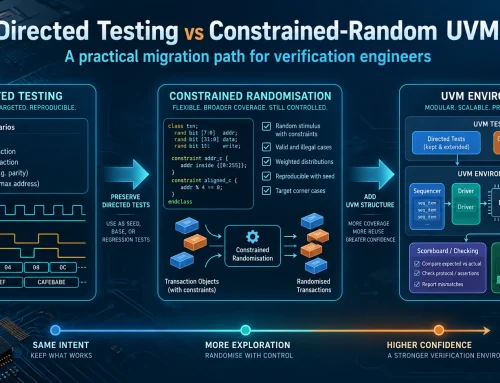
This stage introduces coverage-driven verification without the additional architecture of UVM.
The engineer should be able to explain:
- Why each constraint exists
- What each assertion protects
- What each coverage point measures
- Which bugs the testbench can and cannot detect
Stage 4: Separate generation, driving, monitoring and checking
Refactor the testbench into clear responsibilities:
- Transaction generation
- Interface driving
- Passive monitoring
- Expected-result prediction
- Scoreboard comparison
- Coverage collection
The testbench does not yet need to be UVM-based. The objective is to understand why these responsibilities should be separated.
Once an engineer has experienced the limitations of a tightly coupled testbench, UVM’s component structure has an engineering purpose rather than appearing as unnecessary ceremony.
Stage 5: Rebuild the environment using UVM
The engineer can now map the existing responsibilities into standard UVM components:
| Existing responsibility | UVM implementation |
| Transaction object | uvm_sequence_item |
| Stimulus generation | uvm_sequence |
| Sequence arbitration | uvm_sequencer |
| Signal-level DUT driving | uvm_driver |
| Passive signal observation | uvm_monitor |
| Reusable protocol unit | uvm_agent |
| Expected-versus-actual checking | uvm_scoreboard |
| Integrated verification structure | uvm_env |
| Scenario and configuration selection | uvm_test |
At this stage, learn:
- UVM component hierarchy
- Build, connect and run phases
- Sequence items and sequences
- Sequencer-driver communication
- Analysis ports
- Configuration objects
- uvm_config_db
- Factory registration and overrides
- Objections
- Reporting
- Basic debug
Alpinum’s UVM Introduction Training covers these foundations, including UVM components, sequences, configuration, the factory, scoreboards, TLM analysis connections, register models and debugging.
Stage 6: Practise reuse, debug and coverage closure
A UVM environment is not complete simply because all expected components exist.
Use it against a DUT containing deliberate problems, such as:
- Incorrect status flags
- Dropped transactions
- Ordering errors
- Reset failures
- Protocol violations
- Boundary-condition errors
- Corrupted data
- Timing-dependent failures
Then evaluate whether the environment:
- Detects each defect
- Identifies the failing transaction
- Produces useful diagnostic evidence
- Distinguishes DUT failures from testbench failures
- Measures meaningful functional coverage
- Supports regression execution
- Can be reused at subsystem level
Advanced development can then introduce:
- Virtual sequences and sequencers
- Multiple agents
- Type and instance overrides
- Register Abstraction Layer models
- Complex scoreboards
- Constraint layering
- Error injection
- Reusable verification components
- IP-to-subsystem and subsystem-to-SoC reuse
Alpinum’s Advanced UVM Training develops these areas through advanced sequences, multiple UVCs, factory control, RAL, complex environments, debug and reuse.
When Can an Engineer Start UVM Earlier?
Some engineers can move into UVM more quickly.
An earlier transition may be appropriate when the engineer already has:
- Strong SystemVerilog verification experience
- Good object-oriented programming knowledge
- Experience building transaction-level testbenches
- Understanding of constrained random verification
- Practical knowledge of coverage and assertions
- Experience with another structured verification methodology
For example, an engineer experienced in another object-oriented verification framework may not need to spend weeks on basic class concepts.
However, they should still confirm that they understand SystemVerilog-specific behaviour, especially:
- Object handles
- Randomisation semantics
- Virtual interfaces
- Simulation scheduling
- Constraint inheritance
- Coverage constructs
- Assertions
Moving quickly should mean adapting an existing foundation, not skipping the foundation.
What Should Come After Basic UVM?
Basic UVM knowledge should lead into practical verification capability rather than more class-library memorisation. Engineers should learn to translate requirements into verification objectives, tests, assertions, coverage and clear completion criteria.
The next priorities are debugging failures efficiently, closing meaningful coverage gaps and qualifying the testbench using targeted negative scenarios or deliberate defects. Engineers should also practise reusing components from IP level to subsystem and SoC environments, where configuration, coordination, checking and visibility requirements become more complex.
These capabilities turn a working UVM testbench into a reliable and reusable verification environment.
Where Does AI Fit into Learning and Using UVM?
AI can support engineers by explaining unfamiliar code, adapting approved templates, reviewing small changes and summarising regression results. However, it does not remove the need to understand SystemVerilog behaviour, UVM architecture and verification intent.
Generated code may compile while implementing the wrong handshake, constraint or checking strategy. Engineers must still understand the DUT, define legal scenarios, review assertions and scoreboards, assess coverage quality and validate every change through simulation.
The safest approach is to use AI for small, reviewable tasks while retaining engineering ownership of implementation, debug and sign-off. AlpinumDV’s AI-assisted spec-to-UVM workflow demonstrates how specification understanding, test planning, UVM generation, simulation feedback, debug and coverage improvement can be connected within a structured verification process.
For a broader discussion of suitable use cases, controls and human review, read Alpinum Consulting’s guide to piloting AI in Design Verification safely.
Common Learning Mistakes to Avoid
Trying to memorise the entire UVM class library
Engineers learn more effectively by building and debugging one small complete environment than by memorising dozens of classes and macros.
Building a large SoC environment as the first project
A FIFO or simple peripheral is easier to understand, test and deliberately break. Start with a design where the complete verification flow can be observed.
Treating constrained random stimulus as unlimited randomness
Randomisation must remain connected to legal operation, risk, requirements and coverage objectives.
Delaying checking until after stimulus generation
A test that sends many transactions but cannot determine whether the DUT responded correctly provides activity, not verification confidence.
Using coverage as a substitute for intent
High coverage does not prove that the right behaviour was checked. Coverage must be mapped to meaningful requirements, operating modes and risk.
Ignoring debug until a regression fails
Diagnostic information, transaction recording, report structure and component boundaries should be considered when the environment is designed.
Copying UVM architecture without understanding why it exists
Every component should have a clear role. Additional hierarchy does not automatically create reuse or scalability.
Which Learning Route Is Right for You?
| Current experience | Recommended starting point |
| No HDL or verification experience | Basic Verilog/SystemVerilog simulation and digital design concepts |
| Verilog design experience | SystemVerilog verification features, interfaces, classes and assertions |
| Software or object-oriented programming experience | Simulation semantics, DUT connectivity and verification-focused SystemVerilog |
| Directed-testbench experience | Transactions, constrained randomisation, checking and coverage |
| Strong SystemVerilog verification experience | UVM architecture and practical testbench development |
| Basic UVM experience | Advanced sequences, configuration, reuse, RAL, debug and coverage closure |
| Verification manager or technical lead | Verification strategy, architecture, metrics, planning and sign-off |
The Recommended Path
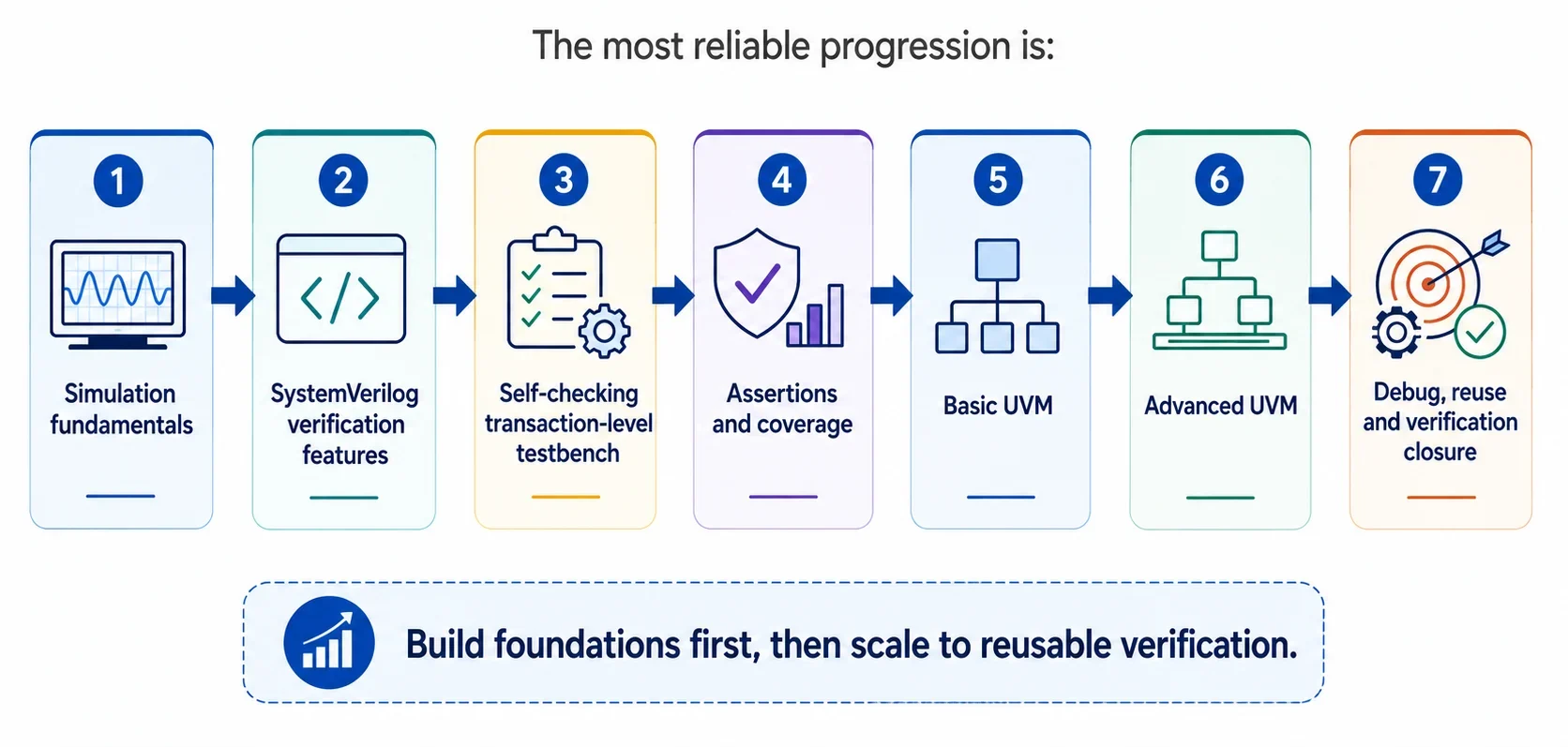
SystemVerilog should come first, but it should be learned through verification problems rather than as an isolated language exercise.
UVM should follow soon enough that engineers can see how SystemVerilog capabilities become part of a reusable verification methodology.
Most importantly, both should be learned within the wider verification cycle:
- Understand the design
- Extract verification features
- Plan the verification strategy
- Generate meaningful stimulus
- Check behaviour
- Measure coverage
- Debug failures
- Qualify the testbench
- Review evidence
- Close verification
Build Practical SystemVerilog and UVM Capability
Alpinum’s Design Verification for SV/UVM Training gives new recruits, interns, design engineers, managers and engineers transitioning into DV a structured route through modern verification practice.
The programme combines:
- Design verification strategy
- Simulation-based verification
- Stimulus generation
- Checking and assertions
- Functional and code coverage
- SystemVerilog exercises
- Basic and advanced UVM
- FIFO, subsystem and CPU-based SoC examples
- Debug and testbench qualification
- Quizzes and practical exercises
- Different pathways for different experience levels
Explore Design Verification for SV/UVM Training
References
[1] IEEE Standards Association, IEEE Standard for SystemVerilog—Unified Hardware Design, Specification, and Verification Language, IEEE Std 1800-2023, Feb. 2024. [Online]. Available: https://standards.ieee.org/ieee/1800/7743/
[2] IEEE Standards Association, IEEE Standard for Universal Verification Methodology Language Reference Manual, IEEE Std 1800.2-2020, Sep. 2020. [Online]. Available: https://standards.ieee.org/ieee/1800.2/7567/
[3] Accellera Systems Initiative, “Universal Verification Methodology (UVM) Working Group.” [Online]. Available: https://www.accellera.org/activities/working-groups/uvm.
[4] Accellera Systems Initiative, “Download UVM: Standard Universal Verification Methodology.” [Online]. Available: https://www.accellera.org/downloads/standards/uvm.
[5] Alpinum Consulting, “Design Verification for SV/UVM Training.” [Online]. Available: https://alpinumconsulting.com/services/training/design-verification-for-sv-uvm-training/.[6] M. Bartley, “AI in Design Verification: Where It Helps, Where It Hurts, and How to Pilot Safely,” Alpinum Consulting, Apr. 20, 2026, updated May 12, 2026. [Online]. Available: https://alpinumconsulting.com/blogs/ai-ml-overview/ai-in-design-verification-safe-pilot/.
FAQs
Yes. Learn the SystemVerilog features used for verification before progressing deeply into UVM. These include classes, interfaces, randomisation, constraints, data structures, coverage, assertions and simulation behaviour. You do not need to master every SystemVerilog feature first.
It is possible to study UVM concepts without Verilog experience, but practical testbench development will be difficult. Engineers need to understand the DUT’s signals, simulation behaviour and hardware interfaces before developing effective UVM drivers and monitors.
Focus on object-oriented programming, interfaces, virtual interfaces, constrained randomisation, queues, dynamic and associative arrays, tasks, functions, packages, coverage and assertions.
UVM is suitable after the learner understands basic simulation and verification-focused SystemVerilog. Beginners usually progress faster when they first build a small non-UVM testbench and then refactor it into UVM.
The time depends on prior SystemVerilog, programming and verification experience. Understanding the component hierarchy can be relatively quick, but developing practical skill requires building, debugging and extending complete verification environments.
No. AI can assist with explanations, templates, code review and analysis, but engineers still need to understand design intent, architecture, constraints, checking, coverage and sign-off evidence

Written by : Mike Bartley
Mike started in software testing in 1988 after completing a PhD in Math, moving to semiconductor Design Verification (DV) in 1994, verifying designs (on Silicon and FPGA) going into commercial and safety-related sectors such as mobile phones, automotive, comms, cloud/data servers, and Artificial Intelligence. Mike built and managed state-of-the-art DV teams inside several companies, specialising in CPU verification.
Mike founded and grew a DV services company to 450+ engineers globally, successfully delivering services and solutions to over 50+ clients.
Mike started Alpinum in April 2016 to deliver a range of start-of-the art industry solutions:
Alpinum AI provides tools and automations using Artificial Intelligence to help companies reduce development costs (by up to 90%!) Alpinum Services provides RTL to GDS VLSI services from nearshore and offshore centres in Vietnam, India, Egypt, Eastern Europe, Mexico and Costa Rica. Alpinum Consulting also provides strategic board level consultancy services, helping companies to grow. Alpinum training department provides self-paced, fully online training in System Verilog, UVM Introduction and Advanced, Formal Verification, DV methodologies for SV, UVM, VHDL and OSVVM and CPU/RISC-V. Alpinum Events organises a number of free-to-attend industry events
You can contact Mike (mike@alpinumconsulting.com or +44 7796 307958) or book a meeting with Mike using Calendly (https://calendly.com/mike-alpinum-consulting).
Stay Informed and Stay Ahead
Latest Articles, Guides and News
Explore related insights from Alpinum that dive deeper into design verification challenges, practical solutions, and expert perspectives from across the global engineering landscape.