
AI session management in design verification means defining a bounded AI-assisted task, supplying approved engineering context, controlling tool access and reviewing the resulting evidence. The engineer remains responsible for accepting the deliverable against its stated requirements.
A verification engineer asks an AI assistant to extend a UVM test. The assistant returns plausible code, a confident explanation and a claim that the missing corner case is covered. The useful engineering work begins with the review: which requirement does the change address, which source revision did it use, what actually ran, and what evidence supports acceptance?
AI session management in design verification adds a coordination responsibility to technical work. Engineers organise tasks, curate context, control access to tools and evaluate generated artefacts. Here, session manager means the engineer who owns those boundaries and decisions. It describes an added responsibility within DV, where specifications, RTL, testbenches and verification results must remain consistent.
For engineers using AI in design verification, a productive session should finish with a reviewable artefact and a clear account of its validation. The following proposed workflow explains how to achieve that across planning, UVM development, regression analysis, assertions and coverage review.
Define the scope of an AI-assisted DV session
Broad requests such as “verify this block” leave too many decisions implicit. An assistant could interpret success as generating tests, obtaining a clean compile, improving a coverage percentage or producing a summary. Each outcome has different evidence requirements.
Choose a bounded deliverable. Examples include reviewing one requirement against a verification plan, drafting a sequence for a specified boundary condition, classifying failures from a fixed regression run, or identifying the evidence missing from a coverage-closure proposal. Record the inputs, permitted changes, required output and acceptance criteria before generating a candidate.
Keep the reference for correctness explicit. Approved requirements define intended behaviour; RTL and testbench code describe implementations that may contain defects. When they disagree, record the discrepancy and involve the responsible engineer. Allowing the assistant to silently treat current RTL behaviour as the specification can reproduce the same defect in the reference model or checker.
NIST identifies confidently generated false or inconsistent content as a generative AI risk [1]. In DV, a fluent explanation therefore needs supporting sources and results. A useful session brief asks for requirement identifiers, source locations, unresolved assumptions and a distinction between proposed checks and executed checks.
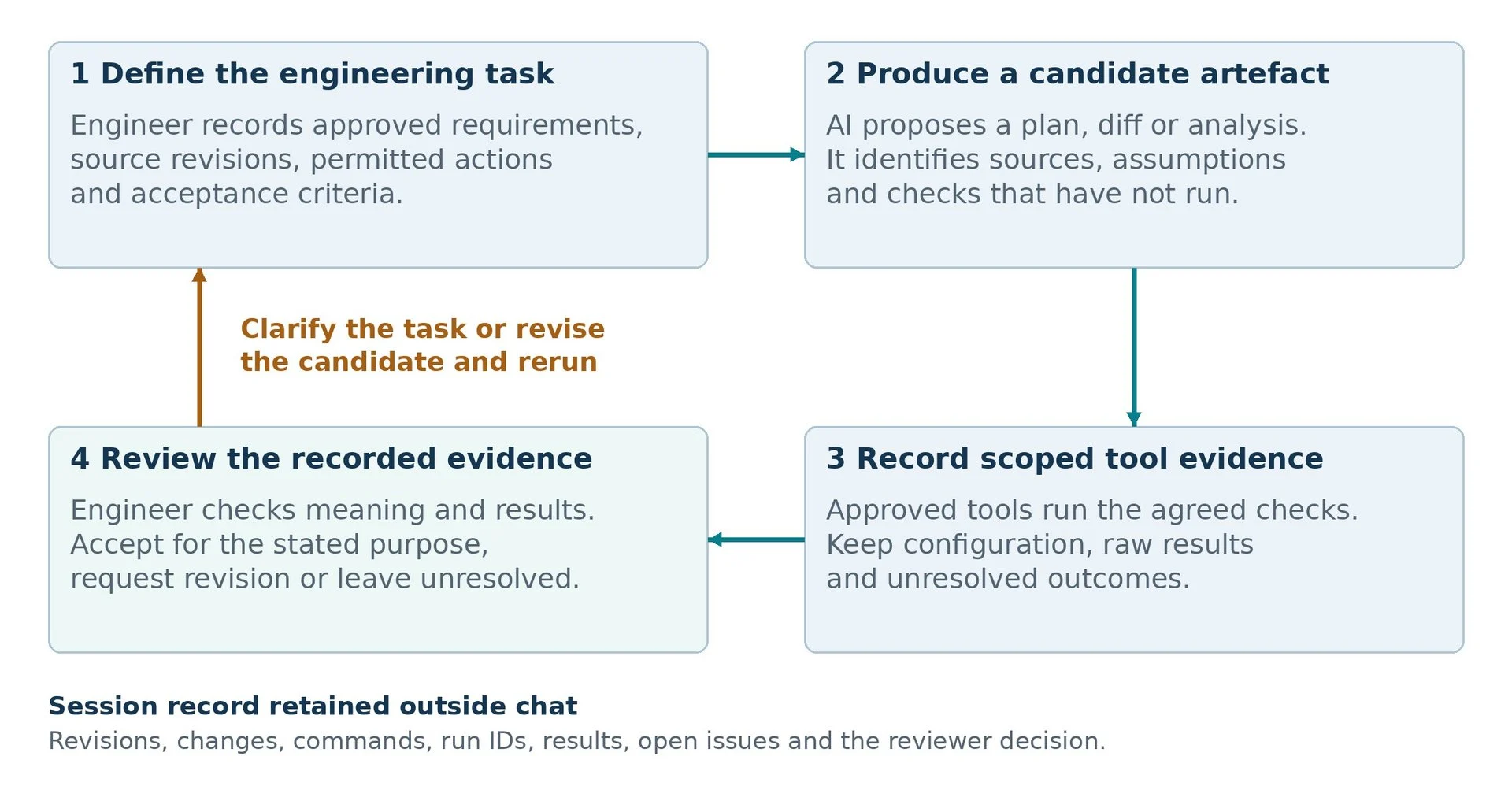
Figure 1. Proposed workflow for one bounded AI-assisted DV task. The engineer defines the scope and reviews recorded evidence before accepting a deliverable for its stated purpose; revision and unresolved outcomes remain explicit.
Write effective prompts for design verification tasks
A prompt becomes easier to review when it separates the objective, evidence, constraints, deliverables and acceptance criteria. Those fields expose decisions that a conversational request can hide.
A worked FIFO planning task
Consider an illustrative four-entry synchronous FIFO. Its reviewed contract uses rising-edge sampling. An active-low synchronous reset has priority and clears occupancy to zero. Outside reset, push and pop acceptance use the full and empty status before the sampling edge. A push is accepted when the FIFO is not full; a pop is accepted when it is not empty. This example has no empty-FIFO bypass.
Under that particular policy, simultaneous requests have the following occupancy effects. Other FIFOs may allow a push on a full cycle when a pop also occurs; the project specification must decide that behaviour.
| Pre-edge occupancy | Push and pop requests | Accepted operations | Occupancy after the edge |
| 0 entries | Both asserted | Push only | 1 entry |
| 1 to 3 entries | Both asserted | Push and pop | Unchanged |
| 4 entries | Both asserted | Pop only | 3 entries |
The session’s deliverable is a reviewable plan for these cases. Data ordering, output timing and reset-release requirements need their own specification-backed checks; this occupancy table does not define them.
An effective task brief could read:
Objective: Draft a UVM sequence plan for simultaneous push and pop
requests at empty, interior and full occupancy in the supplied FIFO.
Evidence: Use the approved FIFO requirements, interface definition,
RTL revision and existing sequence APIs. Identify their revisions.
Constraints: Follow the reviewed acceptance and reset policy.
Do not change RTL, the scoreboard, assertions or coverage exclusions.
Flag missing or conflicting requirements before proposing a policy.
Deliverable: Provide scenarios, expected accepted operations,
occupancy outcomes, requirement links and a sequence approach using
the existing APIs. List candidate checks and unresolved questions.
Acceptance: The engineer reviews the scenario table and expected
outcomes. Any later implementation must pass the applicable build,
targeted tests and checker review. Report only checks actually run.
The engineer can now challenge a specific error. If the draft accepts both requests at full occupancy, it conflicts with the example’s stated policy. Revising that policy to accommodate the draft would change the requirement. Correct the candidate or resolve a genuine requirements issue through the normal review process.
Separate planning from implementation and execution
Accepting the plan authorises the next defined activity. It does not establish that a generated UVM sequence compiles, drives the intended accepted transactions or exercises the checker. A subsequent session can implement the reviewed plan against the actual environment, followed by an approved execution and review step.
Where tool-enabled automation combines these activities, preserve the same boundaries in the recorded workflow. GitHub’s guidance on AI-generated code likewise calls for functional checks and review against project requirements [2]. Hardware verification also needs its specific clocking, reset, protocol and checking context.
Manage AI context and DV session state
Context management determines what the assistant can use to answer the next question. A current requirement extract, the relevant interface, the applicable base sequence and a short failing-log interval can be more useful than an unstructured repository dump. Preserve access to the complete approved sources so that omitted context can be retrieved when necessary.
Anthropic’s context-engineering guidance describes a finite context budget, selective retrieval, compaction and persistent notes [3]. These are useful techniques for organising information. In a DV workflow, the engineer should also check that retrieved material belongs to the intended configuration and revision.
Keep a durable checkpoint outside the chat
Maintain a small versioned session record containing the task identifier, owner, approved requirement references, RTL and testbench revisions, parameters, tool versions, and permitted changes. Add the latest candidate diff, run identifiers, seeds where relevant, observed results, open questions and next action. Identify the model or service version when available and retain the relevant invocation settings.
Separate established observations from hypotheses and unexecuted proposals. For example, “log contains a timeout” is an observation; “the DUT deadlocked” is a hypothesis until the evidence establishes its cause. Preserve the original log and its run metadata so the summary can be checked.
Review handovers and compacted summaries
Before starting a new session or continuing after context compaction, verify the checkpoint against the referenced artefacts. Summaries can omit a reset exception, an unresolved assumption or a failed rerun. A previous assistant message should not become authoritative merely because it survives into the next context window.
Invalidate relevant conclusions after a source or configuration change. A result for one parameter set or compile definition does not automatically support another. The checkpoint should make that dependency visible before additional work begins.
Control iterations token budgets and tool access
Iteration should answer a defined question. After a candidate fails, retain its diff and diagnostic evidence, identify the failing layer and choose the next bounded change. A parse error, a UVM integration problem, a checker failure and a misunderstood requirement need different corrective actions.
Budget for evidence and review
Set practical limits for context size, output length, retries, wall-clock time and tool jobs. Include simulator or formal licence usage where relevant. Reserve enough context to carry the governing requirements and enough output space to report assumptions, changes and results.
A token budget controls the amount of information processed and generated. It is not a measure of verification completeness. Avoid fixed universal token counts: the useful allocation depends on the task, model, tool interface and required evidence. Use focused retrieval or a new scoped session when the working context becomes confused.
Set stop conditions before an automated loop begins. Examples include a requirement conflict, repeated identical failure, an unexpected file change, or a proposed alteration to checking policy. Reaching the retry limit leaves the task unresolved; it does not justify weakening the acceptance criteria.
Enforce permissions through the execution environment
Start with the access required for the task. A log-classification session can normally read selected results without writing RTL. A test-generation session may need a bounded workspace, specific testbench files and approved build commands. Restrict network access, secrets, write paths, job submission and installation privileges according to the team’s policy.
Prompt wording should be backed by technical controls. Repository text, logs and retrieved documents are input data and can contain misleading instructions. Claude Code’s security documentation describes prompt-injection risks and responsibilities around command review [4]. Apply appropriate access controls and isolation to the actual tools being used; a permission prompt alone is not a complete containment mechanism.
Require explicit review for changes to DUT behaviour, scoreboards, assertion disabling, formal assumptions, coverage exclusions and waiver policy. Also verify that the organisation’s approved data-handling arrangements cover the specifications, RTL and third-party IP supplied to the service.
Validate AI-generated verification artefacts
The acceptance criteria should follow the artefact. A successful text response, a clean build, a passing simulation and a completed formal obligation answer different questions.
| AI-assisted output | Evidence the engineer should review |
| Specification summary or verification-plan addition | Requirement locations, interpretation, conflicting clauses, scope and review ownership |
| RTL review or proposed RTL change | Requirement mapping, authorised diff, relevant static and dynamic checks, and any required equivalence or formal analysis |
| UVM sequence or component | Project library version and APIs, build and elaboration results, configuration, stimulus observed at the interface, and active checking |
| Regression-log classification | Run manifest, links to original failures, counts that reconcile, and manual sampling of classified and unclassified cases |
| Candidate assertion | Requirement meaning, clock/reset and sampling semantics, legal assumptions, activation evidence and the applicable simulation or formal results |
| Coverage recommendation | Coverage-model revision, valid sampling, bin meaning, reachability and exclusions, plus associated checking evidence |
Regression summaries need traceable counts
Ask for run IDs and source locations for each proposed failure cluster. Keep build failures, infrastructure failures, timeouts and design or checker mismatches distinguishable. A shared error string can support a grouping proposal, but does not establish a common root cause.
Reconcile the summary against the regression manifest. Include missing, incomplete and unclassified results rather than letting them disappear into a pass total. Sample the classification before using it to prioritise engineering work. Detailed waveform and register-model investigation belongs in Alpinum’s AI-assisted RTL and UVM debugging article.
Review AI-generated assertions
A generated SystemVerilog Assertion can compile while expressing the wrong temporal requirement. Review its sampling event, reset behaviour, implication timing, enable conditions and parameterisation. Check whether its antecedent can occur under the model’s assumptions and whether expected violations are detectable.
Record the actual result of the selected verification flow. A passing set of simulation traces does not establish a proof over all permitted behaviours. A bounded search or unresolved formal obligation also requires its stated scope and status. Repeating an AI explanation of an assertion provides no additional execution evidence.
Review coverage models and sampling
Accellera’s UVM 1.2 User’s Guide relates explicit functional coverage to verification goals and explains limitations of implicit coverage [5]. A reported percentage must therefore be interpreted against the model, configuration and sampling rules that produced it.
For the FIFO example, distinguish a requested push from an accepted push when defining bins. Check that occupancy is sampled at the intended observation point. A simultaneous-request bin and a simultaneous-acceptance bin represent different events at the boundaries described earlier.
Review test intent and checker behaviour alongside coverage. Changing bins or exclusions can change the reported percentage without adding tested behaviour. Retain the baseline model and record reviewed changes. A coverage hit should be presented as evidence of the defined sampled event, rather than automatic evidence that the corresponding requirement was correctly checked.
Close the session with an engineering decision
Closure should leave a compact evidence bundle: the approved task, source revisions, final diff or plan, commands actually executed, run configuration, results, remaining limitations and reviewer decision. State whether the deliverable was accepted for its defined purpose, returned for revision or left unresolved.
Acceptance can be local. An approved verification-plan addition is a planning result; an accepted sequence change supports the tests and configurations reviewed. Neither outcome establishes block-level sign-off. Keep that boundary visible when reporting progress to the wider team.
Measure the whole task: time to an accepted artefact, engineer review effort, reruns, rejected candidates, escaped errors found later, and compute or licence cost. Compare similar tasks and include rework. Prompt volume and generated lines of code alone do not show whether the workflow improved engineering throughput.
Build the capability within the DV team
Effective session management depends on engineers who can recognise an incomplete specification, an invalid assumption, an ineffective checker or a misleading coverage result. AI coordination adds to those verification skills.
Alpinum’s “AI in DV” services address adoption within engineering workflows, tooling integration and team capability. Its AI-Assisted Coding and Agentic AI Training covers related skills including prompt engineering, repository context, tool integration, testing and security. Engineers developing the underlying methodology can explore Design Verification Training with SystemVerilog and UVM.
A practical starting point is one recurring DV task with a known baseline, a named owner and explicit acceptance criteria. Review the resulting evidence before expanding the scope. The engineer’s contribution is the judgement that connects a generated proposal to the requirement and decides what the observed results support.
References
[1] National Institute of Standards and Technology, “Artificial Intelligence Risk Management Framework: Generative Artificial Intelligence Profile,” NIST AI 600-1, July 2024, sec. 2.2. https://nvlpubs.nist.gov/nistpubs/ai/NIST.AI.600-1.pdf
[2] GitHub, “Review AI-generated code,” GitHub Docs, sections on functional checks and context and intent. Accessed: 30 Oct. 2026. https://docs.github.com/en/copilot/tutorials/review-ai-generated-code
[3] Anthropic, “Effective context engineering for AI agents,” 29 Sept. 2025, sections on context management, compaction and structured note-taking. https://www.anthropic.com/research/effective-context-engineering-for-ai-agents
[4] Anthropic, “Security,” Claude Code documentation, sections on user responsibility and prompt injection. Accessed: 30 Oct. 2026. https://code.claude.com/docs/en/security
[5] Accellera Systems Initiative, “Universal Verification Methodology (UVM) 1.2 User’s Guide,” 8 Oct. 2015, secs. 4.10.1-4.10.3. https://www.accellera.org/images/downloads/standards/uvm/uvm_users_guide_1.2.pdf
FAQs
It is a working description of the engineer who defines the task, supplies approved context, controls tool access, manages iterations and reviews the resulting evidence. It does not imply a separate standardised job title.
Clear prompts can improve the candidate and expose assumptions. Acceptance still requires requirement-based semantic review and appropriate validation, including the clock, reset, activation and result scope.
Retain source revisions, the task brief, candidate changes, executed commands, run identifiers, relevant results, open assumptions and the reviewer decision. Preserve links to original artefacts so a later session can verify the checkpoint.

Written by : Mike Bartley
Mike started in software testing in 1988 after completing a PhD in Math, moving to semiconductor Design Verification (DV) in 1994, verifying designs (on Silicon and FPGA) going into commercial and safety-related sectors such as mobile phones, automotive, comms, cloud/data servers, and Artificial Intelligence. Mike built and managed state-of-the-art DV teams inside several companies, specialising in CPU verification.
Mike founded and grew a DV services company to 450+ engineers globally, successfully delivering services and solutions to over 50+ clients.
Mike started Alpinum in April 2016 to deliver a range of start-of-the art industry solutions:
Alpinum AI provides tools and automations using Artificial Intelligence to help companies reduce development costs (by up to 90%!) Alpinum Services provides RTL to GDS VLSI services from nearshore and offshore centres in Vietnam, India, Egypt, Eastern Europe, Mexico and Costa Rica. Alpinum Consulting also provides strategic board level consultancy services, helping companies to grow. Alpinum training department provides self-paced, fully online training in System Verilog, UVM Introduction and Advanced, Formal Verification, DV methodologies for SV, UVM, VHDL and OSVVM and CPU/RISC-V. Alpinum Events organises a number of free-to-attend industry events
You can contact Mike (mike@alpinumconsulting.com or +44 7796 307958) or book a meeting with Mike using Calendly (https://calendly.com/mike-alpinum-consulting).
Stay Informed and Stay Ahead
Latest Articles, Guides and News
Explore related insights from Alpinum that dive deeper into design verification challenges, practical solutions, and expert perspectives from across the global engineering landscape.