
When a formal property neither produces a valid counterexample nor reaches a complete proof, the result is unresolved. An Unproven result is therefore neither a pass nor automatically evidence of defective RTL. The first task is to validate the requirement, property, environment, reset and reachability. Only then should engineers reduce proof complexity, add invariants, introduce abstraction or adjust engines and resources. Any bounded evidence must be reported with its exact model, assumptions, scope and depth.
What Does It Mean When a Formal Proof Does Not Converge?
Formal property checking asks whether a specified property holds for the behaviours represented by a particular model. A completed proof is therefore conditional: the property must express the intended requirement, the RTL configuration and reset model must be appropriate, environmental assumptions must be realistic, and any abstractions must preserve the claim being made.
IEEE 1800-2023 defines the semantics of SystemVerilog, including its assertion and coverage constructs, while Accellera material describes SystemVerilog Assertions (SVA) as a core mechanism for assertion-based and formal verification. Property semantics including sampling are consequently part of the verification problem, not merely syntax. [1][2]
“Non-convergence” is useful engineering shorthand, but it does not identify a root cause. The difficulty may lie in the assertion, environment, analysed design scope or computational problem. A timeout alone cannot distinguish them.
Proven, Falsified, Bounded and Unproven Results
Formal tools do not use identical result taxonomies. Terms such as Proven, Pass, Failed, Falsified, Bounded, Inconclusive, Unproven and Unknown can have tool- and engine-specific meanings. Cadence, for example, documents lower, upper and bounded proof information in Jasper, while Siemens material uses inconclusive when analysis cannot resolve the problem within available capacity. [3][4]
Formal Result Classification and Required Action
| Result category | What it establishes | What it does not establish | Required engineering action |
| Proven | Property holds within the analysed model, assumptions and proof semantics | That the requirement, environment or whole design is necessarily correct | Review requirement, assumptions, activation, configuration and proof dependencies |
| Falsified / counterexample | A trace violates the encoded property | That the RTL is necessarily wrong | Validate the trace, assertion and environment; classify real design bug versus modelling/property problem |
| Bounded | No counterexample was found within a documented analysed depth/scope | Unbounded correctness | Record bound and semantics; determine whether the depth is meaningful for the requirement |
| Unproven / unknown / inconclusive | Analysis has not resolved the property | Pass, failure or bounded adequacy unless separately established | Diagnose intent, environment, reachability, scope and complexity |
| Vacuous | A property may be true without meaningful activation of part of its intent | Useful exercise of the intended requirement | Establish trigger/sequence activation and review constraints |
| Unreachable | A specified state or activation cannot be reached under the analysed model | Whether that unreachability is intentional | Determine whether architecture or excessive constraints caused it |
| Timeout / resource limit | A configured resource or run limit was reached | Anything about design correctness | Preserve evidence, diagnose cause and decide whether further analysis is justified |
Not every tool reports every category separately. Vacuity and unreachability may also be secondary diagnostics rather than top-level property statuses.
Why Formal Proofs Fail to Converge
State-space size matters, but “state-space explosion” is not an adequate diagnosis. An assertion may be difficult because it depends on long sequential history, arbitration, counters, memories or many interacting state elements. It may also be difficult because the formal environment admits behaviour that real hardware never sees, or because the property itself is unnecessarily complex.
The DVCon bounded-proof study identifies large sequential cones of influence, arbiters, counters, memories, FIFOs, assumptions and assertion models among practical sources of difficult proofs. [5]
Why a Formal Property May Remain Unproven
| Root-cause category | Typical symptom | Diagnostic question | Safe response |
| Incorrect/over-complex property | Large logic cone or unexpected temporal depth | Can the requirement be expressed more directly? | Review and simplify without weakening intent |
| Ambiguous requirement | Property changes during debug | Is expected behaviour defined precisely? | Resolve requirement before proof tuning |
| Unrealistic assumptions | Easy proof or odd reachable behaviour | Do assumptions match legal operation? | Review each constraint against architecture/protocol |
| Incorrect reset/initial model | Long or strange initial traces | Are starting states physically and architecturally valid? | Correct reset/initial semantics |
| Unreachable trigger | Assertion never meaningfully activates | Can a cover witness reach the antecedent? | Establish why it is unreachable |
| Excessive cone of influence | Many unrelated flops influence property | Which logic actually contributes? | Reduce scope with justified boundaries |
| Deep sequential behaviour | Bound grows slowly | What functional latency/history is required? | Decompose or strengthen proof reasoning |
| Memories/complex arithmetic | Capacity collapses around datapath/state arrays | Can irrelevant implementation detail be abstracted? | Use validated abstraction |
| Multiple clocks/asynchronous behaviour | Large scheduling/interleaving space | Is the clock/environment model appropriate? | Partition or model interfaces carefully |
| Missing invariant/helper lemma | Induction fails despite plausible property | What intermediate fact would make the inductive step hold? | Add and independently justify the lemma |
| Insufficient partitioning | End-to-end checker dominates runtime | Can obligations be decomposed at clean interfaces? | Partition and discharge interface contracts |
| Weak abstraction | Too much concrete state remains | What state is irrelevant to this property? | Strengthen abstraction conservatively |
| Unsound/over-restrictive abstraction | Proof becomes suspiciously easy | Did the abstraction remove legal behaviour? | Validate against concrete design |
| Tool/engine mismatch | One strategy stalls immediately | Do other supported proof strategies suit this structure? | Re-orchestrate only after model review |
| Resource/runtime limit | Progress ends at configured limit | Is more compute likely to change the conclusion? | Extend resources only with a reason |
| Difficult-to-reach real bug | Deeper search exposes suspicious behaviour | Is the emerging trace legal? | Continue targeted search and validate counterexample |
Symptoms are clues, not proofs of root cause.
Property Problems vs Proof-Complexity Problems
A useful separation is:
- Property problem: the assertion does not encode the requirement cleanly, has incorrect sampling or temporal semantics, or contains unnecessary complexity.
- Environment problem: reset, initial state, assumptions or constraints do not represent legal operation.
- Scope problem: too much irrelevant logic or state participates in the obligation.
- Proof-complexity problem: the claim and environment are legitimate, but the resulting state/transition problem remains hard.
This order matters. Solver tuning cannot repair a wrong requirement.
Formal Proof Non-Convergence Decision Tree
Use a gated diagnostic sequence rather than immediately modifying proof options:
- Confirm the requirement
- Confirm that the property encodes the requirement
- Check compilation, clocking and sampling semantics
- Validate reset and initial-state modelling
- Review assumptions and constraints
- Demonstrate meaningful activation and reachability
- Inspect the property’s cone of influence and sequential depth
- Decide whether justified partitioning, abstraction or invariants can reduce complexity
- Review proof engines, bounds and computational resources
- Re-run and classify the evidence
- Decide whether simulation or system-level evidence is required
- Record the unresolved limitation and responsible reviewer
The sequence is deliberately front-loaded with verification-intent checks. Tool-specific workflows may differ.
Validate the Requirement and Property First
Before changing assumptions or abstractions, read the requirement and assertion together. Check implication direction, temporal ranges, overlapping versus non-overlapping behaviour, disable/reset conditions, clocks and sampling.
For a request/acknowledge property, for example, “an acknowledgement follows a request within four cycles” is different from “if a request is sampled, acknowledgement occurs one to four sampled clock events later”. The engineering requirement must decide which formulation is correct.
Safety properties normally describe behaviour that must never occur; a violation has a finite witness. Liveness properties express eventual progress and may require explicit fairness or progress reasoning. Treating an eventual-grant property like a short bounded safety check can produce misleading confidence. [6]
Check Assumptions, Constraints, Reset and Reachability
Assumptions define which environments the proof is allowed to consider. Under-constraint can admit impossible traffic and make the proof unnecessarily difficult or produce irrelevant failures. Over-constraint can remove legal behaviour and make an invalid engineering claim appear easy to prove. Do not strengthen assumptions merely because a property is difficult.
Use cover properties or another witness mechanism to demonstrate that important antecedents, modes and corner-case sequences can occur. Reset deserves explicit review: an unrealistic initial state may create artificial complexity, while an over-restrictive reset model may remove behaviour that should have been analysed.
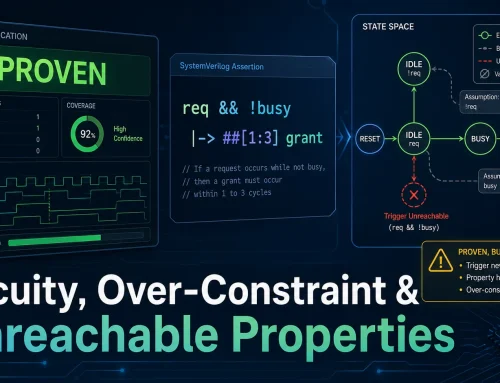
For a deeper discussion of misleading green results, see Alpinum’s analysis of vacuity, over-constraint and unreachable properties.
Analyse the Cone of Influence and Sequential Depth
The cone of influence (COI) identifies logic capable of affecting the property, directly or through its assumptions and dependencies. Siemens recommends examining the active COI when an analysis becomes inconclusive. [4]
Distinguish structural width from temporal depth. A relatively small controller can still require deep reasoning if progress depends on queues, backpressure or repeated arbitration. Conversely, a wide datapath may admit a compact abstraction. A numerical proof depth is not a universal measure of verification progress. One hundred clock events may cover many meaningful transactions for one protocol and barely initialise another design.
Reduce Proof Scope Without Changing the Claim
Safe scope reduction keeps the engineering statement intact.
Useful options include:
- Splitting an end-to-end requirement into interface or pipeline obligations
- Proving independently reusable sub-block contracts
- Removing logic that cannot affect the property
- Tracking a representative symbolic transaction rather than every datapath value
- Isolating control logic from irrelevant datapath implementation
The DVCon bounded-proof case study describes breaking large end-to-end assertions into smaller obligations and verifying some submodules separately before using abstractions. That is one project methodology, not a universal sign-off rule. [5]
Use Abstraction Without Creating False Confidence
Abstraction trades implementation detail for a smaller verification problem. The trade must be explicit.
| Technique | Complexity removed | Behaviours it may introduce | Behaviours it may exclude | Validation and evidence |
| Cut point / black box | Internal logic and state | Arbitrary output behaviour and spurious failures | Legal dependencies if additional constraints are added | Prove interface contracts or compare against concrete runs; record cuts |
| Memory abstraction | Array state and address/data history | Impossible read values, ordering or collision scenarios depending on model | Real alias/collision cases if model is too restrictive | Validate read/write semantics and targeted concrete cases |
| Reduced parameters | Counter widths, FIFO depth, replicated state | Different occupancy/wrap behaviour | Scale-dependent corner cases | Prove scale-independence or separately verify boundaries |
| Functional abstract model | Detailed datapath/internal implementation | Behaviour allowed by the abstract interface but impossible concretely | Concrete implementation dependencies omitted by model | Use refinement/equivalence/contracts and retain model version in evidence |
Counterexample-guided abstraction-refinement research demonstrates the central risk: an abstract model may admit spurious counterexamples, requiring refinement before the trace can be treated as a real design failure. [7]
Likewise, Siemens’ memory-abstraction guidance notes that black-boxed outputs become free inputs, so resulting failures require investigation to determine whether the abstraction created them. [8]
Partition the Design and Apply Assume-Guarantee Reasoning
Assume-guarantee reasoning decomposes a system-level obligation into component guarantees under explicit environmental assumptions. It can reduce the state space dramatically, but the component assumptions must eventually be justified by the neighbouring components or system context. Research on compositional verification emphasises that this reasoning requires a sound method for discharging assumptions; circular “A works if B works, and B works if A works” arguments cannot simply be accepted. [9]
Add Invariants, Lemmas and Helper Properties
Induction may fail because the inductive hypothesis admits mathematically possible states that are unreachable in the real design. An invariant can capture a necessary fact for example, FIFO occupancy never exceeds its implemented capacity. A helper lemma can establish an intermediate relationship between pipeline stages or protocol phases.
The important distinction is whether the helper fact is proved or merely assumed. A proved lemma strengthens the reasoning chain. An assumed lemma transfers part of the proof obligation into the environment and therefore requires separate justification.
Review Proof Engines, Bounds and Computational Resources
Only after validating intent, environment and proof structure should engineers optimize engine selection, orchestration, run limits or compute allocation. Different proof strategies suit different structures, and current commercial platforms use portfolios of engines and orchestration. Their result terminology and bound semantics vary, so tool documentation should determine exactly what a reported bound means.
Engineers who want structured practice across properties, constraints, proof analysis and unresolved-result diagnosis can develop practical formal proof and debug skills through Alpinum’s hardware-focused programme.
How to Interpret a Bounded Formal Result
Bounded model checking analyses behaviour only to a defined bound; classic SAT-based BMC literature formalises this as searching for counterexamples up to a maximum length. [10]
A safer engineering statement is:
A bounded analysis may establish that no counterexample exists within the analysed depth, under the model, assumptions, initial-state semantics and property interpretation used by the tool.
It should not be rewritten as “the design is correct for N cycles”.
The meaning of depth depends on:
- The temporal structure of the property
- Reset and initial-state semantics
- Environmental assumptions
- Design configuration
- Proof method and tool semantics
- Actual functional latency
A depth of 100 may be substantial for a fixed four-cycle request/response rule. The same depth may be weak evidence for a long queue under backpressure, a fairness-dependent arbiter or an eventual-progress requirement. Increasing a bound adds explored depth; it does not by itself turn the result into an unbounded proof.
When Bounded Evidence Is Useful and When It Is Not
Bounded evidence can be useful when the relevant functional horizon can be justified independently for example, when architectural latency, cover witnesses, corner-case sequencing and complementary verification establish why a particular depth is meaningful.
The 2021 DVCon study presents one such project-specific methodology combining calculated latency, scenario covers and formal coverage for packet-processing logic. Its own case study also exposed a reset-abstraction issue during coverage analysis, illustrating why the bound itself was not enough. [5]
It is weak evidence when the required horizon is unknown, progress depends on unbounded waiting, important modes are unreachable, or the result depends on poorly validated abstraction.
Combine Formal Results with Simulation and Coverage
Formal and simulation answer different verification questions. Simulation is often better suited to realistic workloads, long software-driven scenarios, performance behaviour and complex system interactions. Formal is powerful where a precise property and tractable model permit exhaustive reasoning over the relevant state space.
Alpinum’s verification planning and coverage-closure guidance similarly treats formal and simulation as complementary rather than interchangeable.
Code coverage is not proof of completeness. Formal coverage can expose reachability, observability or proof-core gaps, but high coverage does not automatically make the requirement set complete or the sign-off decision correct. The DVCon bounded-proof study explicitly combines coverage information with engineering analysis rather than treating the metric alone as proof. [5]
Mutation or fault-based qualification can add another perspective by asking whether deliberately introduced behavioural changes are detected by the property set. It tests checker effectiveness; it still cannot establish that every intended requirement was specified correctly. DVCon Europe work on mutation coverage makes the same distinction between activation and observation of functional effects. [11]
Formal Sign-Off When Properties Remain Unproven
Formal sign-off is an engineering governance decision, not a colour on a dashboard. Criteria vary by programme, application, risk and verification plan.
Formal Sign-Off Decision Matrix
| Property status | Evidence available | Residual uncertainty | Permitted conclusion | Next action |
| Complete proof; assumptions and activation reviewed | Proof, requirement trace, covers, reviewed environment | Requirement/model adequacy | Property proven under documented conditions | Independent review and archive |
| Valid counterexample | Legal trace and confirmed property | Effect and fix scope | Requirement violated in analysed RTL | Fix RTL/property/environment and regress |
| Bounded + complementary simulation | Bound, assumptions, covers, simulation evidence | Behaviour beyond analysed horizon | No violation found within documented bound; complementary evidence exists | Project-specific risk review |
| Unproven with mitigation | Diagnostic record plus alternative evidence | Property remains unresolved | Formal proof not achieved | Record mitigation/waiver and responsible approval |
| Unreachable by intended architecture | Reachability proof and architectural rationale | Specification adequacy | Target excluded by intended architecture | Document rationale |
| Unreachable due excessive constraints | Constraint analysis | Legal behaviour removed | No valid sign-off conclusion | Correct environment and rerun |
| Abstract proof | Proof plus abstraction validation | Concrete implementation correspondence | Claim proven for validated abstract model | Discharge abstraction/refinement obligation |
| Liveness unresolved | Safety evidence, progress/fairness analysis | Eventual progress | No complete liveness conclusion | Review fairness, scheduler and progress reasoning |
No row automatically authorises tape-out. The responsible project stakeholders must define and approve sign-off criteria.
Where a programme needs external delivery support rather than education, Alpinum separately describes its formal verification services for ASIC and SoC development.
Proof-Convergence Checklist
Before changing an unresolved property’s status, confirm that:
- Requirement reviewed and uniquely identified
- Property reviewed against that requirement
- Clocking and sampling semantics checked
- Reset and initial-state model checked
- Assumptions reviewed against legal operation
- Under-constraint and over-constraint considered
- Cover/witness demonstrates meaningful activation
- Cone of influence understood
- Proof complexity classified
- Invariants and lemmas are justified or independently proved
- Abstractions are documented and validated
- Partition boundaries and interface contracts are reviewed
- Tool settings and engine strategy are recorded
- Achieved proof bound and its semantics are recorded
- Relevant formal coverage has been reviewed
- Complementary simulation evidence is linked
- Residual uncertainty is written explicitly
- Responsible technical reviewer is identified
- Final result classification is approved
The wider AHAA formal-verification framework provides useful context: bounded bug hunting and proof-oriented bug absence deliberately have different completion criteria.
Key Takeaways
A non-convergent property is a diagnostic problem before it is a computational problem.
Validate the requirement, assertion semantics, reset, assumptions and reachability before manipulating proof scope. Then inspect the COI and sequential depth, and introduce decomposition, abstraction or invariants only with explicit evidence that the engineering claim remains valid. Treat bounded results as precisely scoped evidence. Treat abstractions as new proof obligations. Combine formal results with simulation and coverage where they answer complementary questions. Most importantly, record unresolved uncertainty rather than translating it into a pass.
For engineers building this capability hands-on, Alpinum’s six-day practical formal-verification programme covers property writing, proof analysis, debug, formal coverage and advanced proof techniques.
References
[1] IEEE, IEEE Standard for SystemVerilog—Unified Hardware Design, Specification, and Verification Language, IEEE Std 1800-2023, Feb. 2024, doi: 10.1109/IEEESTD.2024.10458102.
https://ieeexplore.ieee.org/document/10458102
[2] I. Ciocirîan, A. Radu, R. Calderón-Rico, and I. Tapia, “SVA advanced topics: SVAUnit and assertions for formal,” tutorial presented at DVCon U.S. 2016, San Jose, CA, USA, Feb. 29, 2016. https://www.accellera.org/resources/videos/systemverilog-assertions-tutorial-2016
[3] A. Anand, C. Chen, B. N. Subramanian, and J. Hupcey, “‘Bounded Proof’ sign-off with formal coverage,” in Proc. Design and Verification Conference and Exhibition (DVCon U.S.), 2021. https://dvcon-proceedings.org/wp-content/uploads/bounded-proof-sign-off-with-formal-coverage.pdf
[4] A. Biere, A. Cimatti, E. M. Clarke, and Y. Zhu, “Symbolic model checking without BDDs,” in Tools and Algorithms for the Construction and Analysis of Systems (TACAS), Lecture Notes in Computer Science, vol. 1579, Berlin, Germany: Springer, 1999, pp. 193–207, doi: 10.1007/3-540-49059-0_14. https://doi.org/10.1007/3-540-49059-0_14
[5] E. M. Clarke, O. Grumberg, S. Jha, Y. Lu, and H. Veith, “Counterexample-guided abstraction refinement for symbolic model checking,” Journal of the ACM, vol. 50, no. 5, pp. 752–794, Sep. 2003, doi: 10.1145/876638.876643. https://doi.org/10.1145/876638.876643
[6] T. A. Henzinger, S. Qadeer, and S. K. Rajamani, “You assume, we guarantee: Methodology and case studies,” in Proc. 10th International Conference on Computer Aided Verification (CAV), Lecture Notes in Computer Science, vol. 1427, Vancouver, BC, Canada, 1998, pp. 440–451, doi: 10.1007/BFb0028765. https://doi.org/10.1007/BFb0028765
[7] J. Hupcey III, “How to reduce the complexity of formal analysis—Part 1: Finding where formal got stuck and some initial corrective steps to take,” Siemens Verification Horizons, Aug. 8, 2018. [Online]. https://blogs.sw.siemens.com/verificationhorizons/2018/08/08/how-to-reduce-the-complexity-of-formal-analysis-part-1-finding-where-formal-got-stuck-and-some-initial-corrective-steps-to-take/
[8] J. Hupcey III, “How to reduce the complexity of formal analysis—Part 3: Assertion decomposition,” Siemens Verification Horizons, Sep. 11, 2018. [Online].
Siemens Assertion Decomposition, Part 3
[9] J. Hupcey III, “How to reduce the complexity of formal analysis Part 5: Memory abstraction,” Siemens Verification Horizons, Oct. 23, 2018. [Online]. https://blogs.sw.siemens.com/verificationhorizons/2018/10/23/how-to-reduce-the-complexity-of-formal-analysis-part-5-memory-abstraction/
[10] Cadence Design Systems, “Bounded proofs, lower bounds, and upper bounds in Jasper Formal Property Verification,” Cadence Support, Application Note, May 23, 2024. [Online]. https://support1.cadence.com/public/docs/content/20513928.html
[11] H. Busch, “An efficient methodology for mutation-coverage-collection of formal-property-checking,” in Proc. Design and Verification Conference and Exhibition Europe (DVCon Europe), Munich, Germany, Dec. 6–7, 2022. https://dvcon-proceedings.org/wp-content/uploads/75412.pdf
FAQs
It generally means the analysis has not established a complete proof or a confirmed failure within the available scope or resources. Exact terminology depends on the tool.
No. It remains unresolved until engineers determine whether the cause lies in the property, environment, design scope, computational complexity or an emerging real bug.
It is a result associated with a finite analysed depth or scope. A bounded analysis can establish absence of a counterexample within that documented analysis, but does not automatically establish unbounded correctness.
A bounded result restricts the analysed temporal horizon or equivalent proof scope. A complete proof establishes the property for all behaviour represented by the analysed model under its assumptions and proof semantics.
It can contribute evidence where a project has a documented methodology for interpreting the bound and complementary evidence. It is not automatically sufficient, and sign-off criteria remain project-specific.
A valid invariant excludes unreachable intermediate states from the proof reasoning and can strengthen induction. The invariant itself must be proved or otherwise justified rather than silently assumed.
After the property, environment and proof scope have been validated and when irrelevant implementation detail is a genuine source of complexity. Every abstraction should have a validation argument and recorded limitations.
Record the requirement, property status, exact bound, tool/engine settings, assumptions, reset model, abstractions, reachability evidence, formal coverage, complementary verification, residual uncertainty, mitigation and responsible reviewer.

Written by : Mike Bartley
Mike started in software testing in 1988 after completing a PhD in Math, moving to semiconductor Design Verification (DV) in 1994, verifying designs (on Silicon and FPGA) going into commercial and safety-related sectors such as mobile phones, automotive, comms, cloud/data servers, and Artificial Intelligence. Mike built and managed state-of-the-art DV teams inside several companies, specialising in CPU verification.
Mike founded and grew a DV services company to 450+ engineers globally, successfully delivering services and solutions to over 50+ clients.
Mike started Alpinum in April 2016 to deliver a range of start-of-the art industry solutions:
Alpinum AI provides tools and automations using Artificial Intelligence to help companies reduce development costs (by up to 90%!) Alpinum Services provides RTL to GDS VLSI services from nearshore and offshore centres in Vietnam, India, Egypt, Eastern Europe, Mexico and Costa Rica. Alpinum Consulting also provides strategic board level consultancy services, helping companies to grow. Alpinum training department provides self-paced, fully online training in System Verilog, UVM Introduction and Advanced, Formal Verification, DV methodologies for SV, UVM, VHDL and OSVVM and CPU/RISC-V. Alpinum Events organises a number of free-to-attend industry events
You can contact Mike (mike@alpinumconsulting.com or +44 7796 307958) or book a meeting with Mike using Calendly (https://calendly.com/mike-alpinum-consulting).
Stay Informed and Stay Ahead
Latest Articles, Guides and News
Explore related insights from Alpinum that dive deeper into design verification challenges, practical solutions, and expert perspectives from across the global engineering landscape.