
A formal tool reports PROVEN. Every assertion on the dashboard is green. The natural reaction is to treat the result as evidence that the RTL satisfies the requirement. Sometimes that conclusion is justified. Sometimes the proof passed because the behaviour that mattered was never allowed to happen.
A property can be mathematically proven and still provide very little verification confidence if its trigger is unreachable, its environment is over-constrained, its requirement has been encoded incorrectly or its proof does not depend on the part of the design it was meant to check.
This is why formal sign-off requires more than counting green properties.
The key takeaway is simple: a proven property tells you that no violation exists in the state space analysed under the current model and assumptions. Before treating that proof as meaningful evidence, establish that the property represents the intended requirement, activates in a legal scenario, operates over a defensible state space and actually checks the behaviour that matters.
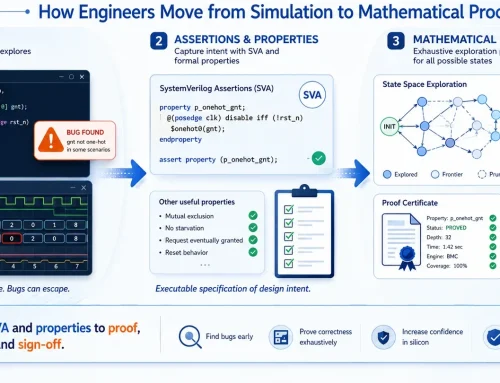
This article focuses on that diagnostic problem. Engineers looking for the broader progression from simulation into property-based verification can first read Alpinum’s practical learning path from simulation to formal proof.
What Does a Green Formal Proof Actually Mean?
Formal property checking analyses a mathematical model of the RTL against a defined property. The result is evaluated within the behaviours permitted by the formal environment.
A statement such as:
“Property P is proven”
is therefore incomplete unless the engineer can also answer:
- Which RTL configuration was analysed?
- What initial-state and reset model was used?
- Which assumptions restricted the environment?
- Which abstractions were introduced?
- Can the property’s triggering condition occur?
- Does the assertion encode the actual requirement?
- Which behaviours were deliberately excluded?
IEEE 1800-2023 defines SystemVerilog as a hardware design and verification language that includes assertions and coverage constructs, while Accellera materials describe SVA as a central mechanism for assertion-based verification and formal specification.
The important distinction is between proof correctness and verification adequacy.
A formal engine can correctly prove the mathematical statement it was given while the engineering team has supplied the wrong statement or the wrong environment. That is not a failure of mathematics. It is a verification-model problem.
Three Ways a Formal Proof Can Pass for the Wrong Reason
Vacuity, over-constraint and unreachability are closely related, but they should not be treated as synonyms.
| Problem | What has happened | Typical symptom | Main engineering question |
| Vacuity | Part of the property is not meaningfully exercised | Assertion proves, but its trigger or another relevant sub-condition never contributes | Did the property ever activate in the way intended? |
| Over-constraint | Legal DUT/environment behaviour has been excluded | Properties become easier to prove; covers or states disappear | Did an assumption remove behaviour the real system permits? |
| Unreachability | A state, transition, trigger or coverage target cannot be reached in the analysed model | Cover target is uncoverable or activation cannot be demonstrated | Is this impossible by design, blocked by assumptions, or caused by the wrong configuration? |
The distinction matters because the corrective action is different.
Vacuity: the property is true without testing the intended obligation
For a common implication-style assertion:
property p_req_gets_grant;
@(posedge clk) disable iff (!rst_n)
req && !busy |-> ##[1:3] grant;
endproperty
assert property (p_req_gets_grant);
The engineering intention is clear: when a valid request occurs while the interface is available, a grant should follow within three cycles.
Now consider the activation condition:
cover property (@(posedge clk) disable iff (!rst_n)
req && !busy);
If formal analysis proves that req && !busy is unreachable, the assertion may have succeeded without ever creating the obligation that the engineer intended to check.In the common implication case, this is the familiar form of vacuous proof.
Vacuity is broader than “the left side was false”, particularly for more complex temporal properties, but antecedent or activation unreachability is the most useful starting point for practical debug. Siemens similarly describes self-vacuous properties, constraint-induced vacuity and cases where the property does not match actual design behaviour.
Over-constraint: the model excludes a legal failure
Suppose the environment contains:
assume property (@(posedge clk) disable iff (!rst_n)
req |-> busy);
That assumption makes req && !busy impossible. The assertion above can therefore turn green without checking the intended request/grant behaviour. This is an obvious example, but real over-constraint is rarely so visible.
A large formal environment may contain:
- Protocol assumptions
- Reset assumptions
- Configuration restrictions
- Legal address ranges
- Mutually dependent interface assumptions
- Abstraction constraints
- Assume–guarantee contracts imported from other blocks
Individually, each assumption may look reasonable. Collectively, they may remove a legitimate operating mode. Siemens describes exactly this risk: as constraint sets grow, combinations of assumptions can exclude legal input scenarios, causing assertions to become vacuous and cover statements unreachable.
Crucially, over-constraint does not always cause vacuity.
An assertion may still activate thousands of ways while one particular legal stress condition has been removed. The proof is non-vacuous, yet a real bug remains outside the analysed state space. That distinction is one reason a simple vacuity report is not enough for formal sign-off.
Unreachable Does Not Automatically Mean Wrong
If a cover target cannot be reached, there are several possible explanations:
- It should be unreachable. The architecture deliberately prohibits the state
- The RTL is wrong. Logic that should make the state reachable is defective
- The property or cover is wrong. The condition does not express the intended behaviour
- The environment is over-constrained. An assumption blocks a legal path
- The wrong configuration is being verified. Parameters, feature enables or reset behaviour do not match the intended design instance
- An abstraction has changed reachability. The simplified model no longer preserves the behaviour being checked
Modern formal coverage workflows use reachability analysis for precisely this distinction. Synopsys, for example, describes formal unreachability analysis as a way to determine whether an uncovered goal is genuinely unreachable; an unexpected unreachable result can indicate either a design problem or an over-constrained environment.
This is also why reachability is not merely a coverage-cleanup exercise. It is evidence about the validity of the verification model.
Alpinum’s Formal Verification Training programme explicitly connects these skills: participants work with assumptions, reachability, assertion quality, formal coverage, completeness, and over- and under-constraint before moving into block-level sign-off. The valuable skill is not making the dashboard green; it is learning to judge whether the green result deserves confidence.
The PASS Audit: Four Checks Before Accepting a Green Proof
A useful proof review can be organised as a PASS audit.
P: Property intent
Start with the requirement rather than the tool result.
Ask:
- What exact requirement does this assertion claim to verify?
- What starts the obligation?
- What must happen afterwards?
- What exceptions are permitted?
- What timing bounds come from the specification?
- Does reset disable the check for exactly the intended period?
- Are configuration-dependent behaviours represented?
A syntactically elegant property can still encode the wrong contract.
Requirements-to-property traceability therefore belongs upstream of proof review. Alpinum’s guide to verification planning from requirements to coverage closure explains the broader need to connect requirements to checkers, assertions and measurable coverage evidence.
A: Activation
Next, prove that the property can actually become relevant.
For an implication property, a companion cover on the meaningful triggering sequence is often useful:
cover property (@(posedge clk) disable iff (!rst_n)
req && !busy);
For a multi-cycle protocol, covering only the first Boolean signal may be insufficient. The cover should represent the meaningful sequence or operating condition whose reachability matters.
Possible evidence includes:
- A cover witness
- A tool-generated vacuity analysis
- Assertion activation metrics
- Reachability results
- An explicit witness showing the intended configuration and mode
A witness answers an existence question: at least one legal trace reaches this behaviour.
It does not prove that every important variation is represented. That distinction prevents another common mistake: replacing “the assertion never activates” with “I found one activation, therefore the property set is complete”.
S: State-space legitimacy
Once activation has been demonstrated, audit the assumptions defining the state space.
Every assumption should have an engineering justification.
A useful constraint ledger contains:
| Assumption | Source | Why legitimate | Behaviour removed | Owner |
| Protocol ordering rule | Interface specification | Initiator cannot issue B before A | Illegal command sequence | Interface owner |
| Address restriction | Product configuration | Only implemented region is legal | Unimplemented addresses | Architect |
| Reset sequencing | Reset specification | Reset must be asserted before operation | Arbitrary power-up operation | RTL/DV |
| Feature disable | Product configuration | Feature absent in this SKU | Feature-enabled states | System architect |
The critical column is Behaviour removed.
An assumption is not harmless documentation. It changes the mathematical problem.
Cadence’s formal-coverage material frames one of the fundamental constraint-quality questions in exactly these terms: are constraints hiding legal behaviour? Reachability coverage can expose design lines or FSM states that the constrained formal model can no longer exercise.
S: Sensitivity and sign-off
Finally, ask whether the successful proof depends on the logic and scenario it was supposed to verify.
Depending on the available tool flow, useful evidence can include:
- Proof-core or formal-core information
- Cone-of-influence analysis
- Property coverage
- Mutation or fault-detection analysis
- Uncovered output/state analysis
- Requirements-to-property mapping
- Review of unreachable and waived targets
If the property “proves” even when the relevant implementation behaviour no longer affects the result, the property may be too weak or checking something different from the requirement.
The objective is not to maximise one metric. It is to construct a defensible chain:
requirement → property → activation → legal state space → proof dependency → sign-off evidence
A Practical Debug Workflow for Vacuity and Over-Constraint
When a property is proven but its activation cover is unreachable, use the following sequence.
Step 1: Inspect the property itself
Check for:
- Contradictory trigger terms
- Incorrect signal polarity
- Wrong clock or sampling event
- Incorrect reset disable condition
- Parameter/configuration mismatches
- Impossible sequence ordering
- Accidental strengthening of the antecedent
If the activation is impossible even without environmental assumptions, the root cause is likely within the property, the RTL or the chosen configuration.
Step 2: Test reachability independently
Do not infer reachability from an assertion’s green status.
Create or use a cover/reachability objective that represents the condition required to exercise the property. If a witness exists, inspect it. Confirm that the trace represents a meaningful, legal operating mode rather than merely satisfying the cover syntactically.
Step 3: Relax constraints diagnostically
Temporarily removing or relaxing assumptions can help distinguish:
- Self/design/configuration unreachability, from
- Constraint-induced unreachability.
If the trigger remains unreachable with environmental assumptions removed, investigate the property, RTL and configuration. If it becomes reachable after assumptions are removed, the constraint set deserves investigation.
This technique is useful diagnostically, but an unconstrained run is not the final sign-off environment: it may permit protocol behaviour that the real system cannot generate.
Step 4: Isolate the conflicting assumptions
Large constraint sets make manual inspection unreliable.
Partition assumptions into logical groups such as:
- Reset
- Interface protocol
- Configuration
- Memory/environment
- Arbitration
- Abstraction
- Assume–guarantee contracts
Reintroduce groups incrementally.
For particularly difficult cases, recursively dividing the constraint set can isolate the subset that makes a property vacuous or a target unreachable. Siemens describes a divide-and-conquer approach to finding problematic constraint subsets in large formal testbenches.
Step 5: Decide whether unreachability is intentional
An unreachable state is not automatically a coverage hole requiring stimulus.
For every unreachable target, classify it:
| Classification | Required action |
| Architecturally illegal | Document requirement and justify exclusion |
| Impossible because of current SKU/configuration | Record configuration dependency |
| Blocked by legitimate environment assumption | Trace assumption to interface/system contract |
| Blocked by unjustified assumption | Relax or correct constraint |
| Unexpectedly unreachable in RTL | Debug as potential design defect |
| Incorrect property/cover | Correct verification intent |
| Unclear | Do not waive until ownership is established |
This makes unreachable-property review an engineering decision rather than a percentage-cleanup exercise.
Why “Just Add Another Assumption” Is Dangerous
An unproven property often tempts engineers to constrain the model until the engine converges.
Sometimes stronger assumptions are exactly the right solution. If the unconstrained environment permits behaviour that the real interface explicitly forbids, adding that rule makes the proof model more accurate. The mistake is adding an assumption because it makes the proof easier rather than because the system specification justifies it.
Each new assumption should survive the question:
Could the real DUT ever experience a behaviour that this assumption removes?
If the answer is yes, the assumption may be hiding a bug.
This is one of the wider methodology risks covered in Alpinum’s analysis of the strategic issues in adopting formal verification: formal capability depends on methodology and engineering judgement, not merely access to proof engines.
Common Mistakes When Reviewing Proven Properties
Treating vacuity and over-constraint as the same problem
Over-constraint can cause vacuity, but it can also remove only a subset of legal behaviour while leaving the property active.
Therefore:
non-vacuous ≠ correctly constrained.
Covering only a trivial trigger
A property may require a specific state, transaction ordering, mode and protocol condition. Covering only req may prove little if the meaningful antecedent is req && mode_x && !busy.
Cover the scenario that matters.
Assuming a witness proves completeness
A witness proves that at least one trace exists.
It does not establish that all intended operating modes remain possible.
Ignoring reset and initial-state modelling
An incorrect reset model can cause states to disappear or render unrealistic states reachable. The existing Alpinum article on X-propagation, reset and unknown-state bugs examines this related problem from the reset/X-analysis side.
Accepting an unreachable target merely because coverage improves after exclusion
Coverage percentage is an outcome, not the justification. Before excluding an unreachable goal, establish why it is unreachable and whether the reason agrees with design intent.
Reviewing assertions but not assumptions
A formal environment is defined by both. Strong properties cannot recover behaviour that an incorrect assumption has removed.
When Is a Green Formal Result Strong Enough for Sign-Off?
A useful review gate is:
- Requirement: Can the engineer state which requirement the property verifies?
- Property: Has the property itself been reviewed for semantic correctness?
- Activation: Is the meaningful trigger or sequence demonstrably reachable?
- Environment: Can every important assumption be justified from architecture or protocol intent?
- Configuration: Is the correct RTL, reset model and product configuration being analysed?
- Coverage: Have meaningful unreachable targets, unchecked behaviour and property effectiveness been reviewed?
- Dependencies: Does the proof depend on the logic expected to implement the requirement?
- Residual risk: Are abstractions, exclusions, unresolved proofs and waivers documented?
A green status becomes strong evidence when these questions have satisfactory answers. It should not be promoted to a statement that “formal proved the design” without qualification. The AHAA formal-verification model is useful context here because different formal activities have different completion criteria. Bug hunting, bug absence and proof-based sign-off should not be judged by one universal green-result metric.
From a Passing Property to Defensible Evidence
The most dangerous formal result is not necessarily a failed property. A failed property gives the engineer something concrete to investigate. A misleading green result can survive review unless someone asks why it passed. That is why vacuity checking, reachability analysis, assumption review and formal coverage belong in the proof workflow rather than being optional clean-up activities at the end.
The practical rule is:
Never ask only whether the property was proven. Ask what had to be possible, what was made impossible and what evidence shows that the proof exercised the intended requirement.
Teams that need project-level help applying these techniques can also review Alpinum’s formal-verification engineering services. For engineers who want to build the capability directly, Alpinum’s six-day Formal Verification Training programme progresses from SVA and proof fundamentals into assumptions, reachability, assertion quality, coverage, over-/under-constraint, full-block formal verification and sign-off through practical worked exercises.
References
[1] IEEE, “IEEE Standard for SystemVerilog—Unified Hardware Design, Specification, and Verification Language,” IEEE Std 1800-2023, published Feb. 2024.https://standards.ieee.org/ieee/1800/7743/
[2] Accellera Systems Initiative, “SVA Advanced Topics: SVAUnit and Assertions for Formal,” DVCon U.S. Tutorial, 2016. https://www.accellera.org/resources/videos/systemverilog-assertions-tutorial-2016
[3] J. Hupcey III, “Formal Tech Tip: What are Vacuous Proofs, Why They Are Bad, and How to Fix Them,” Siemens Verification Horizons, Dec. 2017. https://blogs.sw.siemens.com/verificationhorizons/2017/12/06/formal-tech-tip-what-are-vacuous-proofs-why-they-are-bad-and-how-to-fix-them/
[4] J. Hupcey III, “Formal Tech Tip: How Good Properties Can be Over-constrained and How to Fix It,” Siemens Verification Horizons, Nov. 2015. https://blogs.sw.siemens.com/verificationhorizons/2015/11/18/formal-tech-tip-how-good-properties-can-be-over-constrained-and-how-to-fix-it/
[5] Cadence Design Systems, “The Role of Coverage in Formal Verification, Part 1 of 3,” Cadence Community. https://community.cadence.com/cadence_blogs_8/b/fv/posts/the-role-of-coverage-in-formal-verification-part-1-of-3
[6] Cadence Design Systems, “The Role of Coverage in Formal Verification, Part 2,” Cadence Community. https://community.cadence.com/cadence_blogs_8/b/fv/posts/the-role-of-coverage-in-formal-verification-part-2
[7] Synopsys, “Maximizing Coverage Metrics with Formal Unreachability Analysis,” Synopsys Verification Resources.https://www.synopsys.com/verification/resources/whitepapers/coverage-metrics-formal-unr-wp.html
[8] Synopsys, “How Formal Verification Can Accelerate Coverage Closure,” Aug. 2026. https://www.synopsys.com/blogs/chip-design/speed-up-simulation-coverage-closure.html
FAQs
A vacuous proof is a successful property result in which some part of the specification does not meaningfully contribute to the result. A common case is an implication whose triggering condition is unreachable, so the intended consequent is never exercised.
The mathematical proof can be valid while the verification claim is inadequate. The assertion may encode the wrong requirement, run under unrealistic assumptions, use the wrong configuration or fail to exercise important behaviour
Check the property trigger independently with a cover or reachability objective, then temporarily relax relevant assumptions. If the trigger becomes reachable, investigate the constraint set and identify which assumption or combination is excluding the scenario.
No. It may be intentionally illegal by architecture, blocked by a legitimate configuration, incorrectly specified, hidden by over-constraint or genuinely unreachable because of an RTL defect. The reason must be classified before the target is waived.
Not mechanically, but important implication properties should have evidence that their meaningful activation conditions are reachable. A companion cover is one useful technique; tool-provided vacuity and formal-coverage analysis can provide additional evidence.
Use it iteratively rather than only at final sign-off: after basic proof setup to expose unreachable behaviour or poor constraints, during block closure to assess property effectiveness, and again before sign-off to review exclusions, assumptions and residual gaps

Written by : Mike Bartley
Mike started in software testing in 1988 after completing a PhD in Math, moving to semiconductor Design Verification (DV) in 1994, verifying designs (on Silicon and FPGA) going into commercial and safety-related sectors such as mobile phones, automotive, comms, cloud/data servers, and Artificial Intelligence. Mike built and managed state-of-the-art DV teams inside several companies, specialising in CPU verification.
Mike founded and grew a DV services company to 450+ engineers globally, successfully delivering services and solutions to over 50+ clients.
Mike started Alpinum in April 2016 to deliver a range of start-of-the art industry solutions:
Alpinum AI provides tools and automations using Artificial Intelligence to help companies reduce development costs (by up to 90%!) Alpinum Services provides RTL to GDS VLSI services from nearshore and offshore centres in Vietnam, India, Egypt, Eastern Europe, Mexico and Costa Rica. Alpinum Consulting also provides strategic board level consultancy services, helping companies to grow. Alpinum training department provides self-paced, fully online training in System Verilog, UVM Introduction and Advanced, Formal Verification, DV methodologies for SV, UVM, VHDL and OSVVM and CPU/RISC-V. Alpinum Events organises a number of free-to-attend industry events
You can contact Mike (mike@alpinumconsulting.com or +44 7796 307958) or book a meeting with Mike using Calendly (https://calendly.com/mike-alpinum-consulting).
Stay Informed and Stay Ahead
Latest Articles, Guides and News
Explore related insights from Alpinum that dive deeper into design verification challenges, practical solutions, and expert perspectives from across the global engineering landscape.