
Semiconductor scale-ups often achieve their earliest engineering milestones through the commitment and experience of a small number of highly capable people. Engineers communicate directly. Important decisions are made quickly. Verification knowledge is retained by individuals who understand the design, the testbench, the outstanding risks and the historical reasons behind previous decisions. Such an approach can be highly effective during the early stages of product development. Formal processes may appear unnecessary when the entire engineering team can fit around one table and the lead engineer retains a detailed mental model of the programme.
The operating model becomes harder to sustain as the company grows. More engineers join. Several blocks or projects progress in parallel. Third-party IP is introduced. Customer commitments become firmer. Verification environments grow more complex, while product, software and system-level dependencies increase. The organisation may still be moving quickly, but its verification confidence can become increasingly dependent on undocumented knowledge, individual judgement and late engineering intervention.
The challenge is not that the original approach was wrong. It is that an approach optimised for a small team must evolve when the organisation enters scale-up mode. Effective verification governance provides that evolution. It replaces neither engineering judgement nor agility. Instead, it creates the ownership, evidence and decision structure needed to apply engineering judgement consistently across a larger organisation.
What Verification Governance Means in Practice
Verification governance is sometimes misunderstood as a collection of meetings, approval forms and process documents.
A useful governance model is much more practical.
It establishes:
- What must be verified
- Why each verification activity matters
- Who owns the activity and its evidence
- How progress and risk will be measured
- What constitutes completion
- Who can accept residual risk
- What evidence is required before sign-off
Governance creates an engineering control system around verification. The verification plan remains the technical foundation, but governance determines how the plan is reviewed, executed, changed and closed. Metrics provide visibility, while defined decision rights prevent important questions from remaining unresolved.
Alpinum’s approach to Verification Capability Benchmarking examines capability, maturity, ownership and evidence together because process documents alone do not demonstrate that verification is controlled. The assessment must examine how verification work is performed on real projects and what evidence it produces.
The Semiconductor Scale-Up Inflection Point
The need for governance often appears through several connected symptoms rather than one major failure.
| Scale-up symptom | Underlying verification risk | Required governance response |
| Key knowledge sits with a few engineers | Decisions cannot easily be reviewed, repeated or transferred | Document verification intent, assumptions and ownership |
| Verification plans are incomplete or outdated | Important behaviours may not have an agreed verification strategy | Establish a risk-based, controlled verification plan |
| Progress is reported through activity | Management cannot see actual sign-off readiness | Measure evidence, risk retirement and closure |
| Regressions contain persistent noise | Genuine product failures may be obscured by environment problems | Introduce regression health ownership and triage discipline |
| Technical debt grows without visibility | Short-term workarounds become permanent programme risks | Maintain a prioritised verification-debt register |
| Completion depends on individual judgement | Different teams apply different standards | Define milestone criteria and sign-off authority |
| Architecture develops reactively | Testbenches become difficult to reuse, debug and scale | Define a future-state verification architecture |
No single row necessarily indicates an organisation in difficulty. The concern arises when several conditions exist simultaneously and delivery commitments continue to grow.
At that point, adding more tests or more engineers may increase activity without increasing confidence.
Why Engineering Heroics Stop Scaling
Engineering heroics can rescue a milestone.
An experienced verification engineer may identify a subtle environment issue, create a targeted test, repair a failing regression and provide enough evidence to support a release. Such interventions are valuable and sometimes unavoidable.
A business cannot, however, build a predictable operating model around repeated rescue. Hero-dependent verification creates four structural risks.
Knowledge becomes a bottleneck
When design intent, testbench behaviour and sign-off reasoning reside mainly in individuals, every important review depends on their availability.
New engineers take longer to become productive because they must reconstruct decisions from code, emails, test results and conversations. The problem is not only documentation quality. It is the absence of an agreed engineering record connecting requirements, risks, verification methods and results.
Decisions become difficult to challenge
An experienced engineer may be correct, but a decision that cannot be examined through evidence is difficult to review independently.
Questions such as “Are we ready?”, “Which risks remain?” and “What has been verified?” require more than confidence from the person closest to the work. They require a transparent chain from design intent to verification evidence.
Progress becomes subjective
Teams often report the number of tests written, regressions executed or coverage points collected.
These measures describe activity. They do not necessarily show whether the highest-risk behaviours have been verified or whether the available evidence supports sign-off.
Technical debt compounds
A workaround introduced to protect one milestone may be entirely reasonable. Risk grows when the workaround is not recorded, owned or scheduled for removal.
Over time, unstable infrastructure, incomplete checkers, weak abstractions, duplicated components and unexplained exclusions can become part of the normal verification environment.
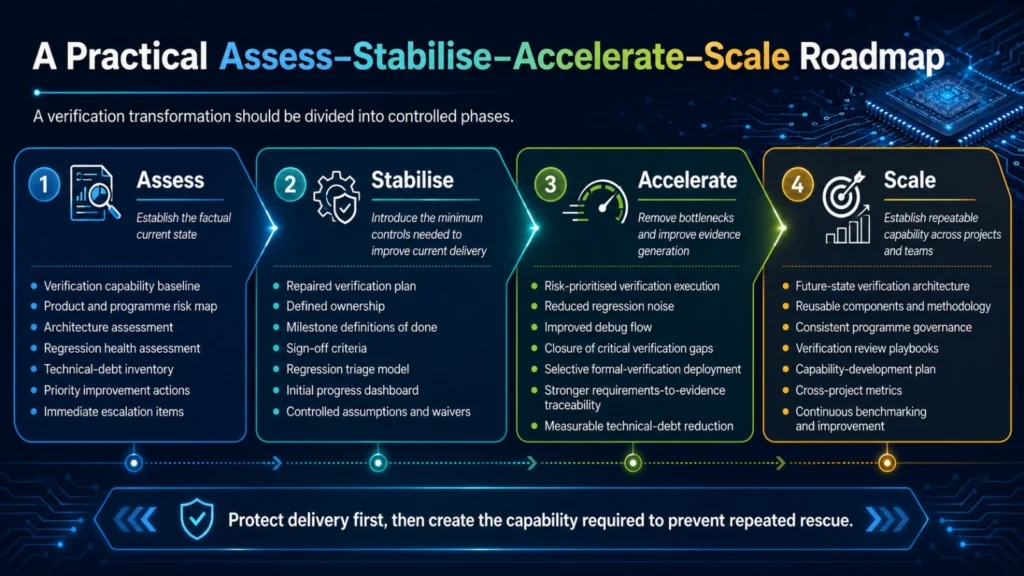
Stabilise the Current Programme Without Stopping Delivery
A scale-up under delivery pressure rarely has the option to pause the programme while creating an ideal methodology.
The first objective should therefore be stabilisation rather than wholesale transformation.
A practical stabilisation effort concentrates on a minimum set of controls that can improve current decisions quickly.
1. Establish a Current-State Verification Baseline
The baseline should examine what is actually happening, not only what existing process documents say should happen.
A focused assessment should review:
- Product requirements and architecture
- Existing verification plans
- Testbench and verification architecture
- Regression configuration and stability
- Functional, code and assertion coverage
- Open defects and recurring failure categories
- Formal verification results where applicable
- Assumptions, exclusions and waivers
- Sign-off criteria
- Technical debt
- Ownership and review practices
The purpose is not to score the team for compliance.
The objective is to identify where product risk, verification gaps and weak visibility intersect. A short assessment should produce a prioritised action plan rather than a long catalogue of observations.
2. Create a Verification Risk Map
Not every incomplete verification task creates the same level of programme risk.
A useful risk map connects each major feature or subsystem with:
- Product impact
- Design complexity
- Novelty
- Verification difficulty
- Current evidence
- Known defects
- Remaining uncertainty
- Schedule dependency
The resulting view enables the team to distinguish between work that is merely incomplete and work that threatens product behaviour, integration or sign-off.
Senior management can then make resource and schedule decisions using engineering evidence rather than the volume of open tasks.
3. Repair the Verification Plan
An effective verification plan is not a static document prepared at the beginning of the programme.
It should function as the principal control mechanism connecting requirements, risks, verification methods and closure evidence.
For every significant requirement or behaviour, the plan should identify:
- The behaviour to be demonstrated
- The risk associated with incorrect implementation
- The most suitable verification method
- Required stimulus and observability
- Checkers, assertions or reference models
- Coverage intent
- Dependencies and assumptions
- Responsible owner
- Expected evidence
- Closure status
The plan may combine simulation, formal verification, static analysis, emulation, FPGA prototyping or software-driven verification. Governance should not force all requirements through the same method.
Alpinum’s guidance on verification planning from requirements to coverage closure explains why more tests and more compute cannot compensate for weak verification intent. The central requirement is a defensible relationship between the product requirement and the evidence used to close it.
4. Define What “Done” Means
Different engineers can interpret completion differently unless the organisation defines it explicitly.
A feature may be considered complete because:
- The directed tests pass
- The main regression is green
- Functional coverage has reached a target
- No high-severity defects remain
- Required assertions have passed
- The responsible engineer believes the remaining risk is acceptable
Each condition may contribute to completion, but none should automatically define completion alone.
A milestone definition of done should specify the evidence required for the relevant maturity level.
For example, block-level verification completion might require:
- Requirements reviewed and baselined
- Requirements mapped to verification activities
- Planned tests implemented and passing
- Required assertions enabled and reviewed
- Coverage goals achieved or justified
- Regression stable over an agreed period
- High-severity defects closed
- Lower-severity residual defects assessed
- Assumptions and exclusions recorded
- Sign-off review completed by authorised owners
The criteria should be agreed before the final sign-off meeting. Introducing closure requirements at the end of the programme creates avoidable conflict and rework.
Accelerating Verification Without Creating More Noise
Teams under schedule pressure often attempt to accelerate by increasing regression frequency, generating more tests or adding engineers.
Additional capacity can help, but acceleration comes primarily from reducing uncertainty and wasted effort.
Restore regression credibility
A regression that produces frequent infrastructure failures, known testbench errors or unexplained intermittent results cannot provide a reliable view of design quality.
Teams should classify failures consistently:
- Probable design defect
- Testbench defect
- Test or stimulus defect
- Infrastructure failure
- Configuration problem
- Known and accepted limitation
- Duplicate failure
- Unresolved
Failure ownership and triage time should be visible. Recurring environment problems should be treated as engineering defects rather than accepted background noise.
Prioritise verification by risk
A team may achieve a high aggregate coverage result while critical behaviours remain weakly verified.
Risk-based prioritisation focuses first on:
- Safety- or security-relevant behaviour
- Data integrity
- Reset and recovery
- Error handling
- Concurrency and arbitration
- Clock and power transitions
- Privilege and access control
- Hardware–software interaction
- Complex state transitions
- Integration boundaries
Coverage remains important, but closure should reflect the significance of what has been covered rather than only the percentage achieved.
Use formal verification selectively
Formal verification can provide strong evidence for behaviours that are difficult to reach or exhaust through simulation, including protocol properties, control logic, deadlock conditions, ordering, arbitration and safety properties.
Formal methods should be integrated into the verification plan rather than applied as an isolated late-stage activity. Proof results also require disciplined interpretation: constraints, abstractions, proof depth, inconclusive properties and assumptions must remain visible.
Alpinum provides formal verification services for ASIC and SoC development to help teams integrate property checking, model checking and related techniques into practical verification workflows.
Protect debug capacity
Debug is often the hidden constraint in an apparently test-limited programme.
Generating failures faster than the team can classify and resolve them creates queues rather than progress. The verification lead should monitor:
- Time from failure detection to classification
- Time from classification to ownership
- Time from ownership to resolution
- Repeated failure patterns
- Defects reopened after an attempted fix
- Percentage of engineering time consumed by environment problems
Improving failure quality and reducing repeated investigation can deliver more schedule benefit than simply increasing simulation volume.
Measuring Verification Progress More Effectively
No single metric can represent verification readiness.
Coverage percentage, test pass rate and defect count all provide useful information, but each can mislead when viewed alone.
A balanced dashboard should connect work completed with risk retired and evidence produced.
| Measurement area | Useful indicators | Decision supported |
| Verification intent | Requirements identified, reviewed and traced | Do we know what must be verified? |
| Plan execution | Planned activities implemented, passing, failing or blocked | Are we executing the agreed strategy? |
| Regression health | Pass rate, infrastructure failures and intermittent failures | Can the regression results be trusted? |
| Coverage | Functional, code and assertion coverage against planned goals | Which behaviours remain insufficiently exercised or observed? |
| Formal verification | Proven, failing, bounded and inconclusive properties | What exhaustive evidence exists and where are the proof limits? |
| Defects | Severity, age, discovery rate and closure rate | Is residual product risk decreasing? |
| Technical debt | Debt introduced, retired, deferred and overdue | Are short-term decisions increasing future delivery risk? |
| Sign-off readiness | Evidence complete, incomplete or conditionally accepted by area | Which blocks or features are genuinely ready? |
The dashboard should enable decisions, not reward favourable-looking numbers.
For example, setting coverage as an isolated target can encourage teams to close easy bins while difficult or high-risk behaviour remains unresolved. A useful coverage review asks what each result says about design intent, observability and residual risk.
Accellera’s standards work reflects the industry need for scalable, reusable verification environments and interoperable coverage information. UVM is defined to support modular, scalable and reusable verification environments, while UCIS provides a standardised mechanism for accessing and exchanging coverage information across tools.
Managing Verification Technical Debt
Verification technical debt deserves the same visibility as design and software technical debt.
Common examples include:
- Temporary testbench workarounds
- Duplicated verification components
- Incomplete checkers
- Disabled assertions
- Unstable tests
- Manual regression steps
- Unreviewed exclusions
- Hard-coded configuration
- Missing reference models
- Weak requirements traceability
- Obsolete tests that remain in regressions
- Coverage waivers without clear justification
Not every debt item must be removed immediately.
Governance should ensure that each material item has:
- A clear description
- A reason for introduction
- An assessment of product and delivery impact
- An owner
- A containment action
- A proposed resolution
- A target milestone
- An escalation path if it remains open
Technical debt becomes dangerous when it is invisible or when temporary decisions lose their history.
A controlled debt register allows the team to make deliberate trade-offs while preserving future accountability.
Building the Future-State Verification Architecture
Stabilisation addresses immediate programme risk. The longer-term objective is a verification architecture that can support more products, engineers and reuse without losing control.
A scalable architecture contains four connected layers.
1. Verification intent and traceability
Product requirements, architectural decisions and identified risks must connect to verification objectives.
Traceability should show how each important behaviour will be stimulated, observed, checked, measured and closed.
The aim is not maximum documentation. The aim is preserving the relationship between what the product must do and why the available evidence is considered sufficient.
2. Reusable verification infrastructure
Testbench components should have clear responsibilities and interfaces.
Depending on the programme, the architecture may include:
- UVM agents and environments
- Verification IP
- Reference models
- Scoreboards
- Protocol and end-to-end checkers
- Assertion libraries
- Coverage models
- Configuration management
- Reusable sequences
- Software-driven test frameworks
- Emulation or FPGA integration
UVM provides an industry-standard foundation for modular and reusable verification components, but adopting UVM alone does not guarantee a scalable architecture. Reuse still depends on appropriate boundaries, configuration discipline, ownership and documentation.
3. Automation and verification data
Automation should make the verification process more repeatable and observable.
The flow should support:
- Controlled build and run configuration
- Automated regressions
- Failure classification
- Result storage
- Coverage aggregation
- Trend analysis
- Defect linking
- Reproducible debug
- Evidence generation
- Sign-off reporting
Automation should reduce manual inconsistency rather than hide the reasoning behind results.
4. Sign-off evidence
The final architecture must produce an evidence package that authorised reviewers can understand.
A sign-off package may include:
- Approved verification plan
- Requirements traceability
- Regression results
- Coverage reports and analysis
- Formal verification status
- Static verification results
- Defect disposition
- Waivers and exclusions
- Known limitations
- Technical-debt decisions
- Reviewer approvals
- Residual risk acceptance
The sign-off package should record not only that a target was reached, but why the evidence supports the decision to proceed.
Developing the Verification Lead and Team
Governance cannot be sustained through documents alone.
The verification lead needs sufficient authority, information and organisational support to control verification decisions across the programme.
The role should include:
- Owning the verification strategy
- Maintaining visibility of product risk
- Assigning artefact ownership
- Reviewing verification plans and architecture
- Protecting regression credibility
- Escalating unresolved sign-off risks
- Coordinating design, verification and software dependencies
- Defining closure criteria
- Leading sign-off reviews
- Developing team capability
The lead should not become the person who personally resolves every difficult technical issue. That model merely replaces one dependency with another.
A stronger approach distributes technical ownership while retaining clear accountability.
Capability development should take place through real project work. Templates, reviews, mentoring and targeted semiconductor verification training can help teams build shared practices across SystemVerilog, UVM, formal verification, assertions, coverage and sign-off.
Governance Without Losing Agility
Scale-ups are right to protect their ability to move quickly.
The answer is not to recreate the process burden of a much larger organisation. Verification governance should be proportionate to product risk, team size and programme complexity.
A lightweight but effective model might use:
- One controlled verification plan
- One product-risk view
- One verification-debt register
- A small set of decision-oriented metrics
- Short weekly risk and closure reviews
- Explicit milestone criteria
- Named sign-off authorities
- A clear evidence repository
Every artefact should support an engineering decision. Any activity that does not improve ownership, visibility, repeatability or confidence should be questioned.
Good governance makes fast decisions safer. It also reduces the time spent rediscovering information, debating completion and recovering from avoidable surprises.
From Successful Scale-Up to Scalable Verification Capability
Early semiconductor success often depends on exceptional people solving difficult problems quickly.
Sustained success requires the organisation to convert that expertise into a verification capability that other engineers can understand, execute and improve.
The transition does not mean replacing judgement with process.
It means ensuring that judgement is supported by:
- Explicit verification intent
- Clear ownership
- Risk-based priorities
- Reliable verification infrastructure
- Measurable progress
- Controlled technical debt
- Reviewable evidence
- Defensible sign-off
A team that makes this transition can continue moving quickly without allowing speed to conceal growing product or delivery risk.
Alpinum’s design verification consulting services support semiconductor teams that need to stabilise delayed programmes, strengthen verification planning, review verification architecture, improve coverage closure or build a more scalable verification operating model.
FAQs
Verification governance is the structure used to control verification ownership, planning, measurement, risk decisions and sign-off. It ensures that verification work produces reviewable evidence connected to product requirements rather than relying only on activity or individual judgement.
Poorly designed governance can create unnecessary administration. Effective governance remains proportionate and decision-focused. Its purpose is to remove uncertainty, clarify ownership and prevent late rework rather than introduce documentation for its own sake.
The first priorities should be a current-state assessment, a verification risk map, a controlled verification plan, explicit milestone definitions of done and a small set of progress measures connected to sign-off readiness.
Progress should be measured through a combination of requirements traceability, plan execution, regression health, coverage analysis, formal-verification status, defect risk, technical debt and sign-off evidence. No single percentage can represent complete verification readiness.
Begin with minimum viable controls around the current programme. Prioritise critical product risks, repair the verification plan, stabilise regressions and define sign-off evidence before attempting a larger methodology transformation.
The verification lead should own the verification strategy, risk visibility, architecture reviews, closure criteria and sign-off preparation. The role should distribute technical ownership across the team rather than becoming the only source of verification knowledge.
External support can help when a team needs an independent capability assessment, urgent project stabilisation, specialist formal-verification expertise, architecture review, coverage-closure support or assistance establishing a scalable verification operating model.
Strengthen Your Verification Capability
Is your organisation scaling faster than its verification processes, architecture or sign-off controls?
Alpinum can assess the current position, identify the most significant product and delivery risks, stabilise the immediate verification programme and work alongside your engineering team to establish a measurable future-state capability.

Written by : Mike Bartley
Mike started in software testing in 1988 after completing a PhD in Math, moving to semiconductor Design Verification (DV) in 1994, verifying designs (on Silicon and FPGA) going into commercial and safety-related sectors such as mobile phones, automotive, comms, cloud/data servers, and Artificial Intelligence. Mike built and managed state-of-the-art DV teams inside several companies, specialising in CPU verification.
Mike founded and grew a DV services company to 450+ engineers globally, successfully delivering services and solutions to over 50+ clients.
Mike started Alpinum in April 2016 to deliver a range of start-of-the art industry solutions:
Alpinum AI provides tools and automations using Artificial Intelligence to help companies reduce development costs (by up to 90%!) Alpinum Services provides RTL to GDS VLSI services from nearshore and offshore centres in Vietnam, India, Egypt, Eastern Europe, Mexico and Costa Rica. Alpinum Consulting also provides strategic board level consultancy services, helping companies to grow. Alpinum training department provides self-paced, fully online training in System Verilog, UVM Introduction and Advanced, Formal Verification, DV methodologies for SV, UVM, VHDL and OSVVM and CPU/RISC-V. Alpinum Events organises a number of free-to-attend industry events
You can contact Mike (mike@alpinumconsulting.com or +44 7796 307958) or book a meeting with Mike using Calendly (https://calendly.com/mike-alpinum-consulting).
Stay Informed and Stay Ahead
Latest Articles, Guides and News
Explore related insights from Alpinum that dive deeper into design verification challenges, practical solutions, and expert perspectives from across the global engineering landscape.