
Executive Summary
Will AI take my job?
For semiconductor and verification engineers, the most realistic answer is that artificial intelligence will change the content of many roles before it removes complete professions. Repetitive tasks such as report summarisation, script generation, regression classification, documentation retrieval and initial testbench creation are becoming easier to automate. Responsibility for requirements, architecture, verification intent, engineering trade-offs, evidence assessment, risk and sign-off remains much harder to delegate.
That distinction matters. Engineers do not need to compete with AI by generating more output than a machine. They need to become better at defining the right problem, directing AI-assisted workflows, checking the resulting evidence and making decisions that require engineering context.
A strong career response therefore combines three elements:
- Deep and commercially valuable domain knowledge
- Practical AI and automation literacy
- Evidence that you can apply both inside real engineering workflows
This article provides a practical 90-day plan for semiconductor, RTL, FPGA, software and verification engineers who want to keep up with AI, protect their employability and identify the right training and industry-development opportunities.
Quick Answer: Will AI Take My Engineering Job?
AI is more likely to automate selected engineering tasks than assume complete ownership of an engineering role.
An AI system may generate RTL, propose assertions, produce testbench scaffolding, summarise regression logs or identify patterns in coverage data. Those outputs can improve productivity, but they do not independently establish that:
- The specification is complete
- The architecture satisfies its intended use
- The testbench represents the correct verification intent
- The assumptions used by formal tools are valid
- Coverage reflects meaningful system behaviour
- A suggested correction will not introduce a different failure
- Residual technical risk is commercially or legally acceptable
- The available evidence is sufficient for sign-off
Those decisions depend on context, experience, traceability and accountability.
Engineers who perform only repeatable execution may experience increasing automation pressure. Engineers who understand the complete workflow, own important decisions and validate AI-generated evidence are more likely to become more valuable.
For a broader examination of automation and employment risk, read Will AI Replace Semiconductor Engineers? The 2026 Reality for Chip Design, Verification and Manufacturing.
Why the Question Feels More Urgent in 2026
AI has moved beyond general-purpose chat assistants. Engineering vendors are introducing systems that can plan and execute increasingly complex, multi-stage workflows.
Cadence, for example, describes its ChipStack AI Super Agent as an agentic workflow supporting RTL generation, testbench creation, regression orchestration and debug. Cadence has reported substantial productivity improvements in selected early deployments. Such vendor results should be evaluated in context, but the direction is clear: AI is moving closer to day-to-day engineering activity.
Accellera has similarly observed that AI is becoming pervasive across design and verification flows, rather than remaining a separate specialist subject.
Workforce expectations are changing at the same time. The World Economic Forum’s Future of Jobs Report 2025 found that employers expect 39% of workers’ core skills to change by 2030. Two-thirds of surveyed employers planned to recruit people with specific AI skills, while 40% anticipated reducing workforce numbers where AI could automate tasks.
Neither extreme provides a reliable career strategy. Assuming that AI will remove every engineering job encourages panic. Assuming that domain knowledge alone guarantees continued relevance encourages complacency.
The practical response lies between them: strengthen the engineering capabilities that remain difficult to automate while learning how to use AI inside controlled, measurable workflows.
What AI Can Already Do in Semiconductor Engineering
AI-assisted systems are increasingly capable of supporting work across the semiconductor lifecycle.
RTL and Design Support
AI can assist with:
- RTL scaffolding
- Syntax correction
- Code explanation
- Refactoring suggestions
- Specification search
- Interface documentation
- Design-space exploration
- Routine script generation
Generated RTL still requires review against architecture, timing, reset, power, protocol and integration requirements. A syntactically correct module is not automatically functionally correct or suitable for implementation.
Verification Planning and Testbench Development
AI can propose:
- Verification-plan structures
- Test ideas
- SystemVerilog assertions
- UVM component templates
- Constrained-random scenarios
- Coverage models
- Interface sequences
- Documentation mappings
The engineer remains responsible for determining what must be verified and whether the generated collateral represents the specification accurately.
A weak understanding of SystemVerilog or UVM cannot be corrected merely by asking an AI system to generate more code. Engineers need a sound methodology against which the generated output can be judged. Alpinum’s Design Verification for SV/UVM Training provides a structured route for building that foundation.
Regression Analysis and Debug
AI may help teams:
- Cluster similar failures
- Identify repeated log signatures
- Summarise regression results
- Correlate failing tests and seeds
- Prioritise likely root causes
- Compare failures across configurations
- Highlight abnormal coverage movement
These applications can reduce time spent organising evidence. They do not remove the need for experienced engineers to interpret design behaviour, reproduce failures and confirm root cause.
Coverage Analysis
AI can assist with coverage-report comparison, gap identification and scenario classification. However, high coverage is not the same as verification completeness.
An engineer still needs to decide whether:
- Coverage points correspond to requirements
- Important combinations are represented
- Exclusions are justified
- Unreachable bins are genuinely unreachable
- Assertions capture meaningful behaviour
- Coverage closure supports the intended sign-off argument
Formal Verification
AI can help prepare properties, explain counterexamples and organise proof activity. Formal verification remains highly dependent on the quality of assumptions, abstraction, property intent and proof interpretation.
Engineers wanting to develop stronger proof-oriented skills can explore Alpinum’s Formal Verification Training for Hardware and Software.
Software and Workflow Automation
Python, C, C++, Rust and automation skills can help engineers connect tools, process results, analyse data and reduce repetitive activity.
The objective is not to become a generic AI developer. The stronger goal is to combine software capability with semiconductor-domain knowledge. Alpinum’s Software Development Programme using Python, C, C++ and Rust provides relevant development pathways for engineers who need stronger automation and programming foundations.
Which Engineering Tasks Face the Greatest Automation Pressure?
The level of exposure depends on whether an activity is repeatable, well-bounded and easy to validate.
| More exposed to automation | More resistant to full automation |
| Boilerplate generation | Architecture ownership |
| Routine scripting | Requirements interpretation |
| Report summarisation | Verification intent |
| Log classification | Cross-domain trade-offs |
| Documentation search | Safety and security judgement |
| Initial test generation | Evidence sufficiency decisions |
| Repeated data transformation | Residual-risk acceptance |
| Template-based code creation | Programme-level accountability |
| Basic issue categorisation | Final engineering sign-off |
The safest position is not to avoid automated tasks completely. Engineers should learn how those activities are automated and move towards ownership of the surrounding workflow.
For example, an engineer who manually classifies thousands of regression failures may face automation pressure. An engineer who designs the classification process, defines acceptable confidence, investigates exceptions, validates root causes and measures the effect on closure is operating at a higher-value level.
The Five Capabilities That Protect an Engineering Career
1. System-Level Understanding
AI can produce local answers without understanding every downstream consequence.
A change to an interface may affect performance, power, safety, software compatibility, verification strategy and implementation constraints. Engineers who can reason across these boundaries remain essential.
System-level capability includes:
- Understanding requirements and architecture
- Recognising dependencies between hardware and software
- Evaluating design and verification trade-offs
- Identifying downstream consequences
- Connecting local results to programme objectives
2. Verification and Evidence Literacy
More AI-generated output creates a greater need for effective validation.
Engineers must know how to distinguish between:
- A plausible explanation and a confirmed result
- A test that runs and a test that verifies meaningful behaviour
- A generated assertion and a valid property
- High coverage and sufficient verification
- A correlated pattern and a proven root cause
- A recommended fix and an engineering-safe change
Verification skills therefore become more important as AI generation improves.
3. Automation and Data Skills
Engineers should understand how to automate repetitive work and analyse the evidence produced by engineering tools.
Useful capabilities include:
- Python scripting
- Structured data processing
- Log parsing
- Results visualisation
- Regression automation
- API integration
- Basic statistics
- Workflow orchestration
- Version control
- Reproducible analysis
A detailed workflow-based learning path is available in How Semiconductor Engineers Can Learn AI and Machine Learning in 2026.
4. AI Output Validation
Prompting alone is not a durable engineering advantage. The ability to test, challenge and validate AI output is more valuable.
Before accepting an AI-generated result, ask:
- Which specification or source was used?
- Is that source current?
- Which assumptions were made?
- What information was missing?
- Can the result be reproduced?
- How will it be verified independently?
- What happens if the result is wrong?
- Does a qualified engineer need to approve it?
- Can the complete decision path be audited?
Engineers who apply this discipline can use AI productively without weakening quality or accountability.
5. Communication and Technical Leadership
AI can generate technical text, but engineering teams still require people who can:
- Explain uncertainty
- Challenge assumptions constructively
- Communicate risk
- Align specialists across disciplines
- Present evidence clearly
- Support technical reviews
- Mentor less-experienced engineers
- Decide when escalation is required
Communication becomes more important when teams are processing more generated information in less time.
A Practical 90-Day AI Career Plan
The objective is not to master every AI platform in three months. The objective is to produce one credible example of improved engineering capability.
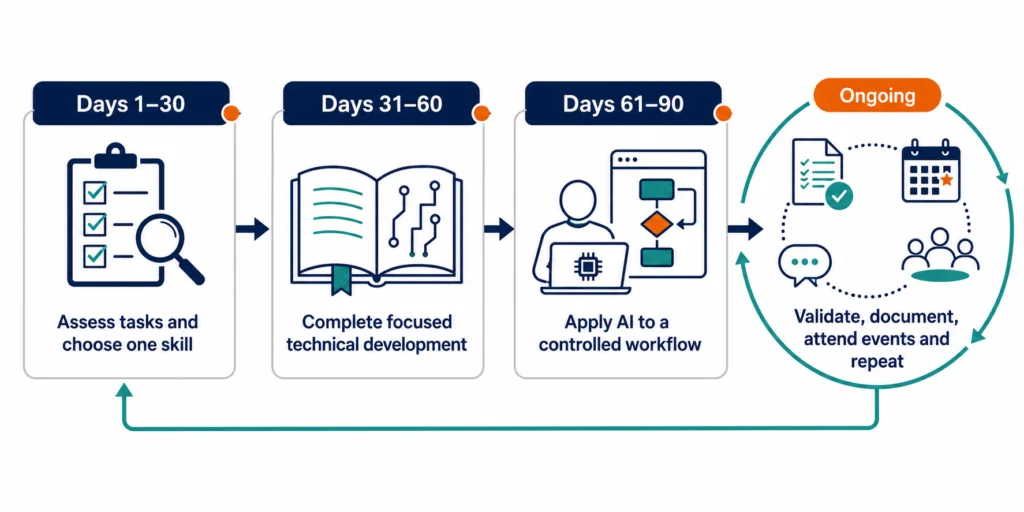
Figure 1: A practical 90-day development cycle for engineers adapting to AI-assisted semiconductor workflows.
Days 1–30: Understand Your Exposure and Choose a Direction
Start by listing your regular activities.
Classify each activity into one of four categories:
- Repetitive execution
- Evidence preparation
- Technical interpretation
- Decision ownership
Activities concentrated in the first category are more likely to be automated. Activities involving interpretation and ownership offer stronger long-term differentiation.
Next, identify one capability gap that limits your ability to move higher in the workflow.
Examples include:
- Limited understanding of UVM architecture
- Weak formal-verification knowledge
- Insufficient Python automation
- Limited processor-verification experience
- Difficulty analysing coverage evidence
- Lack of system-level hardware/software understanding
- Limited experience validating AI-generated engineering output
Choose one development objective rather than attempting to learn everything simultaneously.
Days 31–60: Build a Strong Technical Foundation
Select a learning route connected to real engineering demand.
For Design Verification Engineers
Strengthen SystemVerilog, UVM, constrained-random verification, assertions, scoreboards, coverage and reusable testbench architecture through Design Verification for SV/UVM Training.
AI-generated testbench components are valuable only when the reviewing engineer understands how a robust environment should operate.
For Engineers Moving Towards Proof and Sign-Off
Develop assertion-based verification, property construction, assumptions, counterexample analysis and proof strategies through Formal Verification Training.
Formal skills are particularly valuable because they require precise reasoning about intent, constraints and evidence.
For CPU, SoC and Open-Architecture Engineers
Build processor and instruction-set knowledge through RISC-V Verification Training.
RISC-V provides an open environment for learning processor architecture, privilege modes, exceptions, instruction behaviour and verification challenges.
For Automation-Focused Engineers
Improve Python, C, C++ or Rust capability through Alpinum’s Software Development Programme.
Automation skills help engineers connect AI-assisted analysis to real development and verification workflows.
The full range of available programmes can be found on the Alpinum semiconductor and verification training page.
Days 61–90: Apply AI to One Controlled Workflow
Choose a bounded task with measurable inputs and outputs.
Suitable examples include:
- Classifying regression failures
- Summarising logs with links to original evidence
- Generating initial assertions for engineer review
- Producing test ideas from a controlled specification section
- Extracting coverage trends
- Searching approved technical documentation
- Comparing verification-plan requirements with implemented tests
- Automating a repeated engineering report
Define success before beginning.
Possible measurements include:
- Time saved
- Classification accuracy
- Number of useful suggestions
- Number of incorrect suggestions
- Review effort required
- Reproducibility
- Coverage improvement
- Defects identified
- False-positive rate
- Percentage of outputs requiring correction
Maintain a human approval point for any result that could affect verification intent, design behaviour, safety, security or sign-off.
Alpinum’s guidance on piloting AI safely in design verification explains why bounded use cases, traceability and measurable outcomes should come before wider deployment.
Do Not Try to Follow Every AI Announcement
Engineers can easily lose productive time trying to monitor every model, agent, benchmark and product release.
A more sustainable routine is:
Weekly
- Read one credible technical article
- Test one relevant capability
- Record one useful or unreliable result
- Review one industry discussion or presentation
Monthly
- Examine how AI is changing your specific workflow
- Update one automation or engineering-development objective
- Discuss practical adoption with colleagues
- Review whether a new tool improves measurable outcomes
Quarterly
- Attend an industry conference, webinar or technical event
- Complete one structured learning unit
- Produce one demonstrable workflow improvement
- Reassess which activities in your role are becoming automated
Career resilience comes from consistent development, not constant reaction.
Use Conferences to Learn What Is Actually Working
Formal courses provide structured knowledge. Conferences and professional communities reveal how engineers and organisations are applying that knowledge.
Industry events allow engineers to:
- Hear practical implementation experiences
- Compare methodologies and tools
- Understand emerging employer requirements
- Learn where AI adoption is succeeding or failing
- Meet engineers working on similar problems
- Identify skills that are becoming commercially important
- Challenge vendor claims through technical discussion
Alpinum’s Verification Futures conferences bring together engineers, verification specialists, tool providers and semiconductor organisations. Current programmes include Verification and Semiconductor Futures conferences in Austin and San Jose.
The DV Club programme also provides access to technical events and previous sessions covering AI in design verification, processor verification, RISC-V, security verification and formal methods.
Attendance alone will not transform a career. The value comes from converting what you learn into a new capability, workflow improvement or professional relationship.
Build Evidence of Capability, Not Just a List of Tools
Knowing the names of many AI platforms is not the same as demonstrating engineering value.
A stronger professional record might show that you:
- Automated regression-report preparation
- Reduced initial failure-classification time
- Improved traceability between requirements and tests
- Created a reproducible verification dashboard
- Used AI to suggest properties and documented the review process
- Identified where an AI recommendation was technically unsafe
- Integrated structured document retrieval into an engineering workflow
- Developed an approval process for AI-generated collateral
- Presented lessons from a controlled AI pilot
Record the initial problem, method, constraints, results and lessons learned. Do not disclose confidential design data or employer intellectual property.
A concise, evidence-led case study is more credible than claiming broad AI expertise without measurable examples.
What Managers Should Look for in AI-Ready Engineers
Managers should not assess AI readiness only through tool familiarity.
Stronger indicators include whether an engineer can:
- Select an appropriate problem
- Define measurable success
- Protect confidential data
- Establish review checkpoints
- Validate generated results
- Recognise model limitations
- Preserve traceability
- Communicate uncertainty
- Escalate unsafe outcomes
- Connect productivity gains to engineering quality
An engineer who understands when not to use AI can be as valuable as one who knows how to deploy it.
Your AI Career-Resilience Checklist
Use the following questions to evaluate your current position:
- Can I explain which parts of my role are likely to be automated?
- Do I own any decisions beyond routine execution?
- Can I validate AI-generated code, tests or technical conclusions?
- Do I understand the complete workflow surrounding my task?
- Can I connect results to requirements and design intent?
- Do I have a commercially valuable technical specialism?
- Can I automate repetitive work using software or scripting?
- Have I applied AI to a bounded engineering problem?
- Can I demonstrate the result without exposing confidential information?
- Do I regularly learn from engineers outside my immediate team?
- Have I attended a relevant technical event during the past quarter?
- Do I have a defined development objective for the next 90 days?
If most answers are no, the solution is not panic. Select one capability gap and begin addressing it systematically.
Conclusion: Do Not Compete With AI on Output Volume
AI will generate code, tests, reports and recommendations faster than an individual engineer. Trying to preserve a career by manually producing more routine output is unlikely to succeed.
Compete on what engineering organisations still need:
- Problem definition
- Domain expertise
- Verification intent
- Evidence evaluation
- System-level reasoning
- Risk awareness
- Accountability
- Technical communication
- Sound engineering judgement
The strongest career strategy combines deep engineering knowledge with practical AI literacy.
Choose a relevant discipline. Strengthen it through structured training. Apply AI to one controlled workflow. Validate the result. Learn from the wider engineering community. Repeat the process every quarter.
AI may change your job. Used carefully, it can also expand what you are capable of doing.
References
[1] World Economic Forum, “The Future of Jobs Report 2025,” Jan. 2025. [Online]. Available: https://www.weforum.org/publications/the-future-of-jobs-report-2025/. [Accessed: Jul. 27, 2026].
[2] World Economic Forum, “3. Skills Outlook,” in The Future of Jobs Report 2025, Jan. 2025. [Online]. Available: https://www.weforum.org/publications/the-future-of-jobs-report-2025/in-full/3-skills-outlook/. [Accessed: Jul. 27, 2026].
[3] Cadence Design Systems, “Agentic AI for Chip and System Design.” [Online]. Available: https://www.cadence.com/en_US/home/ai/ai-for-design.html. [Accessed: Jul. 27, 2026].
[4] Cadence Design Systems, “ChipStack AI Super Agent.” [Online]. Available: https://www.cadence.com/en_US/home/tools/system-design-and-verification/chipstack-ai-superagent.html. [Accessed: Jul. 27, 2026].
[5] Accellera Systems Initiative, “Community Newsletter: February 2026,” Feb. 2026. [Online]. Available: https://www.accellera.org/news/newsletters/2026-february. [Accessed: Jul. 27, 2026].
[6] World Semiconductor Trade Statistics, “Global Semiconductor Market Surges Beyond USD 1.5 Trillion in 2026,” Jun. 2, 2026. [Online]. Available: https://www.wsts.org/76/103/Global-Semiconductor-Market-Surges-Beyond-15T-2026. [Accessed: Jul. 27, 2026].
FAQs
AI is likely to automate selected tasks within semiconductor roles, particularly repetitive analysis, scripting, report preparation and initial content generation. Complete engineering roles also involve requirements, architecture, verification intent, trade-offs, evidence assessment and accountability, which remain dependent on qualified engineers.
Engineers should focus on workflow-relevant skills such as automation, Python, data analysis, AI-output validation, documentation retrieval and controlled AI integration. Deep semiconductor-domain knowledge remains essential.
Verification engineers should maintain strong foundations in SystemVerilog, UVM, assertions, coverage, formal methods and debug. They should also develop automation, data-analysis and AI-validation skills.
AI can assist with test generation, regression analysis, failure clustering, coverage review and debugging. Verification engineers still define what must be verified, evaluate evidence and determine whether sign-off expectations have been met.
System architecture, verification intent, formal reasoning, hardware/software integration, safety, security, processor verification, evidence interpretation and technical leadership are likely to remain valuable as automation grows.
Begin with a bounded task, approved data and measurable success criteria. Preserve access to original evidence, validate every important output and require engineer approval for changes affecting verification intent or sign-off.
Conferences cannot guarantee employment, but they can help engineers understand emerging methodologies, employer requirements, technical challenges and practical AI adoption. They also provide opportunities to develop professional relationships and learn from other specialists.
Identify one repetitive activity in your current workflow and one higher-value skill you need to develop. Select a structured learning route, then apply the new capability to a small, measurable project during the next 90 days.

Written by : Mike Bartley
Mike started in software testing in 1988 after completing a PhD in Math, moving to semiconductor Design Verification (DV) in 1994, verifying designs (on Silicon and FPGA) going into commercial and safety-related sectors such as mobile phones, automotive, comms, cloud/data servers, and Artificial Intelligence. Mike built and managed state-of-the-art DV teams inside several companies, specialising in CPU verification.
Mike founded and grew a DV services company to 450+ engineers globally, successfully delivering services and solutions to over 50+ clients.
Mike started Alpinum in April 2016 to deliver a range of start-of-the art industry solutions:
Alpinum AI provides tools and automations using Artificial Intelligence to help companies reduce development costs (by up to 90%!) Alpinum Services provides RTL to GDS VLSI services from nearshore and offshore centres in Vietnam, India, Egypt, Eastern Europe, Mexico and Costa Rica. Alpinum Consulting also provides strategic board level consultancy services, helping companies to grow. Alpinum training department provides self-paced, fully online training in System Verilog, UVM Introduction and Advanced, Formal Verification, DV methodologies for SV, UVM, VHDL and OSVVM and CPU/RISC-V. Alpinum Events organises a number of free-to-attend industry events
You can contact Mike (mike@alpinumconsulting.com or +44 7796 307958) or book a meeting with Mike using Calendly (https://calendly.com/mike-alpinum-consulting).
Stay Informed and Stay Ahead
Latest Articles, Guides and News
Explore related insights from Alpinum that dive deeper into design verification challenges, practical solutions, and expert perspectives from across the global engineering landscape.