
Artificial intelligence is now entering design verification in practical ways. It can help with regression triage, log summarisation, failure clustering, coverage review, documentation search and review assistance. However, the value of “AI in DV” does not come from buying a tool and expecting the verification problem to become smaller.
The value comes from capability.
For semiconductor teams, adopting “AI in DV” is not simply a software decision. It is a question of process readiness, data quality, workflow integration, governance, review discipline and measurable outcomes. Without those foundations, AI can create activity without evidence, speed without confidence, and automation without accountability.
Recent industry discussion reflects this shift. EE Times has highlighted that AI is already useful in repeatable, data-rich verification workflows such as coverage analysis, regression management, test case refinement, and failure grouping, but it does not replace engineering judgement or expert sign-off [1]. Siemens has also described agentic AI as a response to the RTL verification productivity gap, while DVCon 2025 included AI and ML coverage-closure and regression-triage topics, showing that the industry is actively exploring how AI can most effectively help verification teams [2], [3].
For Alpinum’s clients, the practical question is not whether AI will appear in verification. It already has. The more important question is whether the organisation has the capability to adopt it safely, measure its value and integrate it into production verification workflows.
Key learning points
| Key learning point | Link to detailed explanation | External reference link |
| “AI in DV” adoption succeeds when verification teams build governance, workflow integration and measurable engineering processes before scaling tools. | Why “AI in DV” adoption is now a capability question | [1], [2], [5] |
| The strongest early AI use cases in design verification are regression triage, log summarisation, failure clustering and coverage review. | Where AI already helps with design verification | [1], [2], [3] |
| AI verification pilots often fail because they lack baseline metrics, clear ownership and integration with existing UVM and regression workflows. | Where “AI in DV” adoption fails | [1], [4], [5] |
| Verification capability depends on methodology, engineering accountability, review discipline and sign-off evidence, not only on AI tools. | Why tools alone do not create verification capability | [1], [4] |
| Safe “AI in DV” adoption should measure regression-triage efficiency, debug-cycle reduction, coverage-closure improvement, and sign-off confidence. | What a safe “AI in DV” pilot should measure | [1], [2], [5] |
Why “AI in DV” adoption is now a capability question
Verification teams are under increasing pressure. Designs are larger, schedules are tighter, regression data is growing and debug effort remains a major cost. At the same time, engineering teams are being asked to deliver more confidence with fewer wasted cycles.
This is why “AI in DV” is attractive. It promises faster triage, better search across project knowledge, quicker failure grouping and more efficient coverage review. These are real opportunities, but they only matter if the outputs can be trusted, reviewed and connected to verification intent.
A verification team does not only need an AI model. It needs a working adoption capability. That includes clear use-case selection, known data sources, secure access controls, integration with existing UVM, regression and CI workflows, measurable success criteria, review ownership and rules for what AI output can and cannot influence.
This is where many AI adoption efforts fail. A tool demo may look impressive, but production design verification is not a demo environment. It has IP constraints, schedule pressure, legacy flows, safety expectations, customer obligations and sign-off responsibilities.
The better adoption question is therefore:
Can this team use AI in a way that improves verification productivity without weakening review discipline or sign-off confidence?
Where AI already helps design verification
The best early use cases for “AI in DV” are repetitive, data-rich and reviewable. They do not ask AI to own verification intent. They ask AI to reduce friction inside existing workflows.
Regression triage
Regression triage is one of the clearest starting points. Verification teams often spend significant time sorting failures, identifying duplicates, locating likely root causes and deciding which failures need immediate engineering attention.
AI can help by clustering similar failures, summarising logs, identifying recurring error signatures and reducing time spent on manual sorting. This does not remove the engineer. It helps the engineer start from a more organised view of the evidence.
Failure clustering and debug support
AI can also help group failures that share common patterns. In large regressions, many failures may appear unrelated at first. A failure-clustering assistant can help highlight similarity across logs, seeds, tests, assertions or configuration settings.
This is useful because debug time is often lost before deep engineering analysis even begins. The first challenge is knowing where to look. AI can reduce that search space.
Coverage review
Coverage closure is another strong candidate. AI can help identify coverage gaps, summarise under-tested scenarios and suggest areas where additional tests or constraints may be useful. EE Times has described coverage analysis and test case refinement as examples of workflows in which AI assistance is more suitable because the artefacts are iterative, structured, and measurable [1].
However, AI should not be allowed to redefine the meaning of coverage. A high coverage number does not automatically prove that the right behaviour has been verified. Engineers still need to decide whether coverage is meaningful, whether the verification plan is complete and whether the residual risk is acceptable.
Documentation and methodology search
Verification projects contain valuable knowledge in specifications, verification plans, testbench documentation, bug databases, review notes and methodology guidelines. Engineers often spend time gathering information before making a decision.
AI-assisted search can help retrieve relevant context faster. This is especially useful for new team members, distributed teams and long-running projects where historical decisions are difficult to trace.
Review assistance
AI can support reviews by checking consistency, highlighting missing assumptions, summarising long documents and identifying areas that need human attention. This is valuable when used as an assistant, not as an authority.
The output should still be reviewed by engineers who understand the design, the verification intent and the sign-off context.
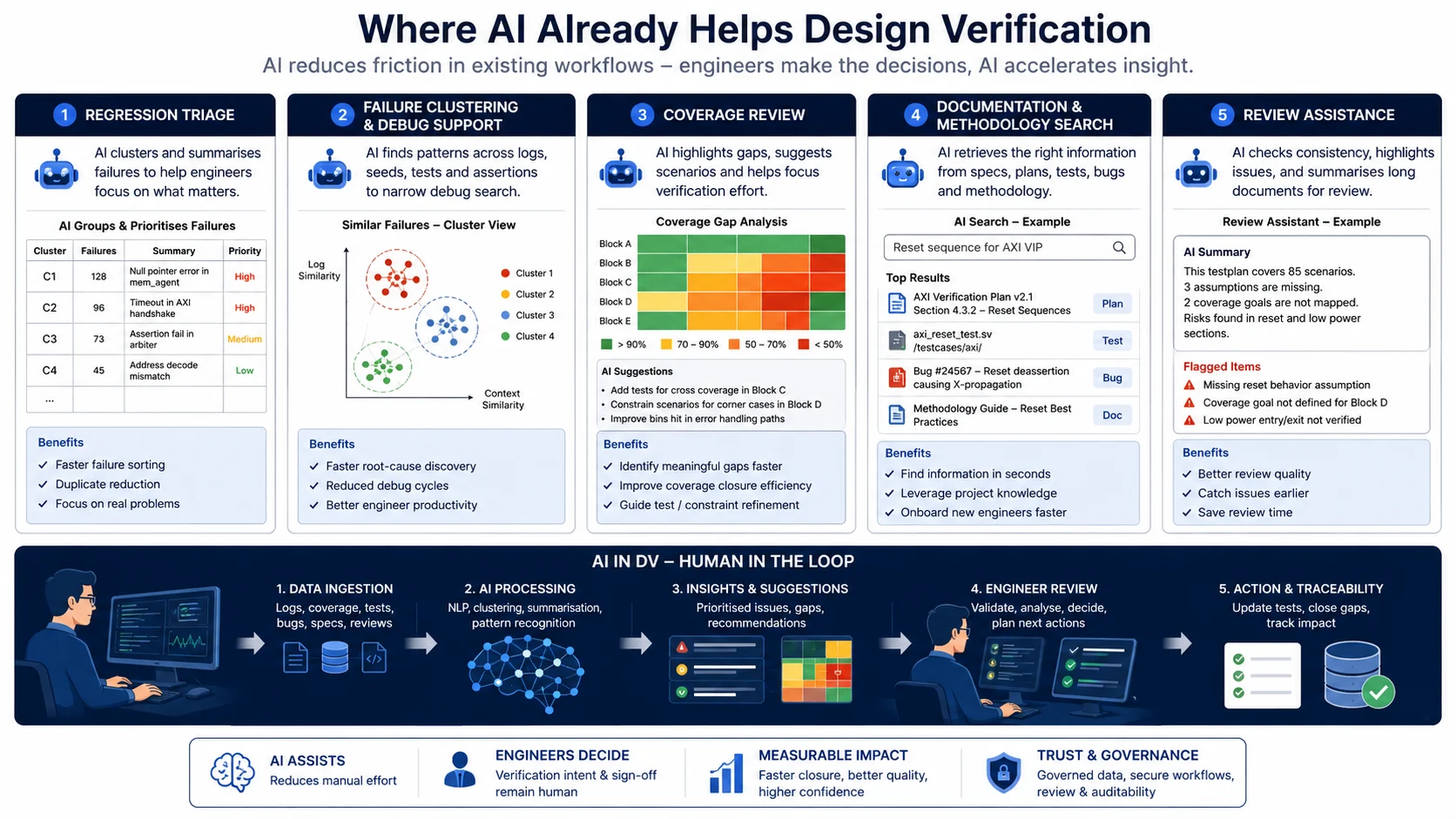
Figure 1: Practical AI in DV workflows for regression triage, coverage analysis, debug support and review assistance.
Where “AI in DV” adoption fails
The most common failure mode is to start with a tool rather than a problem.
A team may run a pilot because AI is strategically attractive, but without a clear baseline, a success metric, or a workflow owner. The result is usually a promising demonstration that never becomes part of production verification.
Vague pilots
A pilot such as “use AI to improve verification” is too broad. It is difficult to measure and easy to misinterpret. A stronger pilot is specific.
Examples include reducing duplicate regression-triage time by 30%, classifying recurring failures within a defined regression set, summarising logs for a specific block or subsystem, identifying coverage gaps against an existing verification plan, or improving documentation retrieval for a known methodology area.
Specific pilots are easier to evaluate because they have boundaries.
Poor data quality
AI adoption depends on data. If logs are inconsistent, coverage data is poorly structured, bug records are incomplete or verification plans are outdated, AI output will be weak.
In design verification, bad data is not just an efficiency problem. It can become a confidence problem. If a model is trained or prompted using an incomplete context, it may produce plausible but misleading recommendations.
Weak integration with existing flows
Verification teams already use established flows: UVM environments, regression dashboards, CI systems, coverage tools, bug trackers, formal tools and review processes. Accellera describes UVM as a standard that improves interoperability and reuse of verification components, which is exactly why AI adoption should integrate with proven flows rather than bypass them [4].
A separate AI tool that sits outside the real workflow may create extra work. A useful AI capability needs to meet engineers where the work already happens.
Unclear ownership
AI outputs need owners. If a model suggests a root cause, who reviews it? If it proposes a testcase, who approves it? If it summarises a coverage gap, who decides whether the gap is real?
Without ownership, teams risk treating AI output as either irrelevant or over-trusted. Both outcomes are poor.
No governance
Governance is not paperwork. In “AI in DV”, governance protects engineering confidence.
Teams need to define which data can be used, where prompts and outputs are stored, which models are allowed, how IP is protected, and whether outputs can be used as sign-off evidence. The NIST AI Risk Management Framework is relevant here because it provides a structured approach to managing AI risks across organisations and systems [5].
For semiconductor teams, this is particularly important because design data, verification logs, specifications and customer information can be commercially sensitive.
Why tools alone do not create verification capability
A tool can accelerate a task. It cannot define verification intent. This distinction matters. Verification is not only about running tests or analysing logs. It is about proving that the design meets its intended behaviour under meaningful conditions. That requires understanding of requirements, architecture, constraints, interfaces, risks, coverage, assumptions, and sign-off criteria.
AI can help with parts of this process. It can shorten repetitive loops, make information easier to find and reduce manual effort in triage. However, it cannot take responsibility for the verification argument. Capability comes from combining tools, methodology, data quality, workflow integration, engineering review, governance, measurement and training.
A team that has these foundations can adopt AI safely and progressively. A team without them may create more noise than value.
This is why the strongest “AI in DV” strategy starts with readiness, not procurement.
The “AI in DV” maturity model
A useful maturity model helps teams understand where they are before they scale adoption. It also prevents the common mistake of launching a broad pilot without the foundations needed to interpret the results.
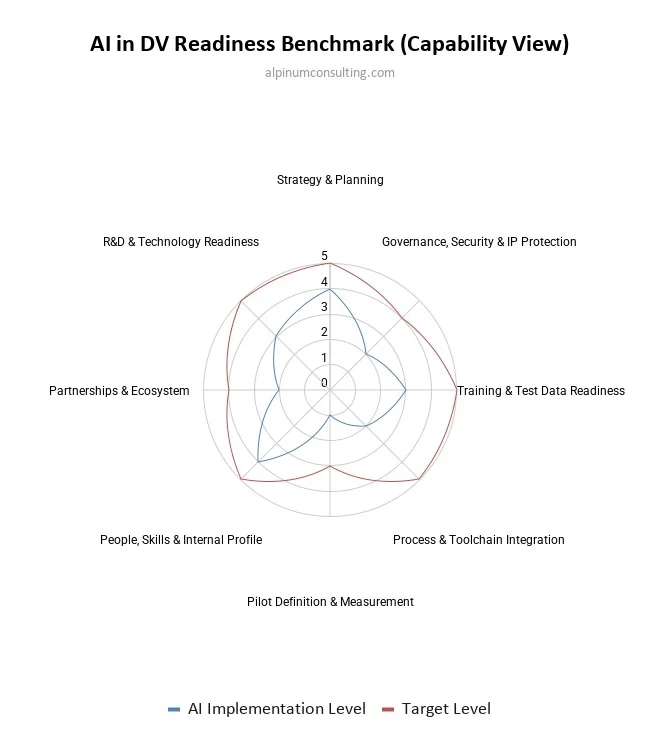
Figure 2: AI in DV Readiness Benchmark (Capability View)
An AI in DV readiness benchmark helps verification organisations assess governance, process integration, training, pilot maturity and operational capability before scaling AI adoption.
A practical “AI in DV” maturity model should assess at least eight areas.
1. Strategy and planning
The team needs a defined AI adoption strategy aligned with verification goals. This should include executive support, priority use cases, a roadmap and measurable KPIs.
The strategy should answer a simple question: what verification outcome should AI improve?
2. Governance, security and IP protection
This area covers data confidentiality, model access, auditability, prompt and output logging, review accountability and compliance with engineering sign-off requirements.
For verification teams, governance should be treated as an engineering requirement rather than a separate procurement concern.
3. Data and infrastructure
AI adoption depends on available, useful and secure data. Teams need to know whether they have the right logs, coverage data, test results, bug histories, specifications and review artefacts.
They also need secure storage, access control and the right compute or deployment environment.
4. Process and toolchain integration
AI should fit into existing verification workflows. This includes UVM environments, regression systems, CI pipelines, coverage tools, formal tools, bug tracking and review processes.
Integration is what turns a promising AI assistant into a usable engineering capability.
5. Pilot definition and measurement
A safe pilot has a limited scope, known input data, baseline metrics, success criteria and review gates. It should measure outcomes such as triage time, duplicate failure reduction, debug cycle time or coverage closure efficiency.
Without measurement, teams cannot tell whether AI has improved the workflow or simply created a new activity.
6. People, skills and internal ownership
Engineers need to understand where AI is useful, where it is risky and how to review its outputs. This does not mean every verification engineer must become a machine learning specialist.
It does mean teams need AI literacy, prompt discipline, review discipline and internal ownership of the adopted workflow.
7. Partnerships and ecosystem
Many organisations will need support from EDA vendors, AI specialists, consultants or internal platform teams. The question is not whether to use partners. The question is whether the partner understands verification evidence, sign-off discipline and semiconductor programme risk.
8. Scalability and operationalisation
A pilot is not the endpoint. Teams need to understand how an AI capability will scale across projects, blocks, teams and programmes. They also need maintenance, update cadence, monitoring and feedback loops.
Scaling too early creates risk. Scaling too late limits the value.
What a safe “AI in DV” pilot should measure
A good pilot does not try to transform the whole verification organisation at once. It selects a bounded workflow in which the team can compare before-and-after results.
| Pilot area | Possible measurement |
| Regression triage | Time from failure detection to initial classification |
| Failure clustering | Reduction in duplicate debug effort |
| Log summarisation | Time saved in first-pass failure review |
| Coverage review | Time to identify meaningful coverage gaps |
| Documentation search | Time to retrieve the relevant specification or methodology context |
| Debug support | Reduction in time to likely root-cause shortlist |
| Review quality | Number of issues caught before formal review |
| Sign-off confidence | Quality and traceability of evidence used in decision-making |
The most important point is that AI output should remain reviewable. If a team cannot explain why an output was used, where it came from and who approved it, it should not become part of a sign-off argument.
How Alpinum helps teams adopt “AI in DV”
Alpinum’s role is not to encourage AI adoption for its own sake. The value is in helping engineering teams decide where AI can create measurable benefit without adding uncontrolled risk. That starts with readiness. A team may be ready for regression triage support but not ready for AI-assisted test generation. Another team may have strong data and governance, but weak toolchain integration. A third may need training before it can scale adoption responsibly.
Alpinum’s AI in DV Capability Assessment can help teams identify where they stand, what gaps need attention and which pilot use cases are most suitable. The goal is to move from general interest in AI to an engineering-led adoption plan.
The strongest path is usually to assess current verification capability, identify bounded AI use cases, define data and governance requirements, select a measurable pilot, integrate with existing workflows, review outputs through engineering owners, measure results and then decide whether to scale.
This turns AI adoption into an engineering programme rather than a tool experiment.
Teams that need a broader technical starting point can also review Alpinum’s AI in Design Verification: Where It Works and Where Teams Fail, as well as its guidance on Choosing an AI in DV Partner.
Organisations reviewing the wider impact of AI on engineering roles will find Alpinum’s analysis of whether AI will replace semiconductor engineers provides useful context.
Where teams need structured support across verification planning, execution and capability development, Alpinum’s Design Verification Services and Token-Based Training for Engineering Teams provide practical routes for building capability.
Conclusion: AI adoption must be engineered, not purchased
“AI in DV” is becoming part of the verification conversation because the pressure on engineering teams is real. Regression volumes are growing, debug cycles are costly, and teams need better ways to manage data-rich verification workflows.
However, AI does not remove the need for a verification judgment. It increases the need for clear ownership, review discipline, governance and measurable outcomes.
The teams that benefit most will not be the ones that buy the most tools. They will be the ones who build the strongest adoption capability.
That means understanding where AI helps, where it should be constrained and how it fits into the evidence-based discipline of design verification. In that sense, successful “AI in DV” adoption is not a shortcut around verification maturity. It is a test of it.
Frequently Asked Questions
What does “AI in DV” mean?
“AI in DV” means applying artificial intelligence to design verification workflows such as regression triage, failure analysis, coverage review, documentation search, debug support, verification planning and review assistance.
Why is “AI in DV” capability important?
“AI in DV” capability is important because AI tools only create value when teams have the data, governance, workflow integration and engineering review discipline needed to use them safely. Without that capability, AI can produce activity without improving confidence in verification.
Where can AI help design verification teams first?
AI can first help with bounded, reviewable tasks such as log summarisation, duplicate failure clustering, regression triage, coverage gap analysis, and methodology knowledge retrieval. These workflows are more suitable because they are repetitive, data-rich and easier to measure.
Why do AI verification pilots fail?
AI verification pilots often fail because they are too broad, lack baseline metrics, use poor data, ignore existing workflows, or fail to define who reviews and approves AI-generated outputs.
How should a team start adopting “AI in DV”?
A team should start with a readiness assessment, select one measurable pilot, define success metrics, protect IP, integrate with existing verification workflows and keep engineers accountable for sign-off decisions.
Can AI replace verification engineers?
No. AI can support repetitive and data-heavy verification tasks, but it cannot own the verification intent, determine whether coverage is meaningful, or take responsibility for sign-off decisions. Engineers remain accountable for evidence quality and programme risk.
What should an “AI in DV” pilot measure?
A pilot should measure practical outcomes such as regression triage time, duplicate failure reduction, debug cycle time, coverage closure efficiency, documentation retrieval time, review quality and confidence in sign-off evidence.
References
[1] M. Bartley, “AI in Design Verification: Where It Works and Where It Doesn’t,” EE Times, Apr. 29, 2026. [Online]. Available: https://www.eetimes.com/ai-in-design-verification-where-it-works-and-where-it-doesnt/ [2] H. Foster, “Agentic AI Tackles RTL Verification’s Productivity Gap,” EE Times, May 8, 2026. [Online]. Available: https://www.eetimes.com/agentic-ai-tackles-rtl-verifications-productivity-gap/ [3] DVCon U.S., “2025 Technical Sessions,” 2025. [Online]. Available: https://dvcon.org/2025-technical-sessions [4] Accellera Systems Initiative, “Download UVM: Standard Universal Verification Methodology.” [Online]. Available: https://www.accellera.org/downloads/standards/uvm [5] National Institute of Standards and Technology, “AI Risk Management Framework.” [Online]. Available: https://www.nist.gov/itl/ai-risk-management-framework
Written by : Mike Bartley
Mike started in software testing in 1988 after completing a PhD in Math, moving to semiconductor Design Verification (DV) in 1994, verifying designs (on Silicon and FPGA) going into commercial and safety-related sectors such as mobile phones, automotive, comms, cloud/data servers, and Artificial Intelligence. Mike built and managed state-of-the-art DV teams inside several companies, specialising in CPU verification.
Mike founded and grew a DV services company to 450+ engineers globally, successfully delivering services and solutions to over 50+ clients.
Mike started Alpinum in April 2016 to deliver a range of start-of-the art industry solutions:
Alpinum AI provides tools and automations using Artificial Intelligence to help companies reduce development costs (by up to 90%!) Alpinum Services provides RTL to GDS VLSI services from nearshore and offshore centres in Vietnam, India, Egypt, Eastern Europe, Mexico and Costa Rica. Alpinum Consulting also provides strategic board level consultancy services, helping companies to grow. Alpinum training department provides self-paced, fully online training in System Verilog, UVM Introduction and Advanced, Formal Verification, DV methodologies for SV, UVM, VHDL and OSVVM and CPU/RISC-V. Alpinum Events organises a number of free-to-attend industry events
You can contact Mike (mike@alpinumconsulting.com or +44 7796 307958) or book a meeting with Mike using Calendly (https://calendly.com/mike-alpinum-consulting).
Stay Informed and Stay Ahead
Latest Articles, Guides and News
Explore related insights from Alpinum that dive deeper into design verification challenges, practical solutions, and expert perspectives from across the global engineering landscape.