
RISC-V adoption in 2026 is moving beyond evaluation boards, academic projects and experimental processor cores. The architecture is increasingly being considered for edge AI devices, automotive systems, industrial controllers, communications infrastructure, security processors and domain-specific silicon.
This expansion is not happening simply because RISC-V is an open instruction set architecture. It is happening because semiconductor companies want greater control over how computing resources are matched to products, workloads and power budgets.
That freedom creates real engineering value. A development team can select an appropriate base instruction set, implement standard extensions, add custom instructions, integrate specialist accelerators and optimise the surrounding memory and interconnect architecture.
However, architectural freedom also creates verification responsibility.
A processor may execute the standard instruction set correctly and still fail when custom instructions interact with exceptions, interrupts, privilege modes, caches, memory ordering, security mechanisms or tightly coupled accelerators. An edge AI device may produce correct inference results under normal workloads but fail when power transitions, asynchronous events or concurrent data movement expose an overlooked corner case.
The central issue for RISC-V adoption in 2026 is therefore not whether the instruction set can support edge AI and custom silicon. It can. The more important question is whether organisations can verify increasingly differentiated implementations with sufficient confidence.
Teams considering RISC-V should understand the fundamentals and current direction of the RISC-V ecosystem before deciding how customisation affects their verification strategy.
Key Learning Points
| Key learning point | Detailed explanation |
| RISC-V adoption is progressing from experimentation towards product deployment | Why RISC-V adoption is changing in 2026 |
| Edge AI benefits from workload-specific processing and local inference | Why edge AI is an important adoption driver |
| Custom extensions increase both differentiation and verification scope | Why custom silicon changes the verification problem |
| Architectural compatibility tests are necessary but not exhaustive | Architectural Compatibility Is Not Complete Processor Verification |
| Effective sign-off requires multiple complementary verification techniques | What a Stronger RISC-V Verification Strategy Looks Like |
Why RISC-V Adoption Is Changing in 2026
Early RISC-V adoption was often driven by education, research, microcontroller experimentation and the desire to evaluate an open instruction set. Those activities remain important, but the conversation has changed.
The architecture is now being assessed against product-level requirements such as:
- Workload-specific performance
- Power and thermal constraints
- Software portability
- Functional safety
- Hardware security
- Real-time behaviour
- Supply-chain control
- Long-term architectural ownership
- Accelerator integration
- Verification cost and schedule
RISC-V International describes RISC-V as an open-standard instruction set architecture that allows developers to build open or proprietary implementations. This is an important distinction. The instruction set is open, but a commercial processor core, system-on-chip or AI accelerator built around it does not have to be open-source.
That combination supports several business models. Organisations can license established processor IP, use an open-source implementation, develop an internal core, or combine a standard core with proprietary instructions and accelerators.
RISC-V adoption is therefore not one uniform migration. It includes different technical and commercial pathways:
- Using a standard RISC-V core as a microcontroller.
- Integrating licensed RISC-V IP into a larger SoC.
- Modifying an existing core for a specialist workload.
- Developing a proprietary RISC-V processor.
- Using RISC-V cores to control dedicated accelerators.
- Building application processors that support rich operating systems.
- Using multiple RISC-V cores with different responsibilities inside one device.
Each pathway produces a different verification problem. A simple control core and a speculative multicore processor with vector execution, coherent caches and virtual memory cannot share the same verification plan.
RISC-V adoption should consequently be evaluated as a system engineering decision, not simply as a processor-licensing decision.
Why Edge AI Is an Important RISC-V Adoption Driver
Edge AI moves part of the inference workload away from centralised cloud infrastructure and into devices located close to sensors, machines, vehicles or users.
Examples include:
- Machine-vision cameras
- Industrial monitoring systems
- Smart sensors
- Wearable devices
- Robotics
- Automotive perception systems
- Predictive-maintenance equipment
- Medical devices
- Audio-processing products
- Communications infrastructure
Local processing can reduce communication latency, lower network traffic and allow devices to respond when cloud connectivity is limited. It may also help keep sensitive data closer to its source.
However, edge AI is not one standard workload. A battery-powered wearable, an automotive perception controller and an industrial inspection system have different performance, memory, safety and energy requirements.
This diversity makes custom silicon attractive.
Instead of using a general-purpose processor for every operation, an edge AI SoC can combine:
- RISC-V control processors
- Vector-processing capabilities
- Neural processing units
- Digital signal processors
- Dedicated tensor or matrix engines
- Hardware security blocks
- Local SRAM
- DMA engines
- Sensor interfaces
- Power-management logic
RISC-V provides a programmable control layer around these components while allowing designers to select or develop the features appropriate to the workload.
A recent RISC-V International project example demonstrates on-device processing in smart glasses using an ultra-low-power multicore RISC-V processor. The system performs real-time processing of eye and brain-related signals, illustrating how local inference can combine specialised hardware, low power consumption and immediate response requirements. RISC-V International published the demonstration in July 2026.
This is where the architecture’s modularity becomes valuable. It is also where verification becomes more difficult.
The processor is no longer an isolated compute block. Its correctness depends on interaction with sensor data, accelerators, memory, firmware, interrupts, clock domains and power states.
The Importance of RISC-V Profiles and Standard Extensions
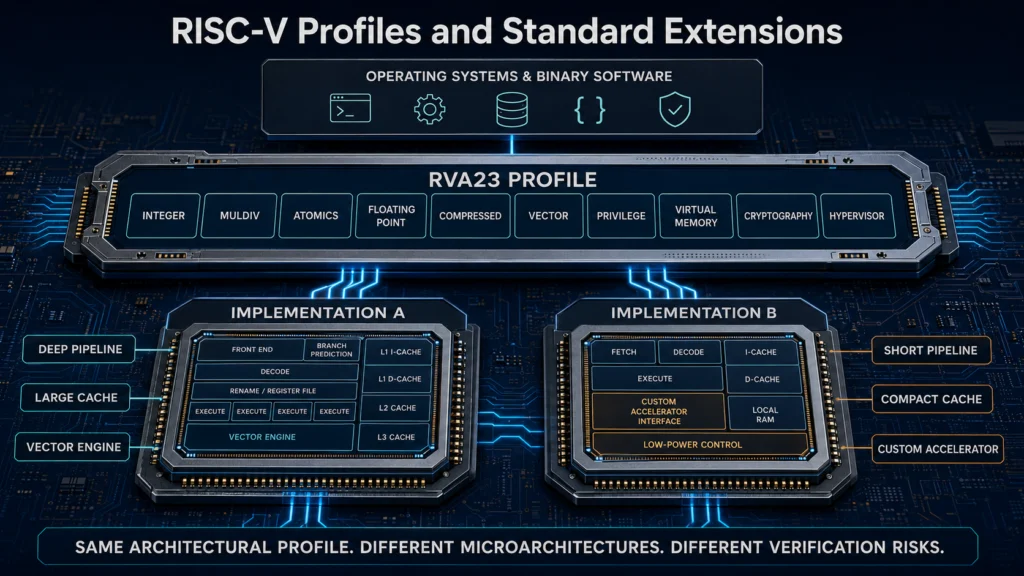
Figure 1: A shared RVA23 profile provides a common software target, while different pipelines, caches, vector engines and custom accelerators create implementation-specific verification risks.
RISC-V is built around a base instruction set and optional extensions. This modular structure allows implementations to include the capabilities required by their target market.
Common areas include:
- Integer execution
- Multiplication and division
- Atomic operations
- Floating-point processing
- Compressed instructions
- Vector processing
- Privilege levels
- Virtual memory
- Cryptographic operations
- Hypervisor support
Profiles help establish common implementation targets. The ratified RVA23 profile, for example, is intended to align 64-bit application processors so that operating systems and binary software can rely on a defined set of features.
RVA23 makes vector and hypervisor capabilities important parts of its application-processor baseline. Vector processing is particularly relevant to AI, machine learning, signal processing, compression and cryptographic workloads. RISC-V International explains that RVA23 aims to improve software portability across compatible implementations.
Profiles reduce fragmentation at the software boundary, but they do not make every processor implementation identical. Designers still make decisions about:
- Pipeline depth
- Branch prediction
- Cache structure
- Execution units
- Memory hierarchy
- Physical memory protection
- Coherency
- Interrupt handling
- Power management
- Debug architecture
- Custom instructions
- Accelerator interfaces
Consequently, two processors supporting the same architectural profile may have very different microarchitectures and different failure modes.
Why Custom Silicon Changes the Verification Problem
Customisation is one of RISC-V’s most significant strengths. It allows a semiconductor company to optimise a processor for a product rather than designing the product around a fixed processor.
For edge AI, custom instructions may accelerate frequently repeated operations such as:
- Dot products
- Multiply-accumulate sequences
- Activation functions
- Quantisation and dequantisation
- Bit manipulation
- Data packing
- Address generation
- Vector reduction
- Cryptographic operations
- Data transfers between processors and accelerators
The performance improvement can be substantial when an instruction removes software overhead or avoids unnecessary movement through the memory hierarchy.
Yet each modification creates new verification obligations.
A custom instruction must be correct across all supported operands and operating states. It must also coexist correctly with the standard architecture.
Questions include:
- What happens if an interrupt occurs during execution?
- Can the instruction be restarted after an exception?
- Does it update architectural state correctly?
- How does it interact with privilege modes?
- What happens when source and destination registers overlap?
- Is the behaviour defined for illegal or unsupported operands?
- Does the instruction interact correctly with virtual memory?
- Can it create a security or isolation weakness?
- Is the reference model updated consistently?
- Can compilers and debuggers represent its behaviour correctly?
- Does implementation-specific optimisation preserve architectural intent?
The verification problem extends beyond instruction execution. A tightly coupled AI accelerator may share memory, issue transactions or operate concurrently with processor software. Its correctness depends on interfaces, coherency, ordering, interrupts and error recovery.
The value of custom silicon therefore depends on disciplined specification and verification. A feature that improves a benchmark but introduces ambiguous behaviour or late integration failures can increase total programme risk.
Architectural Compatibility Is Not Complete Processor Verification
Architectural compatibility testing checks whether an implementation supports defined RISC-V architectural behaviour. It is an essential part of the development process, especially where software portability and ecosystem compatibility matter.
It is not, however, a complete verification strategy.
RISC-V International describes its Architectural Compatibility Tests as a minimal filter. Its documentation explicitly states that passing the tests is not a substitute for rigorous design verification. The official compatibility-test documentation explains the scope and limitation.
This distinction is critical.
Architectural tests assess selected externally visible behaviour. They are not intended to exhaustively verify:
- Every legal instruction sequence
- Microarchitectural corner cases
- Speculative execution
- All exception and interrupt interactions
- Cache replacement behaviour
- Cache coherency
- Bus protocol implementation
- Custom extensions
- Security properties
- Debug functionality
- low-power behaviour
- Multicore concurrency
- Accelerator integration
- Implementation-specific performance features
A processor can pass a compatibility suite and still contain serious functional or security defects.
Compatibility should therefore be treated as one layer of evidence within a broader verification plan.
The Main Verification Challenges for Edge AI RISC-V Systems
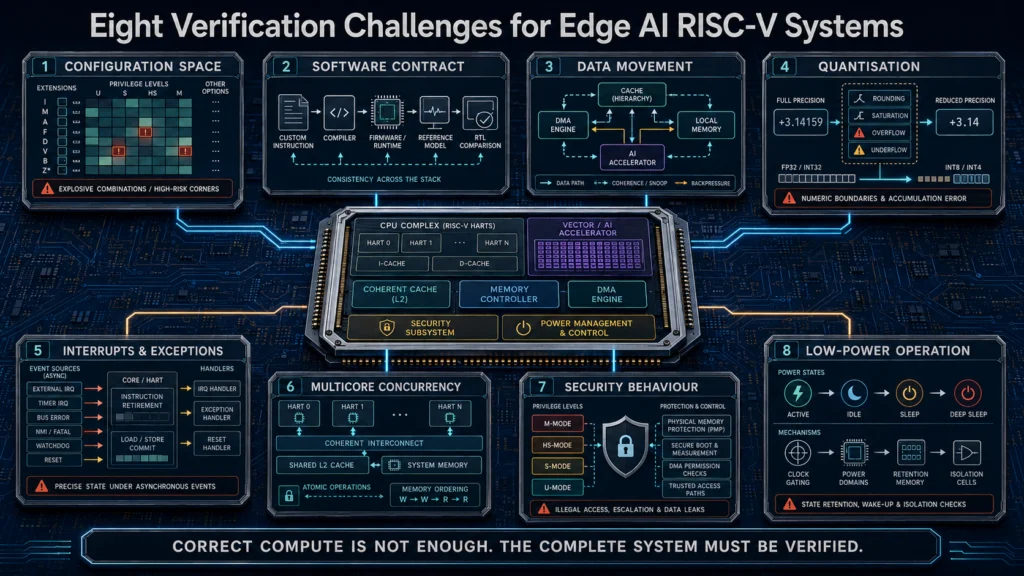
Figure 2: Edge AI RISC-V verification must address configuration growth, software consistency, data movement, numerical corner cases, asynchronous events, concurrency, security and low-power behaviour.
1. The Configuration Space Expands Quickly
A configurable processor can support many combinations of extensions, privilege modes, memory options and implementation parameters.
Verification must cover the configuration intended for production, not an abstract default core. If multiple customer or product configurations are supported, the team must determine which features can be verified once and which combinations require separate evidence.
Uncontrolled configurability can create a matrix too large for practical brute-force testing.
A stronger approach defines supported configurations early, identifies high-risk interactions and uses automation to generate configuration-specific tests, assertions and coverage goals.
2. Custom Instructions Must Match the Software Contract
A custom instruction creates a contract between hardware, compilers, libraries, firmware, simulators and debuggers.
If those components interpret the instruction differently, the silicon may appear correct during block-level testing but fail in application software.
A reference model should define architectural behaviour independently from the RTL. Tests should compare committed processor state against that model while also checking exceptions, control and memory effects.
3. AI Workloads Stress Data Movement
Edge AI performance is often constrained by data movement rather than arithmetic throughput.
Large numbers of transactions may occur between local memory, caches, DMA engines, accelerators and external memory. Verification must address:
- Address correctness
- Access permissions
- Alignment
- Burst behaviour
- Ordering
- Coherency
- Backpressure
- Buffer overflow and underflow
- Partial transactions
- Cancellation and recovery
- Simultaneous processor and accelerator access
A processor that computes correctly but receives stale or corrupted data does not produce a reliable AI system.
4. Quantisation Creates Numerical Corner Cases
Edge AI frequently uses reduced-precision integer or floating-point formats to improve efficiency.
Verification must cover saturation, rounding, overflow, underflow, signed arithmetic and boundary values. Small discrepancies can propagate through a model and change classification or control outcomes.
Golden-model comparison remains important, but numerical tolerances must be specified rather than chosen informally after mismatches appear.
5. Interrupts and Exceptions Expose Hidden Failures
AI accelerators and sensor systems operate alongside asynchronous events. Interrupts, faults and resets may occur during instruction execution, data transfer or accelerator activity.
Verification should examine whether the system:
- Saves and restores state correctly
- Reports the correct exception
- Prevents unintended instruction retirement
- Cancels or completes outstanding transfers safely
- Restarts operations correctly
- Preserves security boundaries
- Avoids duplicated or lost work
These scenarios are difficult to reach using ordinary application workloads, so they require targeted stimulus and assertions.
6. Multicore Systems Add Concurrency
Multiple RISC-V harts may control different sensors, accelerators or operating-system tasks. Shared memory and concurrent execution increase the number of possible interleavings.
Weakly tested concurrency can produce failures that are rare in simulation and difficult to reproduce in the laboratory.
Verification should address memory consistency, atomic operations, cache coherency, inter-processor interrupts, shared-resource arbitration and software-visible ordering.
7. Security Must Be Verified as Behaviour
Security is not established by including a security feature in the architecture. The implementation must enforce the intended properties in every relevant operating state.
Areas requiring attention include:
- Privilege transitions
- Physical memory protection
- Virtual memory
- Debug access
- Secure boot
- Key storage
- Exception handling
- DMA access
- Speculative side effects
- Accelerator permissions
- Fault injection
- Lifecycle configuration
Formal methods can be particularly useful for verifying access-control, isolation and information-flow properties. Alpinum’s analysis of formal security verification in SoC design explains how security requirements can be translated into properties that are checked against RTL.
8. Low-Power Operation Affects Functional Correctness
Edge AI products often use clock gating, power gating, voltage scaling and multiple operating modes.
The verification environment must check behaviour during entry into and exit from low-power states. Retention, isolation, reset sequencing and pending transactions can all affect architectural state.
Power-aware verification should therefore be connected to processor and system-level verification, not treated only as a physical implementation task.
What a Stronger RISC-V Verification Strategy Looks Like
No single verification method is sufficient for a configurable processor connected to custom AI hardware. Confidence comes from combining complementary techniques.
Requirements-Based Verification Planning
The verification plan should connect product requirements to architectural features, implementation blocks, tests, assertions and coverage.
This traceability helps the team answer three important questions:
- What behaviour must be verified?
- Which technique provides the strongest evidence?
- What remains unverified at sign-off?
Requirements should include standard ISA behaviour, custom instructions, microarchitectural features, security properties, system interfaces and product-specific operating modes.
Reference Models and Step-and-Compare Checking
An independent reference model can predict the expected architectural state after instruction retirement. The implementation and model are then compared at defined checkpoints.
This approach is powerful because it detects differences in registers, memory effects, privilege state and exception behaviour.
However, the reference model must support the actual production configuration and any custom instructions. If the model and RTL are modified using the same mistaken interpretation, correlated errors may remain undetected.
Teams should define ownership, reviews and validation for the reference model itself. Alpinum’s explanation of retirement-based lockstep and co-simulation examines how architectural comparison can be incorporated into a RISC-V verification environment.
Constrained-Random Instruction Generation
Random instruction generation can explore combinations that engineers may not anticipate manually.
Effective generation should include:
- Legal instruction sequences
- Deliberately illegal encodings
- Dependency chains
- Exception-generating operations
- Privilege transitions
- Memory hazards
- Interrupts
- Control-flow changes
- Custom instructions
- Interactions between extensions
Randomness alone is not the objective. The generator must be guided by coverage feedback and architectural constraints.
Alpinum’s discussion of random, directed and coverage-driven RISC-V test generation explains why each stimulus method has a different role.
Assertion-Based Verification
Assertions monitor specific properties throughout simulation or formal analysis.
Useful processor assertions may check:
- Correct instruction retirement
- Legal state transitions
- Exception priority
- Invalid privilege access
- Protocol compliance
- Transaction ordering
- Pipeline invariants
- Deadlock conditions
- Security boundaries
Assertions improve observability. Instead of waiting for an architectural mismatch thousands of cycles after the original failure, the environment can identify the violated property close to its source.
Formal Verification
Formal verification explores mathematical state spaces rather than relying only on generated simulation traces. It can prove properties or produce counterexamples that demonstrate failure.
Formal methods are particularly valuable for:
- Control logic
- Privilege enforcement
- Exception handling
- Interrupt behaviour
- Arithmetic corner cases
- Protocol properties
- Cache-coherency rules
- Security isolation
- Deadlock and forward progress
- Custom instruction equivalence
Whole-processor proof remains difficult for complex commercial designs. Formal verification is therefore normally applied selectively alongside simulation, emulation and software-driven testing.
Read more about the growing role of formal verification in RISC-V design.
Functional Coverage
Code coverage shows whether RTL structures were exercised. It does not demonstrate that required architectural behaviour was tested.
Functional coverage should measure meaningful events and combinations, including:
- Instruction and extension combinations
- Operand categories
- Privilege modes
- Exceptions
- Interrupts
- Memory conditions
- Custom instruction states
- Cache and coherency scenarios
- Accelerator operations
- Power transitions
- Security conditions
Cross coverage can reveal missing combinations, but indiscriminate crossing creates unmanageable coverage models. Coverage should be tied to risk and verification intent.
Emulation and FPGA Prototyping
Simulation provides control and debug visibility, but long software workloads may be too slow for practical execution.
Emulation and FPGA prototyping can support:
- Operating-system boot
- Firmware validation
- Driver development
- Long-running workloads
- Multicore software testing
- AI application execution
- Performance analysis
- Hardware-software integration
These platforms extend verification reach, but they do not replace simulation or formal analysis. Some internal signals may be less visible, and mapping constraints can change timing-related behaviour.
Alpinum’s FPGA services and acceleration expertise can support teams using FPGA platforms for prototyping and hardware-assisted verification.
Post-Silicon Planning
Pre-silicon verification should anticipate how failures will be diagnosed after tape-out.
Trace logic, performance counters, error registers and debug access can materially affect the ability to understand silicon behaviour. These capabilities must be specified and verified before fabrication.
Verification Must Extend Beyond the Processor Core
Many serious failures occur at subsystem and SoC boundaries rather than inside individual execution units.
A RISC-V edge AI SoC may include:
- One or more processor cores
- AI accelerators
- DMA controllers
- Coherent and non-coherent interconnects
- External memory controllers
- Security controllers
- Sensor interfaces
- Clock and reset controllers
- Power-management units
- Debug and trace systems
Each block can pass its local verification while the complete system still fails.
For example, a DMA engine may be correct according to its own specification, while a system-level security rule requires it to be blocked from a protected memory region. That requirement is only visible when processor privilege, interconnect permissions and DMA configuration are verified together.
This is why system-level design verification services should address architectural intent, subsystem interaction and software-visible behaviour as connected concerns.
AI Can Support RISC-V Verification, but It Does Not Replace Evidence
AI-assisted engineering tools can help verification teams process logs, classify failures, generate test ideas, search technical knowledge and prioritise regressions.
These capabilities may improve productivity, particularly when large configurable designs produce extensive test and coverage data.
However, generated tests are not automatically correct, relevant or complete. AI-produced assertions may misunderstand temporal behaviour. Suggested fixes may suppress a symptom without resolving the underlying design error.
AI should therefore operate within a controlled verification process that includes:
- Human-reviewed requirements
- Trusted reference models
- Version-controlled prompts and outputs where appropriate
- Regression checking
- Measurable coverage impact
- Independent sign-off criteria
- Protection of confidential design information
The objective is not to increase activity. It is to improve verified capability. Alpinum’s guidance on piloting AI safely in design verification explains how teams can evaluate AI tools without weakening engineering control.
Skills Are Becoming a Constraint on RISC-V Adoption
The RISC-V ecosystem requires more than general RTL knowledge.
Verification engineers may need to understand:
- Instruction-set architecture
- Microarchitecture
- Privilege modes
- Assembly language
- Compiler behaviour
- Reference models
- Constrained-random stimulus
- SystemVerilog and UVM
- Formal verification
- Hardware-software co-verification
- Multicore memory behaviour
- Functional safety and security
A team can license processor IP and verification tools, but those assets do not automatically create the capability to interpret specifications, design coverage or diagnose architectural mismatches.
Structured RISC-V verification training can help engineers connect ISA behaviour to practical verification methods.
The skills question should be addressed during architecture selection, not after integration begins. Alpinum’s analysis of the RISC-V verification skills gap examines the capabilities needed as RISC-V systems become more complex.
A Practical Adoption Framework for Engineering Teams
Before committing to a RISC-V implementation, teams should evaluate five connected areas.
1. Product Requirements
Define workload, latency, energy, safety, security, software and lifetime requirements. Avoid selecting extensions merely because they are available.
2. Architectural Configuration
Document the base ISA, standard extensions, profiles, privilege modes, memory system and custom features. Treat this configuration as a controlled product specification.
3. Software Ecosystem
Confirm toolchain, operating-system, compiler, debugger, library and model support. Custom instructions must be supported across the required software stack.
4. Verification Capability
Assess whether the organisation has suitable reference models, stimulus generation, formal tools, verification IP, emulation capacity, coverage methodology and experienced engineers.
5. Sign-Off Evidence
Define how the team will demonstrate compatibility, functional correctness, safety, security and system-level behaviour. “All tests passed” is not a sufficient sign-off definition unless test completeness is supported by traceability and coverage.
What RISC-V Adoption Means for Semiconductor Programmes in 2026
RISC-V is not automatically the correct choice for every design. Established processor architectures may provide mature software, proven IP, certification assets and lower integration risk for some products.
RISC-V becomes particularly compelling when an organisation values architectural control, workload-specific optimisation, differentiated silicon or reduced dependence on a single proprietary ISA ecosystem.
The commercial decision should consider the complete programme:
- Processor and IP costs
- Custom engineering effort
- Verification resources
- Software enablement
- Certification
- Physical implementation
- Long-term maintenance
- Ecosystem maturity
- Schedule risk
- Post-silicon support
The ISA licence is only one part of total product cost.
A highly customised RISC-V design may produce a strong competitive advantage, but it transfers more architectural and verification responsibility to the organisation developing the product.
Conclusion
RISC-V adoption in 2026 is being strengthened by the demand for edge AI, domain-specific processing and greater control over custom silicon.
The architecture allows semiconductor teams to combine standard software compatibility with differentiated processing capabilities. This can improve performance, power efficiency and product control when the architecture is aligned carefully with the target workload.
The same flexibility also expands the verification problem.
Standard compatibility testing does not exhaustively verify a processor. Custom instructions, AI accelerators, memory systems, privilege modes, security mechanisms, multicore behaviour and low-power operation must be verified as part of the complete system.
Successful adoption therefore depends on more than selecting a RISC-V core. It requires a controlled architectural specification, independent reference models, coverage-driven simulation, targeted formal verification, hardware-software testing and clear sign-off evidence.
For organisations developing RISC-V processors or integrating them into complex SoCs, Alpinum Consulting provides design verification support across planning, implementation, formal analysis, processor verification and verification capability development.
FAQs
RISC-V adoption is being driven by demand for architectural control, custom silicon, edge AI, embedded processing and workload-specific optimisation. Its open-standard ISA allows companies to develop proprietary processors and extensions without creating an entirely new software architecture.
For a broader introduction, read RISC-V: What You Need to Know.
RISC-V allows designers to combine programmable processor cores with vector capabilities, custom instructions and dedicated AI accelerators. This helps teams optimise performance, power consumption and data movement for specific edge workloads.
No. Architectural compatibility tests check selected ISA behaviour and software compatibility. RISC-V International describes them as a minimal filter, not a substitute for comprehensive design verification.
Custom instructions create valuable differentiation, but they must be checked across operands, exceptions, interrupts, privilege states, memory effects and software tools. Their interaction with standard instructions and the surrounding SoC also requires verification.
Common methods include directed testing, constrained-random instruction generation, reference-model comparison, UVM simulation, assertions, formal verification, functional coverage, emulation and FPGA prototyping.
Formal verification can find corner cases that are difficult to reach through simulation. It is particularly useful for privilege logic, security properties, exceptions, custom instructions, protocols and control-path behaviour. Alpinum also offers dedicated formal verification services.
AI can assist with test development, regression analysis, log classification and knowledge retrieval. It does not remove the need for trusted specifications, reviewed properties, reference models, coverage analysis or engineering sign-off.
The role may require knowledge of ISA behaviour, processor microarchitecture, SystemVerilog, UVM, assembly language, constrained-random testing, formal verification, reference models and hardware-software integration.

Written by : Mike Bartley
Mike started in software testing in 1988 after completing a PhD in Math, moving to semiconductor Design Verification (DV) in 1994, verifying designs (on Silicon and FPGA) going into commercial and safety-related sectors such as mobile phones, automotive, comms, cloud/data servers, and Artificial Intelligence. Mike built and managed state-of-the-art DV teams inside several companies, specialising in CPU verification.
Mike founded and grew a DV services company to 450+ engineers globally, successfully delivering services and solutions to over 50+ clients.
Mike started Alpinum in April 2016 to deliver a range of start-of-the art industry solutions:
Alpinum AI provides tools and automations using Artificial Intelligence to help companies reduce development costs (by up to 90%!) Alpinum Services provides RTL to GDS VLSI services from nearshore and offshore centres in Vietnam, India, Egypt, Eastern Europe, Mexico and Costa Rica. Alpinum Consulting also provides strategic board level consultancy services, helping companies to grow. Alpinum training department provides self-paced, fully online training in System Verilog, UVM Introduction and Advanced, Formal Verification, DV methodologies for SV, UVM, VHDL and OSVVM and CPU/RISC-V. Alpinum Events organises a number of free-to-attend industry events
You can contact Mike (mike@alpinumconsulting.com or +44 7796 307958) or book a meeting with Mike using Calendly (https://calendly.com/mike-alpinum-consulting).
Stay Informed and Stay Ahead
Latest Articles, Guides and News
Explore related insights from Alpinum that dive deeper into design verification challenges, practical solutions, and expert perspectives from across the global engineering landscape.