
RISC-V is becoming an important capability for processor, embedded software and design verification teams. For a working engineer, however, the main challenge is rarely finding introductory material. It is building a structured path from the instruction set to toolchains, CPU behaviour, verification and SoC integration without stepping away from current project responsibilities. A well-designed RISC-V verification training programme can make that progression practical by combining focused teaching with exercises that resemble real engineering work.
The goal is not to memorise every instruction or complete as many tutorials as possible. It is to understand how a selected RISC-V configuration behaves, how software reaches that hardware, how a verification environment checks it and what evidence is needed before a design can be trusted. That depth is what turns general awareness into a useful project skill.
Why RISC-V skills matter across hardware and software
RISC-V is an open instruction set architecture with a modular structure. A base integer ISA can be combined with ratified extensions and implemented in different microarchitectures. This gives engineering teams flexibility, but it also creates choices that must be understood and verified. The official ratified RISC-V specifications define architectural behaviour; an individual processor and SoC still require careful implementation, software enablement and verification.
That is why RISC-V learning should not stop at an architectural overview. Hardware engineers need to understand pipelines, privilege modes, CSRs, memory behaviour and implementation trade-offs. Software engineers need to understand toolchains, binaries, boot flow and debugging. Verification engineers must connect the specification to stimulus, reference models, checking, coverage and sign-off. Engineering leaders need enough shared vocabulary to define scope and recognise risk. For broader market and architecture context, see Alpinum’s RISC-V architecture guide.
Choose a learning outcome before choosing content
A common mistake is to consume a wide range of RISC-V material without deciding what competence should result. Working engineers learn more efficiently when every module serves a clear outcome.
- Architecture and RTL engineers: understand the ISA-to-microarchitecture relationship, pipeline behaviour, exceptions, privilege and implementation choices.
- Embedded software engineers: compile, link, run and debug code for a defined RISC-V target, then understand how firmware, an RTOS and drivers interact with the SoC.
- Design verification engineers: translate the specification and configured features into a verification plan, stimulus, checkers, coverage and defensible closure criteria.
- Technical leaders and managers: understand the major CPU and SoC verification strategies well enough to review scope, evidence, residual risk and schedule implications.
These paths overlap, but the desired outcome determines where to spend practical time. A software engineer may go deeper into the ABI, linker and runtime, while a verification engineer may spend more time on instruction generation, architectural comparison and coverage closure.
A flexible learning model for full-time engineers
RISC-V can be learned alongside a full-time role when the work is divided into small, connected learning blocks. Each block should contain one concept, one practical task and one visible result. Recorded or online teaching can provide flexibility, but practical application and feedback are what make the knowledge durable.
| Learning block | Core focus | Practical outcome |
| 1. ISA foundations | RV32I/RV64I, extensions, registers, privilege modes and CSRs | Read a specification and define the configuration being studied |
| 2. Toolchain | Assembler, C/C++, compiler flow, linker, simulator and debugger | Build, run and debug a small RISC-V program |
| 3. CPU behaviour | Pipeline, hazards, exceptions, memory and implementation choices | Explain expected architectural behaviour and likely corner cases |
| 4. Verification | UVM, instruction generation, reference models, scoreboards and coverage | Run a self-checking CPU-level verification flow |
| 5. SoC integration | Boot, interrupts, peripherals, software-driven tests and debug | Verify that the processor works correctly inside a system |
| 6. Capstone | Coverage closure, triage and sign-off reasoning | Present evidence, remaining risks and next verification actions |
The blocks do not need to be completed on a fixed weekly timetable. An engineer can adjust the pace around release cycles and project peaks while keeping the sequence intact. The important discipline is to finish the practical outcome from one block before moving to the next.
1. Start with the ISA, privilege model and pipeline
Begin with the relationship between an instruction set architecture and a processor implementation. Learn the base RV32I or RV64I instruction set, then study the extensions that are relevant to the target, such as M for integer multiplication and division, A for atomic operations, F and D for floating point, C for compressed instructions and V for vector processing. The exact set matters because verification scope, software build options and architectural tests all depend on it.
The next layer is privileged behaviour: machine and supervisor modes, control and status registers, exceptions, interrupts, address translation and memory protection. These features are central to boot, operating systems, security and system integration. A learner should be able to state the target ISA string and privilege assumptions before running tests. Otherwise, a test may be valid for one configuration and meaningless for another.
A simple five-stage pipeline is a useful mental model for linking architectural instructions to hardware activity. Fetch, decode, execute, memory access and write-back introduce hazards, control decisions and timing interactions that are not visible in an ISA description alone.
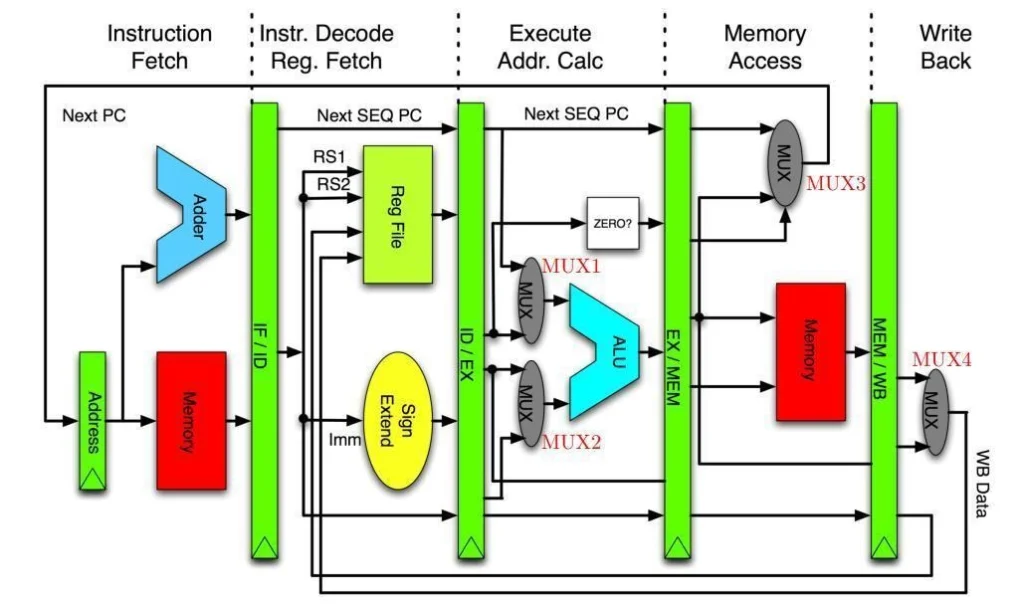
Figure 1. A simplified five-stage processor pipeline.
The ISA defines what the processor must do, while the microarchitecture defines how the implementation achieves it. Verification must check both the architecturally visible result and the design-specific mechanisms that can produce corner-case failures, such as stalls, forwarding, branch recovery, exceptions and simultaneous events.
2. Move from architecture to C/C++ and the toolchain
Software makes the architecture observable. A useful learning path therefore includes assembly, C or C++, compiler options, the linker, binary formats and a simulator. The GNU RISC-V toolchain can build code for RISC-V targets, while Spike and QEMU’s RISC-V system emulation provide different ways to execute and inspect software before physical silicon is available.
Start with a small assembly routine so that registers, instructions and memory operations are visible. Then cross-compile a C or C++ programme, inspect the generated assembly, load the binary into a simulator and single-step it with a debugger. This creates a concrete connection between source code, compiler output, architectural state and observable processor behaviour.
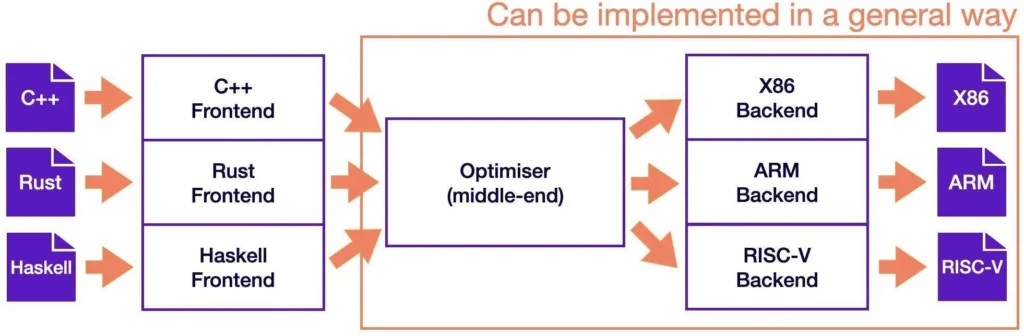
Figure 2. A compiler flow can use a shared optimisation stage and a RISC-V back end.
The compiler is only one layer. Real products also depend on boot code, board support packages, libraries, operating systems, drivers and build infrastructure. Alpinum’s guide to the RISC-V software ecosystem explains why software enablement and system risk must be considered alongside the processor.
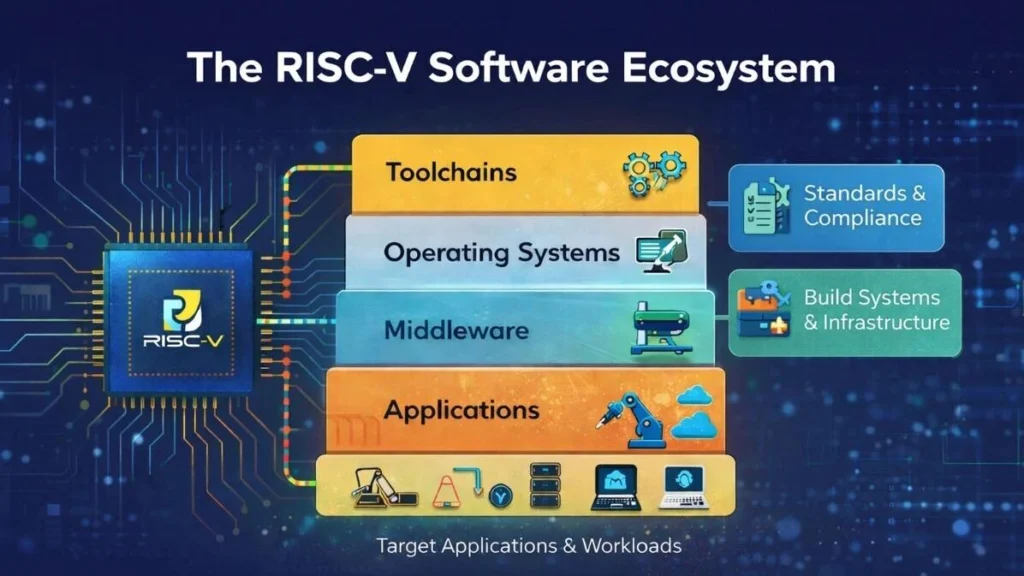
Figure 3. The RISC-V software ecosystem connects toolchains, operating systems, middleware and applications to the target hardware.
3. Make verification part of the learning path
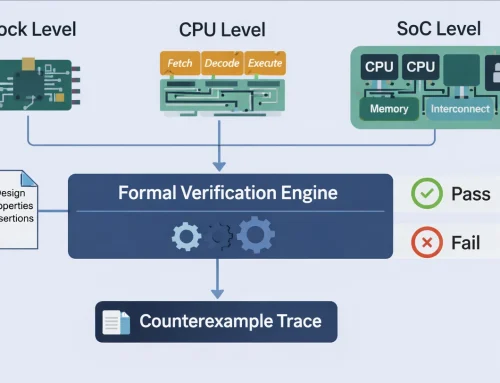
A processor can execute simple programmes and still contain serious defects. Project-ready RISC-V learning must therefore explain how to move from demonstration to verification. At CPU level, a verification environment may generate instruction streams, load a programme into the design under test, observe retirement or architectural state, compare behaviour with a reference model and record coverage. At SoC level, software-driven tests may also check boot, interrupts, memory maps, peripherals, clocking, reset and other integration behaviours.
Engineers with limited SystemVerilog or UVM experience may benefit from establishing that foundation through Design Verification for SV/UVM Training. For RISC-V work, UVM is valuable because it supports reusable stimulus, monitors, scoreboards, coverage and structured testbench components, but methodology knowledge must still be connected to processor-specific checking.
Open-source tools help make this practical. riscv-dv is a random instruction generator used in processor verification flows. A learner can inspect the generated programme, run it in simulation, review the result and then change constraints or coverage to understand cause and effect. This is much more instructive than treating the tool as a black box.
4. Understand compliance, design verification and sign-off
Architectural compliance and design verification answer different questions. Architectural tests help determine whether an implementation behaves according to the selected RISC-V specification and profile. They do not, by themselves, prove that the entire microarchitecture, implementation-specific features or SoC integration have been verified.
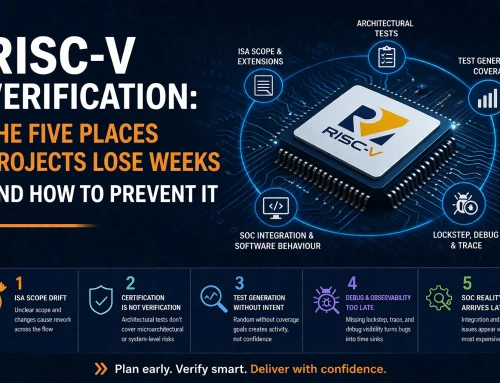
A practical course should show how a compliance framework such as RISCOF fits into a wider strategy. That wider strategy should cover configured extensions, exceptions, privilege behaviour, hazards, memory ordering, custom features, debug visibility and system interactions. Alpinum’s article on the five places RISC-V projects lose time is a useful follow-on for understanding why scope, models, coverage and integration must be planned together.
Sign-off is an evidence-based decision. It combines passing tests, functional and code coverage, assertion results, review of exclusions and waivers, bug status and an explicit assessment of remaining risk. No single tool or test suite replaces that engineering judgement.
5. Learn how coverage, test generation, formal methods and co-simulation work together
Verification techniques are most useful when their roles are clearly separated and then combined.
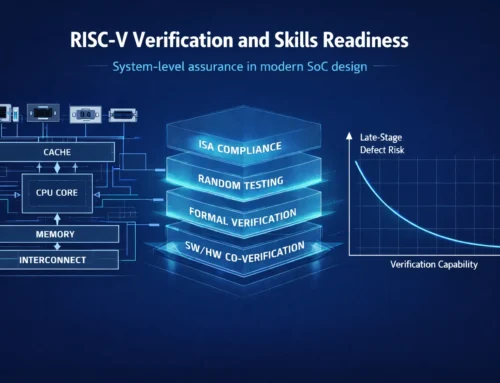
- Functional coverage for RISC-V measures whether planned architectural and microarchitectural scenarios have been exercised. A strong model is configuration-aware and connected to the verification plan.
- Random and directed test generation creates stimulus. Constrained random generation explores combinations, while directed tests efficiently target known behaviours and hard-to-reach conditions.
- Formal verification for RISC-V proves properties or finds counterexamples within stated assumptions. It is especially useful for control logic, protocol properties and corner cases that are difficult to reach in simulation.
- Lockstep co-simulation compares the implementation with a reference model at defined architectural checkpoints. It can detect divergence, but reliable use depends on aligned configuration, event handling and comparison rules.
Engineers who need deeper proof-based skills can follow the dedicated Formal Verification Training pathway. The important learning outcome is not to choose one technique as universally best, but to understand what evidence each technique contributes and where its blind spots remain.
6. Finish with software-driven SoC verification
CPU verification checks the processor as a design, while SoC verification asks whether the processor operates correctly inside a complete system. Software-driven tests can exercise reset and boot sequences, interrupt routing, memory maps, peripherals, power and clock controls, and representative use cases. These tests also expose integration issues that are difficult to discover with isolated IP-level stimulus.
A useful lab progression begins with running an existing self-checking test, then modifying it, writing a new test, adding coverage and finally debugging a known fault. This sequence teaches the workflow as well as the technology: build, run, observe, compare, triage, fix and confirm.
Engineers focusing on firmware and applications can extend this pathway through Alpinum’s software development programme or Zephyr RTOS training. These are complementary paths rather than substitutes for processor and SoC verification.
Practical activities that build project-ready skill
The strongest RISC-V learning programmes make every important concept observable. Suitable activities include:
- Write and run a small RV32I or RV64I assembly programme.
- Cross-compile a C or C++ programme and inspect the generated RISC-V assembly.
- Use a simulator and debugger to examine registers, memory, control flow and exceptions.
- Define the target ISA configuration, privilege assumptions and verification scope.
- Generate an instruction stream, run it on a design and review the pass/fail result.
- Compare architectural behaviour with a reference model and investigate a deliberate mismatch.
- Extend a functional coverage model and modify constraints or tests to hit a missing scenario.
- Run a software-driven SoC test, add a self-check and debug an integration fault.
Quizzes and short exercises are useful when they require explanation rather than recall alone. Asking why a test passed, what assumption a property uses or why a coverage hole remains develops engineering judgement. A capstone exercise should then combine several skills and require the learner to explain evidence, limitations and next actions.
How to keep learning sustainable alongside project work
- Protect a small recurring study block. Short, regular sessions are easier to sustain than occasional long sessions. Reserve additional time for labs, because practical work often reveals the real questions.
- Use one defined target configuration. Choose a concrete RV32 or RV64 configuration and keep it consistent across the toolchain, reference model and design exercises.
- Apply each concept immediately. Inspect a trace after learning pipeline behaviour, write a property after learning a control rule or add a coverpoint after identifying an important scenario.
- Keep an engineering notebook. Record commands, assumptions, errors, fixes and unanswered questions. The notebook becomes a reusable project reference rather than a set of disconnected notes.
- Seek review and feedback. A working simulation is not always a correct verification result. Expert review helps expose invalid assumptions, weak checks and misleading coverage.
- Measure capability, not content consumed. Track outcomes such as explaining the target configuration, running a self-checking test, finding a divergence and defending closure evidence.
What to look for in a RISC-V course
A high-quality course for working engineers should provide:
- A clear progression from CPU and ISA foundations to RISC-V CPU verification and SoC integration.
- Current specifications and explicit configuration assumptions.
- Practical exercises using realistic toolchains, simulators and verification environments.
- A distinction between architectural compliance, implementation verification and system sign-off.
- Coverage, instruction generation, reference-model comparison, assertions and formal methods in the correct context.
- Feedback on exercises and opportunities to discuss how the methods apply to real projects.
- A delivery model that allows professionals to learn without leaving current responsibilities behind.
Benefits for engineers and organisations
For individual engineers, structured RISC-V training creates a coherent mental model across hardware, software and verification. That can make it easier to transition into CPU or SoC work, contribute to technical reviews and diagnose problems across discipline boundaries.
For organisations, the value is shared capability. Teams with a common understanding of the configured ISA, verification strategy, software flow and sign-off evidence can make faster decisions and communicate risks more precisely. Training is most valuable when it is connected to a current or planned project and reinforced through practical work.
Explore RISC-V Verification Training
Alpinum’s fully online RISC-V Verification Training programme is designed for engineers who want to understand best-practice CPU and CPU-based SoC design verification. It combines lectures, quizzes and practical exercises, including work with an open-source UVM testbench, instruction generation, compliance, coverage and software-driven SoC verification.
Participants can build knowledge around existing responsibilities, then apply the methods to a basic RISC-V CPU and SoC before considering how they transfer to real designs. Review the course objectives, prerequisites and detailed content to decide whether the complete programme or a more focused pathway best matches your role.
FAQs
Yes. A part-time approach works when learning is divided into connected blocks and each block includes a practical outcome. The pace can flex around project demands, but regular practice is important.
Some SystemVerilog and UVM experience is beneficial for CPU-level verification exercises. Engineers without that background can first establish the basics or follow a parallel SV/UVM learning path. Software-focused learners can begin with the ISA and toolchain before moving into verification methodology.
No. RISC-V projects depend on architecture, RTL, verification, compilers, firmware, operating systems and system integration. The right emphasis depends on the learner’s role, but cross-disciplinary understanding is valuable for the whole team.
Not for the early stages. Simulators, emulators and verification environments can support ISA, software and CPU verification exercises before hardware is available. A development board becomes useful when the learning objective moves towards physical peripherals, performance or board-specific integration.
No. Architectural tests provide important evidence about specification compliance, but complete verification also covers microarchitectural behaviour, configured features, implementation-specific logic, SoC integration, coverage, bug status and residual risk.
Start with an assembler or compiler, a simulator and a debugger so that instructions and architectural state are visible. Verification engineers can then add instruction generation, a reference model, UVM testbench components, coverage and formal tools in a structured sequence.

Written by : Mike Bartley
Mike started in software testing in 1988 after completing a PhD in Math, moving to semiconductor Design Verification (DV) in 1994, verifying designs (on Silicon and FPGA) going into commercial and safety-related sectors such as mobile phones, automotive, comms, cloud/data servers, and Artificial Intelligence. Mike built and managed state-of-the-art DV teams inside several companies, specialising in CPU verification.
Mike founded and grew a DV services company to 450+ engineers globally, successfully delivering services and solutions to over 50+ clients.
Mike started Alpinum in April 2016 to deliver a range of start-of-the art industry solutions:
Alpinum AI provides tools and automations using Artificial Intelligence to help companies reduce development costs (by up to 90%!) Alpinum Services provides RTL to GDS VLSI services from nearshore and offshore centres in Vietnam, India, Egypt, Eastern Europe, Mexico and Costa Rica. Alpinum Consulting also provides strategic board level consultancy services, helping companies to grow. Alpinum training department provides self-paced, fully online training in System Verilog, UVM Introduction and Advanced, Formal Verification, DV methodologies for SV, UVM, VHDL and OSVVM and CPU/RISC-V. Alpinum Events organises a number of free-to-attend industry events
You can contact Mike (mike@alpinumconsulting.com or +44 7796 307958) or book a meeting with Mike using Calendly (https://calendly.com/mike-alpinum-consulting).
Stay Informed and Stay Ahead
Latest Articles, Guides and News
Explore related insights from Alpinum that dive deeper into design verification challenges, practical solutions, and expert perspectives from across the global engineering landscape.