Develop practical semiconductor verification skills with industry-led training in SystemVerilog, UVM, Formal Verification, RISC-V, AMS, FPGA and “AI in DV” workflows. Alpinum training supports engineers, verification teams and organisations working with complex SoCs, embedded systems, AI accelerators, mixed-signal integration and modern verification environments.
Practical Semiconductor Verification Training for Modern Engineering Workflows
Semiconductor verification teams are under increasing pressure to deliver reliable designs across larger SoCs, tighter schedules, mixed hardware and software interaction, and more complex sign-off expectations. Alpinum training is designed to help engineers build usable verification capability, not just theoretical knowledge. The courses cover practical workflows across digital verification, UVM, SystemVerilog, Formal Verification, RISC-V, AMS, FPGA and AI-assisted verification.
The aim is to help engineers understand how verification methods apply in real project environments, where quality, traceability, coverage, debug and decision confidence matter.
Why Engineers and Teams Train with Alpinum
Alpinum training covers the core skills used by modern verification and semiconductor engineering teams. These areas help engineers build stronger foundations, improve methodology adoption and support more reliable project delivery.




Details of online/self-paced delivery format
Our Moodle-based self-paced learning platform offers interactive video lectures, notes, quizzes, and hands-on EDA tool exercises with instant automated feedback. Students benefit from guided support via bots, discussion forums, and optional weekly live tutorials. Progress is tracked continuously, leading to a final graded exam.
Explore Alpinum Technical Training Areas
Alpinum training is delivered by experienced semiconductor, software, systems and verification practitioners. Our courses support individual engineers, graduate engineers, verification teams, FPGA teams, technical managers and organisations looking to strengthen internal engineering capability.
Semiconductor Verification Training Areas
Practical verification training for engineers and teams working across SystemVerilog, UVM, formal verification, RISC-V verification and mixed-language verification environments.
Analog and Mixed-Signal (AMS) Training
Practical training for analogue design, mixed-signal modelling and verification engineers. These courses cover Python-assisted analogue IC design, Verilog-AMS and SystemVerilog-AMS modelling, real-number modelling, UVM-AMS integration, AMS co-simulation and power-aware verification using UPF.
AI in VLSI Training
Training for engineering teams exploring how AI can support modern VLSI design and verification workflows, from productivity improvement to practical adoption across semiconductor engineering teams.
Security & Functional Safety Verification Training
Practical security and functional safety verification training for engineering teams working across silicon roots of trust, secure boot, CPU and SoC security, safety mechanisms, fault injection, FMEDA, formal verification, ISO 26262 evidence and system-level assurance.
Software Development & Testing Training
Practical software development and testing training covering Python, C/C++, Rust, Linux, networking, embedded systems, AI-assisted coding, RAG, MCP, agentic AI, AI/ML systems engineering and automotive software development.
Course and Tool Overview Videos
Watch short overview videos for selected Alpinum training courses and tools before registering or exploring our solutions.
Reduced-Price Access for University Students Upto 50% Off
Alpinum supports selected university students with reduced-price access to eligible semiconductor training programmes using a valid academic email address. This helps students and early-career engineers access practical training in verification, UVM, Formal Verification, RISC-V and related semiconductor workflows.
Upcoming Hybrid Training
Explore Alpinum’s upcoming hybrid semiconductor verification training, with options to attend in person or online. Select Register for full course information and booking details.
| Training Title | Date and Time | Registration |
|---|---|---|
| Hands-on AI in Formal Verification Training (Edinburgh or Online) | Wed 2 Dec 2026, 9:00 AM–12:30 PM GMT | Register |
Online Submission Portal for Hands-On Verification Training
Alpinum’s online and self-paced training is supported by the Alpinum Online Submission Portal, a controlled environment for running practical verification exercises. The portal supports formal verification job configuration, EDA tool selection, example target designs, default scripts, custom TCL uploads, custom design uploads, live execution monitoring, logs and downloadable results.
It is designed for structured training access and approved engineering workflows, helping learners connect course content with real verification practice.
On-demand Training
On-demand training gives engineers flexible access to semiconductor verification learning at their own pace. This format is suitable for busy engineers, distributed teams and organisations that want training available across project schedules. The on-demand programme supports practical learning in Formal Verification, open-source verification, SystemVerilog, SVA, UVM, testbench development and advanced verification workflows.
| Title | Description | Get Tickets |
|---|---|---|
| Hardware & Software Security Training (3 Parts) | This three-part Hardware & Software Security Training programme is now available as on-demand recordings, allowing engineers and teams to access the training at their own pace while developing practical knowledge across hardware and software security topics. | Get recordings |
| Formal Verification Training (6-Day Programme) | Our 6-Day Formal Verification Training Programme is now available as on-demand recordings, allowing engineers and teams to learn at their own pace while gaining practical knowledge that can be applied directly to real verification projects. | Get recordings |
| Open-Source Verification Training Series (3 sessions) | This three-part training series will equip you with the knowledge and practical skills needed to confidently integrate open-source tools into your verification workflow. Each session focuses on a key area—Python-based verification, open-source libraries, and shift-left testing—giving you a practical foundation you can apply immediately. | Get recordings |
| Ramping Up Formal Verification Training Series (3 sessions) | This three-part training series is designed to take participants from foundational formal concepts through to advanced verification techniques, with a strong focus on practical application using SystemVerilog Assertions (SVA). Across the series, you will progressively build the skills needed to write, debug, and prove assertions effectively, making formal verification a productive and scalable part of your verification flow. | Get recordings |
| [3 sessions] From Verilog to SystemVerilog for Advanced Verification | This three-part training series is designed for engineers transitioning from traditional Verilog into modern SystemVerilog-based verification. Across three structured sessions, you’ll move from core SystemVerilog concepts to advanced language features and real-world testbench development techniques. | Get recordings |
| Advanced Communication Skills Training for Engineers | Take your communication skills to the next level with our 2-hour intensive training, designed specifically for engineers. This practical course equips you to communicate technical information clearly, confidently, and effectively in any professional setting. | Get recordings |
| [3 sessions] SystemVerilog Assertions (SVA) | This focused three-part series is dedicated to mastering SystemVerilog Assertions (SVA) for functional correctness and design verification. From basic assertion concepts to advanced temporal properties and real-design applications, this series equips you with the skills to write precise, effective assertions that catch bugs early and improve verification confidence. | Get recordings |
| [9 sessions] Complete Verification Training Bundle: SystemVerilog, UVM & SVA | Take your digital verification skills to the next level with this comprehensive nine-session training bundle, combining three focused series:
| Get recordings |
| [3 sessions] Building Advanced UVM Test Benches | This three-part training series provides a structured introduction to building professional, scalable verification environments using the Universal Verification Methodology (UVM). Starting from core concepts and progressing to advanced testbench architectures, this series is ideal for engineers moving from custom SystemVerilog testbenches to industry-standard UVM flows. | Get recordings |
| [3 sessions] AI in DV and VLSI | This focused three-part series explores how AI is transforming VLSI design and Design Verification (DV) — from code generation to autonomous verification workflows. | Get recordings |
| Part 1: Introduction to CPU and CPU Verification | 3-Part RISC-V Verification Course | Part 1 introduces the fundamentals of CPU design and verification. Participants will explore CPU architectures and instruction set architectures (ISA), microarchitecture design, and hierarchical verification strategies at the unit, CPU, and system levels. The course covers instruction stream generation and open-source tools such as riscv-dv, as well as functional coverage modeling, test generation, and practical verification exercises. Students will gain hands-on experience through exercises designed to extend coverage models and constraints, with guided classroom review sessions to reinforce learning. This part provides the foundation for understanding CPU verification and prepares participants for more advanced RISC-V and SoC verification topics. | Get recordings |
| Part 1++ CPU & Verification Foundations – Advanced | 3-Part RISC-V Verification Course +++ | Part 1++ builds on the fundamentals of CPU and CPU verification, providing advanced, block-level verification strategies. In addition to the standard course, participants gain extra lessons and slides covering UVM verification of multiple CPU units, including: Detailed design overviews for each block, Block interfaces and functionality, Verification plans and execution examples, and Hands-on practical exercises demonstrating full block verification. This advanced module provides a comprehensive understanding of hierarchical CPU verification and prepares participants for CPU-level and subsystem verification in RISC-V projects. | Get recordings |
| Part 2: RISC-V CPU Verification | 3-Part RISC-V Verification Course | Part 2 focuses on verifying RISC-V CPUs and building practical experience with RISC-V software and hardware tools. Participants will learn the RISC-V ISA, assembly language, software toolchains, and how to run programs using the RARS simulator. The course includes hands-on exercises with riscv-dv, teaching test generation, functional coverage, and constraint modeling. Architectural compliance and advanced CPU microarchitectures, including pipelining, superscalar, and multithreaded processors, are covered to deepen understanding. Practical exercises and classroom review sessions ensure that participants can confidently verify RISC-V CPUs and contribute effectively to CPU verification projects. | Get recordings |
| Part 2++: RISC-V CPU Verification – Advanced | 3-Part RISC-V Verification Course +++ | Part 2++ extends RISC-V CPU verification to advanced CPU-level strategies using multiple instruction stream generators (ISGs). Participants explore different instruction types, pipelines, microarchitectures, and caches, and gain hands-on experience with: Generating complex instruction streams using ISGs, Applying advanced constraints and coverage models, and Optimising verification for varied CPU microarchitectures. This module builds real project-ready expertise, ensuring participants can confidently tackle RISC-V CPU verification in demanding environments. | Get recordings |
| Part 3++: RISC-V SoC Verification – Advanced | 3-Part RISC-V Verification Course +++ | Part 3++ provides advanced SoC-level verification strategies, building on Part 1++ and 2++. Participants learn to verify a complete RISC-V subsystem or SoC, covering: Full SoC verification strategies, Integration, reset/boot sequences, clocks, power management, and interrupts, Functional coverage, sign-off, and debugging practices, and Extra lessons and exercises tailored to full SoC designs. This module ensures participants can confidently verify complex RISC-V SoCs and accelerate project delivery using best-practice strategies. | Get recordings |
| Part 3: RISC-V SoC Verification | 3-Part RISC-V Verification Course | Part 3 focuses on verifying a RISC-V CPU within a System-on-Chip (SoC). Participants will explore SoC verification strategies, learn about the architecture and environment of a training SoC, and gain hands-on experience running, updating, and creating self-checking tests. The course covers debugging, verification of specific SoC features such as reset, boot, clocks, power, interrupts, and system control, and sign-off procedures, including collecting coverage metrics and writing SoC verification reports. Practical exercises combined with classroom review sessions allow participants to apply learned techniques to real-world SoC verification scenarios, ensuring they can contribute effectively to SoC verification projects. | Get recordings |
| 3-Part RISC V Verification Course +++ | The Complete Program provides the full advanced RISC-V verification experience, combining all three advanced modules. Participants gain: Full access to Moodle for structured learning, Quizzes and exams to validate understanding, Advanced designs and formal verification applications, Extra lessons covering block-level, CPU-level, and SoC verification strategies, and VIP support tailored to your specific RISC-V CPU or SoC design. This programme delivers project-ready skills, accelerating your RISC-V verification work and providing practical expertise that goes far beyond the standard course. | Get recordings |
| 3-Part RISC-V Verification Course | The full RISC-V Verification Training Course provides comprehensive coverage of CPU and SoC Design Verification (DV) strategies, equipping participants to contribute effectively to real projects. Delivered entirely online, it combines lectures, quizzes, and practical exercises to reinforce learning. Participants will start with CPU fundamentals, learning architectures, microarchitectures, and hierarchical verification strategies. The course then progresses to RISC-V CPU verification, including programming in assembler and C, using simulators and the open-source riscv-dv tools, and understanding architectural compliance. Finally, it covers RISC-V SoC verification, focusing on CPU integration, SoC feature verification, debug, functional coverage, and sign-off procedures. By completing all three parts, participants gain the knowledge and hands-on experience needed to confidently apply best-practice DV methodologies to real projects. | Get recordings |
| [3 sessions] Analog IC Design Using Python | This practical three-part online training introduces a modern and efficient approach to analog IC design (using the gm/ID methodology), combined with a Python-based workflow for rapid transistor sizing and design exploration. | Get recordings |
| [3 sessions] Verilog-AMS, SystemVerilog-AMS & UVM-AMS | Designed for engineers working across Digital and Analog domains, this course bridges theory with practical verification strategies used in real-world semiconductor projects. | Get recordings |
| [3 sessions] Zephyr RTOS for Embedded Engineers | Learn how to build scalable, portable, and production-ready embedded systems using the Zephyr RTOS ecosystem. | Get recordings |
| [3 parts] Hardware & Software Security | Learn how modern hardware and software security mechanisms work together — from silicon roots of trust and secure boot through CPU privilege architecture, microarchitectural protection, SoC security, and formal information-flow verification. | Get recordings |
| [3 sessions] AMS Co-Simulation (RNM & UVM) | Learn how modern mixed-signal verification environments integrate SystemVerilog, Verilog-AMS, SPICE, RNM, and UVM methodologies. | Get recordings |
| [3 sessions] AMS Co-Simulation (Power-Aware / UPF) | Learn how to build and verify power-aware mixed-signal systems using UPF, SystemVerilog, SPICE, and UVM methodologies. | Get recordings |

Flexible Token-Based Enterprise Training for Engineering Teams
Need training across multiple projects and teams?
For organisations that need flexible access to training across multiple engineers or teams, Alpinum offers token-based engineering training. This approach allows companies to allocate training access based on project needs, team availability and internal capability development priorities. Token-based training is useful for organisations that want to support continuous learning across verification, FPGA, Formal Verification, RISC-V, AMS and AI-assisted engineering workflows.
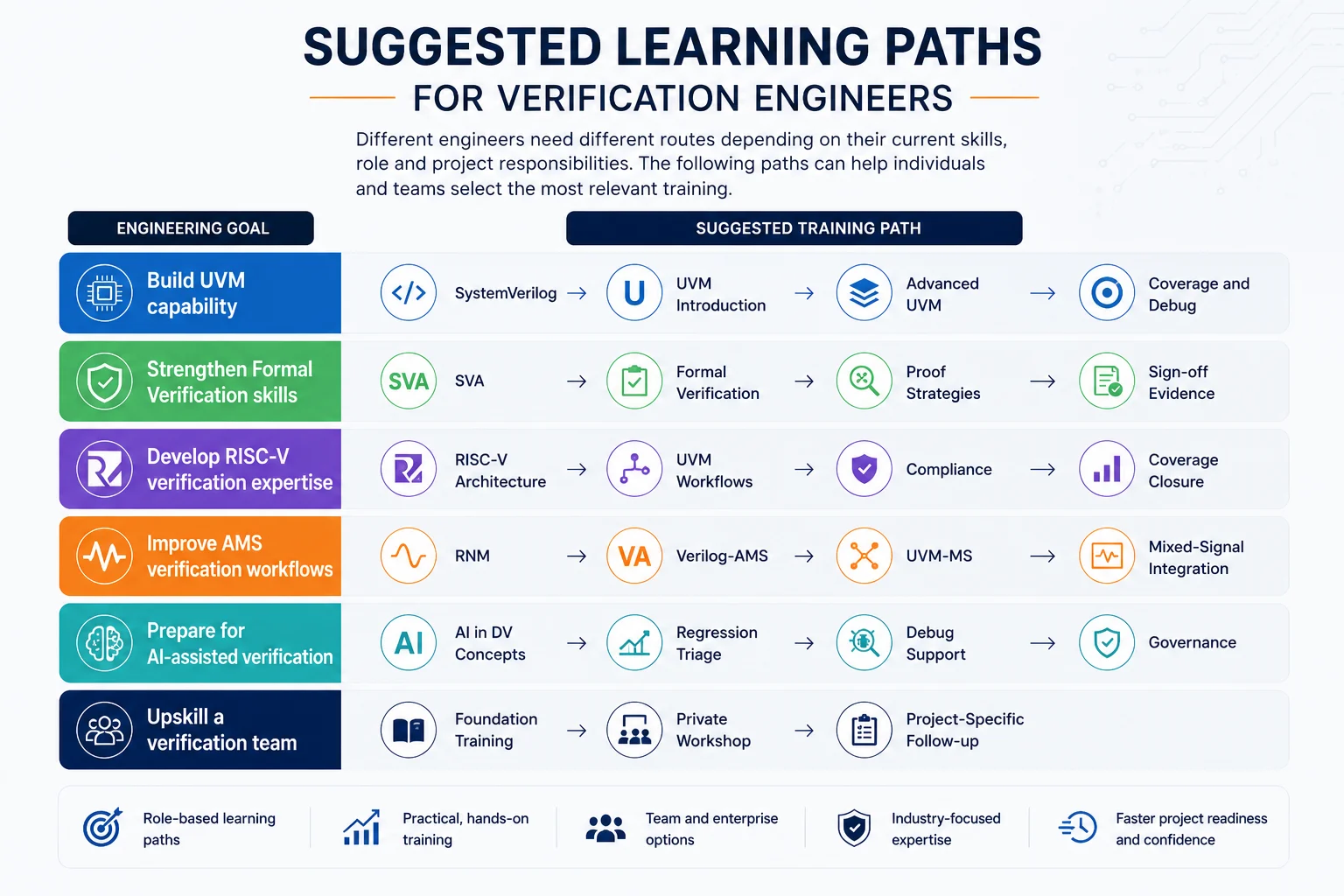
Why Modern Semiconductor Teams Need Continuous Verification Training
Verification complexity continues to increase as semiconductor designs include more software interaction, mixed-signal behaviour, AI acceleration, custom processors, configurable IP and system-level integration. This changes what engineers need from training. They must understand not only language syntax or tool use, but also verification intent, coverage strategy, debug methods, traceability and sign-off confidence. Continuous training helps teams reduce methodology gaps, improve shared engineering practice and respond more effectively to project risk. It also helps organisations prepare for new workflows, including AI-assisted verification, without losing control of review, evidence and engineering accountability.
Training for AI in Design Verification Workflows


Why Choose Alpinum for Semiconductor Verification Training
Build Practical Verification Capability with Alpinum Training
Whether you are an individual engineer, a graduate learner, a verification lead or an organisation developing team capability, Alpinum training helps you build practical skills for modern semiconductor verification.
Explore the available courses, review upcoming sessions or speak to Alpinum about training options for your team.
What Engineers Say About Alpinum Training


Featured Engineering Training Programmes




Speak to Alpinum About Your Verification Training Needs
Whether you are developing internal verification capability, onboarding graduate engineers, exploring “AI in DV” workflows or scaling semiconductor training across teams, Alpinum can help you identify the most suitable training path.
Our training programmes support engineers and organisations working across UVM, SystemVerilog, Formal Verification, RISC-V, AMS, FPGA and modern semiconductor verification workflows.
We aim to respond within one business day. All submitted information will be handled confidentially.
Prefer direct contact?
Write to mike@alpinumconsulting.com
Book a quick meeting with Mike:
https://calendly.com/mike-alpinum-consulting