
The semiconductor industry depends on more than technology. It depends on people who are willing to share knowledge, train the next generation, support early-career engineers, challenge weak assumptions and help the wider community move forward.
That is what “give back culture” means to Alpinum Consulting.
Key Learning Points
| Key learning point | Link to detailed explanation | External reference link |
| The semiconductor skills gap requires industry participation through mentoring, training and community knowledge sharing. | Why giving back matters in semiconductor engineering | [1] |
| Intern programmes and early-career support help transform academic knowledge into practical engineering capability. | Supporting interns and early-career engineers | [2] |
| Reduced student pricing and accessible verification training help strengthen the future semiconductor workforce. | Reduced student pricing for semiconductor training | [3] |
| Free conferences, DVClub events and technical presentations accelerate knowledge transfer across the verification community. | Free conferences, DVClub events and technical presentations | [4] |
| AI in Design Verification should be adopted through practical learning, governance and measurable engineering outcomes. | A give-back culture for the AI in the DV era | [5] |
In many industries, giving back is treated mainly as charity or corporate social responsibility. In semiconductor engineering, it has a more direct and practical meaning. It means helping engineers gain skills they can apply to real projects. It means making high-quality technical learning more accessible. It means creating free spaces where engineers, students, researchers, EDA companies, semiconductor start-ups and industry leaders can exchange ideas. It means contributing to technical discussions even when there is no immediate commercial return.
For Alpinum, this is closely connected to its work in semiconductor verification training, design verification consulting, free industry events and practical community initiatives such as DVClub. This matters because semiconductor design and verification are becoming more complex. Modern SoCs, AI accelerators, RISC-V processors, chiplets, mixed-signal systems, safety-related devices and security-sensitive platforms all require stronger engineering capability. At the same time, the UK and global semiconductor sectors face a continuing skills challenge. The UK National Semiconductor Strategy identifies skills and talent as a core requirement for sector growth, while the UK Semiconductor Workforce Study highlights the need to sustain and grow the semiconductor talent pipeline.
For Alpinum, giving back is therefore not a side activity. It is part of building a stronger semiconductor ecosystem.
Why giving back matters in semiconductor engineering
Semiconductor engineering is a knowledge-intensive industry. Engineers do not become productive simply by reading a textbook or completing a generic online course. They need exposure to real design constraints, verification planning, debug methods, coverage closure, tool limitations, sign-off discipline, team communication and project risk.
This is especially true in design verification. Verification is not only about finding bugs. It is about building evidence that a design behaves correctly under the conditions that matter. That requires technical judgement, methodology discipline and the ability to reason about residual risk. The UK Semiconductor Workforce Study estimated that around 39% of the UK semiconductor workforce may retire within 15 years, posing a major succession-planning challenge. It also found that design-related roles dominate technical employment in the sector.
This makes knowledge transfer essential. When experienced engineers share methods, mentor younger engineers and contribute to community learning, they help reduce the gap between academic knowledge and industry-ready capability. Giving back also supports innovation. Start-ups, students and small engineering teams often need access to expertise before they can afford large consultancy engagements or extensive commercial training. Free technical events, reduced student pricing, open presentations and white papers can help these groups make better decisions earlier.
In a field where mistakes can cost millions, sharing practical engineering knowledge is not optional. It is part of responsible industry development.
Alpinum’s give back culture: practical contribution, not slogans
Alpinum’s give-back culture is built around practical contribution. The focus is not on broad statements about community support, but on specific activities that help engineers, students, companies and the wider verification ecosystem. This includes intern programmes, reduced-price training access for university students, free-to-attend industry events, technical presentations, white papers, community discussions, start-up support and direct involvement in industry groups.
The common purpose behind these activities is simple: to make strong semiconductor engineering knowledge more accessible. Alpinum’s training portfolio already reflects this approach. The company provides practical semiconductor verification training across SystemVerilog, UVM, Formal Verification, RISC-V, AMS, FPGA and “AI in DV” workflows. The training is aimed at helping engineers build usable capability, not just theoretical awareness. Alpinum’s training page positions these courses around practical verification methods, testbench development, assertions, coverage, debug and workflow improvement.
This is important because many organisations do not only need more engineers. They need engineers who can contribute effectively to real projects, understand verification intent and make sound technical decisions under schedule and quality pressure.
Supporting interns and early-career engineers
One of the most valuable ways a company can give back is by helping early-career engineers understand what real engineering work looks like. Intern programmes are important because they expose students and graduates to practical workflows that are often difficult to experience in academic environments. Semiconductor verification involves many concepts that only become fully meaningful when applied to real project contexts: specification review, test planning, requirements traceability, constrained-random testing, assertions, coverage modelling, regression analysis, debug, reporting and sign-off.
Alpinum’s intern and early-career support can help bridge this gap. The aim is not only to assign interns tasks but also to help them develop professional engineering habits. These include asking better questions, documenting assumptions, understanding why evidence matters, communicating clearly with senior engineers and recognising the difference between “a test passed” and “we have meaningful confidence”.
This type of experience benefits both the individual and the industry. Students become more employable. Companies gain better-prepared graduates. The wider semiconductor ecosystem gains people who understand the discipline required to deliver complex engineering projects. For a skills-constrained industry, this is one of the most direct forms of giving back.
Reduced student pricing for semiconductor training
Alpinum also supports university students through reduced-price access to selected training programmes. This gives students and early-career engineers a route into practical verification topics that are highly relevant to industry, including UVM, Formal Verification, RISC-V and related semiconductor workflows.
Alpinum’s semiconductor verification training page offers discounted access for selected university students with a valid academic email address. This helps students and early-career engineers access practical training in verification, UVM, Formal Verification, RISC-V and related semiconductor workflows. This matters because access is often one of the biggest barriers for young engineers. High-quality technical training can be expensive, and many students do not yet have employer sponsorship. Reduced student pricing helps lower that barrier.
It also supports the long-term health of the industry. If students can access practical training earlier, they can enter the workforce with a stronger understanding of how real verification teams operate. They are better prepared for graduate roles, internships, research projects and early technical contributions. Reduced pricing is not simply a discount. It is an investment in the next generation of semiconductor engineers.
Free conferences, DVClub events and technical presentations
Community events are another important part of Alpinum’s give-back culture. Alpinum supports and promotes events that bring together semiconductor engineers, verification specialists, EDA companies, researchers, students and technical leaders. These events provide space for people to share what is working, what is difficult and where the industry needs to improve.
Through Alpinum events, engineers can access technical discussions, training opportunities, conference activity and community learning. The DVClub programme is especially important because it gives the design verification community a regular forum for practical technical exchange. The DVClub page includes topics such as RISC-V verification, security verification, AI in Design Verification, processor verification, formal methods, hardware-assisted verification, chiplet-based systems and mixed-signal verification.
These events are valuable because they give engineers access to current technical thinking beyond their own company. A verification engineer working on RISC-V can learn from processor specialists. A team exploring AI in DV can hear from others who have tested practical workflows. A student can attend and discover what real verification problems look like. An EDA vendor can hear directly from users about pain points.
That exchange of knowledge strengthens the whole ecosystem.
Giving back through white papers and technical content
Technical content is another way to give back, especially when it addresses real engineering problems rather than generic trends. Alpinum and Mike Bartley have contributed technical articles to EE Times and Electronic World, as well as white papers and presentations on topics including AI in Design Verification, AMS verification, formal methods, verification planning, RISC-V, safety-related verification, and semiconductor project risk. This type of content is useful because it helps teams frame problems more clearly. In a market full of hype around AI, automation and tool promises, engineers need practical guidance. They need to know where a method is genuinely useful, where it is risky and how it should be introduced into existing workflows.
This is particularly important around AI in Design Verification. AI has the potential to improve productivity in areas such as testbench development, debug support, requirements analysis, coverage review and documentation. However, it must be introduced carefully. Verification teams still need traceability, review, measurable confidence and sign-off discipline. That is why Alpinum’s work around AI in DV adoption is strongly aligned with a give-back culture. It helps the industry move beyond hype and towards practical, evidence-led adoption.
Good white papers and technical presentations do not simply promote a service. They help engineers think better. That is a meaningful contribution.
How Mike Bartley personally gives back to the industry
Alpinum’s give-back culture is also shaped by the personal contribution of Dr Mike Bartley. Mike has worked in software testing and semiconductor design verification for more than three decades. His experience includes verifying silicon and FPGA designs across sectors such as mobile, automotive, communications, cloud/data servers and artificial intelligence. Alpinum’s team overview describes his background in CPU verification, verification leadership and building a DV services company to more than 450 engineers globally, delivering services to over 50 clients.
That background gives Mike a rare perspective. He has seen the industry evolve from earlier verification approaches through constrained-random methodologies, coverage-driven verification, formal verification, requirements-driven approaches, RISC-V, system-level verification and now AI-assisted workflows. His personal give-back activities include chairing and contributing to industry groups, supporting technical communities, writing white papers, presenting at conferences, advising companies, and supporting start-ups through guidance and, where appropriate, investment.
This type of contribution matters because experienced engineers carry knowledge that is not always captured in tools or textbooks. They understand why projects fail late. They know how organisational structure affects verification quality. They understand the difference between a fashionable method and one that can survive real project pressure. When that experience is shared with the community, it helps others avoid mistakes and make better decisions.
Supporting start-ups and emerging semiconductor companies
Start-ups are essential to semiconductor innovation, but they often face difficult technical and commercial constraints. They may have strong ideas but limited access to senior verification expertise, proven methodology, investor-ready technical evidence or scalable engineering processes. This is where a give-back culture and commercial experience can meet in a positive way.
Supporting start-ups does not always mean providing a full consultancy engagement. Sometimes the highest-value contribution is early guidance: reviewing assumptions, identifying verification risks, improving technical messaging, advising on engineering priorities or helping founders understand what investors and customers will expect.
The UK National Semiconductor Strategy recognises that start-ups and SMEs can face barriers around access to infrastructure, chip design tools, IP and commercialisation support. In that context, experienced industry guidance can make a real difference. Mike’s personal involvement with start-ups, advisory work and selective investment reflects this broader commitment. It helps promising technology businesses avoid common mistakes and move towards stronger execution.
Giving back strengthens engineering quality
There is also a direct technical benefit to giving back. When engineers attend free events, join technical discussions, read white papers or access practical training, they improve the quality of their own work. That can lead to better verification plans, stronger coverage strategies, clearer requirements, more effective debugging, improved formal adoption, safer AI usage and stronger sign-off confidence.
This is especially important as verification teams face new pressures. AI accelerators, RISC-V processors, chiplets, mixed-signal systems, automotive safety requirements and security-sensitive SoCs all increase the difficulty of verification. Teams must reason about more interactions, more configuration states, more software dependencies and more evidence.
Giving back helps spread good practice across the industry. It reduces isolation. It helps engineers compare approaches. It encourages more disciplined conversations around risk, quality and delivery. In this sense, giving back is not separate from engineering excellence. It is one of the ways engineering excellence spreads.
Why does community contribution also support clients?
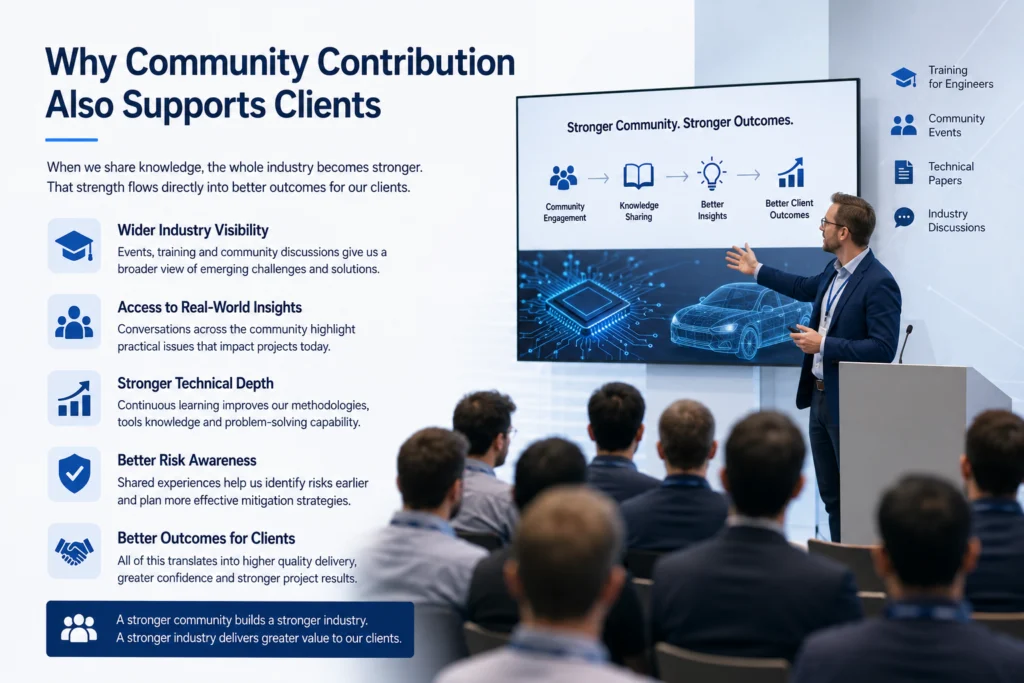
Clients benefit when a consultancy is active in the wider industry.
A company that only delivers private projects may have limited visibility into wider patterns. A company that teaches, chairs discussions, hosts events, writes technical content and supports multiple communities sees more of the industry’s real challenges.
That perspective helps clients.
Alpinum’s involvement in training, events and technical discussion means it is continually exposed to current engineering concerns: AI adoption, verification productivity, RISC-V confidence, formal verification barriers, AMS complexity, safety compliance, talent shortages and project delivery risk.
This creates a feedback loop. Community engagement improves Alpinum’s understanding of industry needs. That understanding improves the support Alpinum can provide to clients. Client experience then informs future training, events and technical guidance.
That is a healthy model for the industry.
A give-back culture for the AI in DV era
The next stage of semiconductor verification will be shaped by AI, but AI will not remove the need for engineering judgement. In many cases, it will increase the need for disciplined review, governance and evidence.
This makes community learning even more important.
Engineers need safe ways to discuss where AI can help and where it can weaken confidence. They need examples of bounded workflows, measurable pilots, traceable outputs and reviewable automation. They also need to understand the risks of over-relying on tools that produce plausible but incorrect results.
Alpinum’s work around AI in DV fits naturally into its give-back culture. Through training, articles, events, and practical discussions, the goal is to help teams adopt AI in ways that improve productivity without sacrificing accountability. For organisations that are still unsure where to begin, Alpinum’s AI in DV adoption support helps teams assess their current capability, identify practical use cases and introduce AI into verification workflows in a controlled and measurable way.
That is the kind of contribution the industry needs: not hype, but practical, evidence-led adoption.
Building a stronger verification ecosystem
Giving back in semiconductor engineering is not only about goodwill. It is about building the capability the industry needs to grow. Alpinum’s give-back culture is visible through internship programmes, access to student training, free events, technical presentations, white papers, community leadership, and support for start-ups. These activities help students enter the field, help engineers improve, help teams adopt better methods and help the wider verification community share practical knowledge.
For Mike Bartley and Alpinum, giving back is not separate from the business. It is part of the mission: to strengthen semiconductor engineering capability, support the next generation and help the industry solve harder problems with better judgment.
As design complexity increases, that kind of contribution becomes more important, not less.
Looking to strengthen your verification capability?
Alpinum Consulting supports semiconductor teams with practical training, design verification expertise, “AI in DV” adoption guidance and free industry events.
Explore Alpinum’s semiconductor verification training, join an upcoming DVClub event, or speak with Alpinum about your semiconductor consulting and verification challenges.
External References
[1] UK Government, National Semiconductor Strategy, Department for Science, Innovation and Technology, London, U.K., May 2023. [Online]. Available: https://www.gov.uk/government/publications/national-semiconductor-strategy
[2] UK Electronics Skills Foundation (UKESF), UK Semiconductor Workforce Study, Newbury, U.K., 2023. [Online]. Available: https://www.ukesf.org
[3] Alpinum Consulting, “Semiconductor Training Services,” Alpinum Consulting, 2026. [Online]. Available: https://alpinumconsulting.com/services/training/
[4] Alpinum Consulting, “DVClub – Design Verification Community Events,” Alpinum Consulting, 2026. [Online]. Available: https://alpinumconsulting.com/events/dvclub/
[5] M. Bartley, “AI in Design Verification: Safe Pilot Approaches and Industry Adoption,” Alpinum Consulting, 2026. [Online]. Available: https://alpinumconsulting.com/blogs/ai-ml-overview/ai-in-design-verification-safe-pilot/
FAQs
Give back culture in semiconductor engineering means sharing expertise, supporting students and early-career engineers, contributing to technical communities, offering accessible learning opportunities and helping the wider industry improve engineering capability.
Design verification depends on practical experience, strong methodology and good engineering judgement. When experienced engineers share knowledge through training, events, mentoring and technical content, they help improve verification quality across the industry.
Alpinum supports selected university students through reduced-price access to eligible semiconductor training programmes, helping them gain practical knowledge in areas such as UVM, Formal Verification, RISC-V and design verification workflows.
Alpinum supports the verification community through free, educational industry events, DVClub activities, technical presentations, white papers, training programmes, and discussions on emerging topics such as AI in Design Verification.
Semiconductor start-ups often face high technical risk, limited resources and investor pressure. Early verification guidance can help them identify risks, improve technical planning, build stronger evidence and avoid costly late-stage failures.
AI in DV is a fast-moving area where many teams need practical guidance. By sharing training, articles, events, and adoption support, Alpinum helps verification teams understand how to introduce AI safely, measurably, and responsibly.
Companies attend DVClub and Alpinum events to learn from industry experts, understand emerging verification challenges, compare technical approaches and connect with the wider design verification community.

Written by : Mike Bartley
Mike started in software testing in 1988 after completing a PhD in Math, moving to semiconductor Design Verification (DV) in 1994, verifying designs (on Silicon and FPGA) going into commercial and safety-related sectors such as mobile phones, automotive, comms, cloud/data servers, and Artificial Intelligence. Mike built and managed state-of-the-art DV teams inside several companies, specialising in CPU verification.
Mike founded and grew a DV services company to 450+ engineers globally, successfully delivering services and solutions to over 50+ clients.
Mike started Alpinum in April 2016 to deliver a range of start-of-the art industry solutions:
Alpinum AI provides tools and automations using Artificial Intelligence to help companies reduce development costs (by up to 90%!) Alpinum Services provides RTL to GDS VLSI services from nearshore and offshore centres in Vietnam, India, Egypt, Eastern Europe, Mexico and Costa Rica. Alpinum Consulting also provides strategic board level consultancy services, helping companies to grow. Alpinum training department provides self-paced, fully online training in System Verilog, UVM Introduction and Advanced, Formal Verification, DV methodologies for SV, UVM, VHDL and OSVVM and CPU/RISC-V. Alpinum Events organises a number of free-to-attend industry events
You can contact Mike (mike@alpinumconsulting.com or +44 7796 307958) or book a meeting with Mike using Calendly (https://calendly.com/mike-alpinum-consulting).
Stay Informed and Stay Ahead
Latest Articles, Guides and News
Explore related insights from Alpinum that dive deeper into design verification challenges, practical solutions, and expert perspectives from across the global engineering landscape.