
FPGA Services
FPGA Consulting & Verification Services
Modern FPGA-based systems are central to performance-critical electronic products across telecommunications, aerospace and defence, automotive electronics, medical systems, industrial automation, AI acceleration, and high-speed data processing. As FPGA complexity grows, spanning multi-million-gate programmable logic, SoC-based adaptive computing, high-speed serial interfaces, and real-time digital signal processing, engineering teams must manage architecture trade-offs, tool-chain optimisation, verification risk, and system integration while still meeting aggressive delivery schedules.
Alpinum provides vendor-independent FPGA consulting, engineering, and verification services that support organisations throughout the complete FPGA development lifecycle, from requirements capture and system architecture through RTL design, FPGA implementation, verification, silicon validation, and product deployment.
Our focus is practical engineering delivery that reduces technical risk, timing-closure uncertainty, and verification rework, enabling predictable FPGA sign-off and accelerated time-to-market.





FPGA Design Services for Complex Electronic Systems
Alpinum provides specialist FPGA design services for organisations developing performance-critical electronic systems across telecommunications, aerospace and defence, automotive electronics, industrial automation, medical systems, AI acceleration, and high-speed data processing.
Our FPGA design support covers architecture definition, requirements capture, RTL design, IP integration, interface selection, verification planning, timing-aware implementation, and system integration. We help engineering teams make early architecture decisions that reduce downstream rework, improve design predictability, and support reliable FPGA sign-off.
Typical FPGA design activities include:
- FPGA architecture definition and design feasibility review
- RTL design using VHDL, Verilog, and SystemVerilog
- IP selection, integration, and customisation
- High-speed interface and data-path design
- SoC, ASIC-to-FPGA, and embedded system integration
- Design reviews focused on timing, area, power, and verification risk
Alpinum’s approach is vendor-independent and engineering-led. We support teams using AMD/Xilinx, Intel, Lattice, Microchip, and other FPGA technology platforms, helping clients select the right architecture and implementation strategy for their product goals.
FPGA Engineering Services from Architecture to Deployment
Our FPGA engineering services support the full delivery lifecycle, from early concept and requirements analysis through implementation, verification, board bring-up, debug, and deployment.
Many FPGA projects face delivery pressure because architecture, RTL design, verification, timing closure, and hardware integration are treated as separate activities. Alpinum helps organisations connect these disciplines into a structured engineering flow, reducing risk at each stage of the programme.
We provide FPGA engineering support for:
- Requirements analysis and technical feasibility assessment
- FPGA architecture and platform selection
- RTL implementation and IP integration
- Verification strategy, simulation, and regression planning
- Timing closure, synthesis, place-and-route support
- Board bring-up, lab debug, and system validation
- Engineering governance, progress tracking, and sign-off evidence
This end-to-end capability is especially valuable for complex FPGA programmes where delivery confidence depends on both technical depth and disciplined execution.
FPGA Development Services for High-Performance Products
Alpinum delivers practical FPGA development services for companies building high-performance, safety-critical, and data-intensive products. Our development support can be used to extend an internal engineering team, provide specialist expertise at a critical project stage, or deliver a complete FPGA work package.
Our FPGA development model is flexible. We can support architecture reviews, targeted RTL development, verification rescue work, timing-closure support, or full lifecycle FPGA delivery depending on project need.
Common FPGA development use cases include:
- New FPGA product development
- Legacy FPGA redesign or migration
- ASIC-to-FPGA prototyping and emulation
- FPGA-based acceleration platforms
- High-speed data acquisition and processing systems
- Safety-critical and mission-critical electronics
- FPGA verification, validation, and sign-off support
By combining design, verification, implementation, and integration expertise, Alpinum helps clients reduce development uncertainty and move from concept to working hardware with greater confidence.
FPGA Acceleration Consulting for AI, DSP, and Data-Intensive Workloads
Alpinum provides FPGA acceleration consulting for organisations evaluating or implementing FPGA-based acceleration for AI, machine learning, digital signal processing, networking, video, imaging, cryptography, and low-latency data processing.
FPGA acceleration can deliver strong performance and efficiency benefits, but only when the workload, architecture, memory movement, interface constraints, and development effort are properly understood. Alpinum helps clients assess whether FPGA acceleration is the right technical and commercial choice before committing to full-scale development.
Our FPGA acceleration consulting includes:
- Workload and algorithm suitability assessment
- FPGA vs GPU vs CPU acceleration trade-off analysis
- Architecture definition for low-latency and high-throughput systems
- Data-path, memory, and interface optimisation
- Prototype planning and proof-of-concept development
- Performance bottleneck analysis
- Risk assessment before full FPGA implementation
This helps organisations avoid expensive false starts and focus FPGA development effort where it can deliver measurable system-level value.
End-to-End FPGA Services Across the Complete Lifecycle
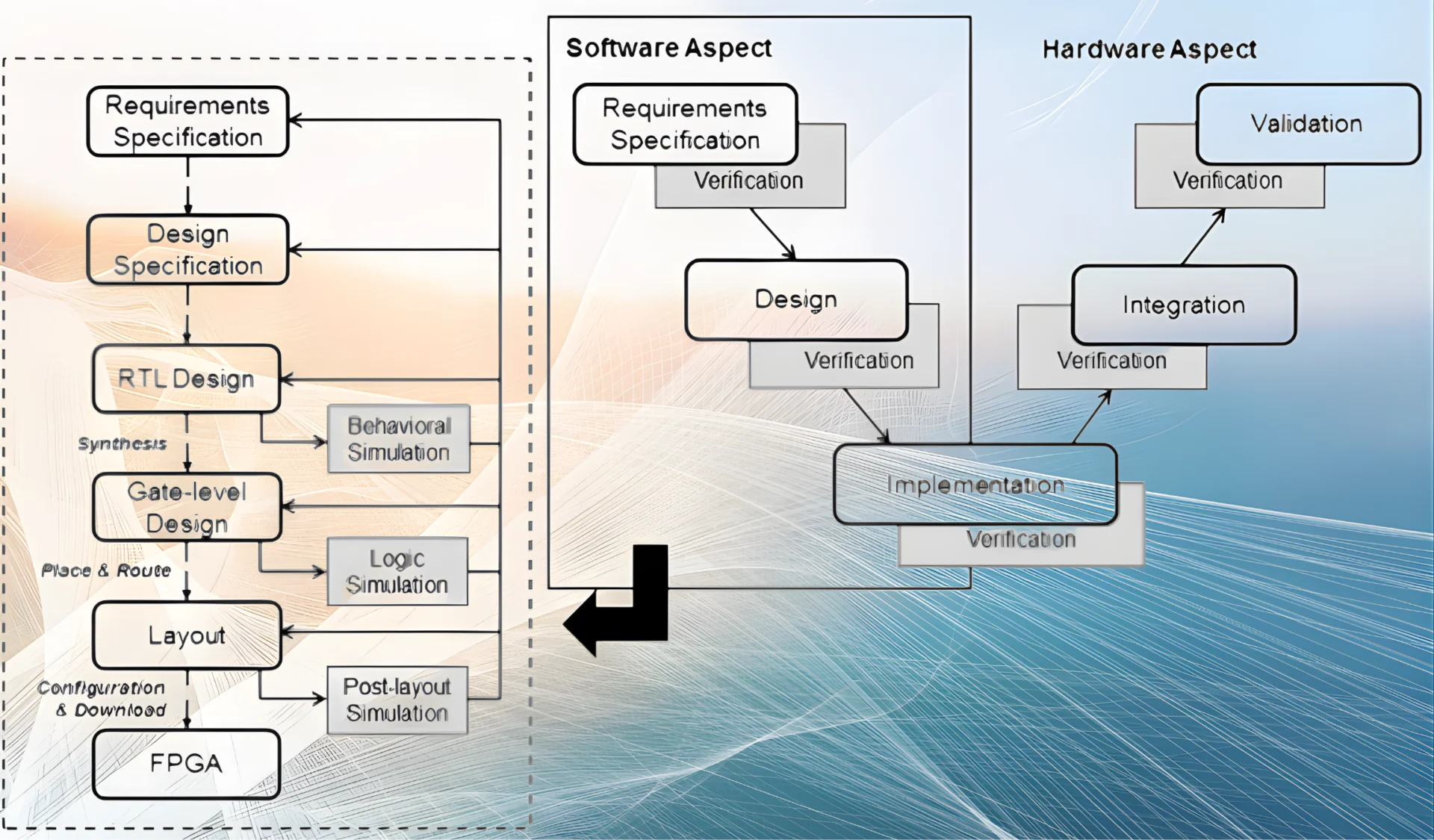
Successful FPGA delivery requires more than isolated RTL design or late-stage verification support. Complex FPGA programmes need joined-up engineering across architecture, design, implementation, validation, timing closure, and deployment. Alpinum’s FPGA services are structured to support each stage of the lifecycle, helping clients reduce technical risk, improve design quality, and maintain delivery confidence from early planning through final system sign-off.
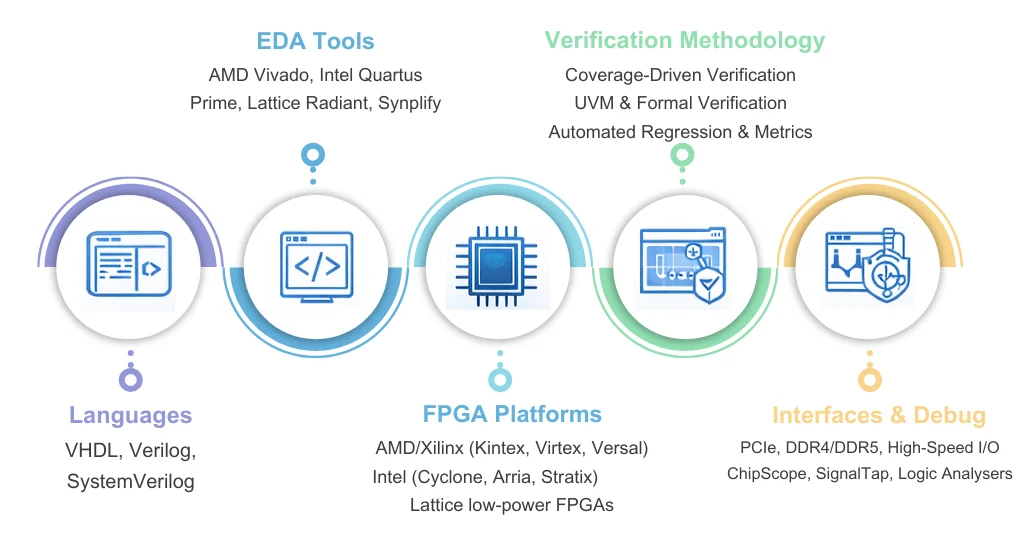
Our Expertise
FPGA Verification & Validation Services
As FPGA functionality expands, coverage-driven verification and formal validation become essential for reliability, safety compliance, and schedule confidence. Alpinum delivers independent verification and validation aligned with DO-254-compliant design and safety-critical engineering.

Verification Planning, Requirements Traceability & Methodology
We establish structured FPGA verification frameworks that include:
- Requirement capture, feature mapping, and verification planning
- Coverage-driven and assertion-based verification methodologies
- Risk-aligned verification strategy and measurable sign-off criteria
This prevents late-stage defects and uncontrolled redesign.

Simulation, UVM Environments & Hardware/Software Co-Verification
Our scalable infrastructures support:
- SystemVerilog UVM testbenches and constrained-random verification
- Automated regression, functional coverage, and CI-driven verification flows
- Hardware–software co-verification and SoC functional validation
These practices deliver transparent verification progress and predictable closure.

Formal Verification, Protocol Validation & Safety Analysis
Where formal methods provide clear value, we implement:
- Property checking, deadlock analysis, and protocol compliance verification
- Corner-case coverage for networking, storage, video, and high-speed interfaces
- Safety-critical validation aligned with aerospace, defence, and medical electronics
This hybrid approach improves verification depth without schedule overhead.

Metrics, Coverage Closure & Predictable FPGA Sign-Off
- Coverage dashboards, defect analytics, and regression stability metrics
- Evidence-based functional and timing sign-off
- Independent validation supporting certification and deployment
The outcome is faster closure, reduced rework, and higher system confidence.

Industry Applications & Deployment Experience
Our FPGA consulting experience spans demanding, performance-sensitive domains
This breadth enables rapid understanding of domain-specific constraints and reliability expectations.
Flexible Engagement Models
Alpinum provides delivery models aligned with organisational structure and project scale
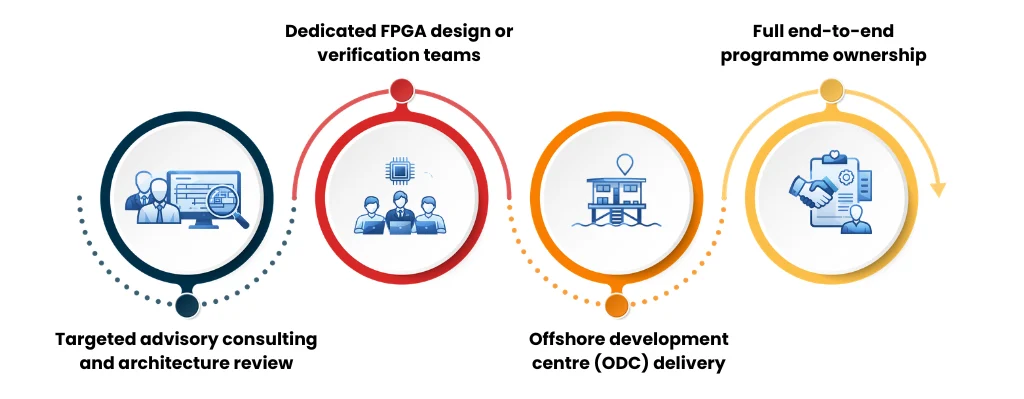
All engagements include clear accountability, transparent communication, and structured knowledge transfer to ensure long-term client independence.
Why Organisations Choose Alpinum for FPGA Engineering
Our goal is simple: enable reliable FPGA delivery with reduced risk and predictable schedules
✔️ Deep expertise across FPGA design, verification, and system integration
✔️ Strong heritage in semiconductor and complex electronic systems
✔️ Proven delivery in safety-critical and high-performance applications
✔️ Flexible global engagement with onsite, hybrid, and offshore models
✔️ Focus on measurable outcomes rather than theoretical guidance

Strategic Semiconductor & FPGA Partnerships
Alpinum collaborates with leading semiconductor companies, FPGA technology providers, EDA innovators, and specialist engineering organisations to support the reliable delivery of complex electronic systems across global markets.

Alpinum maintains a vendor-neutral consulting approach, ensuring that architectural and technology decisions remain fully aligned with each client’s technical, commercial, and long-term product objectives.
This combination of independent engineering leadership and deep industry collaboration enables organisations to accelerate innovation, achieve predictable verification sign-off, and deploy robust FPGA- and semiconductor-based systems with confidence.
Engineering Knowledge: Design, Verification, DVClub & AI in EDA
Readers are guided toward deeper insight into FPGA consulting services, detailed methodologies behind FPGA verification services, and practical engineering experience that demonstrates Alpinum’s FPGA design expertise across complex semiconductor programmes.
Additional contextual pathways connect this content with:
- Specialist FPGA technical blogs exploring real-world design and verification challenges
- Dedicated verification capability pages describing structured coverage, formal validation, and sign-off methodology
- DVClub engineering events that share practical experience from industry practitioners
Emerging research and collaboration in AI-driven design automation within EDA workflows

Start Your FPGA Project with Confidence
Whether you require architecture guidance, full FPGA implementation, or structured verification support, Alpinum provides the engineering expertise needed to deliver complex FPGA systems successfully.
Related Engineering Capabilities




Drop us a line about your FPGA design project and get a quote!
We will contact you today or the next business day. All submitted information will be kept confidential.
Prefer direct email?
Write to mike@alpinumconsulting.com
Book a quick meeting with Mike:
https://calendly.com/mike-alpinum-consulting