
FPGA acceleration consulting is most valuable when a team needs more than general engineering effort. It is useful when the project depends on low-latency processing, high-throughput data movement, deterministic timing, hardware-level parallelism or specialist implementation knowledge that is difficult to deliver through software-only development.
FPGAs can be extremely powerful, but they are not a shortcut. They can improve performance, latency and system efficiency when used for the right problem. They can also increase delivery risk when the architecture is unclear, requirements are unstable, interfaces are poorly defined, or verification is treated as a late-stage activity.
That is why structured FPGA consulting services and verification matter. The decision is not simply “should we use an FPGA?” A stronger question is: what workload, interface, timing requirement, dataflow or product constraint makes FPGA acceleration worth the additional design, verification and integration effort?
For engineering managers, start-ups, semiconductor teams and product companies, FPGA acceleration consulting should help answer three practical questions:
- Is FPGA the right technical route for this problem?
- What delivery risks must be controlled before implementation starts?
- What verification evidence is needed before the design can be trusted?
Key learning points
| Key learning point | Why it matters | Relevant Alpinum link |
| FPGA acceleration is valuable when the workload benefits from parallelism, deterministic timing or low-latency hardware execution. | FPGA projects work best when the architecture matches a clear performance or integration need. | FPGA Consulting Services and Verification |
| FPGA delivery risk often comes from unclear requirements, weak architecture decisions and late verification. | These issues can create delays during RTL design, timing closure, board integration or deployment. | Design Verification Services |
| FPGA verification should start before implementation is complete. | Early verification planning helps reduce debug cost and improves confidence before deployment. | Formal Verification Services |
| FPGA services should support the full lifecycle, not only RTL coding. | Requirements, architecture, implementation, timing, verification and validation all affect delivery success. | FPGA Services |
| The right FPGA partner should de-risk the project, not simply provide extra engineering capacity. | Buyers need architecture judgement, verification discipline and practical delivery support. | Contact Alpinum Consulting |
What FPGA acceleration consulting means
FPGA acceleration consulting helps teams decide whether FPGA technology is suitable for a specific product, workload or system challenge. It also helps define the design route, architecture, implementation plan, verification strategy and delivery risks before the project becomes expensive to change.
A strong FPGA acceleration consulting engagement may include:
- Requirements review and feasibility assessment
- Workload analysis and architecture exploration
- FPGA versus CPU/GPU/software-only trade-off review
- Dataflow, memory, interface and timing analysis
- RTL architecture planning
- IP selection and reuse strategy
- FPGA implementation planning
- Verification and validation planning
- Timing closure risk review
- Board, system and software integration support
- Deployment and productisation support
The goal is not to push FPGA technology into every project. The goal is to identify where FPGA acceleration creates measurable engineering value and where another approach may be simpler, cheaper or lower risk.
Alpinum provides vendor-independent FPGA consulting, engineering and verification services for teams that need support across requirements, architecture, RTL design, implementation, verification, validation and product deployment.
When FPGA is better than CPU, GPU or software-only approaches
FPGAs are most useful when the system needs hardware-level control over performance, timing or interfaces. A CPU may be easier to programme, and a GPU may be excellent for highly parallel numerical workloads, but an FPGA can be a better fit when the design needs customised dataflow, deterministic response or direct hardware integration.
FPGA acceleration may be worth considering when a project needs:
- Very low latency
- Deterministic processing
- High-throughput data pipelines
- Real-time signal processing
- Custom protocol handling
- Hardware-level parallelism
- Direct interface with sensors, converters or communication links
- Pre-processing before data reaches a CPU or GPU
- Custom acceleration for networking, imaging, AI, communications or control systems
- Long product lifecycles where hardware flexibility remains valuable
However, an FPGA is not automatically the best choice. FPGA development can require specialist skills, longer verification cycles, timing closure work, board integration and careful toolchain management. The value case is strongest when the performance, latency, determinism or interface benefits outweigh the additional engineering complexity.
This is where FPGA acceleration consulting can prevent costly mistakes. A structured review can help determine whether FPGA is the right fit before the team commits to architecture, budget and schedule.
Common FPGA delivery risks
Many FPGA projects do not fail because the technology is weak. They struggle because delivery risk is underestimated. FPGA work sits between hardware, software, verification, system integration and product constraints. If those boundaries are not controlled, issues appear late and become expensive to fix.
Common FPGA delivery risks include:
- Requirements that are too vague for hardware implementation
- Performance targets without clear measurement criteria
- Interfaces that are not fully specified
- Dataflow and memory assumptions that do not scale
- Reuse of IP without proper integration checks
- RTL that works in simulation but fails timing closure
- Verification environments built too late
- Weak coverage and unclear sign-off criteria
- Board-level integration issues
- Toolchain, constraint or implementation problems
- Software and firmware integration gaps
- Late changes to protocols, throughput targets or external interfaces
The most dangerous risk is late discovery. A design can appear healthy during early RTL development but fail when timing, system integration, real data traffic or board-level constraints are introduced.
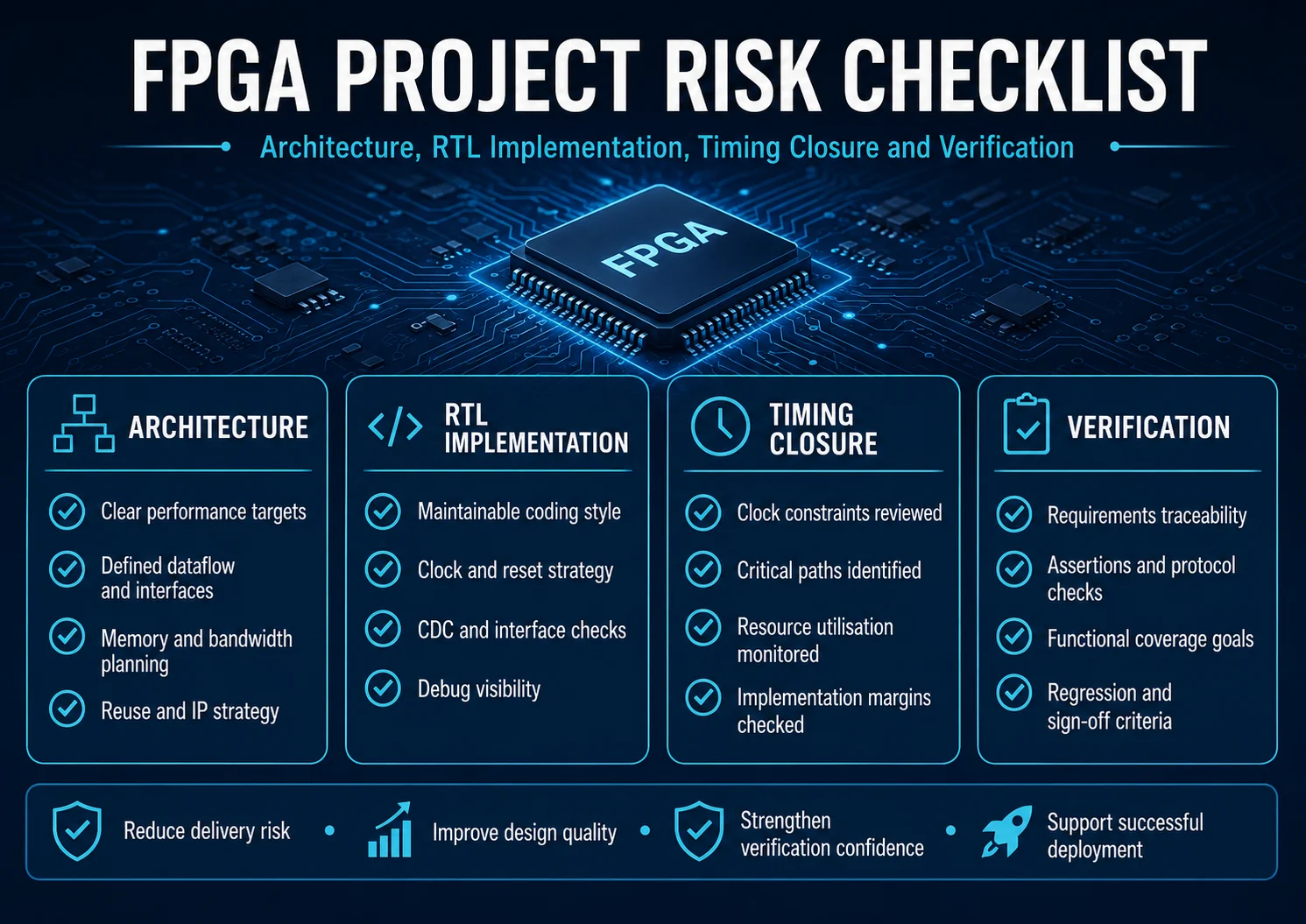
Figure 1: FPGA project risk checklist for architecture, RTL implementation, timing closure and verification.
For teams already facing delivery pressure, Alpinum’s broader design verification services can support verification planning, testbench architecture, assertions, coverage-driven verification, regression management, debug and verification closure.
FPGA architecture, RTL, timing and verification checkpoints
A strong FPGA project should be controlled through clear engineering checkpoints. These checkpoints help teams find problems early, make better design decisions and avoid reaching deployment with unresolved technical risk.
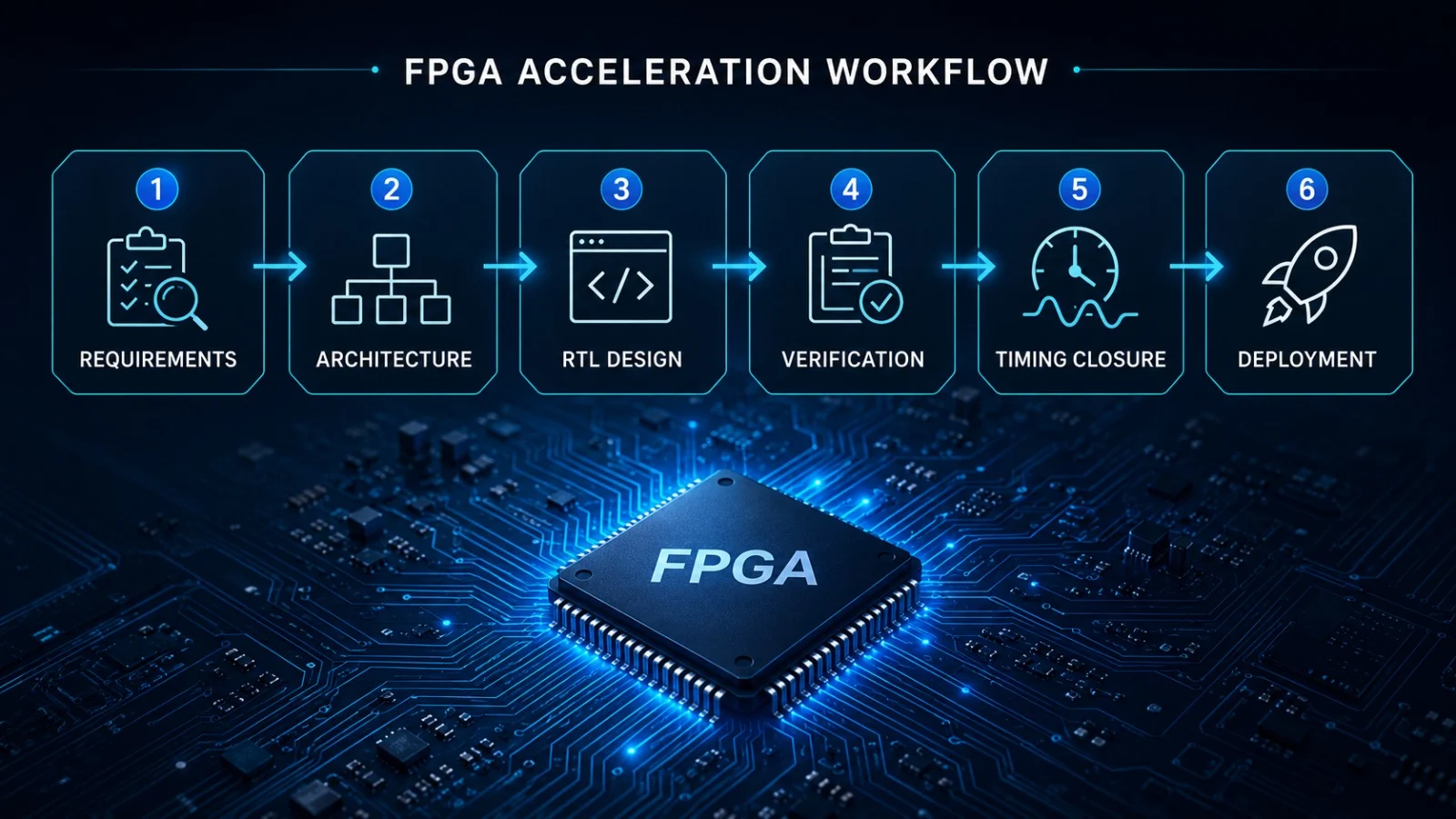
Figure 2: FPGA acceleration workflow showing requirements, architecture, RTL design, verification, timing closure and deployment.
1. Requirements checkpoint
Before architecture begins, the team should confirm:
- What the FPGA must accelerate
- What latency, throughput or timing target must be achieved
- Which interfaces are required
- Which external devices, processors or boards are involved
- Which standards, protocols or safety constraints apply
- Which behaviours must be verified before release
The output should be a testable set of requirements, not only a high-level feature list.
2. Architecture checkpoint
The architecture stage should answer:
- How will data move through the design?
- Which processing blocks are needed?
- Where are the timing-critical paths likely to appear?
- What memory bandwidth is required?
- Which functions should remain in software or firmware?
- Which IP blocks can be reused?
- What verification strategy is needed for each critical block?
A weak architecture decision can create months of downstream implementation and timing problems. This is one of the areas where experienced FPGA engineering services can reduce delivery risk.
3. RTL design checkpoint
During RTL design, the team should check:
- Coding style and maintainability
- Clock domain crossings
- Reset strategy
- Interface correctness
- Buffering and flow control
- Error handling
- Data integrity
- Latency and throughput behaviour
- Debug visibility
The RTL should not only be functionally correct. It should also be structured for verification, timing closure, debug and future maintenance.
4. Timing and implementation checkpoint
FPGA implementation risk often appears during synthesis, place-and-route and timing closure. Teams should review:
- Clock constraints
- Timing paths
- Resource utilisation
- Memory usage
- DSP and logic use
- Floorplanning needs
- Routing congestion
- Build repeatability
- Implementation margins
A design that is functionally correct but cannot close timing is not ready for deployment. Timing closure must be treated as an engineering requirement, not a final tool step.
5. Verification checkpoint
Verification should confirm that the design behaves correctly against requirements, not only that simulation has run. The verification plan should include:
- Directed tests
- Constrained-random tests where suitable
- Assertions
- Functional coverage
- Code coverage
- Protocol checks
- Error-path testing
- Regression tests
- Hardware validation
- Sign-off criteria
For designs with complex control logic, interface behaviour or safety-critical concerns, formal verification services can help prove important properties, uncover corner-case bugs and strengthen verification confidence.
Why verification matters before deployment
FPGA verification is not optional if the design is part of a commercial product, safety-related system, communications platform, semiconductor prototype or high-performance embedded system. A design that works in a small set of tests may still fail under real traffic, boundary conditions, reset scenarios, timing pressure or interface stress.
Verification matters because FPGA failures can be difficult to debug after deployment. Once a design is running on hardware, visibility is lower than in simulation. If the project reaches board bring-up with poor test coverage, the team may spend significant time trying to determine whether the issue is RTL, constraints, board behaviour, software, firmware, drivers or external devices.
A strong FPGA verification strategy should define:
- What must be verified before hardware testing
- Which behaviours require simulation
- Which behaviours require formal methods
- Which behaviours require board-level validation
- Which coverage metrics matter
- Which defects block release
- Which evidence supports sign-off
Alpinum’s design verification services are directly relevant for FPGA teams because they support verification planning, SystemVerilog, UVM, assertions, constrained-random verification, coverage-driven verification, regression management, debug and verification closure.
How to evaluate an FPGA services partner
Choosing an FPGA services partner should not be based only on availability or hourly rate. FPGA projects need engineering judgement across architecture, implementation, timing, verification and integration. A partner that only writes RTL may not reduce project risk if the architecture or verification strategy is weak.
Before selecting a partner, buyers should ask:
- Can the partner assess whether FPGA is the right approach?
- Can they support requirements and architecture, not only implementation?
- Do they understand RTL design, timing closure and FPGA tool flows?
- Can they support FPGA verification and validation?
- Can they work across hardware, software and system integration boundaries?
- Can they identify risks before they become delivery blockers?
- Do they understand coverage, regression and sign-off evidence?
- Can they support both project recovery and planned development?
- Can they work vendor-independently?
- Can they explain trade-offs clearly to engineering managers and technical teams?
The right partner should help the team make better decisions earlier. Strong FPGA services should reduce uncertainty around architecture, implementation, verification and deployment.
FPGA acceleration consulting checklist
Use this checklist before starting an FPGA acceleration project:
| Area | Key question | Why it matters |
| Business need | What problem must FPGA acceleration solve? | Prevents technology-first decision-making |
| Workload | Is the workload suitable for parallel or deterministic hardware execution? | Confirms FPGA fit |
| Latency | Is low latency a core requirement? | Helps justify hardware acceleration |
| Throughput | What data rate must be sustained? | Shapes architecture and memory planning |
| Interfaces | Which protocols, sensors, processors or devices must connect? | Reduces integration risk |
| Architecture | How will data move through the design? | Prevents bottlenecks |
| RTL design | Is the design maintainable and testable? | Reduces debug and future rework |
| Timing closure | Are constraints, clocks and critical paths understood? | Avoids late implementation delays |
| Verification | What evidence is needed before release? | Improves sign-off confidence |
| Deployment | How will the FPGA integrate into the final product? | Reduces board and system-level surprises |
How Alpinum supports FPGA teams
Alpinum supports FPGA teams that need practical engineering expertise across the full development lifecycle. This includes early feasibility work, architecture decisions, implementation planning, verification strategy, timing risk review, validation and product deployment.
Alpinum’s FPGA support can help with:
- FPGA acceleration consulting
- FPGA design services
- FPGA engineering services
- Requirements and architecture review
- RTL design and implementation support
- FPGA verification services
- Timing closure risk assessment
- FPGA prototyping and validation
- Hardware/software integration support
- Project recovery and delivery support
For organisations deciding whether FPGA acceleration is worth it, Alpinum can help evaluate the technical case before implementation starts. For teams already in delivery, Alpinum can support architecture review, verification planning, debug, implementation risk and sign-off confidence.
Need support with FPGA acceleration or verification?
Contact Alpinum Consulting to discuss FPGA acceleration consulting, FPGA design services or FPGA verification support for your project.
Conclusion
FPGA acceleration consulting is valuable when the team needs to make a clear engineering decision before committing to design effort, budget and schedule. FPGAs can offer major benefits in latency, throughput, deterministic behaviour and hardware-level parallelism, but those benefits only become real when the architecture, implementation and verification strategy are controlled.
A successful FPGA project requires more than RTL development. It needs clear requirements, strong architecture, timing awareness, verification planning, integration discipline and release evidence. Without those controls, FPGA projects can become difficult to debug, hard to close and risky to deploy.
Alpinum helps engineering teams reduce that risk through FPGA consulting services and verification, design verification services, formal verification services and practical project support across FPGA design, implementation, validation and deployment.
Ready to de-risk your FPGA project?
Book a technical discussion with Alpinum to review whether FPGA acceleration is the right route and what needs to be controlled before delivery begins.
FPGA acceleration consulting helps engineering teams decide whether FPGA technology is suitable for a specific workload, product or system challenge. It can include feasibility review, architecture planning, performance analysis, implementation strategy, verification planning and delivery risk assessment.
FPGA services are worth it when the project needs low latency, deterministic timing, high-throughput data processing, custom hardware interfaces, real-time processing or specialist FPGA implementation knowledge that cannot be delivered efficiently through software-only development.
FPGA is not always better. A CPU may be simpler for general control software, and a GPU may be better for certain numerical workloads. FPGA can be the better option when the system needs customised dataflow, deterministic response, low latency or direct hardware-level control.
The main risks include unclear requirements, weak architecture, interface uncertainty, timing closure issues, poor verification planning, board integration problems, toolchain complexity and late discovery of defects.
FPGA verification checks whether the design behaves correctly before deployment. It helps reduce the risk of discovering bugs during board bring-up or customer use, where debug visibility is lower and fixes can be more expensive.
An FPGA verification plan should include requirements traceability, directed tests, assertions, coverage goals, regression testing, protocol checks, error-path testing, timing-related checks, hardware validation and clear sign-off criteria.
Alpinum supports FPGA acceleration consulting, FPGA design services, FPGA engineering services, RTL design, implementation planning, FPGA verification services, formal verification and deployment support. Teams can contact Alpinum Consulting to discuss the best route for their FPGA project.

Written by : Mike Bartley
Mike started in software testing in 1988 after completing a PhD in Math, moving to semiconductor Design Verification (DV) in 1994, verifying designs (on Silicon and FPGA) going into commercial and safety-related sectors such as mobile phones, automotive, comms, cloud/data servers, and Artificial Intelligence. Mike built and managed state-of-the-art DV teams inside several companies, specialising in CPU verification.
Mike founded and grew a DV services company to 450+ engineers globally, successfully delivering services and solutions to over 50+ clients.
Mike started Alpinum in April 2016 to deliver a range of start-of-the art industry solutions:
Alpinum AI provides tools and automations using Artificial Intelligence to help companies reduce development costs (by up to 90%!) Alpinum Services provides RTL to GDS VLSI services from nearshore and offshore centres in Vietnam, India, Egypt, Eastern Europe, Mexico and Costa Rica. Alpinum Consulting also provides strategic board level consultancy services, helping companies to grow. Alpinum training department provides self-paced, fully online training in System Verilog, UVM Introduction and Advanced, Formal Verification, DV methodologies for SV, UVM, VHDL and OSVVM and CPU/RISC-V. Alpinum Events organises a number of free-to-attend industry events
You can contact Mike (mike@alpinumconsulting.com or +44 7796 307958) or book a meeting with Mike using Calendly (https://calendly.com/mike-alpinum-consulting).
Stay Informed and Stay Ahead
Latest Articles, Guides and News
Explore related insights from Alpinum that dive deeper into design verification challenges, practical solutions, and expert perspectives from across the global engineering landscape.