
Embedded software does not fail in isolation. It fails at the boundary between firmware, hardware, timing, interfaces, memory limits, operating conditions and real product behaviour. That is why embedded software testing services need to go beyond simple functional checks. A test may prove that a feature works once, but it may not prove that the firmware behaves correctly under interrupt load, degraded communication, timing pressure, power transitions, hardware revisions or long-running regression scenarios.
For engineering teams building automotive systems, IoT products, consumer electronics, industrial controllers or semiconductor-connected platforms, embedded software validation is now a delivery-risk issue. Products are expected to be smarter, more connected and more software-defined, but the hardware constraints have not disappeared. Memory is still limited. Timing is still real. Interfaces still misbehave. Hardware changes still arrive late. Integration still exposes assumptions that were invisible during early development.
This is where structured embedded software testing and validation services become important. The objective is not only to find defects. The objective is to build enough engineering evidence to support release, compliance, customer acceptance and long-term maintainability.
Key learning points
| Key learning point | Why it matters | Relevant Alpinum link |
| Embedded software testing must validate behaviour across firmware, hardware and system context. | Many serious defects appear only when software interacts with real devices, timing constraints and physical interfaces. | Embedded Software Testing |
| Firmware validation needs repeatable regression, not only manual feature checks. | CI/CD-driven regression helps teams detect integration breaks earlier and reduce late-stage release risk. | Embedded Software Development |
| HW/SW integration testing is essential before product release. | Hardware revisions, drivers, boot behaviour, communication interfaces and timing assumptions can create defects that unit tests miss. | Embedded Software Design and Testing |
| Automotive embedded software testing needs stronger traceability and safety evidence. | Safety-critical systems require disciplined validation, coverage and review of failure modes. | Automotive Embedded Software Testing |
| The right testing partner should improve sign-off confidence, not just execute test cases. | Buyers need evidence, coverage, failure analysis and practical engineering judgement. | Contact Alpinum |
What embedded software testing services include
Embedded software testing services cover the activities needed to verify and validate firmware and software that run close to hardware. This includes low-level drivers, middleware, RTOS-based applications, bootloaders, communication stacks, control logic, diagnostics, security-related behaviour and system-level interactions.
A strong embedded testing programme usually includes:
- Requirements review and testability analysis
- Firmware unit testing
- Driver and interface validation
- Hardware/software integration testing
- Simulation-based testing where hardware is not yet available
- Hardware-in-the-loop or board-level validation
- Regression testing across firmware versions
- Fault injection and negative testing
- Timing, memory and performance checks
- Toolchain and build validation
- Release evidence, defect analysis and test reporting
The most important point is that embedded testing must connect software intent to system behaviour. A firmware function may pass a unit test but still fail when interrupts arrive in a different order, when power modes change, when a sensor returns noisy data or when an external interface violates timing assumptions. Testing has to be designed around these realities.
For teams that need a structured partner, Alpinum provides embedded software testing and validation services across embedded platforms, hardware/software co-verification, toolchain validation and CI/CD-driven regression.
Why firmware bugs escape basic functional testing
Many firmware defects are not caused by obvious coding mistakes. They are caused by incorrect assumptions about the environment in which the software runs. Basic functional testing can confirm that a command works under expected conditions, but embedded systems often fail under less convenient conditions.
Typical escape points include:
- Race conditions between interrupts, tasks and shared resources
- Timing failures caused by bus load, clock changes or scheduling pressure
- Memory corruption, stack growth or buffer boundary issues
- Driver assumptions that do not match final hardware behaviour
- Boot or reset sequence failures
- Communication timeouts and retry logic failures
- Error-handling paths that are rarely exercised
- Power state transitions that expose hidden state bugs
- Build or toolchain differences between development and release environments
These issues are difficult to catch with ad hoc manual testing. They require a planned validation strategy that includes boundary conditions, fault scenarios, integration stress, automated regression and clear defect triage.
This is why embedded software testing should begin before final hardware is available. Early simulation, stubs, emulation, prototype boards and continuous integration can expose problems before they become expensive system-level defects.
HW/SW co-verification and integration testing
Hardware/software integration is where many embedded projects lose time. Firmware teams may assume that a register behaves one way, while the hardware behaves slightly differently. A driver may be correct against an early specification but wrong against the final silicon or board implementation. A timing budget may be acceptable during isolated testing but fail when the full system is active.
HW/SW integration testing should answer practical engineering questions:
- Does the firmware correctly initialise the hardware?
- Are register accesses, memory maps and peripheral configurations correct?
- Do drivers handle timeout, retry and error states?
- Does boot behaviour remain stable across resets and power cycles?
- Are interrupts, DMA paths and communication interfaces handled safely?
- Does the system meet timing expectations under realistic load?
- Are hardware errata and late design changes reflected in the software test plan?
A strong HW/SW integration plan creates traceability between requirements, hardware assumptions, firmware behaviour and validation evidence. It also reduces the risk of late discovery, where the first realistic system test happens too close to release.
For teams building resource-constrained or hardware-dependent systems, Alpinum’s article on embedded software development is a useful supporting resource because it explains how timing, memory, hardware boundaries and integration loops shape embedded delivery risk.
CI/CD regression testing for embedded systems
CI/CD is often associated with cloud software, but it is increasingly important in embedded development. The difference is that embedded CI/CD must deal with cross-compilation, target hardware, board availability, toolchain configuration, firmware images, test fixtures and sometimes hardware-in-the-loop environments.
A practical embedded regression strategy should include:
- Automated build checks for every relevant configuration
- Static analysis and coding standard checks
- Unit tests for firmware modules
- Interface and driver-level tests
- Simulation or model-based tests where possible
- Hardware smoke tests on representative boards
- Automated regression for critical workflows
- Test reporting linked to requirements and release decisions
- Failure triage that separates code defects, test issues, hardware issues and environment issues
The goal is not to automate everything at once. The goal is to create a regression backbone that catches high-risk failures early and repeatedly. When firmware changes weekly or daily, teams cannot rely on occasional manual testing to protect the release baseline.
CI/CD regression testing also helps programme managers. It provides visibility into whether quality is improving, whether new defects are appearing, and whether the release candidate is becoming more stable. For buyers evaluating embedded testing services, this is one of the most important questions to ask: can the partner help create repeatable evidence, or are they only running manual checks?
Automotive embedded software testing and safety-critical validation
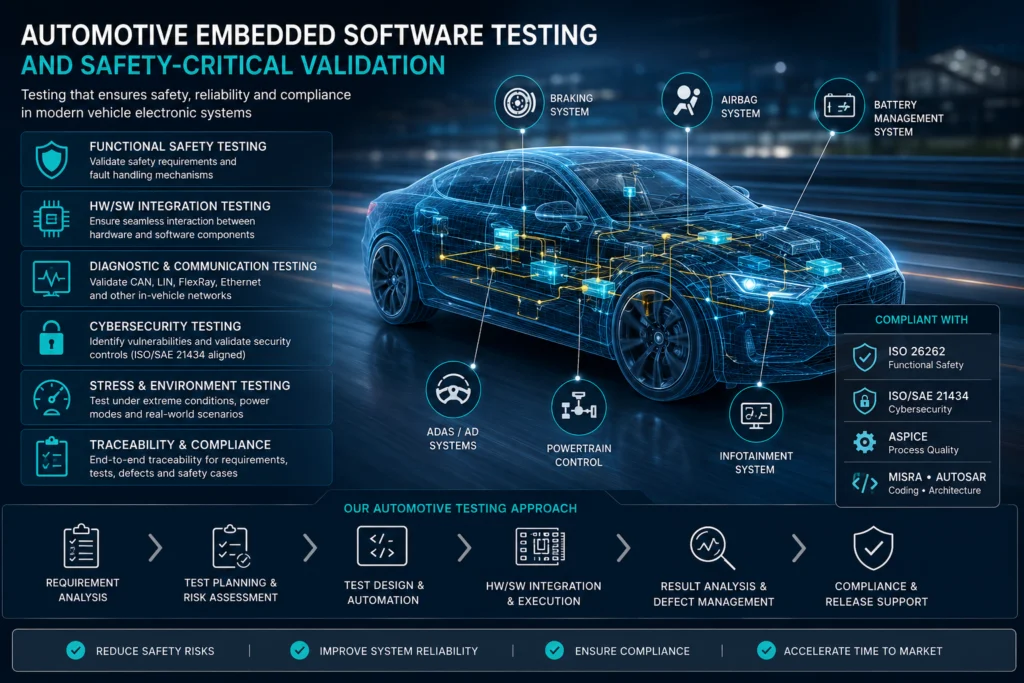
Automotive embedded software testing carries additional pressure because defects can affect safety, compliance, customer trust and product recalls. Modern vehicles contain many software-controlled electronic systems, and those systems must operate correctly under changing environmental, electrical and user conditions.
Automotive embedded software validation may involve:
- Requirements-based testing
- Safety requirement traceability
- Diagnostic behaviour validation
- Fault injection
- Communication testing across automotive networks
- Power mode and reset behaviour testing
- Cybersecurity-related verification
- Regression evidence for software updates
- Review of failure handling and degraded modes
A useful automotive testing strategy does not treat safety as a final checklist. It connects safety intent to test design from the beginning. Requirements, test cases, coverage, defects and release evidence should be aligned so that the engineering team can explain what has been tested, what remains open and what evidence supports sign-off.
Alpinum provides dedicated automotive embedded software testing support for teams that need structured validation across functional safety, SoC power-performance behaviour, cybersecurity verification and release confidence.
Embedded testing for IoT and connected devices
IoT products introduce another layer of complexity. The firmware may be correct in isolation, but the product still has to operate across connectivity changes, cloud interactions, mobile applications, gateways, device updates and real user environments.
IoT embedded software testing should include:
- Connectivity and reconnection behaviour
- Firmware update and rollback validation
- Sensor and actuator behaviour
- Security-sensitive interface testing
- Power and battery behaviour
- Long-duration stability tests
- Interoperability across platforms and network conditions
- Failure recovery after network, power or service interruptions
For connected products, the user experience is often shaped by edge cases. A device that works in the lab may fail in the field because the network is unstable, a cloud response is delayed, a firmware update is interrupted or a peripheral returns unexpected data. Structured IoT embedded software testing helps teams validate these behaviours before customers experience them.
Embedded testing for consumer electronics
Consumer electronics teams face a different but equally demanding challenge: short delivery timelines, high user expectations, frequent product variations and limited tolerance for visible defects. A device may need to be reliable, responsive, power-efficient and easy to update across different production batches or hardware revisions.
Testing should therefore cover:
- User-facing feature behaviour
- Startup, reset and recovery paths
- Power consumption and battery behaviour
- Firmware update reliability
- Connectivity and peripheral interactions
- Performance under realistic use
- Manufacturing and production test considerations
- Regression across product variants
Alpinum’s consumer embedded software testing support is relevant for teams building connected devices, consumer electronics and embedded products where quality issues can quickly affect user trust.
What buyers should ask before choosing an embedded testing partner
Not every testing provider is suitable for embedded systems. General software testing experience is useful, but embedded validation requires hardware awareness, firmware knowledge and an ability to reason about system-level behaviour.
Before choosing a partner, buyers should ask:
- Can the partner test across firmware, hardware interfaces and system-level behaviour?
- Do they understand timing, memory, interrupts, drivers and hardware constraints?
- Can they support CI/CD regression for embedded software?
- Can they validate on real boards, prototypes or hardware-in-the-loop setups?
- Can they separate firmware defects from hardware, test environment or toolchain issues?
- Can they provide clear coverage and release evidence?
- Do they understand safety-critical or regulated engineering environments?
- Can they help improve the test strategy, not just execute test cases?
- Can they support debugging and root-cause analysis?
- Can they scale support across different embedded product types?
The strongest testing partners improve the engineering process. They do not only produce a list of defects. They help teams identify risk, prioritise validation effort, reduce late integration surprises and make better release decisions.
For engineering teams that need wider design and verification support, Alpinum’s embedded software design and testing services provide a useful route from early software planning through to validation and release support.
How Alpinum supports embedded software testing
Alpinum supports engineering teams that need practical, structured and technically informed embedded validation. The focus is on reducing integration risk and building stronger confidence before release.
Alpinum’s embedded software testing support can help with:
- Embedded software test strategy
- Firmware validation
- HW/SW co-verification
- Toolchain and build validation
- CI/CD-driven regression testing
- Automotive embedded software testing
- IoT embedded software testing
- Consumer embedded software testing
- Failure analysis and debugging support
- Test evidence for engineering sign-off
For organisations developing embedded products, the value is not only extra test capacity. The value is stronger engineering control. A structured testing partner can help define what needs to be validated, where risk is concentrated, which tests should be automated, and what evidence is needed before release.
If your team is facing firmware integration risk, limited test coverage, late hardware changes or release pressure, Alpinum can help you review the current validation approach and identify practical next steps.
Need support with embedded software testing?
Contact Alpinum Consulting to discuss firmware validation, HW/SW integration testing or CI/CD regression support for your embedded system.
Practical checklist for embedded software validation
Use this checklist when reviewing an embedded testing plan:
| Testing area | Key question | Evidence to collect |
| Requirements | Are the requirements testable and linked to system behaviour? | Requirements-to-test traceability |
| Firmware modules | Are critical functions tested before integration? | Unit test results and static analysis |
| Drivers and interfaces | Do drivers handle normal, boundary and error conditions? | Interface test results |
| HW/SW integration | Does software behave correctly on target hardware or representative platforms? | Board-level validation evidence |
| Timing and performance | Does the system meet timing expectations under realistic load? | Timing logs and stress test results |
| Regression | Are critical behaviours retested after firmware changes? | CI/CD regression reports |
| Fault handling | Are timeout, reset, retry and degraded modes tested? | Fault injection and negative test evidence |
| Safety and compliance | Are safety-related requirements validated with traceability? | Review records and test coverage |
| Release decision | Is there enough evidence to support sign-off? | Defect status and release readiness report |
Conclusion
Embedded software testing services are most valuable when they protect the release from integration risk. Firmware does not operate in a clean software-only environment. It operates inside a constrained system where hardware behaviour, timing, communication, memory, power, safety and user conditions all matter.
That is why embedded testing must include more than feature checks. It should cover firmware validation, HW/SW integration, regression testing, failure handling, safety-critical behaviour and release evidence. For automotive, IoT, consumer electronics and semiconductor-connected systems, this structured approach can reduce late-stage surprises and improve confidence before product launch.
Alpinum helps teams build that confidence through practical embedded software testing services, automotive embedded software testing, IoT embedded software testing, consumer embedded software testing and CI/CD-driven regression.
Ready to strengthen your embedded software validation?
Request a technical consultation with Alpinum and discuss how your firmware, HW/SW integration or regression testing approach can be improved.
FAQs
Embedded software testing services validate software and firmware that run on dedicated hardware. They can include unit testing, driver testing, HW/SW integration testing, regression testing, hardware-in-the-loop testing, fault injection, timing checks and release evidence preparation.
Embedded software interacts directly with hardware, sensors, actuators, memory, timing constraints, power states and communication interfaces. This means defects can appear only under specific hardware or system conditions, even when the software appears correct in isolation.
Firmware validation checks whether low-level software behaves correctly on the intended hardware or representative platform. It may include boot behaviour, register access, driver functionality, error handling, memory use, timing behaviour and firmware update reliability.
HW/SW integration testing verifies that embedded software works correctly with the target hardware. It checks assumptions around registers, peripherals, timing, interrupts, memory maps, communication interfaces, reset behaviour and hardware error conditions.
CI/CD helps embedded teams catch regression defects earlier. Automated build checks, static analysis, unit tests, simulation, board-level smoke tests and hardware regression can reduce the risk of discovering critical defects late in the release cycle.
Automotive embedded software testing should include requirements-based testing, safety-related traceability, diagnostic validation, communication testing, fault injection, power mode testing, cybersecurity-related checks and regression evidence for release decisions.
Alpinum supports embedded software testing, firmware validation, HW/SW co-verification, toolchain validation, CI/CD-driven regression testing, automotive embedded testing, IoT embedded testing and consumer embedded software validation. Teams can contact Alpinum Consulting to discuss a practical testing strategy for their project.

Written by : Mike Bartley
Mike started in software testing in 1988 after completing a PhD in Math, moving to semiconductor Design Verification (DV) in 1994, verifying designs (on Silicon and FPGA) going into commercial and safety-related sectors such as mobile phones, automotive, comms, cloud/data servers, and Artificial Intelligence. Mike built and managed state-of-the-art DV teams inside several companies, specialising in CPU verification.
Mike founded and grew a DV services company to 450+ engineers globally, successfully delivering services and solutions to over 50+ clients.
Mike started Alpinum in April 2016 to deliver a range of start-of-the art industry solutions:
Alpinum AI provides tools and automations using Artificial Intelligence to help companies reduce development costs (by up to 90%!) Alpinum Services provides RTL to GDS VLSI services from nearshore and offshore centres in Vietnam, India, Egypt, Eastern Europe, Mexico and Costa Rica. Alpinum Consulting also provides strategic board level consultancy services, helping companies to grow. Alpinum training department provides self-paced, fully online training in System Verilog, UVM Introduction and Advanced, Formal Verification, DV methodologies for SV, UVM, VHDL and OSVVM and CPU/RISC-V. Alpinum Events organises a number of free-to-attend industry events
You can contact Mike (mike@alpinumconsulting.com or +44 7796 307958) or book a meeting with Mike using Calendly (https://calendly.com/mike-alpinum-consulting).
Stay Informed and Stay Ahead
Latest Articles, Guides and News
Explore related insights from Alpinum that dive deeper into design verification challenges, practical solutions, and expert perspectives from across the global engineering landscape.