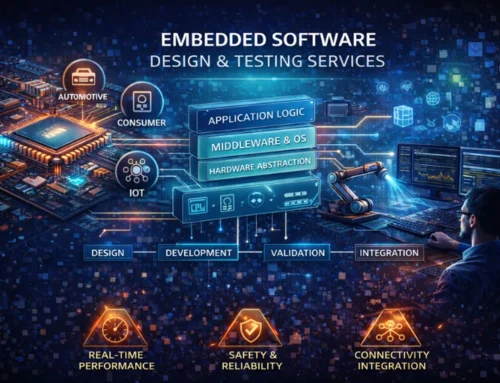

Embedded software controls how electronic products sense, communicate, calculate and respond to the physical world. It runs inside vehicles, industrial equipment, medical devices, consumer electronics, communication systems, IoT products and semiconductor platforms.
Developing this software involves much more than writing code for a microcontroller.
The software must operate within a defined hardware architecture, fixed memory capacity, limited processing resources, power constraints and timing requirements. It must interact correctly with registers, interrupts, sensors, actuators, buses and communication interfaces. It may also need to remain safe, secure and maintainable for many years after deployment.
Successful embedded software development therefore depends on joined-up engineering across:
- Product requirements
- System architecture
- Hardware and software partitioning
- Firmware and driver implementation
- Real-time behaviour
- Hardware/software integration
- Verification and validation
- Security
- Deployment and lifecycle management
The strongest embedded programmes treat these activities as one connected engineering process rather than separate hardware, software and testing workstreams.
Quick Answer: What Is Embedded Software Development?
Embedded software development is the process of designing, implementing, integrating, testing and maintaining software that runs on dedicated electronic hardware.
Unlike general-purpose software, embedded software usually operates within fixed constraints such as processing capacity, memory, power consumption, interface timing and real-time response requirements. It may interact directly with hardware registers, peripherals, sensors, communication buses and physical control systems.
The development process normally includes:
- Requirements definition
- System and software architecture
- Hardware/software interface definition
- Firmware, driver and application development
- Hardware bring-up and integration
- Testing and system validation
- Secure deployment and updating
- Long-term maintenance
Embedded software quality cannot be assessed from code alone. The software must be evaluated as part of the complete hardware and system environment.
What Is an Embedded System?
An embedded system is a computing system designed to perform a specific function within a larger electronic product.
It may be based on:
- A microcontroller
- A microprocessor
- A System-on-Chip
- An FPGA with embedded processing
- A heterogeneous platform combining multiple processors and accelerators
- A dedicated application-specific device
The software may control a simple sensor node or coordinate a complex system containing multiple processors, operating systems, interfaces and safety-critical functions.
Examples include:
| Application | Typical embedded software responsibilities |
| Automotive ECU | Sensor processing, control logic, diagnostics and vehicle communication |
| Consumer device | User interaction, connectivity, power control and peripheral management |
| Industrial controller | Deterministic control, monitoring, fault handling and field communication |
| IoT product | Sensor acquisition, local processing, security and cloud connectivity |
| Medical device | Measurement, control, alarms, data integrity and safety-related behaviour |
| Semiconductor platform | Boot software, drivers, firmware, diagnostics and hardware enablement |
Embedded software is inseparable from the hardware on which it runs. A software decision may affect memory use, timing, power consumption, safety behaviour and even the hardware selected for the product.
Embedded Software, Firmware and General Software: What Is the Difference?
The terms embedded software and firmware are sometimes used interchangeably, but they do not always describe exactly the same layer.
| Area | Typical role |
| Firmware | Low-level software closely connected to hardware initialisation, device control and boot behaviour |
| Device drivers | Software that provides controlled access to peripherals and hardware functions |
| Board Support Package | Platform-specific software required to initialise and operate a particular board |
| Embedded application software | Product logic, control algorithms, communication and higher-level behaviour |
| Middleware | Reusable services such as networking, file systems, diagnostics and communication frameworks |
| General-purpose software | Software designed to run across flexible desktop, server, mobile or cloud environments |
Firmware often sits closest to the hardware, while embedded application software implements broader product behaviour.
In practice, these layers must work together. A defect in a device driver can appear as an application failure. An incorrect application assumption can expose a hardware limitation. A boot or update problem can prevent the entire product from operating.
The architecture should therefore define ownership, interfaces and expected behaviour across every layer.
Why Embedded Software Development Is a System Engineering Discipline
General software can often rely on additional processing, storage or infrastructure when demand increases. Embedded systems usually cannot.
The hardware configuration may be fixed before software development is complete. Once the board, processor, memory and interfaces have been selected, the software must operate within those physical limits.
That creates a set of connected engineering questions:
- Can the processor meet worst-case timing requirements?
- Is enough memory available for the application and future updates?
- Which functions belong in hardware and which belong in software?
- How will the software recover from peripheral or communication failures?
- Can the device be updated securely in the field?
- How will engineers observe failures after deployment?
- What happens if one task blocks, crashes or consumes excessive resources?
- How will changes to the hardware affect drivers and application software?
These questions cannot be resolved by a software team working in isolation.
Embedded systems development requires coordination across architecture, electronics, silicon, firmware, application software, testing, security and product management.
For programmes involving programmable logic or hardware acceleration, Alpinum's FPGA services cover architecture, RTL development, hardware/software co-design, verification, bring-up and deployment support.
The Embedded Software Development Lifecycle
The embedded software development lifecycle provides a structured route from a product requirement to a deployable, maintainable system.
The stages are connected rather than strictly sequential. Findings during integration or testing frequently expose assumptions that must be corrected in requirements, architecture or interface specifications.
1. Requirements Definition and Feasibility
Embedded development should begin with measurable system requirements rather than a list of software features.
Functional requirements describe what the product must do. Non-functional requirements determine whether it can do so reliably within its operating environment.
These may cover:
- Response deadlines
- Startup time
- Memory limits
- Power consumption
- Communication throughput
- Availability
- Fault recovery
- Environmental conditions
- Security
- Safety
- Maintainability
- Product lifetime
A requirement such as "the device shall respond quickly" is not sufficient. The team needs to know the permitted response time, operating conditions, priority, failure consequence and method of measurement.
Feasibility should also be assessed before the architecture becomes fixed. A processor may support the required functionality but lack enough timing margin for future features. A communication interface may meet nominal throughput but fail under contention. A memory allocation may fit the first release but leave no space for secure update support.
Early feasibility analysis reduces the risk of discovering fundamental limitations during integration.
2. System Architecture and Hardware/Software Partitioning
System architecture defines how responsibilities are distributed across:
- Hardware
- Firmware
- Application software
- Operating-system services
- Programmable logic
- External processors
- Cloud or companion applications
Hardware/software partitioning is particularly important.
A function placed in hardware may offer lower latency or greater determinism but require more complex verification and less flexibility after manufacture. A software implementation may be easier to update but consume more processing resources and introduce timing variability.
Architecture should define:
- Processing elements
- Memory organisation
- Task and thread structure
- Communication paths
- Interrupt routing
- Peripheral ownership
- Boot flow
- Reset and recovery behaviour
- Trust boundaries
- Power states
- Diagnostic mechanisms
The architecture must also reserve margin. A design that consumes nearly all available memory, bandwidth or processor capacity during the first release is unlikely to support product evolution safely.
3. Software Architecture and Component Boundaries
Software architecture translates system responsibilities into maintainable components.
A strong architecture separates:
- Hardware-specific code
- Drivers and Board Support Packages
- Operating-system services
- Middleware
- Product logic
- Diagnostics
- Security functions
- Update and lifecycle services
This separation helps teams manage hardware revisions, reuse software and test components independently.
However, abstraction must be purposeful.
A hardware abstraction layer can improve portability, but an overly generic abstraction may hide timing, error or configuration behaviour that the application needs to understand. Abstraction should reduce unnecessary coupling without concealing critical engineering constraints.
Good software architecture also defines:
- Component responsibilities
- Public interfaces
- Data ownership
- Concurrency rules
- Error propagation
- Startup and shutdown order
- State transitions
- Configuration management
- Logging and observability
Architecture documentation should record not only what components exist but also the assumptions connecting them.
Hardware and Software Integration
Hardware/software integration is one of the most important and most failure prone parts of embedded software development.
Many embedded defects are not exclusively hardware or software defects. They occur because the two domains implement different interpretations of the same interface.
A strong hardware/software integration process begins with a clear Hardware/Software Interface specification.
What Should a Hardware/Software Interface Specification Cover?
The specification should define the contract through which software controls and observes hardware.
It normally includes:
Memory maps and registers
For each control and status register, document:
- Address
- Field definition
- Reset value
- Read and write behaviour
- Access permissions
- Reserved bits
- Side effects
- Error behaviour
- Timing dependencies
Software should not need to infer register behaviour from RTL, informal discussions or incomplete spreadsheets.
Interrupts and events
Define:
- Interrupt source
- Priority
- Trigger type
- Masking behaviour
- Clear conditions
- Expected software response
- Shared interrupt handling
- Behaviour during reset and low-power states
Incorrect interrupt assumptions can cause missed events, repeated interrupts, priority inversion or difficult-to-reproduce race conditions.
Peripheral and communication interfaces
Document behaviour for interfaces such as:
- SPI
- I²C
- UART
- CAN
- Ethernet
- USB
- PCIe
- GPIO
- Sensor buses
- Proprietary interfaces
The specification should address not only successful transfers but also timeouts, retries, partial messages, contention, invalid data and recovery.
Boot and reset behaviour
Software needs a defined view of:
- Reset sources
- Hardware initial state
- Boot stages
- Memory availability
- Peripheral initialisation order
- Clock and power readiness
- Recovery modes
- Watchdog behaviour
An inconsistent boot assumption can prevent the platform from reaching a usable state even when individual components function correctly.
Error reporting
Hardware and software teams should agree how faults are:
- Detected
- Recorded
- Communicated
- Classified
- Cleared
- Escalated
- Recovered
Silent errors and inconsistent status reporting create substantial downstream debug risk.
Alpinum's Embedded Software Testing and Validation Services include HW/SW integration verification, interface specification review, register and interrupt validation, co-verification and continuous regression support.
Drivers and Board Support Packages
Device drivers and Board Support Packages sit at the boundary between software architecture and physical hardware.
They translate higher-level software requests into register operations, bus transactions, interrupts and device-specific sequences.
Driver quality affects:
- System stability
- Portability
- Startup behaviour
- Error handling
- Timing
- Power management
- Security
- Observability
A driver should not merely produce the expected output in the nominal case. It should also handle:
- Invalid configuration
- Peripheral unavailability
- Timeouts
- Concurrent access
- Interrupted operations
- Hardware error states
- Reset during activity
- Power-state changes
Where final hardware is unavailable, teams can begin driver development against simulation models, emulation platforms or FPGA prototypes. Early software execution can expose interface mismatches before physical board bring-up.
Real-Time Embedded Software Development
A real-time system is defined by the correctness of both its output and the time at which that output is produced.
A control decision delivered after its deadline may be as unacceptable as an incorrect decision.
Determinism Matters More Than Average Performance
Average execution time is not enough for time-critical functions.
Teams must consider:
- Worst-case execution time
- Interrupt latency
- Scheduling delay
- Bus contention
- Cache behaviour
- DMA activity
- Lock contention
- Communication latency
- Priority inversion
A system may appear reliable during ordinary testing but fail when multiple high-priority events occur together.
Real-time architecture should therefore define:
- Task priorities
- Execution periods
- Deadlines
- Pre-emption rules
- Shared-resource protection
- Overrun behaviour
- Fault containment
Bare-Metal or RTOS?
Bare-metal development may be appropriate for simple systems with limited concurrency and a small number of defined states.
A Real-Time Operating System can provide:
- Task scheduling
- Synchronisation
- Timers
- Message queues
- Memory services
- Driver frameworks
- Networking
- Power management
An RTOS does not automatically make a system deterministic. Incorrect priorities, unbounded execution, excessive locking and poor task design can still produce timing failures.
Platforms such as Zephyr support resource-constrained embedded systems, multiple processor architectures, configurable scheduling, driver frameworks, memory protection and modular services.
Teams developing modern connected or real-time products can explore Alpinum's Zephyr RTOS Training Series, which covers build configuration, kernel features, driver development, inter-process communication, testing and portability.
Memory, Processing and Power Constraints
Resource constraints are architectural inputs, not late optimisation tasks.
Memory
Memory planning should account for:
- Code
- Static data
- Stacks
- Heaps
- Buffers
- Communication queues
- Logging
- Bootloaders
- Recovery images
- Security metadata
- Future features
Dynamic allocation may create fragmentation or unpredictable failure in long-running systems. Some applications therefore favour static allocation or fixed memory pools.
Teams should also analyse task stack use under realistic and worst-case execution paths. Stack overflow may remain hidden until an uncommon interrupt, error or diagnostic path is exercised.
Processing Capacity
CPU utilisation should be measured under:
- Peak input rates
- Maximum communication load
- Multiple simultaneous events
- Diagnostics enabled
- Error recovery
- Background update activity
- Worst-case algorithmic paths
Averages can conceal short periods of overload that cause deadline misses or dropped data.
Power and Thermal Behaviour
Software affects power through:
- Processor utilisation
- Peripheral use
- Memory access
- Communication activity
- Clock configuration
- Sleep-state selection
- Wake-up frequency
Power management should be designed into the software architecture. Adding it after functionality is complete often reveals components that cannot suspend safely or resume in the required order.
Embedded Software Languages, Tools and Environments
The correct language and toolchain depend on the platform, product lifetime, safety needs and available engineering capability.
C and C++
C remains widely used for low-level embedded development because it provides direct control over memory, data layout and hardware access.
C++ can add stronger abstraction, type safety and reusable design patterns, but teams need coding rules that prevent uncontrolled dynamic behaviour or unnecessary runtime complexity.
Rust
Rust is increasingly considered for embedded development where memory safety and concurrency safety are important. Adoption still depends on hardware support, toolchain maturity, library availability and integration with existing C-based environments.
Python
Python is generally used around the embedded target rather than for its most constrained real-time functions.
Common uses include:
- Test orchestration
- Build automation
- Log processing
- Data analysis
- Tool integration
- Manufacturing utilities
- Configuration generation
RTOS and Embedded Linux
An RTOS may suit deterministic microcontroller-based products, while embedded Linux may be appropriate when the system requires richer networking, process separation, file systems or complex application frameworks.
Some products combine both approaches across heterogeneous processors.
Engineers building capability across these languages and environments can review Alpinum's Software Development Training Using Python, C/C++ and Rust.
Embedded Software Implementation Best Practices
Implementation quality depends on more than compliance with a coding standard.
Strong embedded software should be:
- Predictable
- Reviewable
- Testable
- Observable
- Recoverable
- Maintainable
Keep hardware access controlled
Application code should not perform uncontrolled direct register access across the codebase.
Hardware interactions should pass through defined drivers or interface modules so that behaviour can be reviewed, tested and changed consistently.
Make state explicit
Complex embedded behaviour is easier to reason about when operating modes, transitions and error states are explicitly represented.
State machines should define:
- Valid states
- Permitted transitions
- Entry and exit actions
- Invalid events
- Timeout behaviour
- Recovery behaviour
Design error handling before errors occur
Do not treat fault handling as a collection of last-minute return-code checks.
For each failure, define:
- Detection
- Containment
- Reporting
- Retry policy
- Degraded operation
- Recovery
- Escalation
Avoid hidden timing dependencies
Software should not depend on undocumented delays or assumptions about how quickly another component will respond.
Use explicit readiness checks, timeouts and state transitions.
Build observability into the product
Embedded failures are difficult to diagnose without useful evidence.
Consider:
- Structured logs
- Error counters
- Reset-cause recording
- Watchdog history
- Event traces
- Persistent fault records
- Version information
- Health monitoring
Observability must be balanced against memory, performance, power and security constraints.
Embedded Software Testing and Validation
Testing should begin before final hardware is available and continue throughout development.
The purpose is not simply to demonstrate that nominal functionality works. It is to build evidence that the software behaves correctly across expected, unexpected and degraded operating conditions.
Unit and Component Testing
Individual algorithms, state machines and software components can often be tested on a host environment before target integration.
Unit testing helps detect:
- Boundary errors
- Invalid state transitions
- Arithmetic problems
- Incorrect error handling
- Data-conversion defects
Hardware dependencies should be controlled through interfaces, stubs or models where appropriate.
Software-in-the-Loop
Software-in-the-Loop testing executes software against simulated inputs, interfaces or plant models.
It can provide early feedback before physical hardware becomes available.
Processor-in-the-Loop and Target Testing
Execution on the target processor exposes issues associated with:
- Compilation
- Data representation
- Timing
- Memory
- Interrupts
- Peripherals
- Toolchain behaviour
Hardware-in-the-Loop
Hardware-in-the-Loop testing connects the embedded target to controlled models or external test equipment.
It is useful for exercising real-time responses, physical interfaces and fault conditions that are difficult or unsafe to reproduce in the final environment.
Integration Testing
Integration testing should focus on boundaries:
- Driver to peripheral
- Software to hardware
- Task to task
- Device to device
- Device to cloud
- Bootloader to application
- Update service to storage
- Software to external sensor or actuator
Continuous Regression
Automated regression helps teams detect unintended effects as the software, hardware and configuration evolve.
A reliable regression system should record:
- Software version
- Hardware revision
- Configuration
- Toolchain
- Test environment
- Results
- Logs
- Known limitations
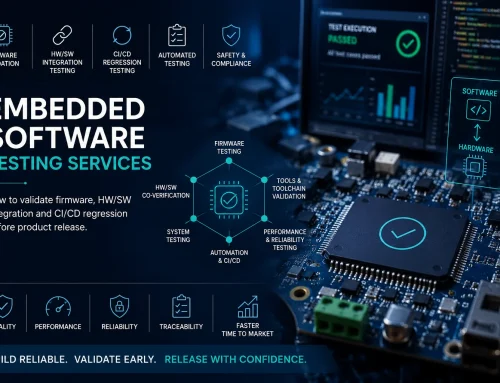
Alpinum provides embedded validation support across functional behaviour, HW/SW integration, CI/CD regression, connectivity, security and AI/ML-enabled devices.
For a more detailed testing-focused discussion, read Embedded Software Testing Services: Firmware Validation, HW/SW Integration and CI/CD Regression.
Secure Embedded Software Development
Security must be included in architecture, development, integration and maintenance.
Connected embedded products may expose:
- Debug ports
- Communication interfaces
- Update mechanisms
- Credentials
- Cryptographic keys
- Local storage
- Cloud APIs
- Mobile applications
- Third-party libraries
Secure Boot
Secure boot helps ensure that only authorised software is executed.
The design may include:
- Immutable boot code
- Signature verification
- Device identity
- Key protection
- Version checking
- Anti-rollback controls
Secure Updates
A secure update process should address:
- Authentication
- Integrity
- Confidentiality where required
- Rollback protection
- Interrupted update recovery
- Power loss
- Version compatibility
- Recovery images
NIST's platform firmware resiliency guidance structures protection around preventing unauthorised modification, detecting changes and recovering securely from firmware attacks.
Least Privilege and Isolation
Software components should receive only the permissions and hardware access they require.
Where the processor and operating system support it, teams can use:
- Memory protection
- User and privileged modes
- Process or thread isolation
- Secure execution environments
- Restricted peripheral access
Security Maintenance
Security work continues after release.
Long-lived products need a process for:
- Vulnerability monitoring
- Dependency review
- Patch assessment
- Secure updates
- Key lifecycle management
- Incident response
- End-of-support planning
Alpinum's Hardware and Software Security Verification Training covers secure boot, roots of trust, cryptography, CPU privilege, embedded software security, SoC protection and system-level assurance.
Deployment and Embedded Software Lifecycle Management
The embedded software lifecycle does not end when the first production image is released.
A product may remain deployed for years while:
- Hardware becomes obsolete
- Toolchains change
- Dependencies reach end of support
- Security vulnerabilities emerge
- Regulations evolve
- New product variants are introduced
Configuration and Version Control
A released software image should be traceable to:
- Source-code revision
- Hardware revision
- Build configuration
- Compiler and toolchain
- Linked libraries
- Bootloader version
- Test results
- Approval records
Without this traceability, teams may be unable to reproduce a customer issue or determine which products contain a defect.
Release Management
Release criteria should include more than the completion of planned features.
Consider:
- Regression status
- Known defects
- Timing margin
- Resource margin
- Security findings
- Update compatibility
- Recovery testing
- Documentation
- Manufacturing readiness
Long-Term Support
Long-term maintenance may require:
- Toolchain preservation
- Reproducible builds
- Dependency control
- Hardware abstraction
- Migration planning
- Archived test environments
- Updated security controls
Projects using an RTOS or external framework should also understand its release and support policy. For example, Zephyr distinguishes stable and long-term-support releases and maintains documentation for version transitions and migration.
Common Embedded Software Development Challenges
Ambiguous requirements
When timing, error handling or operating limits are unclear, teams create different interpretations. The mismatch often appears during integration.
Late hardware changes
A register change, pin reassignment or altered peripheral sequence can affect drivers, tests, diagnostics and application behaviour.
Limited observability
A system may fail without providing enough evidence to reconstruct the cause.
Concurrency defects
Race conditions, deadlocks and priority inversion may appear only under particular event sequences or workloads.
Resource exhaustion
Memory leakage, stack growth, queue saturation and CPU overload may remain invisible during short nominal tests.
Weak interface ownership
Problems arise when no team owns the complete behaviour across a hardware/software boundary.
Incomplete update strategy
A product may work at launch but become impossible to maintain safely once deployed.
Testing too late
Waiting for final hardware concentrates integration, performance, security and functional testing into the most schedule-sensitive stage.
How to Reduce Embedded Development Risk
1. Define measurable system requirements
Include timing, power, memory, recovery and security—not only functionality.
2. Create the Hardware/Software Interface specification early
Do not wait for final RTL or board completion before defining registers, interrupts, memory maps and peripheral behaviour.
3. Validate architecture with realistic workloads
Use worst-case input rates, concurrency and operating modes.
4. Preserve engineering margin
Reserve processing, memory, bandwidth and power capacity for product evolution and uncertainty.
5. Begin software before final hardware is available
Use models, emulation or FPGA prototypes where practical.
6. Automate builds and regressions
Every controlled change should be buildable and testable through a repeatable process.
7. Design for observability
Logs, traces, counters and diagnostics should help engineers explain failures without changing the failure itself.
8. Test error paths deliberately
Timeouts, corrupted data, power interruption, communication loss and invalid states deserve explicit testing.
9. Make release evidence traceable
Connect requirements, implementation, test results, defects and approvals.
10. Plan maintenance at the beginning
Update, recovery, versioning and support are architectural requirements.
Embedded Development Across Automotive, Consumer and IoT Systems
The engineering principles are consistent, but priorities differ by market.
Automotive Embedded Software
Automotive software may need to coordinate ECUs, domain controllers, sensors, communication networks, diagnostics, secure updates and safety-related functions.
Relevant concerns include:
- Functional safety
- Cybersecurity
- Deterministic control
- Fault tolerance
- Long product lifetimes
- HW/SW co-verification
See Alpinum's Automotive Embedded Software Testing and Functional Safety support for ISO 26262, ISO/SAE 21434, hardware/software integration and SoC validation.
Consumer Embedded Software
Consumer devices combine cost constraints, user experience, connectivity, energy efficiency and rapid product evolution.
Testing must consider:
- Startup and recovery
- Peripheral compatibility
- Multimedia or sensor performance
- Power behaviour
- Firmware updates
- Real-world usage variation
Alpinum provides Consumer SoC Verification and Embedded Testing for connected devices and consumer electronics.
IoT Embedded Software
IoT software connects resource-constrained devices with networks, gateways, applications and cloud services.
Development must account for:
- Interoperability
- Intermittent connectivity
- Local data storage
- Security
- Device identity
- Remote updates
- Fleet management
- Scalability
Alpinum's IoT Embedded Testing Services cover connectivity, interoperability, resilience, security and end-to-end system validation.
How Alpinum Supports Embedded Software Programmes
Alpinum approaches embedded software as a system-level verification and integration challenge.
Support can include:
- Embedded software testing
- Firmware validation
- HW/SW interface verification
- Hardware/software co-verification
- Functional and integration testing
- CI/CD regression automation
- Connectivity testing
- Concurrency validation
- Security testing
- Automotive, consumer and IoT validation
- FPGA prototyping and system integration
- Engineering training
The objective is to identify integration risk early, improve evidence quality and support more confident product release.
Engineering teams can explore:
Conclusion
Embedded software development is not simply software engineering on a smaller computer.
It is the disciplined development of software that must operate correctly within a specific hardware, timing, power, memory and operational environment.
Successful programmes connect:
- Requirements
- Architecture
- Hardware/software partitioning
- Interface definition
- Implementation
- Integration
- Testing
- Security
- Deployment
- Lifecycle management
The greatest risks often appear at boundaries—between hardware and software, between normal and fault behaviour, and between initial product delivery and long-term support.
Teams that define those boundaries early, preserve engineering margin, automate validation and maintain traceable evidence can identify problems earlier and deliver more predictable embedded systems.
For support with firmware validation, hardware/software integration, regression automation or embedded product testing, contact Alpinum Consulting.
FAQs
Embedded software development is the process of creating software for dedicated electronic hardware. It includes requirements, architecture, firmware and driver implementation, HW/SW integration, testing, deployment and maintenance.
Embedded systems development covers the complete product, including electronics, processors, programmable logic, firmware, application software, interfaces, testing and system integration.
The lifecycle normally includes requirements, feasibility assessment, architecture, implementation, integration, testing, release, deployment, updating and long-term maintenance.
Embedded software is developed by defining system requirements, selecting the hardware platform, designing the architecture, implementing drivers and application logic, integrating the software with hardware, and validating the full system under realistic conditions.
Hardware/software integration verifies that software interacts correctly with registers, memory maps, interrupts, peripherals, buses, boot logic and hardware error mechanisms.
Firmware usually refers to low-level software that initialises or directly controls hardware. Embedded software is a broader term that can include firmware, drivers, middleware, operating-system services and product application logic.
C and C++ remain common for firmware and real-time development. Rust is increasingly considered for memory-safe embedded systems, while Python is widely used for automation, testing, data analysis and development tools.
Real-time embedded development creates software that must produce correct outputs within defined timing limits. The design must account for scheduling, interrupts, execution time, concurrency and worst-case system load.
Embedded software is tightly coupled with hardware, often has limited observability and must operate under timing, memory, power and environmental constraints. Many failures appear only during integration or under unusual event sequences.
Testing may include unit testing, Software-in-the-Loop, processor or target testing, Hardware-in-the-Loop, integration testing, performance testing, fault injection, security testing and automated regression.
Full-lifecycle development covers the product from initial requirements and architecture through implementation, integration, deployment, updates, maintenance and end-of-support planning.
Risk can be reduced through measurable requirements, early interface specification, realistic architecture analysis, continuous integration, automated regression, deliberate error testing, resource margin and traceable release evidence.

Written by : Mike Bartley
Mike started in software testing in 1988 after completing a PhD in Math, moving to semiconductor Design Verification (DV) in 1994, verifying designs (on Silicon and FPGA) going into commercial and safety-related sectors such as mobile phones, automotive, comms, cloud/data servers, and Artificial Intelligence. Mike built and managed state-of-the-art DV teams inside several companies, specialising in CPU verification.
Mike founded and grew a DV services company to 450+ engineers globally, successfully delivering services and solutions to over 50+ clients.
Mike started Alpinum in April 2016 to deliver a range of start-of-the art industry solutions:
Alpinum AI provides tools and automations using Artificial Intelligence to help companies reduce development costs (by up to 90%!) Alpinum Services provides RTL to GDS VLSI services from nearshore and offshore centres in Vietnam, India, Egypt, Eastern Europe, Mexico and Costa Rica. Alpinum Consulting also provides strategic board level consultancy services, helping companies to grow. Alpinum training department provides self-paced, fully online training in System Verilog, UVM Introduction and Advanced, Formal Verification, DV methodologies for SV, UVM, VHDL and OSVVM and CPU/RISC-V. Alpinum Events organises a number of free-to-attend industry events
You can contact Mike (mike@alpinumconsulting.com or +44 7796 307958) or book a meeting with Mike using Calendly (https://calendly.com/mike-alpinum-consulting).
Stay Informed and Stay Ahead
Latest Articles, Guides and News
Explore related insights from Alpinum that dive deeper into design verification challenges, practical solutions, and expert perspectives from across the global engineering landscape.