Embedded Software Testing & Validation Services

Embedded software devices are tightly integrated with their hardware, resource-constrained, and increasingly connected via multiple interfaces and protocols.

To ship reliably, teams need more than basic unit tests; they need structured validation across functional behaviour, HW/SW integration, performance, security, and continuous regression testing.

Alpinum Consulting provides embedded software testing, HW/SW co-verification, toolchain validation, CI/CD-driven regression testing, and AI-supported testing to reduce integration risk and enable fast, confident product sign-off.

Speak to an Embedded Verification Expert

Embedded Software Devices and Why Testing Is Different

Embedded software has specific characteristics that create unique validation challenges: it is designed for a specific device with limited functions, is tightly integrated with hardware, often runs on a microcontroller or purpose-built IC, and must operate under limited memory/processing constraints.

At the same time, embedded products are increasingly connected through multiple interfaces and protocols, expanding the test surface for interoperability and security.

Typical embedded device categories include consumer electronics (e.g., smart TVs, appliances, wearables), automotive control and sensing systems, and IoT platforms using BLE/WiFi/ZigBee or LoRaWAN connectivity.

What this means in practice: successful validation must cover firmware correctness, real-world integration, connectivity behaviour, and risk exposure, not just code-level testing.

What We Test Across the Embedded Lifecycle

Embedded Systems Testing

  • Functional module testing
  • Integration testing
  • Software toolchain validation

CI/CD & Test Automation

  • CI/CD integration and test execution
  • Device-to-cloud automation
  • Test automation frameworks
  • QA farm setups and scripted regression flows

Product Testing for Real-World Behaviour

  • Performance and functional testing
  • Sensor integration and interoperability
  • Peripheral and connectivity testing
  • Network connectivity testing
  • App and edge testing for connected devices

ML Model & AI Testing for Embedded AI

  • Dataset and feature validation
  • Model benchmarking and parameter traceability
  • Embedded NN testing and CNN compiler validation
  • ML library integration testing

HW/SW Integration Verification and HSI Discipline
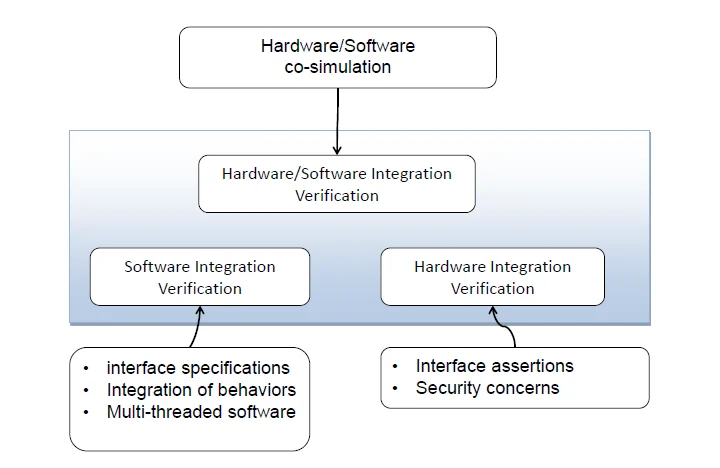
Many embedded defects are not “software bugs” or “hardware bugs”; they are integration defects caused by mismatched assumptions at the hardware/software boundary.

Alpinum supports hardware/software integration verification with emphasis on:

  • Interface specifications
  • Integration of behaviours
  • Multi-threaded software interactions
  • Interface assertions
  • Security concerns
  • HW/SW co-simulation where appropriate
A high-quality HSI (Hardware/Software Interface) specification typically includes:

  • Memory maps and registers (CSRs): addressable locations, register fields, reset values, read/write behaviour
  • Peripheral control: peripheral functionality and how software manipulates it
  • Interrupts and events: notification mechanisms from hardware to software
  • Electrical I/O and pin mapping: pin muxing, directions, voltage logic levels
  • Error logging/reporting: how hardware faults are reported for reliability/serviceability

A strong HSI discipline enables earlier driver development (even before final hardware), reduces HW/SW communication bugs, and creates clear responsibility boundaries between teams.

FPGA prototyping and emulation services

Multi-Threaded Embedded Software and Concurrency Risk

Embedded software is increasingly parallel. Unlike sequential programs that depend only on the initial state and inputs, parallel programs also depend on interactions between threads.

We validate concurrency behaviour using the two common communication models:

  • Shared memory: coordination via locking mechanisms such as mutexes and semaphores
  • Message passing: asynchronous or synchronous exchange where senders may block until messages are received

This matters because concurrency defects (deadlocks, race conditions, event-ordering faults) often evade basic functional tests and emerge only under realistic load, timing variation, and integration pressure.

Security Testing and Firmware Risk Exposure

Security is increasingly mandatory for connected embedded systems, driven by privacy concerns, regulation, and industry pressure.

Threats include attackers modifying software running on hardware, exploiting design bugs, or introducing faults that can be exploited.

What We Validate

  • Secure update and firmware integrity controls
  • Negative testing (ensuring unintended behaviour is not reachable)
  • Interface-level risk exposure (especially for connected products)
  • Evidence-driven remediation support

Why security testing is essential

Examples of AI-Supported Embedded Device Test Solutions

Where appropriate, AI can augment test coverage and prioritisation, especially when systems are large, and test outcomes generate significant data.

The multiple AI-supported test patterns, including:

  • Predictive maintenance testing: targeting high-risk wear-out scenarios
  • Efficiency / zero downtime testing: mining past downtime scenarios to discover new ones
  • Digital transformation / end-to-end path testing: automating previously manual steps and exploring error cases
  • Connectivity resilience testing: validating device behaviour when cloud connections drop and data stores locally
  • AI/ML model testing: bias/outliers/unseen scenarios
  • NFR testing: identifying extreme conditions by analysing test databases for patterns
  • Security testing: vulnerability analysis against top risk classes

Get in touch with us today and explore how our multi-domain expertise can benefit your project!

Get in touch with us today and explore how our multi-domain expertise can benefit your project!

Tools, Languages, and Engineering Environments We Work With

We support embedded development and verification across common stacks, including:

  • MATLAB and Simulink
  • Firmware and FreeRTOS
  • C, C++, Python, Rust, Java
  • Linux, BSP, Yocto applications
  • safety and security engineering contexts

Why Alpinum

  • Independent verification mindset (reduce risk, improve evidence quality)
  • Strong HW/SW integration discipline (HSI and interface verification focus)
  • Regression automation and continuous validation approach
  • Security awareness and negative testing orientation for connected systems
  • Practical experience with complex, repeatable test frameworks and certification evidence

Ready to de-risk your embedded software programme?

Whether you are validating a new SoC, integrating firmware with complex hardware interfaces, or strengthening continuous regression, Alpinum can support your programme with structured verification evidence and practical engineering delivery.

Drop us a line about your Embedded Software Testing project and get a quote!

We will contact you today or the next business day. All submitted information will be kept confidential.

Prefer direct email?
Write to mike@alpinumconsulting.com

Book a quick meeting with Mike:
https://calendly.com/mike-alpinumconsulting

    Frequently Asked Questions

    Embedded software testing verifies firmware on resource-constrained devices to ensure correct behaviour, reliable integration, performance under constraints, and security readiness.
    Functional module testing, integration testing, toolchain validation, product performance testing, connectivity testing, and CI/CD-driven automated regression.
    Validation that firmware and hardware interact correctly through memory maps, registers (CSRs), interrupts/events, and pin mapping, using interface specifications and, where needed, co-simulation.
    HSI specifications define the contract between hardware and software teams, covering registers, interrupts, pin mapping and error reporting, reducing integration defects and shortening development time.
    By validating shared-memory and message-passing interactions, including locking behaviour (mutexes/semaphores) and sequencing issues that can create race conditions and deadlocks.
    By integrating test execution into build pipelines with device-to-cloud automation, QA farm setups, test automation frameworks, and scripted regression flows for continuous validation.
    Yes, coverage includes dataset/feature validation, model benchmarking, parameter traceability, embedded NN testing, CNN compiler validation, and ML library integration testing.