Formal Verification Services for ASIC and SoC Development

Alpinum provides advanced formal verification services that help semiconductor teams mathematically prove design correctness, uncover complex corner-case bugs, and strengthen verification confidence in modern ASIC and SoC architectures.

As semiconductor systems become increasingly complex, simulation alone cannot guarantee full verification coverage. Formal verification techniques such as property checking, model checking, and equivalence verification allow engineers to analyse design behaviour exhaustively and detect subtle design errors early in development.

Alpinum Consulting supports design teams in integrating formal verification into real verification workflows, improving design quality while reducing silicon risk.

The Growing Verification Challenge
in Modern Semiconductor Design

Semiconductor designs today integrate multiple subsystems including processors, accelerators, security modules, and high-speed communication interfaces. As system complexity grows, verification effort often accounts for the majority of engineering work within ASIC programmes.

Simulation-based verification remains essential, particularly when using structured methodologies such as Universal Verification Methodology environments. However, simulation cannot exhaustively explore all possible system behaviours. Rare corner cases involving protocol interactions, arbitration logic, or state transitions may remain undetected until late in the design cycle.

Formal verification addresses these limitations by applying mathematical analysis to the design model, allowing engineers to prove that specific behavioural properties always hold true.

Capabilities of Formal Verification

Formal verification provides engineers with a fundamentally different approach to validating hardware behaviour. Instead of generating stimulus and observing results, formal tools explore the reachable state space of a design and determine whether defined properties can ever be violated.

This allows engineers to detect issues such as:

Illegal State Transitions
Protocol Violations
Deadlocks In Arbitration Logic
Data Integrity Failures
Security Policy Violations

Formal techniques are particularly effective for verifying control logic and protocol behaviour in complex SoCs.

Key Techniques Used in Formal Verification

Property Checking

Property checking verifies whether a design satisfies a set of behavioural properties defined by engineers.

These properties are typically implemented using assertions written in SystemVerilog environments.

Formal engines analyse the design to determine whether any sequence of events could violate these rules.

Assertion-Based Verification

Assertion-based verification introduces behavioural checks directly into the verification environment.

Assertions define expected design behaviour such as protocol timing constraints, valid state transitions, and safety conditions.

Formal tools can then prove whether these properties always hold true.

Equivalence Checking

Equivalence checking verifies that two versions of a design behave identically.

This technique is commonly used after synthesis or optimisation to confirm that implementation changes have not altered functional behaviour.

Formal Verification Workflow in Semiconductor Projects
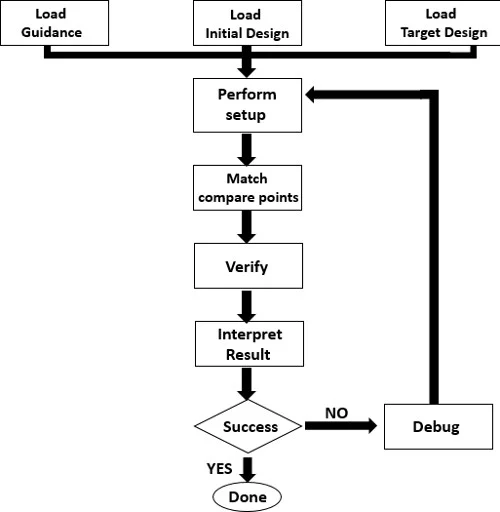
Formal verification is most effective when integrated into a structured verification methodology.

A typical workflow includes:

  • Verification planning to identify design components that benefit from formal analysis.
  • Property development where engineers define assertions describing expected behaviour.
  • Formal model analysis in which tools explore the design state space.
  • Counterexample debugging where engineers investigate traces generated by the tool.
  • Integration with simulation environments to support verification closure.
Formal Verification Workflow in Semiconductor Projects showing assertion based verification and property checking for ASIC design

Tools Used in Formal Verification Projects

Formal verification environments typically integrate several semiconductor verification technologies. Engineers define behavioural properties using constructs available in SystemVerilog assertion languages. Formal analysis is performed using industry tools developed by companies such as:

These tools provide capabilities including model checking, property verification, and equivalence analysis. Formal environments are frequently integrated with simulation environments built using Universal Verification Methodology.

Where Formal Verification Is Used

Formal verification is widely used across semiconductor sectors where high reliability and complex control logic are required.

  • Automotive semiconductor systems use formal verification to validate safety-critical control logic.
  • AI accelerators rely on formal methods to verify scheduling and resource arbitration logic.
  • Networking ASICs use formal verification to ensure protocol compliance.
  • RISC-V processors benefit from formal verification when validating control logic and exception handling.
  • IoT chipsets use formal verification to validate security mechanisms and power management behaviour.

Formal Verification Consulting from Alpinum

Alpinum Consulting supports semiconductor design teams by integrating formal verification techniques into practical verification workflows. Our consultants help organisations identify design components that benefit from formal analysis and develop property specifications aligned with design requirements.

We also support verification teams in interpreting formal verification results and integrating formal analysis with simulation-based verification flows. This approach allows semiconductor organisations to improve verification coverage, detect subtle design errors earlier, and reduce the risk of silicon respins.

Ready to strengthen your formal verification strategy?

Whether you are validating complex control logic, introducing formal verification techniques into your verification flow, or improving property coverage before tape-out, Alpinum can support your team with experienced formal verification specialists and practical engineering delivery.

Formal Verification Services and
Specialised Verification Solutions

Design teams exploring formal verification also work with broader Design Verification Services, including Pre-Silicon Verification and Post-Silicon Validation.

These connections reinforce Alpinum’s expertise across the semiconductor verification lifecycle.

Discuss Your Formal Verification Challenges

Alpinum Consulting helps semiconductor organisations implement practical verification strategies that improve design confidence and reduce silicon risk.

Prefer direct email?
Write to mike@alpinumconsulting.com

Book a quick meeting with Mike:
https://calendly.com/mike-alpinumconsulting

    Formal Verification Training

    Engineers who want to develop in-house expertise in formal methods can attend Alpinum’s Formal Verification Training, covering property checking, assertion-based verification, and practical verification workflows used in ASIC and SoC development.

    FAQ – Formal Verification

    Formal verification is a hardware verification methodology that uses mathematical analysis to prove whether a design satisfies defined behavioural properties. Instead of running test scenarios, formal tools explore all reachable states of the design to detect potential property violations.
    Simulation verifies behaviour by executing test scenarios generated by a verification environment. Formal verification mathematically analyses the design model to determine whether defined properties can ever be violated. Both approaches are typically used together to improve verification coverage.
    Formal verification is most effective when validating complex control logic such as state machines, arbitration units, security mechanisms, and communication protocols. It is commonly applied during RTL development and pre-silicon verification to detect subtle design errors early.
    Formal verification environments typically use industry tools from Synopsys, Cadence Design Systems, and Siemens EDA. Engineers define properties using SystemVerilog assertions, which formal engines analyse to validate design behaviour.
    Formal verification complements simulation rather than replacing it. Simulation validates system behaviour under realistic scenarios, while formal verification proves correctness of specific design properties across all reachable states.
    Formal verification is effective at identifying issues such as illegal state transitions, protocol violations, deadlocks, data integrity errors, and security policy violations that may remain hidden in simulation environments.
    Property checking verifies whether a design always satisfies defined behavioural rules. Engineers specify these rules using assertions, and formal engines analyse the design to determine if any sequence of events could violate them.
    Equivalence checking proves that two versions of a design behave identically. It is commonly used after synthesis or optimisation to ensure that implementation changes have not altered functional behaviour.

    Get in touch with us today and explore how our multi-domain expertise can benefit your project!

    Get in touch with us today and explore how our multi-domain expertise can benefit your project!