
Modern ASIC and SoC verification is no longer constrained by tools. It is constrained by how effectively effort is prioritised. As design complexity increases, applying uniform verification across the entire system becomes inefficient and results in diluted coverage. A risk-based verification strategy provides a structured way to address this challenge.
Risk-based verification focuses effort on the areas of highest design risk. These risks typically arise from three factors: functional complexity, potential impact of failure, and known coverage gaps. Rather than treating all blocks equally, verification planning is aligned to the likelihood and consequence of defects.
In practice, critical areas such as safety-relevant logic, high-bandwidth interfaces, and newly integrated IP are prioritised. These areas receive deeper analysis through a combination of simulation, formal techniques, and targeted test development. Lower-risk areas are verified with proportionate effort, maintaining efficiency while avoiding unnecessary overhead.
This approach is closely related to broader programme-level considerations, as discussed in system-scale programme risk verification, where verification risk must be managed across the full system lifecycle.
A key advantage of a risk-based approach is greater confidence in sign-off. By linking verification depth directly to risk, teams can justify coverage decisions with clear engineering rationale. This becomes critical in safety-driven sectors such as automotive and industrial systems.
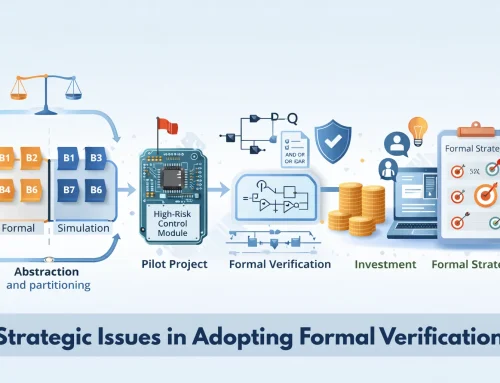
However, risk-based verification is not a standalone solution. It must be integrated with a wider verification strategy and methodology. Challenges in adopting structured approaches are explored in strategic issues adopting formal verification, where teams often struggle with methodology alignment and execution.
When combined with structured verification planning and advanced techniques, risk-based verification shifts the focus from activity-based metrics to outcome-based assurance.
For organisations aiming to strengthen verification effectiveness, aligning risk-based planning with professional services, such as design verification, and specialised training, such as formal verification training, can significantly improve both efficiency and confidence.
Conclusion
As verification cost and complexity continue to rise, a risk-based verification strategy offers a practical and scalable solution. It ensures that effort is applied where it delivers the greatest value, enabling teams to achieve stronger coverage, clearer justification, and higher confidence at sign-off.

Written by : Mike Bartley
Mike started in software testing in 1988 after completing a PhD in Math, moving to semiconductor Design Verification (DV) in 1994, verifying designs (on Silicon and FPGA) going into commercial and safety-related sectors such as mobile phones, automotive, comms, cloud/data servers, and Artificial Intelligence. Mike built and managed state-of-the-art DV teams inside several companies, specialising in CPU verification.
Mike founded and grew a DV services company to 450+ engineers globally, successfully delivering services and solutions to over 50+ clients.
Mike started Alpinum in April 2025 to deliver a range of start-of-the art industry solutions:
Alpinum AI provides tools and automations using Artificial Intelligence to help companies reduce development costs (by up to 90%!) Alpinum Services provides RTL to GDS VLSI services from nearshore and offshore centres in Vietnam, India, Egypt, Eastern Europe, Mexico and Costa Rica. Alpinum Consulting also provides strategic board level consultancy services, helping companies to grow. Alpinum training department provides self-paced, fully online training in System Verilog, UVM Introduction and Advanced, Formal Verification, DV methodologies for SV, UVM, VHDL and OSVVM and CPU/RISC-V. Alpinum Events organises a number of free-to-attend industry events
You can contact Mike (mike@alpinumconsulting.com or +44 7796 307958) or book a meeting with Mike using Calendly (https://calendly.com/mike-alpinumconsulting).
Stay Informed and Stay Ahead
Latest Articles, Guides and News
Explore related insights from Alpinum that dive deeper into design verification challenges, practical solutions, and expert perspectives from across the global engineering landscape.